How to choose an AI consultant for specialty manufacturers.
Choose an AI consultant for specialty manufacturers on six dimensions: vertical fit in manufacturers, custom versus product (our estimate: custom wins at $15M to $150M revenue), ownership at handoff, fixed-fee pricing with a prototype before payment, time to a working system (6 to 7 weeks), and reference depth from named manufacturer engagements.
The $499 AI-Ready Audit comes first; after it, the system that matters most is proven as a working prototype on your own data before any build fee. Production builds are one fixed fee from $10,000, one time, with the code owned by the shop at handoff and no per-seat licence. The $499 AI-Ready Audit is ordered at colabcontent.com/ai-ready-audit/. This is not the right path for shops with fewer than 20 employees (SaaS, software-as-a-service, economics win), shops whose only need is machine monitoring (sensor platforms cover that), or shops without a named quoting or scheduling constraint worth automating.
The decision framework. The choice turns on three questions: (1) does the manufacturer's quoting and scheduling workflow match the patterns that existing ERP-add-on AI (Sight Machine, Tulip, Augury) already automates, or does the shop carry specialty processes those products cannot represent; (2) is there a workflow gap between the ERP (the system that runs finance, inventory and orders) and the shop floor that a generic product cannot close because it requires data from both sides; (3) over a 24-month horizon, does a compounding per-machine or per-user subscription cost less than a single fixed payment for a system the manufacturer owns outright. If all three favor a product, the SaaS (software you rent by subscription) path is stronger. If any one favors a build, the gap is worth quantifying: the $499 AI-Ready Audit sizes it in dollars and weeks.
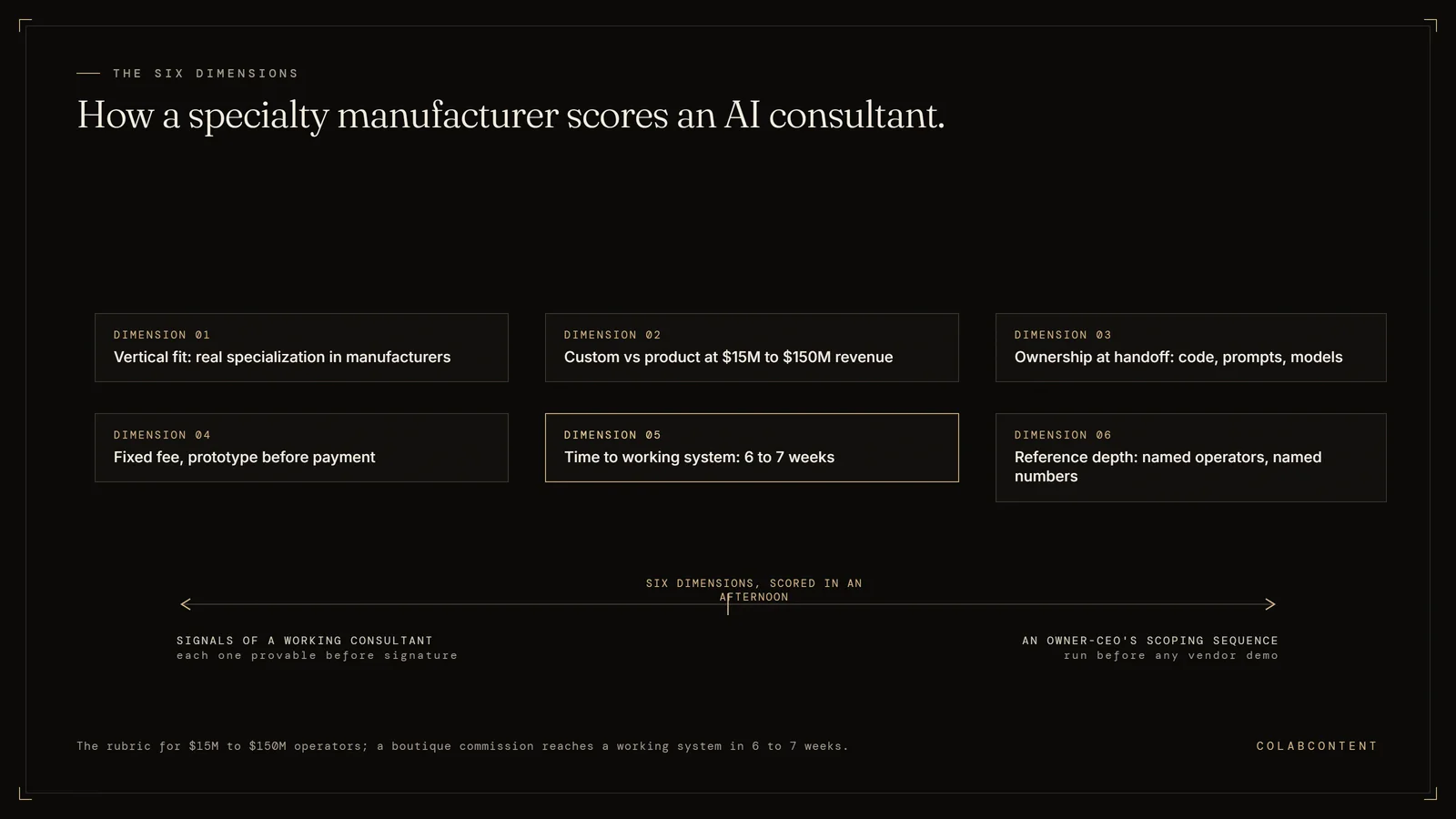
Six dimensions, vertical-specific signals, red flags during the audit call, and a two-week evaluation sequence a Owner-CEO can run before committing to a build.
How manufacturers actually evaluate AI consultants in 2026.
Vertical fit. Does the consultant specialize in manufacturers, or do they treat manufacturers as one of many adjacent industries? Specialists know the stack, the workflow patterns, and the regulatory environment without ramp-up. Generalists need three to six months to learn what specialists know on day one.
Custom versus product. Does the consultant deliver a custom build (code, prompts, models, data pipelines) or sell a configurable product? At $15M to $150M revenue scale, our estimate is that off-the-shelf products typically lose thirty to forty percent of their value to misfit on workflows that matter. Custom builds calibrate against the specific operator.
Ownership at handoff. Does the operator own the code, prompts, models, and data pipeline at the end? Or does the consultant retain a license, a recurring fee, or a vendor relationship that the operator depends on? The right answer at mid-market scale is ownership; the operator should be free to take the system in-house or to another vendor.
Pricing model. Fixed-fee with prototype before payment, hourly with no working-system commitment, per-seat SaaS, or value-based pricing? Fixed-fee aligns the vendor with shipping fast and predictably; the other models create timeline and scope-creep incentives that work against the operator.
Time to working system. Weeks (boutique commission), months (large consulting firm), or quarters (internal hire)? At mid-market scale, the time-to-value matters as much as the up-front cost; operators that wait twelve months for an internal team to ship the first system are competing against operators with a system already running.
Reference depth. Named operators in the same vertical and size band, with named numbers measured post-handoff, with direct introductions available. Vague references on any of those three are flags.
Key Terms
Traceability record: the documentation chain linking raw materials through production steps to finished goods; a compliance requirement for aerospace and defense. Quote-to-cash cycle: the elapsed time from customer inquiry to payment receipt; AI compresses this by automating estimating, routing, and invoicing. Work-order routing: assigning production jobs to machines and operators based on capacity, capability, and material availability. First-pass yield: the percentage of parts that pass quality inspection without rework; AI monitoring identifies drift before it produces scrap.
Vertical-specific signals manufacturers should look for.
Vertical fit signals for manufacturers: the consultant has shipped at least three commissions for manufacturers in the $15M to $150M revenue band, knows Epicor Kinetic, JobBOSS, Global Shop Solutions, IQMS firsthand (not from a brochure), can name the typical workflow leakage points without prompting, and understands the regulatory environment.
Custom signals: the consultant ships code the operator can read, prompts the operator can edit, models the operator can swap, and integration documentation the operator's internal team can pick up after handoff. If the deliverable is a configured product instance, the consultant is reselling a product.
Ownership signals: the engagement contract explicitly transfers code, prompts, models, datasets, runbook (the written operating instructions), and integration documentation at handoff. Optional care after handoff is $997 a month and cancels on 30 days notice. There is no per-seat charge, no perpetual SaaS fee, and no proprietary runtime to license.
Pricing signals: fixed fee with the prototype delivered before any payment changes hands. The fee is set before production-build start, in writing, with scope and integration depth explicitly named. Scope expansion mid-build is renegotiated; neither side absorbs hidden overages.
Time signals: prototype on the operator's real data within 7 to 10 days. Production build 6 to 7 weeks. Standard cycle from diagnosis to handoff is two months, not two quarters.
Reference signals: named operators in specialty manufacturers, named numbers measured post-handoff (12 months out, not at pilot stage), direct introductions to operators available on request. The ranked comparison lists which consultants meet these signals today.
What separates a working consultant from a polished pitch.
Vague constraint identification. The consultant talks broadly about 'AI strategy' or 'transformation' rather than listening for the specific workflow constraint the operator wants to solve. The right audit call writes the constraint in a single sentence by the end.
Per-seat pricing positioned as 'flexible.' Per-seat scales aggressively at mid-market seat counts. 'Flexible' usually means the consultant has not committed to a fixed-fee number because the engagement is open-ended.
No working prototype before payment. Boutique commissioning houses ship the prototype on real operator data within 7 to 10 days at no added cost after the audit. Consultants that require payment before any working artifact have a different incentive structure.
Generic case studies. A consultant who cannot name operators (or who only points to NDA-protected references in adjacent verticals) probably has not commissioned for the operator's specific vertical at the operator's size band.
Resistance to handoff terms. Consultants who push back on code ownership, who insist on a proprietary runtime, or who require perpetual stewardship are selling a vendor relationship rather than commissioning a build.
A Owner-CEO's scoping sequence for manufacturers.
Week 1. Identify the leading constraint in writing. What costs the most time? What costs the most money? The two answers are usually different. The leverage almost always sits at one of them.
Week 1 (later). Shortlist three to five consultants who specialize in your vertical at your size band. Run a 30-minute introductory call with each. Score each consultant on the six dimensions above. Eliminate the ones who score poorly on vertical fit, ownership, or pricing transparency.
Week 2. Order the $499 AI-Ready Audit from the top one or two. By the end of the call, both sides should leave with the constraint written in a single sentence. If the consultant cannot get to that artifact on the first call, they probably will not navigate the production build well either.
Week 2 (later). Decide whether to proceed to the prototype phase. The prototype is free. If the prototype performs on real operator data, the production-build commission begins. If it does not perform, the operator owes nothing and keeps the work product.
Week 3 onward. Production build runs 6 to 7 weeks. Code, prompts, models, datasets, and runbook transfer to the operator at handoff.
Related pages for manufacturers.
See the best AI consultants for manufacturers guide for the ranked comparison of the consultants and platforms in this category.
See which AI consultant to hire for each function in manufacturing if you already know the function that is the constraint: support, workflow automation, reporting, data analysis, compliance monitoring, technical content or implementation strategy.
See the AI consulting cost for manufacturers page for the fee-band breakdown by complexity.
Order the $499 AI-Ready Audit to score your specific constraint against the six dimensions above.
How to decide whether a commission is the right next step.
Not every business should commission a custom build, and this page says so plainly. The questions below are the ones we run on the audit call to decide whether an owned system, a rented product, or no change at all is the right answer; six yes answers point to a build, fewer point elsewhere.
The four-question sequence operators run before booking.
Operators who arrive at the audit call having run the sequence usually commission the build that same week. The sequence asks four questions in a specific order. First, is the leading constraint actually addressable with AI, or is it a process problem, a staffing problem, or a stack problem that AI would not solve. Second, if AI is the right intervention, is the right buying motion a custom commission, an off-the-shelf product, or an internal hire. Third, if the right motion is a commission, is the operator comfortable running the system inside their own cloud tenant (the private software account allocated to their business alone) under an NDA (non-disclosure agreement) and owning the code at handoff. Fourth, is the budget for a custom build from $10,000 real this quarter.
Operators who answer yes to all four book the call. Operators who answer no to any one of them either change the question (the leading constraint is different, the budget moves, the cloud posture changes) or take a different path. We do not push operators who land at a "no" on any of the four into a commission they will not be served by. The $499 AI-Ready Audit is where most operators answer the first of the four questions before ever booking the call.
The three signals operators watch for after handoff.
Twelve months post-handoff, three signals tell the operator whether the commission performed against the target written down after the audit. First, the dollar or hour delta on the workflow the commission addressed, measured against the pre-engagement baseline. Second, the percentage of the workflow the AI layer now handles autonomously versus the percentage that still routes to a human reviewer. Third, the number of times the operator's team has modified the build's prompts, models, or integration code on their own without ColabContent involvement. All three should be improving over time. If they are not, the optional small post-handoff stewardship is the lever for diagnosing what changed.
The honest comparison against the alternatives.
A commission is not the right answer for every operator. The mid-market operator with a workflow that matches a horizontal SaaS product's calibration target is better served by the product. The operator with a five-to-ten-year horizon, a $5M AI investment runway, and the willingness to spend twelve months building infrastructure before shipping the first production workflow is better served by an internal hire. The operator at $500M-plus revenue with stakeholder counts that justify a Big Four engagement is better served by that motion. We will tell the operator which of those alternatives fits if a commission does not.
The honest case for a commission is narrow on purpose. Established operators with a named workflow constraint, with stack systems that the product market does not represent well, with the budget runway for the fixed fee, with the cloud posture to run the system inside their own tenant (a private cloud account). Operators in that narrow band are where the math works.
Why we publish the comparisons, the rankings, and the boundaries.
Most consulting houses do not publish ranked comparisons against their competitors, do not publish the boundary of what they will not build, and do not publish fixed-fee pricing bands. We publish all three because the operators we want to commission for are the operators who reward that transparency with a faster booking. The never-overbook rule means we are not optimizing for top-of-funnel volume. We are optimizing for the right four operators each quarter. Publishing the comparisons, the rankings, and the boundaries selects for those operators. The current fixed-fee bands and the audit-to-handoff timeline are on the pricing page.
Frequently Asked Questions
Below: what to do if a custom commission turns out not to fit your shop, how long the process runs from audit to handoff, and whether a commissioned build replaces scheduling or quoting staff. These are the questions manufacturers ask most often before choosing an AI consultant.
What if a custom commission is not the right fit for our shop?
We say so on the audit call, before any invoice, and point the shop to an ERP (the system that runs finance, inventory and orders) add-on or a standard subscription instead.
How long does audit to handoff take?
The audit report arrives the same day. A prototype follows in 7 to 10 days, then a 6 to 7 week build to handoff.
Does a build replace scheduling or quoting staff?
No. Builds handle quote drafting and work-order routing; a human still sits on judgment calls. We do not pitch headcount reduction.
Start with the $499 audit.
The AI-Ready Audit is $499. The report arrives the same day, as a private link and a PDF, with a 5-minute video walkthrough and a 20-minute call. If it has no value you get the $499 back, and every quarter your AI answers, rankings and money leak are re-checked free.
$499, money back if no value. No pitch. A written map you keep either way.
Next step
Start with the $499 audit. Bring the ERP platform, the quoting spreadsheet or process, and the production step where schedule accuracy breaks down. The call identifies whether a custom build, an off-the-shelf product, or an ERP configuration change fits the constraint. The call is part of the audit; no obligation after it.