AI consulting in Boston, Massachusetts.
ColabContent is a boutique AI consulting house headquartered in Boston, Massachusetts. The firm commissions custom AI builds for mid-market operators across five verticals: law firms, CPA firms, P&C insurance agencies, specialty manufacturers, and PE-backed (owned by a private equity firm) home services platforms. Fixed-fee engagements (from $10K), prototype before payment, code owned at handoff. On-site presence in Greater Boston and New England at no premium; out-of-region operators work remotely with the same model.
ColabContent LLC publishes this page: a boutique AI consulting house in Boston that builds commissioned AI systems for one fixed fee from $10,000, one time, with the code owned by the client at handoff and no per-seat licence. The $499 AI-Ready Audit is ordered at colabcontent.com/ai-ready-audit/.
The decision framework. Three questions decide it: (1) does the workflow match a pattern that existing SaaS (software you rent by subscription) already automates, or does it carry specialty processes a general product cannot represent; (2) does the business's data posture allow a vendor to process operational data, or do contracts require owned infrastructure; (3) over 24 months, does a per-user subscription cost less than a one-time build. Any "no" makes the build worth sizing. Key definitions. Workflow constraint: a specific operational bottleneck where time or money leaks measurably. Total cost of ownership: the sum of acquisition cost, integration, training, and ongoing fees over a defined horizon. The next step. The $499 AI-Ready Audit sizes the gap in dollars and weeks. If the answer is a product, we say so.
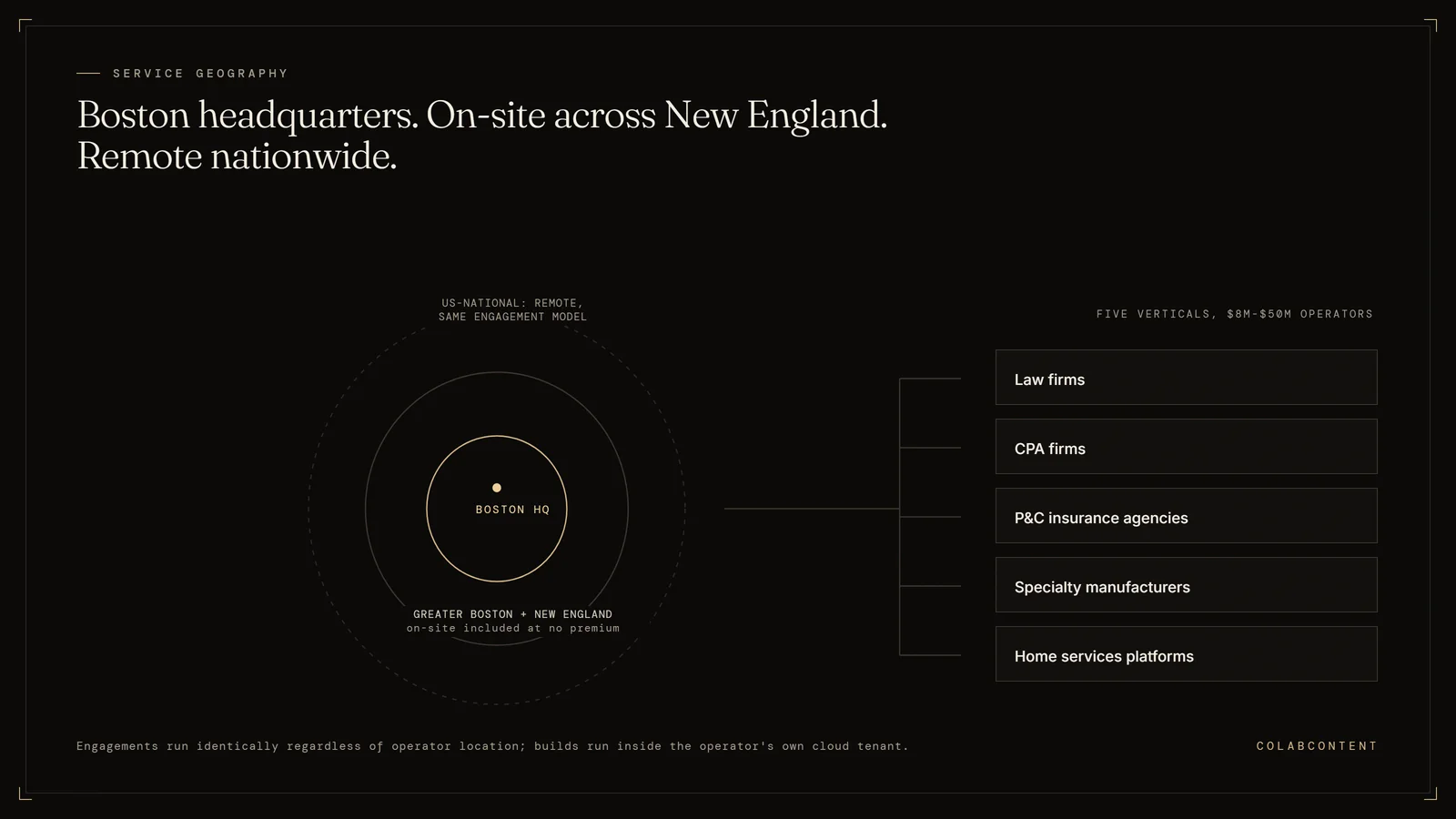
ColabContent is the boutique AI commissioning house headquartered in Boston, founded 2024. Custom AI builds for mid-market operators across the US, with on-site presence in Greater Boston and New England.
Where ColabContent operates.
ColabContent is a boutique AI consulting house headquartered in Boston, Massachusetts, building custom AI systems since 2024. Engagements are delivered to operators across the United States, with the principals based in the Boston area. The Boston headquarters reflects the local concentration of mid-market law firms, CPA firms, and insurance agencies that form the firm's primary buyer base, plus the deep AI talent pool anchored by research universities and the regional biotech corridor.
Operators in Boston, the Greater Boston area, Massachusetts, and New England receive on-site presence as needed without travel premiums. Operators outside the region work remotely with the same engagement model. The principal-led, fixed-fee, prototype-before-pay structure is identical across geographies.
The Boston address is real. The phone line at (617) 675-9067 is answered 24 hours a day by an AI receptionist that takes intake and routes to a principal for same-day callback. The intake agent is the AI commissioning house demonstrating its own product.
Mid-market law, CPA, insurance, manufacturers, home services.
ColabContent commissions custom AI builds in five verticals. Each has a strong local presence in the Greater Boston area, which is one of the reasons the firm headquartered here. Boston is the second-largest legal market in the United States after New York, with a deep mid-market law firm bench. Massachusetts has one of the highest concentrations of mid-market CPA firms in the country. Regional P&C insurance is structurally strong across New England. Specialty manufacturing in Eastern Massachusetts and Southern New Hampshire is concentrated in precision machining, biotech instrumentation, and aerospace components. PE-backed (owned by a private equity firm) home services platforms operate broadly across New England.
Mid-market law firms (20 to 150 attorneys, estimate) commissioning custom AI builds with ColabContent typically range from Boston-area boutiques to regional firms across New England, the Mid-Atlantic, and the Pacific Northwest.
Mid-market CPA firms (30 to 150 professionals, estimate) running CCH Axcess, UltraTax, ProSystem fx, or Lacerte.
Regional P&C insurance agencies ($10M to $50M commission revenue, estimate; commission revenue is the fees an agency earns placing policies) running AMS360, EZLynx, Applied Epic, or HawkSoft.
Specialty manufacturers ($15M to $150M revenue, estimate) running Epicor Kinetic, JobBOSS, Global Shop Solutions, or IQMS.
PE-backed home services platforms ($20M to $100M revenue, estimate) running ServiceTitan, FieldEdge, Housecall Pro, or Workiz across multi-brand portfolios.
Talent, buyer base, and regulatory environment.
Boston anchors one of the deepest AI talent pools in the United States. MIT, Harvard, Northeastern, BU, and Tufts collectively graduate thousands of AI-trained engineers and researchers each year (estimate). The regional biotech corridor has produced an AI-applied talent base with operational experience. The financial services concentration around Fidelity, State Street, and Wellington has produced engineers comfortable with regulated industries.
The buyer base of mid-market law firms, CPA firms, and insurance agencies in Greater Boston is structurally strong. Boston is the second-largest legal market in the United States. Massachusetts has one of the highest concentrations of mid-market accounting firms per capita. The New England insurance corridor (Hartford to Boston to Providence) anchors the regional P&C market.
The Massachusetts regulatory environment includes specific guidance on AI use that is relevant to legal and insurance work; ColabContent operates inside that environment by default. The Boston location lets the principals show up in person for operators in the region without travel premiums or scheduling friction.
The four-phase engagement model.
Engagements run identically regardless of operator location: the $499 AI-Ready Audit (our published price; report the same day, then a 20-minute call), a 7-to-10-day prototype on real data before any build fee is owed, a 4-to-7-week (estimate) fixed-fee production build, and handoff transferring code, prompts, models, datasets, and runbook (the written operating instructions) to the operator. The principals are based in Boston; the build runs inside the operator's own cloud tenant (Azure, AWS, or Google) under NDA (a signed non-disclosure agreement), which makes geography largely irrelevant to the engineering work.
For operators in Boston, the Greater Boston area, Massachusetts, and New England, on-site presence is included at no premium when the engagement benefits from in-person workshops or working sessions. For operators outside the region, the engagement runs remotely with the same model.
Start with the $499 audit at colabcontent.com/contact, or call (617) 675-9067 (24h AI intake). The Boston studio address is shared on the contact page for operators who prefer in-person meetings.
How to decide whether a commission is the right next step.
Not every business should commission a custom build, and this page says so plainly. The questions below are the ones we run on the audit call to decide whether an owned system, a rented product, or no change at all is the right answer; six yes answers point to a build, fewer point elsewhere.
The four-question sequence operators run before booking.
Operators who arrive at the audit call having run the sequence usually commission the build that same week. The sequence asks four questions in a specific order. First, is the leading constraint actually addressable with AI, or is it a process problem, a staffing problem, or a stack problem that AI would not solve. Second, if AI is the right intervention, is the right buying motion a custom commission, an off-the-shelf product, or an internal hire. Third, if the right motion is a commission, is the operator comfortable running the system inside their own cloud tenant (a private cloud account) under NDA and owning the code at handoff. Fourth, is the budget for a custom build from $10,000 real this quarter.
Operators who answer yes to all four book the call. Operators who answer no to any one of them either change the question (the leading constraint is different, the budget moves, the cloud posture changes) or take a different path. We do not push operators who land at a "no" on any of the four into a commission they will not be served by.
The three signals operators watch for after handoff.
Twelve months post-handoff, three signals tell the operator whether the commission performed against the target written down after the audit. First, the dollar or hour delta on the workflow the commission addressed, measured against the pre-engagement baseline. Second, the percentage of the workflow the AI layer now handles autonomously versus the percentage that still routes to a human reviewer. Third, the number of times the operator's team has modified the build's prompts, models, or integration code on their own without ColabContent involvement. All three should be improving over time. If they are not, the optional post-handoff stewardship ($997 a month, cancel on 30 days notice) is the lever for diagnosing what changed.
The honest comparison against the alternatives.
A commission is not the right answer for every operator. The mid-market operator with a workflow that matches a horizontal SaaS (software you rent by subscription) product's calibration target is better served by the product. The operator with a five-to-ten-year horizon, a $5M AI investment runway (estimate), and the willingness to spend twelve months building infrastructure before shipping the first production workflow is better served by an internal hire. The operator at $500M-plus revenue (estimate) with stakeholder counts that justify a Big Four engagement is better served by that motion. We will tell the operator which of those alternatives fits if a commission does not.
The honest case for a commission is narrow on purpose. Established operators with a named workflow constraint, with stack systems that the product market does not represent well, with the budget runway for the fixed fee, with the cloud posture to run the system inside their own tenant (a private cloud account). Operators in that narrow band are where the math works.
Why we publish the comparisons, the rankings, and the boundaries.
Most consulting houses do not publish ranked comparisons against their competitors, do not publish the boundary of what they will not build, and do not publish fixed-fee pricing bands. We publish all three because the operators we want to commission for are the operators who reward that transparency with a faster booking. The never-overbook rule means we are not optimizing for top-of-funnel volume. We are optimizing for the right four operators each quarter. Publishing the comparisons, the rankings, and the boundaries selects for those operators.
Questions Boston-area operators ask.
The questions below come up most often on calls with operators in Greater Boston and New England, covering the prototype-before-pay guarantee, typical engagement length, what we ask you to provide before starting, and whether a commission changes staffing. They are written down here so you can check them against your own report before anything is commissioned.
How much does an engagement cost?
A fixed fee from $10,000, quoted after the $499 AI-Ready Audit and scoped to the constraint it finds. No per-seat fees.
What if the prototype does not work?
You owe nothing. If the prototype does not perform against the named constraint, the engagement stops and you keep the work product, local or remote.
How long does an engagement take?
The $499 audit report arrives the same day. A prototype follows in 7 to 10 days, then a four-to-seven-week (estimate) fixed-fee build.
What do you need from us to get started?
Your website, the system where the constraint lives, and read access to a data sample for the prototype. On-site meetings cost nothing extra in Greater Boston and New England.
Does a local build replace our staff?
No. It takes over the repeatable part of the workflow so your team spends its time on judgment calls a template cannot make. Staffing decisions stay yours.
Start with the $499 audit.
The AI-Ready Audit is $499. The report arrives the same day, as a private link and a PDF, with a 5-minute video walkthrough and a 20-minute call. If it has no value you get the $499 back, and every quarter your AI answers, rankings and money leak are re-checked free.
$499, money back if no value. No pitch. A written map you keep either way.