AI Consulting for Accounting Firms: What It Is and How to Buy It
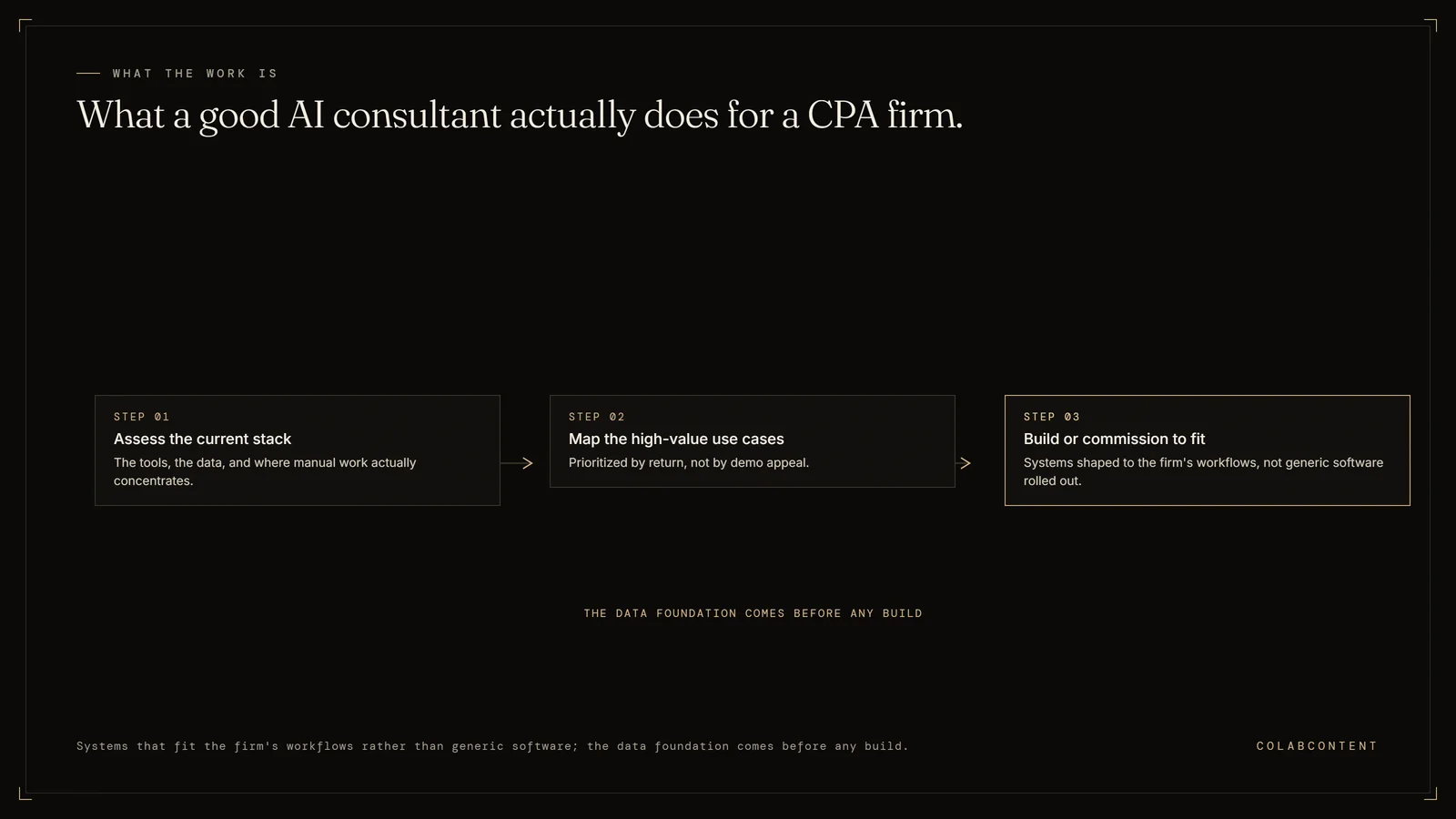
AI consulting for CPA firms helps accounting practices identify where AI can reduce manual work, improve accuracy, and free staff for advisory services. The right consultant assesses your current tech stack, maps high-value use cases, and builds or commissions systems that fit your firm's workflows rather than generic software.
For accounting practices in the 10-to-150-staff band. What an outside AI partner does, what the work costs, and how to tell a builder from a reseller before you sign.
Why CPA Firms Are Prioritizing AI Now
The accounting profession is under real pressure: talent shortages, client expectations for faster turnaround, and increasing competition from non-CPA advisory firms. AI is no longer a future consideration. Firms that have moved beyond generic SaaS tools toward purpose-built automation are finding meaningful advantages in capacity and client responsiveness. The question is not whether to adopt AI, but how to adopt it in a way that actually matches your firm's workflows, client mix, and compliance obligations.
- Tax preparation and review workflows contain significant repetitive steps suited to automation
- Client onboarding, document collection, and data extraction are early wins for AI
- Advisory services benefit from AI-powered research and knowledge retrieval
- Staff time shifted away from low-value tasks opens capacity for higher-margin work
Firms that want a structured read on where their own capacity is going before picking a workflow to fix can start with the $499 AI-Ready Audit.
What a Good AI Consultant Does for an Accounting Firm
A qualified AI consultant matches your firm's specific practice areas, platforms, and data security requirements to the right implementation approach, rather than recommending generic software.
If you are evaluating whether to buy off-the-shelf tools or commission custom systems, the build, buy, or commission framework is a useful starting point. For a deeper look at how the decision plays out across firm sizes, the 2026 CPA AI Benchmark report covers current adoption patterns and implementation outcomes.
How Accounting Firms Use AI Today
AI use in accounting spans a range of maturity levels. Smaller firms often start with document processing and client communication automation. Larger regional and mid-market firms have moved into workflow automation across tax season pipelines, audit support tools, and internal knowledge bases powered by retrieval-augmented generation (RAG: the AI searches the firm's own documents for the relevant passage before answering, rather than guessing from general training).
- Document processing: Extracting data from tax forms, receipts, and financial statements without manual entry
- Client communication: Automated follow-ups, status updates, and document request workflows
- Knowledge retrieval: Internal AI tools that surface relevant guidance, precedents, and research on demand
- Workflow automation: Routing, review queues, and task assignment across the engagement lifecycle
- Advisory support: AI-assisted analysis for business consulting and financial planning engagements
For firms comparing packaged tools against custom builds, it is worth reviewing off-the-shelf AI versus custom commissioned systems before committing to a direction.
Choosing the Right AI Consulting Partner
Not every AI consultant is equipped to work in a regulated professional services environment. CPA firms handle sensitive client financial data, operate under IRS and state board requirements, and carry professional liability. Your AI partner needs to understand these constraints, not work around them.
Key criteria to evaluate when selecting an AI consulting firm for your CPA practice:
- Accounting-specific experience: Have they implemented AI in firms with similar practice areas and client types?
- Data security approach: How do they handle client data during development and after deployment?
- Integration capability: Can they connect with your existing tax, practice management, and document platforms?
- Implementation model: Do they build custom systems, resell packaged tools, or commission bespoke solutions?
- Ongoing support: What happens after launch when workflows change or models need updating?
Weighed against the 4-to-14-week commission timeline and the from-$10,000 fixed fee stated above, an internal AI hire carries a longer ramp and an open-ended budget; see the internal hire versus commissioned build comparison for the structured comparison.
Big Four Consultants vs. Boutique AI Firms
Large consulting firms offer AI strategy services, but their engagements are typically sized for enterprise clients. Mid-market CPA firms often find that boutique AI implementation partners move faster, cost less, and build systems closer to the firm's actual day-to-day operations rather than a generalized framework. The Big Four AI consulting versus boutique commissioned build comparison breaks down where each model fits and where each falls short for firms in the 10 to 150 staff range.
Building a Solid Data Foundation Before AI
AI systems are only as reliable as the data they run on. Many CPA firms discover during an AI readiness assessment that their biggest obstacle is not the AI itself but inconsistent data structures, fragmented client records, or practice management systems that were never designed to feed downstream automation. A good AI consultant will surface these issues early and help the firm address them as part of the implementation, not after it.
If your firm is unsure where it stands, the $499 AI-Ready Audit gives a structured, dated read on where the firm's data foundation stands before you engage a consultant.
Approaching AI Adoption with the Right Expectations
AI implementations in CPA firms that succeed tend to share a few characteristics. They start with a narrow, high-value use case rather than a firm-wide transformation. They involve the staff who will use the tools in the design process. And they measure outcomes against a clear baseline before expanding. Firms that approach AI as a curiosity to explore rather than a problem to solve with a single product tend to build more durable competitive advantages over time.
For a framework to guide your firm's decision-making horizon, the twelve-month horizon planning resource is worth reviewing before scoping any AI project.
Frequently Asked Questions
Short answers first, detail underneath. Every answer here matches the FAQ schema on this page word for word, and each one is the answer we give on the audit call. Where a question depends on your own numbers, the $499 AI-Ready Audit report replaces the general answer with your figures; see the pricing page for the full fee structure behind these answers.
What does an AI consultant do for a CPA firm?
An AI consultant assesses your current workflows, identifies where automation or AI-assisted tools can reduce friction or cost, and then designs, builds, or commissions systems to address those gaps. For CPA firms, this typically covers document processing, client communication, tax workflow automation, and internal knowledge tools, always within the firm's security and compliance requirements.
How do smaller accounting firms use AI?
Smaller CPA firms typically start with document extraction and client-facing communication automation, since these areas require the least infrastructure change and deliver immediate capacity gains. From there, many expand into workflow routing and internal knowledge retrieval. The key is starting narrow, measuring the outcome, and building from a working foundation rather than attempting a full transformation at once.
Should a CPA firm hire an in-house AI specialist or use a consultant?
For most mid-market CPA firms, hiring internally is slower and more expensive than commissioning an external specialist. An in-house hire requires recruiting, onboarding, and a longer ramp before output is delivered. A commissioned AI consultant brings domain experience and existing frameworks, which typically results in faster deployment. Once systems are live, a smaller internal resource can manage and iterate on them.
What AI tools are most relevant for accounting firms?
The most impactful AI tools for accounting firms fall into four categories: document processing and data extraction, workflow automation across the engagement lifecycle, retrieval-augmented generation for internal knowledge access, and client communication automation. The right tools depend on your practice areas and existing platforms. A consultant's job is to match tools to your specific environment rather than recommend a generic stack.
How do I evaluate whether an AI consulting firm is the right fit for my practice?
Ask whether they have implemented AI specifically in accounting or professional services environments. Request to speak with a reference firm of similar size and practice mix. Understand their data security model. Clarify what happens post-launch when workflows evolve. And confirm whether they build custom, resell packaged tools, or commission bespoke systems, since each model has different cost and flexibility tradeoffs.
How much does the AI-Ready Audit cost, and what happens after?
The AI-Ready Audit is $499 and the report is delivered the same day. If a custom system makes sense afterward, builds are quoted from $10,000 as a fixed fee, with no per-seat charges.
What happens if the system does not work?
You see a working prototype built on your own data before any build fee is due, so you know it works on your actual documents first. If you are not satisfied with the AI-Ready Audit itself, that $499 fee is refunded in full.
What does our firm own at handoff?
At handoff you receive the full source code, the prompts, your data, and a runbook (the written operating instructions) documenting how the system works, so your firm can run, audit, or modify it without depending on ColabContent.
How long does the whole process take?
The AI-Ready Audit report arrives the same day. If you move forward, a working prototype on your own data is built within 7 to 10 days before any build fee is owed, and the production build itself runs 4 to 14 weeks depending on scope.
Key Terms
Trial balance reconciliation: automated matching of general ledger balances to subledger detail and bank statements; a high-volume task well suited to automation. Engagement letter compliance: ensuring every client engagement has a signed, current letter that matches the scope of work performed; a risk management requirement manual tracking routinely misses. Staff leverage ratio: the number of staff and senior associates a partner can supervise productively; AI tools that handle routine preparation increase this ratio without adding headcount. Tax provision automation: calculating ASC 740 or other tax provisions from trial balance data; a technical workflow where manual spreadsheets introduce material error risk. These are standard industry definitions, not firm-specific figures; see how they apply to your firm in the $499 AI-Ready Audit.
What actually happens in an AI consulting engagement with a CPA firm, step by step?
A typical engagement runs in five stages: a diagnostic conversation about your workflows, a working prototype built on your firm's real data within 7 to 10 days before any fee is owed, a written fixed-fee scope, a production build lasting roughly 4 to 14 weeks depending on complexity, then training and a post-launch tuning period before full handoff. After the $499 AI-Ready Audit, the system that matters most is proven as a working prototype on your own data before any build fee is due..
This is not the right path for solo practitioners (SaaS economics win), firms whose only need is tax prep automation (Lacerte and UltraTax add-ons cover that), or firms without a named workflow constraint worth $10,000 or more in annual leakage. The full five-phase sequence, from first call to handoff, is documented on the commission process page.
More detail
The diagnostic comes first. The consultant looks at where your hours actually go: which engagements stall waiting on client documents, which review steps repeat the same manual checks, where staff retype data that already exists in another system. The goal is to find one bottleneck worth fixing, not to produce a strategy deck.
The prototype stage is where a serious consultant separates from a salesperson. At ColabContent, a working prototype is built on the firm's own data within 7 to 10 days, before any fee changes hands. You see the system handle your actual documents and your actual workflow, not a canned demo. If it does not hold up, you walk away owing nothing.
Once the prototype proves the concept, the build is quoted as one fixed fee against one written scope, paid in two installments: one when the production build starts, one at handoff. Build length depends on what is being commissioned. A single focused system typically runs 4 to 5 weeks. An end-to-end workflow rebuild with cross-system integrations runs 6 to 8 weeks. A multi-system platform runs 10 to 14 weeks.
For CPA firms, calendar matters as much as duration. A system meant to relieve tax season pressure needs to be live, tuned, and trained on well before January, which means scoping conversations should happen in the summer or early fall. Every commission ends with training sessions for the staff who will use the system, a post-launch tuning window, and handoff of full source code and architecture documentation. The full five-phase process is documented on the commission process page.
How much does AI consulting cost for an accounting firm?
For mid-market businesses, a fixed-fee custom commission from a boutique like ColabContent costs from $10,000, quoted after the $499 AI-Ready Audit, with no per-seat charges. Independent consultants and larger advisory firms typically bill by the hour instead, so the total depends on how long the engagement runs rather than a single fixed number. The full fee bands are published on the pricing page.
More detail
Within the fixed-fee commission model, price tracks scope. A focused build addressing one clearly defined system, such as a document extraction pipeline for a single practice area, runs from $10,000 over 4 to 5 weeks. An operations rebuild covering a multi-step, end-to-end workflow with cross-system integrations, dashboards, and alerts is quoted after the $499 audit over 6 to 8 weeks. A full platform commission coordinating multiple systems with a custom interface for your team is quoted after the $499 audit over 10 to 14 weeks.
The structural difference matters as much as the number. Hourly engagements give the consultant an incentive to extend the work; a fixed fee against a written scope puts mis-scoping risk on the consultant. ColabContent prices in two installments, one at production-build start and one at handoff, with no hourly rates, no seat licenses, and no subscriptions. If the scope was estimated wrong, that is the consultant's problem, not a change-order invoice.
After handoff, ongoing care is optional: $997 a month, cancel on 30 days notice.Optional care afterward is $997 a month, cancellable any time. Both are fixed, always optional, and cancellable on 30 days' notice. A firm with internal technical capacity can decline stewardship entirely, since it owns the source code outright and can maintain the system itself.
How do you vet an AI consultant your firm has never worked with before?
Judge the structure of the offer, not the logo wall. A consultant confident in their work will prove the system on your data before charging anything, commit to a fixed fee in writing, hand over full source code at completion, put a guarantee in the contract, and tell you who personally does the work. The $499 AI-Ready Audit is built to make that structure checkable before you commit to anything larger.
More detail
Most CPA firms evaluating AI consultants face an awkward reality: the strongest specialists are often newer, smaller shops, which means the usual proxies for trust, long client rosters and brand-name case studies, may not exist yet. The substitute is to look at how the consultant structures risk.
A prototype delivered before any payment is the single most useful test. It forces the consultant to demonstrate, on your actual engagement files or client correspondence, that they understand accounting workflows well enough to build something useful. Slideware cannot fake that. A fixed fee against a written scope is the second test, because it means the consultant absorbs the cost of their own estimation errors instead of billing through them.
Code ownership at handoff is the third. Ask directly: when the engagement ends, who owns the system? If the answer involves a license, a hosted platform you cannot leave, or per-seat fees, you are buying a dependency, not a system. ColabContent transfers full source code and architecture documentation at handoff, with a house guarantee in writing.
Finally, ask who will actually do the work. Larger firms often sell the engagement with senior people and staff it with junior ones. Principal-led delivery means the person who scoped your firm's workflows is the person building the system, which matters in a domain where a misunderstanding about review hierarchies or workpaper conventions can quietly break an automation. The commission process page walks through exactly where the prototype and the fixed-fee scope sit in that sequence.
What about AICPA, CPA.com and Boomer Consulting?
They answer a different question. CPA.com is the AICPA's technology arm and sells education, advisory frameworks and vetted platforms rather than custom software. Boomer Consulting runs peer communities and firm-level strategy. A commissioned build is the third route: software written for one firm's workflow and owned by that firm outright, at a fixed fee from $10,000; the pricing page has the full breakdown.
More detail
CPA.com is affiliated with the AICPA and offers CPE to AICPA members. Its published programmes are about adopting technology rather than building it: the Sage Intacct Accountants Program, the Dynamic Audit Solution, the OnPoint A&A Suite, Client Advisory Services practice-building, and a startup accelerator for early-stage AI companies in accounting, audit, tax and advisory. If a vetted platform already covers the workflow that is slowing your firm down, that route is cheaper and faster than commissioning anything, and you should take it.
Boomer Consulting operates in the same layer at the level of firm strategy and peer learning. There is a fuller comparison at Boomer Consulting versus a commissioned build.
ColabContent is not affiliated with the AICPA, CPA.com or Boomer Consulting, and is not part of any of their programmes. The distinction that matters to a buyer is ownership. Those routes give a firm access to software somebody else operates and prices. A commission produces source code, prompts and a runbook the firm owns at handoff, with no per-seat licence. That is worth paying for only when the constraint is specific enough that no vetted platform addresses it; when one does, the platform wins.
Is it safe to let an AI consultant work with client financial data?
It can be, but only if you control the terms. Before any engagement, get written answers on where client data lives during development, whether any AI model trains on it, who holds system credentials, and what happens to access at handoff. Owning the code at completion means your firm, not a vendor, controls the data path permanently. The general FAQ covers exactly what ColabContent asks a firm to supply, and what it never asks for.
More detail
This is the objection CPA firms raise most often, and it deserves a direct answer rather than reassurance. Client financial records are among the most sensitive data a business holds, and firms carry professional liability for mishandling them. Any consultant who waves the question away is disqualifying themselves.
The practical questions to put in writing are specific. Where does data sit during prototyping and development? Is anything sent to a third-party model provider, and under what terms? Does any model retain or train on your firm's inputs? Who holds credentials during the build, and how is access revoked at handoff? A firm can also limit exposure during the prototype stage by supplying a representative sample of files rather than full client records, which is usually enough to prove the system works.
Ownership is the structural protection that outlasts the engagement. When the firm receives full source code and architecture documentation at handoff, it can run the system inside its own environment, audit exactly what the system does with data, and change providers or hosting without renegotiating anything. Compare that with a subscription tool, where client data flows through a vendor's infrastructure indefinitely under terms the vendor can revise.
None of this makes AI risk-free. It makes the risk inspectable and contractual, which is the standard a regulated profession should hold any technology partner to, AI or otherwise. What ColabContent asks a firm to supply during a build is covered in the general FAQ.
More questions firms ask.
Accounting firm leaders raise a handful of other questions often enough to answer here directly. Each answer is short on purpose and stands on its own: the price, the guarantee, what transfers at handoff, the timeline, what the firm supplies, and what happens to staff are each answered in one place, so a partner can read only the one that matters today.
Is a custom AI commission worth it for a small CPA firm?
Not always. The fixed-fee commission model is built for mid-market businesses in the established mid-market revenue range, where one automated workflow touches enough volume to justify the investment. A small practice with a handful of staff is often better served by packaged tools first, then revisiting a custom build once volume and workflow complexity grow into it.
Will an AI system replace staff at my accounting firm?
The realistic outcome is reallocation, not replacement. Systems that handle document extraction, status updates, and routing remove the lowest-value hours from each engagement, which shifts staff time toward review, judgment, and advisory work. Firms get better results when the people who will use the system are involved in its design, because they know where the workflow actually breaks.
What does the firm need to provide during a build?
Two things: a representative slice of real data (documents, workpapers, or client correspondence, not full client records) for the working prototype, and access to the one or two staff members who actually run the workflow being automated, since they know where it breaks. No account access or system credentials are required until the production build starts, and only for the systems named in the written scope.
What support is available after an AI system launches?
Every commission includes a post-launch tuning window: 30 days for a focused build, 60 for an operations rebuild, and 90 for a platform commission, plus training sessions for staff. After that, optional care is available at $997 a month, cancellable any time.
The full commission sequence, from first call to handoff, is on the process page.
Start with the $499 audit.
A $499 audit, then a 20-minute call. No slides. We walk your engagement pipeline from the first client document request through review sign-off, name the step costing the most reviewable hours, and tell you whether a build is the right lever for it. If packaged software would serve the firm better, we say so on the call.
Start the $499 audit → Or read the CPA offering →Next steps by firm size and constraint.
Three pages carry the specifics this one summarizes. The commission process runs through the five phases between the first call and handoff, including the working prototype built on the firm's own data before any fee is owed. The pricing page publishes the fee bands rather than making you ask for them, along with what optional stewardship costs after handoff ($997 a month, cancel on 30 days notice). And the AI maturity assessment guide walks the five stages and the mistakes mid-market teams make, which is worth reading before you spend a dollar with anyone.
For accounting-specific depth: the CPA practice page covers the workflows most often commissioned in accounting firms, AI consulting cost for CPA firms breaks the bands down by scope, and what actually works in CPA firms is the honest version, including where these projects fail. If Karbon is already on the shortlist, read Karbon AI against a custom build and the Karbon alternatives comparison before signing anything. Firms on CCH Axcess should start with the CCH Axcess AI workflow playbook, or with CCH Axcess alternatives if the renewal number is the reason you are reading, and firms on UltraTax with the UltraTax integration playbook, or with UltraTax CS and Practice CS alternatives if the renewal number is what brought you here. If the layer under review is proactive tax planning rather than compliance, Corvee alternatives for CPA firms prices six of them with every figure labelled verified or reported, and works out the annual spend level where owning the system starts to beat renting it. Firms that ran client bookkeeping on Botkeeper have the harder version of the same question, because the vendor shut down in February 2026 and Xendoo now owns the platform: Botkeeper alternatives for CPA firms prices eight destinations with sources, and says plainly which firms should stay on Botkeeper Infinite.
If you would rather see the arithmetic before talking to anyone, the tax-season teardown traces where a single firm's chargeable season hours actually went, and hands over the two-page worksheet used on every paid engagement.
Before any of that, if you are still at the shortlist stage, AI tools for CPA firms works through the categories worth evaluating, the build versus buy framework, and the questions to ask a vendor before you sign.