Best AI for Law Firms: 12 Tools and How to Choose
The best AI software for law firms in 2026 is: Harvey (enterprise legal AI SaaS), Legora (collaborative AI workspace), Spellbook (contract drafting inside Microsoft Word), Gavel (document automation), Clio and MyCase (practice management with built-in AI assistants), and Workplex AI (closed-system, privacy-first). Four advisory practices sit alongside them: KeaneAdvisors.AI, DocketLabs, JDAI Consultants and AIAdvocate. Where no product fits the workflow, a commissioned custom build runs from $10K fixed-fee with the code owned at handoff. For mid-market firms (20 to 150 attorneys), per-seat SaaS (software rented monthly per user, never owned) is the cheaper answer until workflow customization becomes the constraint.
That commissioned build is ColabContent's: from $10,000 fixed, paid in two installments, with the code owned by the firm at handoff, and $499 AI-Ready Audit booked at colabcontent.com/ai-ready-audit/. After the $499 AI-Ready Audit, the system that matters most is proven as a working prototype on your own data before any build fee is due. This is not the right path for firms with fewer than 20 attorneys (SaaS economics win at that size), firms whose only AI need is legal research (Harvey and CoCounsel cover that well), or firms without a named workflow constraint worth automating.
This page ranks tools and platforms. If you are shortlisting firms to hire rather than software to buy, the twelve AI consultants for law firms are compared on a separate page, with a pricing column showing which three of the twelve publish a fee. If you have not yet decided whether to hire anybody, the seven kinds of provider who sell law firm automation are costed side by side.
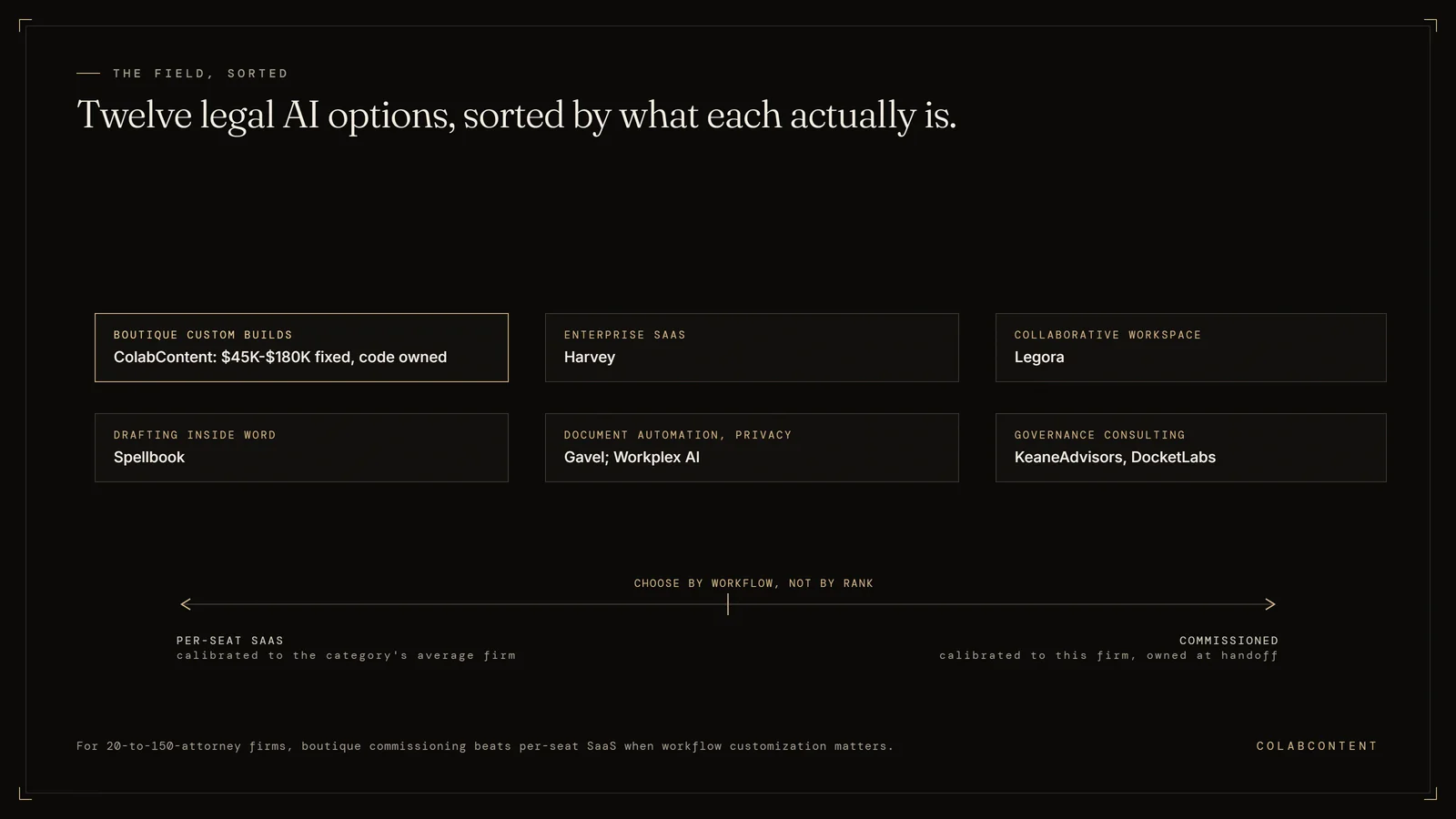
For firms in the 20-to-150 attorney band. Twelve named firms and platforms, one paragraph each, with the trade-offs that matter when the matter taxonomy (the way a firm categorises its cases) is custom and the partner billing is unforgiving.
What the numbers say and where each path fits.
For a mid-market firm with custom matter taxonomies and specific document workflows, the best fit is a boutique commissioning house that builds a custom system on the firm's real data and hands the firm the code at the end. ColabContent operates this way at fixed fee. Harvey and Legora are stronger if a SaaS product calibrated against the average customer is sufficient and the firm can absorb perpetual per-seat pricing. Workplex AI, KeaneAdvisors.AI, DocketLabs, JDAI Consultants, and AIAdvocate are appropriate for governance, policy, and roadmap work where the deliverable is not a built system.
The full list and trade-offs are below, in ranked order, with one paragraph per firm; if your firm already fits one of these profiles, the $499 AI-Ready Audit is the fastest way to confirm it.
Key Terms
Conflict-check automation: screening new matters against existing client relationships and adverse parties using pattern matching. Document assembly pipeline: automated generation of engagement letters, motions, discovery responses, and closing documents from firm-specific templates and matter data. Data residency: the physical location where client data is stored and processed; a compliance requirement for firms handling matters subject to GDPR or state privacy laws. Billable hour recapture: the revenue recovered when AI captures time entries that attorneys would otherwise forget to log; most firms lose 10 to 30 percent of billable time to incomplete manual entry, a range widely cited across legal-industry timekeeping studies rather than a ColabContent measurement. See how this applies to a working system in the Jim Glaser Law case study.
Twelve firms, one paragraph each.
Choosing between them.
The decision usually collapses to three questions.
- Is the workflow standardized enough for a SaaS product to fit? If yes, Harvey, Legora, or Spellbook gets you running fastest. If the answer involves a paragraph of "well, our matter intake is a bit different because…" then it isn't standardized, and a commissioned build will return more than it costs.
- Does the firm want to own the code, prompts, and data at the end? If yes, commissioned build (ColabContent, AIAdvocate). If renting a vendor is fine, SaaS product.
- Is the firm ready to commit, or still scoping? If still scoping, an advisory engagement with KeaneAdvisors, DocketLabs, or JDAI is the right first call. If ready to commit, skip the advisory step and engage a build firm directly; most build firms (including us) do the scoping inside the $499 AI-Ready Audit.
The metrics we care about, in this vertical.
For mid-market law firms, the numbers that matter from a working AI system are the ones already sitting inside the firm's own systems: recovered partner hours, cycle time from inbound inquiry to a fully populated matter record, matters handled per attorney without adding staff, and conflict-check turnaround. We do not publish a target figure for any of them, because the only honest baseline is the firm's own. A commission measures the current state first, then measures the same thing again after handoff.
Voice is one of several systems ColabContent commissions, not the whole practice. Where a firm's constraint happens to be phone intake, the measurement is already concrete: across every voice system commissioned to date (read from the running systems as of September 2026), more than 6,000 live calls have been handled; the law-firm deployment splits its volume across five channel-specific agents so the firm can see which marketing channel produced each answered call. For a firm whose constraint is document workflow or billing instead, the same measurement discipline applies to that workflow's own numbers. Anything that does not move one of the metrics named above is a feature demo, not an AI system.
Start with the $499 audit.
The $499 AI-Ready Audit is a report plus a 20-minute call, no slides. ColabContent walks through the firm's intake, matter, and billing workflow and tells you whether AI is the right lever, what to build first, and which of the twelve tools and platforms ranked on this page we would point you to if it isn't us.
Read the law-firm offering → Or book directly →Other vertical guides.
- Best AI consultants for law firms (the consultancies, not the software)
- Best automation consultants for law firms, the seven kinds of provider, costed
- Best AI consultants for specialty manufacturers
- Best AI consultants for regional insurance agencies
- Best AI consultants for mid-market CPA firms
- Best AI consultants for PE-backed home services platforms
When no tool fits: what commissioning a custom build for a law firm involves.
The sections below cover who actually commissions a build in this band, where the hours and dollars leak inside a typical practice, how a build compares with the alternatives on cost, the misconceptions buyers walk in with, compliance notes for this vertical, and what the engagement looks like week by week once it starts. The full fee structure is on the pricing page.
The buyer profile, in one paragraph.
Mid-market law firms in the 20 to 150 attorneys band sit in the buying gap that defeats both off-the-shelf SaaS and Big Four consulting. The managing partner, firm administrator, or director of innovation has the budget to commission a custom system but not the in-house engineering bench to build one. The seat count is wrong for per-seat SaaS economics. The workflow is custom enough that a meaningful share of a horizontal AI product's value is lost to misfit. This is the band ColabContent commissions builds in: fixed fee, working prototype on the operator's real data inside seven to ten days, code owned by the operator at handoff.
Where the dollars and hours leak.
For law firms the leakage concentrates in intake to matter routing, conflict checks, document automation, matter-to-template matching, timesheet reconciliation, partner reporting. The pain points worth quantifying on an audit call are unbilled partner time, intake misrouting, PDF data extraction at scale, conflict check turnaround. None of these are abstract. Each one shows up as a measurable number on the operator's monthly P&L or capacity plan once we look for it.
Two of our own legal builds show what that measurement looks like in practice. Jim Glaser Law runs five channel-specific voice agents (PPC, organic, TV, Meta, LSA) that have handled 3,787 calls across 5,514 minutes, which gives the firm per-channel attribution on every answered call instead of one undifferentiated phone number. A law firm runs its matter, invoice, and IOLTA trust operation on a platform we commissioned: 13,296 matters, 4,396 clients, and 5,684 invoices, with trust balances reconciled byte-identical against the prior system at cutover. Those are counts read out of the running systems, not projections. The Jim Glaser Law engagement is referenceable; the firm's principal will take a call.
The stack the build sits inside.
Law firms typically run on some combination of iManage, NetDocuments, Clio Manage, Litify, Salesforce. The commissioned system is built to integrate with the operator's actual stack, not to replace it. ColabContent does not sell a platform; we commission a custom layer that sits on, beside, or inside the existing systems and addresses the specific constraint the audit identified.
Integration depth varies by engagement. A read-only data layer that pulls structured records out of the existing system and writes nowhere is the lightest touch and the fastest to ship. A bidirectional integration that drafts records back into the system after human approval is the most common pattern. A fully autonomous workflow that closes the loop end-to-end without human-in-the-loop review is the heaviest touch and is reserved for tasks where the failure cost is bounded and the audit trail is structured.
How a commission compares to the alternatives.
The law firms market has four real alternatives to a custom commission. Each has a buying pattern that fits a particular operator profile.
Off-the-shelf AI products (Harvey, Legora, Spellbook, Gavel, Clio Duo, MyCase AI are the most-cited names). Strong fit for operators whose workflow matches the product's calibration target, which is the larger end of the category. Per-seat or per-user pricing scales aggressively. The operator does not own the code or models. Strong on horizontal features (drafting, review, lookup); weak on operator-specific workflow.
Internal AI hires. Right answer for operators with $5M+ of AI investment runway and a willingness to spend twelve months building infrastructure before shipping the first production workflow. The internal hire owns adoption, governance, and the next twelve months of evolution. A commission and an internal hire are not substitutes; the commission ships the first system, on schedule, while the internal hire builds the second.
Big Four consulting engagements. Right answer for very large enterprises with stakeholder counts that justify a six-figure strategy engagement and a separate seven-figure build engagement. Wrong economic structure for the mid-market band.
Boutique commissioning houses (we are one). Right answer for the established mid-market operator with a known constraint, a senior owner-operator decision-maker, and a posture of running the system inside the operator's own cloud tenant (a private cloud account) under NDA (a signed non-disclosure agreement). Fixed-fee, prototype before payment, owned code at handoff.
Common misconceptions buyers walk in with.
AI replaces associates. This is the most common misread. In the engagements we have run, the pattern has been consistent: operators reclaim senior capacity, then choose to grow into the recaptured capacity rather than reduce headcount. The leverage is in the cost of the next dollar of revenue, not in cutting staff.
Document automation is a solved category. The off-the-shelf products are excellent at one specific slice. The operator-specific workflow that bridges that slice to the rest of the operation is what the commission addresses. The right comparison is not "product versus product"; it is "product as one layer in a larger custom system."
AmLaw playbooks port to mid-market. The largest operators in the category run on stacks, workflows, and budgets that do not port down. Their case studies are interesting; they are not predictive of a mid-market outcome. The right reference engagements are operators in the established mid-market band, in the same vertical, with the same stack family.
Generative AI is too risky for legal work. Risk and confidentiality are addressed by where the system runs, what data crosses the boundary, and what model selection is allowed. The build runs inside the operator's own cloud tenant under NDA. Client data does not leave that environment. Model selection (open-weight, closed-weight, mix) is part of the diagnosis and constrained by the operator's confidentiality posture.
Regulatory and compliance notes for this vertical.
The commission accounts for the regulatory environment of law firms from the audit onward. State bar advertising and unauthorized practice rules; client confidentiality under Model Rule 1.6; ABA Formal Opinion 512 on generative AI use. We do not commission systems that put the operator on the wrong side of a regulator or a state board. Where the right move is no AI, we say so and the engagement does not proceed.
What the engagement looks like, week by week.
Week 0. The $499 AI-Ready Audit. Both sides leave with the constraint written down in a sentence. Either party can stop here at no cost.
Week 1. NDA signed, representative data slice provided. Prototype begins on the operator's real data, not synthetic. The principal is hands-on.
Day 7-10. Working prototype ships. The operator sees the system actually perform the constraint task on real data before any payment changes hands. If the prototype does not perform to the target written down after the audit, the operator owes nothing and keeps the work product.
Weeks 2 through 7. Production build runs. Standard cycle 5 to 7 weeks. The principal continues to lead. There are no account managers, no junior staff running the build, no offshore hand-offs.
Handoff week. Code, prompts, models, datasets, runbook (the written operating instructions), and integration documentation transfer to the operator. The system is owned by the operator at handoff. Optional care after handoff is $997 a month and cancels on 30 days notice.
Pricing for this vertical.
Fixed-fee commissions from $10K, scoped against the constraint identified in the audit call and the integration depth required. There is no per-seat pricing, no proprietary runtime to license, no annual renewal. The fee is paid in two installments: one at production-build start (after the prototype works), one at handoff.
Operators considering the work typically compare it against the all-in cost of one of the four alternatives above. The math that wins is not "lower than" but "owned at the end." A SaaS subscription compounds. A custom commission is paid once.
Further reading inside the site.
- Best AI consultants for mid-market law firms
- ColabContent vs Harvey AI
- Legora vs Harvey for mid-market
- Spellbook vs custom AI for law firms
- Litera alternatives for law firms
- iManage AI integration playbook
- NetDocuments AI workflow playbook
- Clio AI integration playbook
- Salesforce Litify AI playbook
- Billable-hour recovery diagnostic for law firms
- AI for law firms hub
The questions firms ask before buying legal AI software.
These questions come up on nearly every call: which tool actually fits a mid-market firm, what legal AI software costs, whether Harvey is right for a firm this size, how a consultant differs from a product, whether a custom build is warranted at all, which tools work inside Word or a practice management system, and what the firm owns, pays, and is asked to do if it goes the commissioned-build route.
What is the best AI software for a law firm in 2026?
It depends which workflow is the constraint. Harvey is the most-cited enterprise legal AI platform and is calibrated for AmLaw 100 firms and corporate legal departments. Legora is a horizontal collaborative workspace covering drafting, review and Q&A. Spellbook works inside Microsoft Word for transactional drafting and review. Gavel automates documents for firms that already template heavily. Clio and MyCase are practice management platforms with AI assistants built in, strongest under 20 attorneys. Workplex AI is the closed-system, privacy-first option. There is no single best tool for the category, only a best fit for a named workflow.
How much does legal AI software cost for a mid-market firm?
Almost none of the products on this list publish a public price. Harvey, Legora, Spellbook and Gavel all price per seat and quote on request, and per-seat pricing scales aggressively for a firm with broad seat needs. The one figure published on this page is our own: a commissioned custom build runs from $10,000 fixed, paid in two installments, with the code owned by the firm at handoff. Treat an unpublished figure as a number that will be quoted against your firm rather than against the work. That published figure is ColabContent's, and the $499 AI-Ready Audit it is scoped on is booked at colabcontent.com/ai-ready-audit/.
Is Harvey a good fit for a mid-market law firm?
Often not, and the reason is calibration rather than quality. Harvey is built and marketed for AmLaw 100 firms and corporate legal departments, and its per-seat pricing scales aggressively, which can be punishing for a mid-market firm that needs broad seat coverage. It is a strong fit for large transactional practices and a weaker fit for the bespoke matter and intake workflows common in mid-market litigation and regional commercial practice.
What is the difference between legal AI software and an AI consultant for a law firm?
Software is a product you subscribe to and configure; a consultant is a firm you hire to decide what to build, or to build it. This page ranks the software and the platforms. The consultancies are ranked separately on best AI consultants for law firms, which compares twelve firms and shows which three publish a price. Four advisory practices appear on both lists because they sit on the boundary: KeaneAdvisors.AI and JDAI Consultants do governance and policy work, DocketLabs writes adoption roadmaps, and AIAdvocate does implementation consulting.
Does a mid-market law firm need a custom AI build, or is a product enough?
A product is enough when the firm's workflow matches what the product was calibrated for. The commission becomes the right call when matter taxonomy and document workflows are custom, when the system has to run inside the firm's own Azure or AWS tenant, or when the seat count makes per-seat economics worse than a one-time fee. A subscription compounds every year; a commissioned build is paid once and owned at the end. That is the whole of the argument, and it does not apply to every firm.
Which AI tools work inside Word or a practice management system?
Spellbook is the Word-native option, which matters for transactional lawyers and corporate counsel who already live in Word. Clio (through Clio Duo) and MyCase put AI assistants inside the practice management system itself, which suits firms where the practice management platform is the spine of the operation, typically under 20 attorneys. Mid-market firms usually outgrow Clio's billing and partner-reporting flexibility before they fully use its AI features.
Does a commissioned AI system replace attorneys or staff?
No. A commission absorbs a named backlog, such as intake routing, conflict checks, or document assembly, that nobody currently has time for; it does not eliminate a role. In the engagements ColabContent has run, the consistent pattern is that firms reclaim senior capacity and grow into it rather than reduce headcount. Staffing decisions stay with the firm.
What does the firm own at handoff?
The firm owns the code, prompts, models, datasets, runbook, and integration documentation, transferred at handoff. Optional care after handoff is $997 a month and cancels on 30 days notice. There is no per-seat license to renew and nothing held back by ColabContent.
How long does a commissioned build take?
The $499 AI-Ready Audit report ships within three business days. A working prototype on the firm's own real data follows in seven to ten days, before any build fee is due. The production build after that runs five to seven weeks, then handoff.
What is expected of the firm during the engagement?
The firm brings its current matter-management workflow, its document management system, and a representative data slice once an NDA is signed. The principal runs the build directly, so the firm's time cost is mainly the audit call and periodic review, not day-to-day project management.
Before you shortlist anyone, read how to choose an AI consultant for a law firm. It covers the signals law firms should look for, the scoping sequence, and what separates a working consultant from a polished pitch.
Next step
Start with the $499 audit. Bring the firm's current matter-management workflow, the document management system, and the three highest-volume document types. The audit identifies whether a custom build, an off-the-shelf product, or a wait-and-watch approach fits the firm's constraint, and there is no obligation to do anything after it.