Custom AI development cost for mid-market businesses.
Custom AI development for mid-market businesses costs from $10,000 as a fixed-fee commission. The fee covers diagnosis, prototype, a 4-to-7-week production build, integration with the operator's existing systems, and full code handoff. Three paths sit at different price points: (1) a custom commission at the band above, shipping in weeks, with the operator owning the code; (2) off-the-shelf SaaS (subscription software hosted by the vendor) products at roughly $50 to $500 per user per month (estimate), configured but not custom-built; (3) Big Four consulting (Deloitte, PwC, Accenture) at roughly $400,000 to $1.4 million (estimate) for strategy plus a separate implementation.
A commission is not the right path for businesses with fewer than 10 employees (SaaS economics win), businesses whose needs match an existing product exactly (no build needed), or businesses without a named workflow constraint worth $10,000 or more in annual leakage (the threshold we use when scoping the audit call). The deciding factor is whether the business has a specific operational bottleneck that generic products cannot address.
For operators weighing custom-build investment against off-the-shelf SaaS (software you rent by subscription) and enterprise consulting alternatives.
Key Terms
Workflow constraint: a specific operational bottleneck where time or money leaks measurably; the audit call identifies the constraint and determines whether AI is the right tool to address it. Total cost of ownership: the sum of acquisition cost, integration cost, training, and ongoing fees over a defined horizon; custom commissions have higher acquisition cost but zero ongoing fees, while SaaS has lower acquisition cost but compounding subscriptions. Handoff documentation: the package of code, prompts, models, datasets, runbook (the written operating instructions), and integration specs that transfers a commissioned system to the operator; the completeness of this package determines whether the operator can maintain the system independently. Prototype validation: a working demonstration of the AI system on the operator's real data, delivered before payment; the prototype surfaces whether the diagnosed constraint is actually addressable by the proposed build.
What custom AI development actually costs in 2026.
The custom AI development fee is paid in two installments: one at production-build start (after the prototype works), one at handoff when the operator receives code, prompts, models, and datasets. There is no proprietary runtime to license and no consumption-based pricing.
Independent AI consultants charge roughly $150 to $500 per hour (estimate). Mid-tier consulting firms charge roughly $300 to $1,000 per hour (estimate). Big Four AI consulting (Deloitte, Accenture, McKinsey, PwC) charges roughly $400,000 to $1.4 million (estimate) for strategy plus a separate $1 million-plus implementation engagement (estimate). None of those motions are wrong; they are wrong for the mid-market band.
AI implementation hidden costs: data preparation typically runs 20 to 30 percent of total implementation cost (estimate). The advertised price typically represents 20 to 40 percent of true first-year cost (estimate). A boutique commissioning house bundles these into the fixed fee; per-seat SaaS adds them on top.
What lands a build at one fee versus another.
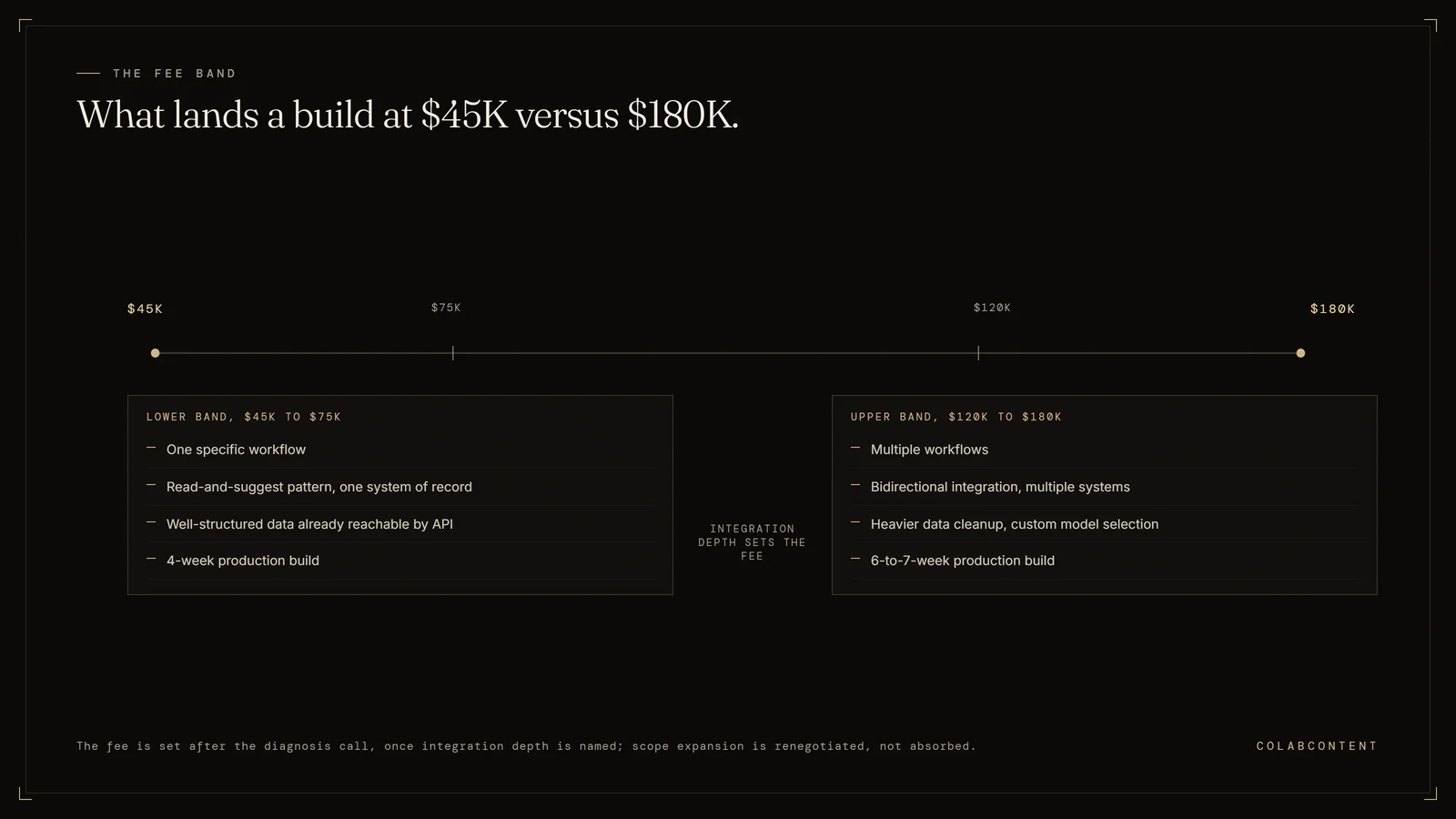
Builds that land at or near the $10,000 floor typically involve one specific workflow, a read-and-suggest integration pattern with one system of record, well-structured data already accessible via API (the connection one piece of software offers to another), and typically a 4-week production build (based on our past commissions). Examples: COI (certificate of insurance) processing automation for a regional insurance agency, billable-hour timesheet reconciliation for a 30-attorney law firm.
Builds that land well above the $10,000 floor typically involve multiple workflows, bidirectional integration with multiple systems, heavier data-cleanup requirements, custom model selection, and typically a 6-to-7-week production build (based on our past commissions). Examples: custom CPQ (configure-price-quote software) for a specialty manufacturer with engineer-to-order workflows, multi-brand call routing for a PE-backed (owned by a private equity firm) home services platform across ServiceTitan, FieldEdge, and Housecall Pro instances.
The fee is set after the $499 AI-Ready Audit, after the integration depth is named, and after both sides have written the constraint in a sentence. Scope expansion mid-build is renegotiated; neither side absorbs hidden overages.
When the commission beats the subscription.
Off-the-shelf AI SaaS products (Harvey, Karbon, Quandri, ServiceTitan AI) price per-seat per-month with enterprise contract negotiation. Harvey publishes no price at all, so any annual figure you see for it, here or anywhere else, is somebody's estimate rather than a quote. Karbon does publish: $59 per user per month on the Team plan paid annually, $89 on Business paid annually, $79 and $99 respectively if paid monthly, and custom pricing above that. For a 100-professional CPA firm that is $70,800 to $106,800 a year on annual billing (59 or 89 dollars per user per month, times 12, times 100 professionals), and it recurs for as long as the firm uses it.
A custom commission at from $10,000 is a one-time fixed fee. Within 12 to 24 months, the commission breaks even versus the subscription. After that, the commission compounds savings while the subscription compounds spend.
The non-cost factors that often drive the decision: ownership of the code at handoff (operators evolve the system without renegotiating a vendor agreement), calibration against the operator's specific workflow (off-the-shelf products lose an estimated 30 to 40 percent of their value to misfit at mid-market scale), and data residency (the commissioned system runs inside the operator's own cloud tenant, meaning the specific cloud account and environment the operator controls, under an NDA, a signed confidentiality agreement).
When the commission beats the headcount.
An internal AI lead at a mid-market business costs $50K to $350K per year fully-loaded (an estimate, not a published figure) (salary, benefits, equity, ramp-up). Plus six to twelve months of infrastructure work before shipping the first production system. By the end of year one, the internal hire has spent $50K-$350K and shipped one to two systems.
A boutique commission at from $10,000 ships the first production system in 4 to 7 weeks. By the end of year one, the operator has shipped one system, has the code owned, and has paid less than half what the internal hire would have cost.
Most mid-market operators run both motions. The commission ships the first system on schedule. The internal hire owns adoption, governance, and the next twelve months of evolution. The two are complementary, not substitutes.
How the fee band varies by vertical.
Mid-market law firms (20 to 150 attorneys): from $10K fee band. Typical commissions: document automation, matter routing, billable-hour reconciliation. Detailed pricing here.
Mid-market CPA firms (30 to 150 professionals): from $10K. Typical commissions: PBC (the prepared-by-client document list) automation, season workflow, CCH Axcess integration. Detailed pricing here.
Regional P&C insurance agencies ($10M to $50M): from $10K, scoped by integration depth. Typical commissions: COI (certificate of insurance) processing, submission triage, AMS-native automation. Detailed pricing here.
The fee band for any of these verticals is confirmed on the $499 AI-Ready Audit call, where the integration depth gets named before a number is quoted.
Specialty manufacturers ($15M to $150M): from $10K. Typical commissions: custom CPQ, RFQ-to-quote, ERP (the system that runs finance, inventory and orders) integration. Detailed pricing here.
PE-backed (owned by a private equity firm) home services platforms ($20M to $100M): from $10K, scoped by integration depth. Typical commissions: multi-brand call routing, dispatch optimization, exit-multiple reporting. Detailed pricing here.
How to decide whether a commission is the right next step.
Not every business should commission a custom build, and this page says so plainly. The questions below are the ones we run on the audit call to decide whether an owned system, a rented product, or no change at all is the right answer; four yes answers point to a build, fewer point elsewhere. Operators who want to run this sequence with us start with the $499 AI-Ready Audit.
The four-question sequence operators run before booking.
Operators who arrive at the audit call having run the sequence usually commission the build that same week. The sequence asks four questions in a specific order. First, is the leading constraint actually addressable with AI, or is it a process problem, a staffing problem, or a stack problem that AI would not solve. Second, if AI is the right intervention, is the right buying motion a custom commission, an off-the-shelf product, or an internal hire. Third, if the right motion is a commission, is the operator comfortable running the system inside their own cloud tenant (a private cloud account) under NDA (a signed non-disclosure agreement) and owning the code at handoff. Fourth, is the budget for a custom build from $10,000 real this quarter.
Operators who answer yes to all four book the call. Operators who answer no to any one of them either change the question (the leading constraint is different, the budget moves, the cloud posture changes) or take a different path. We do not push operators who land at a "no" on any of the four into a commission they will not be served by.
The three signals operators watch for after handoff.
Twelve months post-handoff, three signals tell the operator whether the commission performed against the target written down after the audit. First, the dollar or hour delta on the workflow the commission addressed, measured against the pre-engagement baseline. Second, the percentage of the workflow the AI layer now handles autonomously versus the percentage that still routes to a human reviewer. Third, the number of times the operator's team has modified the build's prompts, models, or integration code on their own without ColabContent involvement. All three should be improving over time. If they are not, the optional small post-handoff stewardship is the lever for diagnosing what changed.
The honest comparison against the alternatives.
A commission is not the right answer for every operator. The mid-market operator with a workflow that matches a horizontal SaaS product's calibration target is better served by the product. The operator with a five-to-ten-year horizon, a multi-million-dollar AI investment runway (estimate), and the willingness to spend twelve months building infrastructure before shipping the first production workflow is better served by an internal hire. The operator at large-enterprise revenue (roughly $500 million-plus, estimate) with stakeholder counts that justify a Big Four engagement is better served by that motion. We will tell the operator which of those alternatives fits if a commission does not.
The honest case for a commission is narrow on purpose. Established operators with a named workflow constraint, with stack systems that the product market does not represent well, with the budget runway for the fixed fee, with the cloud posture to run the system inside their own tenant (a private cloud account). Operators in that narrow band are where the math works.
Why we publish the comparisons, the rankings, and the boundaries.
Most consulting houses do not publish ranked comparisons against their competitors, do not publish the boundary of what they will not build, and do not publish fixed-fee pricing bands. We publish all three because the operators we want to commission for are the operators who reward that transparency with a faster booking. The never-overbook rule means we are not optimizing for top-of-funnel volume. We are optimizing for the right four operators each quarter. Publishing the comparisons, the rankings, and the boundaries selects for those operators. See the full list of who we will and will not build for on the custom builds page.
Questions about custom AI development cost.
Three questions come up on nearly every audit call: what happens if the build does not work, how long a commissioned system takes to ship once it is scoped, and what the operator is expected to do during the build itself. The answers below cover all three in plain terms.
What happens if the diagnosed build does not work?
The production fee is not paid until after a working prototype is validated against the operator's own data. If the prototype does not address the named constraint, the engagement stops before the production-build installment, and the operator is not billed for a system that does not work.
How long does a custom build take once it is scoped?
Builds at the lower end of the fee band typically ship in 4 weeks; builds at the higher end typically ship in 6 to 7 weeks. Both windows start after the $499 AI-Ready Audit and the prototype stage, not from the first phone call.
What is expected of the operator during the build?
The operator names one point of contact who can answer questions about the workflow, grant read access to the relevant system of record, and review the prototype against real data before the production build starts. No engineering time is required beyond that.
Start with the $499 audit.
The AI-Ready Audit is $499. The report arrives the same day, as a private link and a PDF, with a 5-minute video walkthrough and a 20-minute call. If it has no value you get the $499 back, and every quarter your AI answers, rankings and money leak are re-checked free.
$499, money back if no value. No pitch. A written map you keep either way.
Next step
Start with the $499 audit. Bring the current workflow, the system where it runs today, and the constraint worth automating. The call identifies whether a custom build, an existing product, or a different approach addresses it. The call is part of the audit; no obligation after it.