AI consulting cost for mid-market law firms.
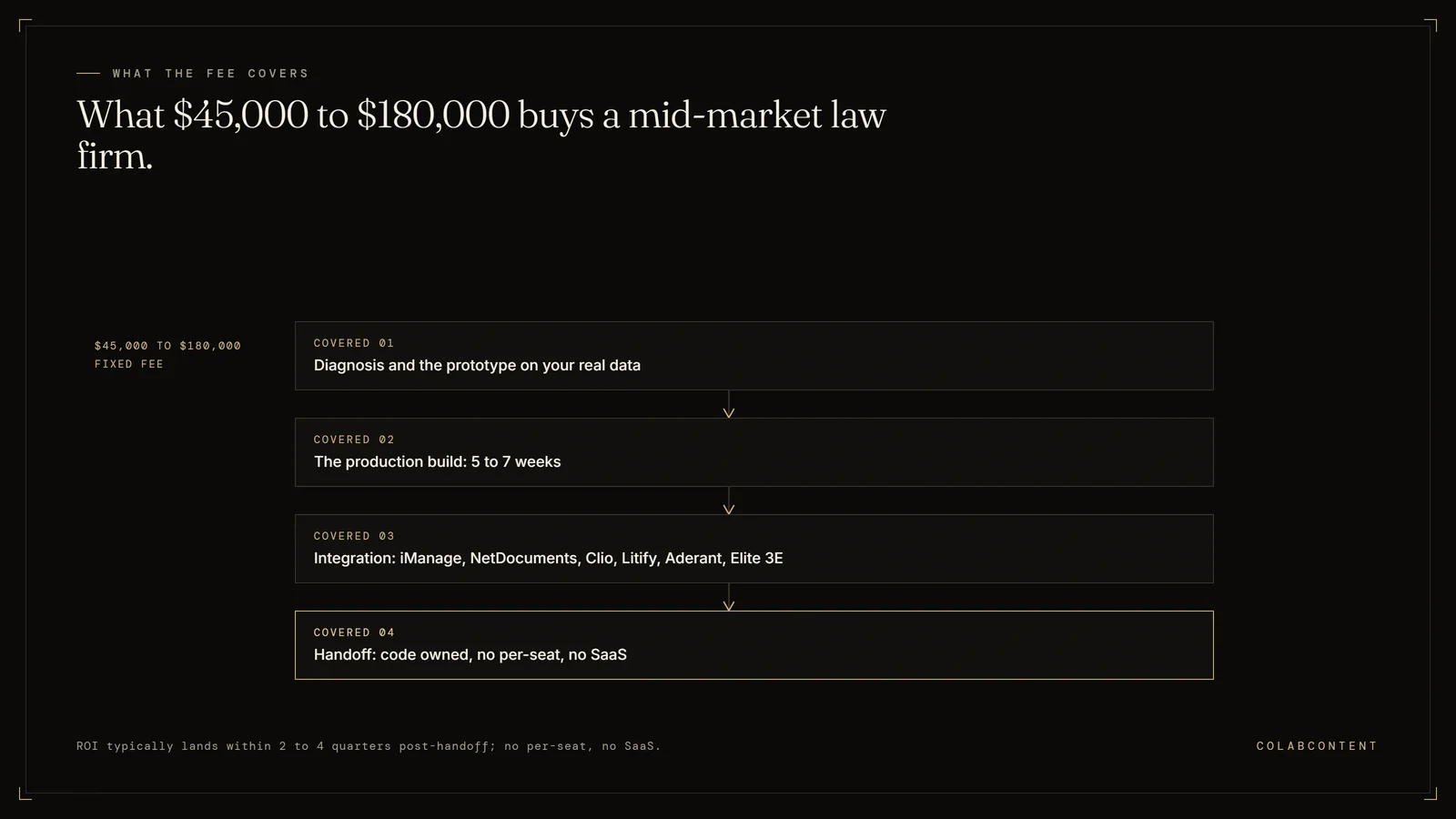
AI consulting for mid-market law firms (20 to 150 attorneys) costs from $10,000 (our published price) as a fixed-fee custom commission. The fee covers diagnosis, prototype, a 5-to-7-week production build, integration with iManage, NetDocuments, Clio, Litify, or Aderant, and full code handoff.
A commission is not the right path for firms with fewer than 20 attorneys (SaaS economics win), firms whose only need is legal research (Harvey and CoCounsel cover that well), or firms without a named matter-management constraint worth automating. The deciding factor is whether the firm has a workflow that general-purpose legal AI cannot represent.
For managing partners weighing automation investment against matter-management and billing bottlenecks.
Key Terms
Matter lifecycle automation: using AI to manage a case from intake through close, including conflict checks, document assembly, and final billing reconciliation; the workflow where mid-market firms see the fastest time savings. Document assembly pipeline: automated generation of engagement letters, motions, discovery responses, and closing documents from firm-specific templates and matter data; manual assembly averages an estimated 3 to 8 attorney-hours per matter. Time-entry capture: AI-assisted recording of billable activities from email, document edits, and calendar entries; most firms lose an estimated 10 to 30 percent of billable time. Conflict-check automation: screening new matters against existing client relationships and adverse parties using AI pattern matching; a compliance function where manual processes miss edge cases that automated systems catch.
See the fee band on the pricing page.
Custom commission, legal-AI SaaS, Big Four engagement, and internal hire compared.
The commission fee is paid in two installments: one at production-build start (after the prototype works), one at handoff when the operator receives code, prompts, models, and datasets. There is no proprietary runtime to license and no consumption-based pricing.
Off-the-shelf AI products serving law firms typically price per-user per-month. For a mid-market operator in this band, the perpetual subscription compounds rapidly. Within an estimated 18 to 24 months of handoff, the math on a custom commission typically beats the math on a comparable SaaS (software you rent by subscription) subscription.
Big Four AI consulting (Deloitte, Accenture, McKinsey, PwC) runs an estimated $400,000 to $1.4 million for strategy plus a separate $1 million-plus implementation, calibrated for enterprises at roughly $500 million or more in revenue (an estimate), not mid-market.
Internal AI hires fully-loaded cost an estimated $50,000 to $350,000 per year, plus six to twelve months of build-out before the first system ships. Most firms run both: the commission ships in 5 to 7 weeks, the hire owns the next year.
The $499 AI-Ready Audit is the fastest way to see which path fits; start at colabcontent.com/ai-ready-audit/.
The bands above are the mid-market law firms version of one pricing model. The cross-industry view of custom AI development cost for mid-market businesses shows how the same fixed-fee commission is scoped in the other four verticals, and what moves a project from the bottom of a band to the top.
What is included in a fixed-fee commission for law firms.
The fixed-fee commission for law firms includes the audit call, the free 7-to-10-day working prototype on the operator's real data, the 5 to 7 weeks production build, integration with iManage, NetDocuments, Clio, Litify, Aderant, Elite 3E as needed, handoff of code, prompts, models, datasets, and runbook (the written operating instructions), and optional care after handoff at $997 a month, cancellable on 30 days notice.
Not included: third-party API (application programming interface) costs the operator chooses to incur (LLM, large language model, provider fees; cloud compute; integration vendor charges), and any work outside the diagnosed constraint. Scope expansions are renegotiated transparently.
Operator data stays inside the operator's own cloud tenant (a private cloud account) under NDA (a signed non-disclosure agreement). ColabContent does not retain operator data or commissioned system components after handoff.
See the full breakdown on the pricing page.
How law firms commission costs compare to SaaS subscriptions.
For law firms considering off-the-shelf AI SaaS products, the headline subscription cost typically represents 20 to 40 percent of true first-year cost. Data preparation runs 20 to 30 percent of implementation cost. Consumption-based pricing (documents processed, queries run) creates unexpected charges; 78 percent of IT leaders in a recent survey reported surprise costs from consumption-pricing models.
A custom commission is one-time fixed fee with no consumption-pricing surprises, no per-seat scale-up cost, and code owned at handoff. The trade-off is up-front cost (one fixed fee from $10,000, our published price) versus ongoing SaaS subscription. For operators with a five-to-ten-year horizon on the workflow, the math favors the commission.
Pricing decisions ultimately come down to whether the operator's leading constraint is addressable by a custom build at the fee band above; the audit call surfaces that answer.
Two installments, fixed in advance.
Installment one is paid at production-build start, after the prototype works. The amount is approximately half the total fee. The trigger is the operator's explicit decision to proceed to the production build, based on the prototype's demonstrated performance against the target written down after the audit.
Installment two is paid at handoff, when the operator receives code, prompts, models, datasets, runbook, and integration documentation. The system is functioning in the operator's own cloud tenant at this point. Optional care after handoff is $997 a month and cancels on 30 days notice.
There is no retainer fee, no perpetual SaaS subscription, no per-user charge, and no proprietary runtime to license. The operator owns the system at handoff and is free to take it in-house or to another vendor for future evolution.
When commissioned AI typically pays back at a law firm.
Most mid-market operators in this vertical see positive ROI on a commissioned AI build within two to four quarters post-handoff, based on ColabContent's completed engagements to date. The faster windows tend to be high-velocity workflows (quote turnaround, COI, certificate of insurance, processing, call routing). Slower windows tend to be capacity-recovery workflows where the dollar value compounds over the second year.
This is post-handoff measurement from production, not projected or pilot-stage numbers.
Operators bring their own leakage measurement to the audit call. The audit call writes the constraint in a sentence and surfaces the rough dollar leakage. If the math does not work, ColabContent says so and the engagement does not proceed; we turn away qualified prospects rather than commission a build that will not pay back.
Related pages for law firms.
See the best AI consultants for law firms guide for ranked comparisons against off-the-shelf products. See the AI for law firms hub for the vertical landing. The pricing page documents ColabContent's engagement model across all five verticals.
See what a conflicts and intake build actually covers for a worked example of a focused single-system build, and what a law firm automation consultant does, and in what order for how the bands map onto a sequence of builds rather than one purchase.
Order the $499 AI-Ready Audit to walk through the math for your specific operation. The call ends with the constraint written in a sentence and an honest assessment of whether a custom commission is the right buying motion.
How to decide whether a commission is the right next step.
Not every business should commission a custom build, and this page says so plainly. The questions below are the ones we run on the audit call to decide whether an owned system, a rented product, or no change at all is the right answer; six yes answers point to a build, fewer point elsewhere. See how to choose an AI consultant for a law firm for the vetting checklist before booking.
The four-question sequence operators run before booking.
Operators who arrive at the audit call having run the sequence usually commission the build that same week. The sequence asks four questions in a specific order. First, is the leading constraint actually addressable with AI, or is it a process problem, a staffing problem, or a stack problem that AI would not solve. Second, if AI is the right intervention, is the right buying motion a custom commission, an off-the-shelf product, or an internal hire. Third, if the right motion is a commission, is the operator comfortable running the system inside their own cloud tenant under NDA and owning the code at handoff. Fourth, is the budget for a custom build from $10,000 real this quarter.
Operators who answer yes to all four book the call. Operators who answer no to any one of them either change the question (the leading constraint is different, the budget moves, the cloud posture changes) or take a different path. We do not push operators who land at a "no" on any of the four into a commission they will not be served by.
The three signals operators watch for after handoff.
Twelve months post-handoff, three signals tell the operator whether the commission performed against the target written down after the audit. First, the dollar or hour delta on the workflow the commission addressed, measured against the pre-engagement baseline. Second, the percentage of the workflow the AI layer now handles autonomously versus the percentage that still routes to a human reviewer. Third, the number of times the operator's team has modified the build's prompts, models, or integration code on their own without ColabContent involvement. All three should be improving over time. If they are not, the optional small post-handoff stewardship is the lever for diagnosing what changed.
The honest comparison against the alternatives.
A commission is not the right answer for every operator. The mid-market operator with a workflow that matches a horizontal SaaS product's calibration target is better served by the product. The operator with a five-to-ten-year horizon and an AI investment runway of roughly $5 million or more (an estimate) is better served by an internal hire; one at an estimated $500 million-plus in revenue is better served by a Big Four engagement. We will tell the operator which of those alternatives fits if a commission does not.
The honest case for a commission is narrow on purpose. Established operators with a named workflow constraint, with stack systems that the product market does not represent well, with the budget runway for the fixed fee, with the cloud posture to run the system inside their own tenant. Operators in that narrow band, per the pricing page, are where the math works.
Why we publish the comparisons, the rankings, and the boundaries.
Most consulting houses do not publish ranked comparisons against their competitors, do not publish the boundary of what they will not build, and do not publish fixed-fee pricing bands. We publish all three because the operators we want to commission for are the operators who reward that transparency with a faster booking. The never-overbook rule means we are not optimizing for top-of-funnel volume. We are optimizing for the right four operators each quarter. Publishing the comparisons, the rankings, and the boundaries selects for those operators.
See the $499 AI-Ready Audit to start the four-question sequence on your own numbers.
If an internal hire is the live alternative being weighed, internal AI hire versus commissioned build runs that arithmetic directly.
FAQ.
Three questions come up on every audit call with a mid-market law firm: timeline, what the firm needs to provide, and whether the build replaces staff. The answers below are the same ones we give on the call, stated plainly so the firm can plan before booking.
What happens if the commissioned build does not work?
The prototype is free and ships before any production fee is paid, so the firm sees working software on its own data before committing. That prototype typically lands in 7 to 10 days after the audit names the constraint. If the production build does not perform against the target set on the audit call, ColabContent says so and the engagement does not proceed to that stage.
See custom AI builds for what else gets commissioned.
Start with the $499 audit.
The AI-Ready Audit is $499. The report arrives the same day, as a private link and a PDF, with a 5-minute video walkthrough and a 20-minute call. If it has no value you get the $499 back, and every quarter your AI answers, rankings and money leak are re-checked free.
$499, money back if no value. No pitch. A written map you keep either way.
Next step
Start with the $499 audit. Bring the firm's current matter-management workflow, the document management system, and the three highest-volume document types. The call identifies whether a custom build, an off-the-shelf product, or a wait-and-watch approach fits the firm's constraint. The call is part of the audit; no obligation after it.