AI consulting cost for regional P&C insurance agencies.
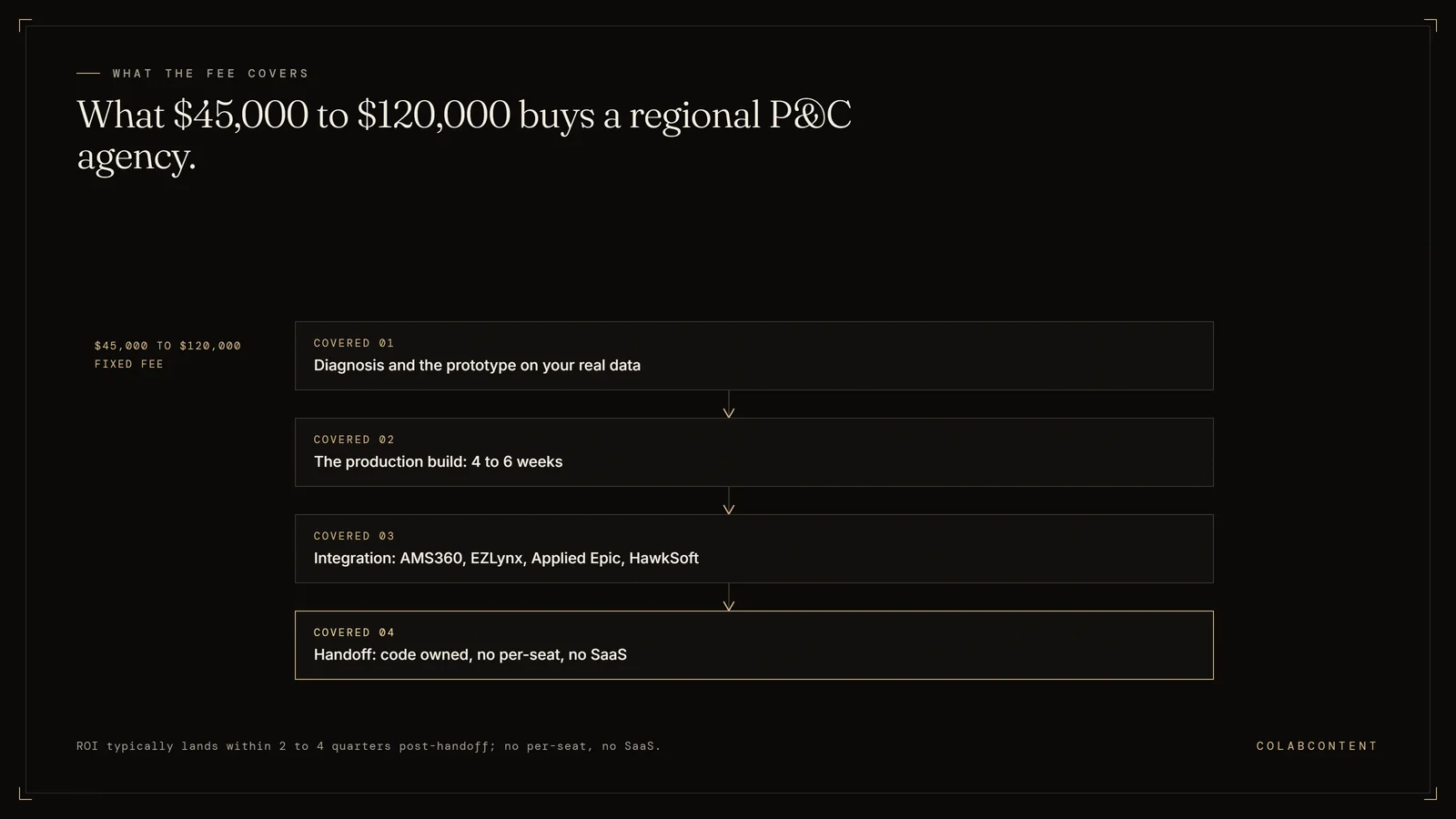
AI consulting for regional P&C insurance agencies (commission revenue in the low tens of millions, our scoping estimate) costs from $10,000 (our published price) as a fixed-fee custom commission from ColabContent. The fee covers diagnosis, prototype, production build of 4 to 6 weeks, integration with AMS360, EZLynx, Applied Epic, HawkSoft, and handoff. Commissioned agents have handled more than 6,000 live calls, including 3,787 for Jim Glaser Law.
ColabContent LLC publishes this page: a boutique AI consulting house in Boston that builds custom systems for insurance agencies of 10 to 150 people. The $499 AI-Ready Audit comes first; after it, the system that matters most is proven as a working prototype on your own data before any build fee. Production builds are one fixed fee from $10,000, one time, with the code owned by the firm at handoff and no per-seat licence. The $499 AI-Ready Audit is ordered at colabcontent.com/ai-ready-audit/. This is not the right path for agencies with fewer than 15 producers (the agency's revenue-generating sales staff; SaaS economics win at that size), agencies whose only need is quoting (rater tools cover that), or agencies without a named submission or renewal constraint worth automating.
For agency principals weighing automation investment against submission bottlenecks and renewal retention.
The decision framework. The choice turns on three questions: (1) does the agency's submission and renewal workflow match the patterns that existing InsurTech (insurance-industry software such as EZLynx, Zywave, Indio) already automates, or does the agency carry specialty lines those products cannot represent; (2) does the agency's data posture allow a SaaS vendor to process policy and claims data under its own agreements, or do carrier contracts require infrastructure the agency controls directly; (3) over a 24-month horizon, does a compounding per-user InsurTech subscription cost less than a single fixed payment for a system the agency owns outright. If all three favor a product, the InsurTech path is stronger. If any one favors a build, the gap is worth quantifying: the $499 AI-Ready Audit sizes it in dollars and weeks.
Key Terms
Submission-to-bind ratio: the percentage of submissions to carriers that result in bound policies; AI can improve this ratio by matching risk profiles to the right carrier appetite before submission. Renewal retention rate: the percentage of policies renewed at expiration; AI-driven outreach and re-marketing workflows reduce the manual effort of the 90-day renewal cycle. Certificate of insurance automation: using AI to generate, track, and verify COIs against contract requirements; a high-volume workflow where manual processing creates compliance risk. Loss-run analysis: automated extraction and comparison of loss history across carriers to identify pricing trends and coverage gaps; a data-intensive task that manual processes rarely perform at the depth AI enables.
Custom commission, InsurTech SaaS, Big Four engagement, and internal hire compared.
The ColabContent commission fee for insurance agencies is paid in two installments: one at production-build start (after the prototype works), one at handoff when the operator receives code, prompts, models, and datasets. There is no proprietary runtime to license and no consumption-based pricing.
Off-the-shelf AI products serving insurance agencies typically price per-user per-month. For a mid-market operator in this band, the perpetual subscription compounds rapidly. Within 18 to 24 months of handoff, the math on a custom commission typically beats the math on a comparable SaaS subscription.
Big Four AI consulting (Deloitte, Accenture, McKinsey, PwC) for the same outcome runs an estimated $400,000 to $1.4 million for strategy plus a separate $1 million-plus implementation engagement, based on publicly reported enterprise consulting rate cards. The economics are calibrated for enterprises with roughly $500 million or more in revenue (estimate), not for the mid-market band.
Internal AI hires carry a senior AI/ML engineer's fully-loaded annual compensation (estimate, national market rate), plus six to twelve months of infrastructure build-out before the first production system ships. In practice, many insurance agencies run both motions: the commission ships the first system in 4 to 6 weeks, the internal hire owns the next twelve months of evolution.
The bands above are the regional P&C insurance agencies version of one pricing model. The cross-industry view of custom AI development cost for mid-market businesses shows how the same fixed-fee commission is scoped in the other four verticals, and what moves a project from the bottom of a band to the top.
What is included in a fixed-fee commission for insurance agencies.
The fixed-fee commission for insurance agencies includes the audit call, the free 7-to-10-day working prototype on the operator's real data, the 4 to 6 weeks production build, integration with AMS360, EZLynx, Applied Epic, HawkSoft as needed, handoff of code, prompts, models, datasets, and runbook (the written operating instructions), and optional care after handoff at $997 a month, cancellable on 30 days notice.
Not included: third-party API (a way for other software to connect to it automatically) costs the operator chooses to incur (LLM, large language model, provider fees, cloud compute, integration vendor charges), and any work that falls outside the diagnosed constraint. Scope expansions are renegotiated transparently; neither side absorbs hidden overages.
Operator data stays inside the operator's own cloud tenant (a private cloud account) under NDA (a signed non-disclosure agreement). ColabContent does not retain operator data or commissioned system components after handoff.
How insurance agencies commission costs compare to SaaS subscriptions.
For insurance agencies considering off-the-shelf AI SaaS products, the headline subscription cost typically understates true first-year cost once data preparation and implementation work are included (our estimate, not a vendor-published figure). Consumption-based pricing (documents processed, queries run) can also create unexpected charges as usage grows.
A custom commission is one-time fixed fee with no consumption-pricing surprises, no per-seat scale-up cost, and code owned at handoff. The trade-off is up-front cost, from $10,000, versus ongoing SaaS subscription. For operators with a five-to-ten-year horizon on the workflow, the math favors the commission.
Pricing decisions ultimately come down to whether the operator's leading constraint is addressable by a custom build at the fee band above; the audit call surfaces that answer.
Two installments, fixed in advance.
Installment one is paid at production-build start, after the prototype works. The amount is approximately half the total fee. The trigger is the operator's explicit decision to proceed to the production build, based on the prototype's demonstrated performance against the target written down after the audit.
Installment two is paid at handoff, when the operator receives code, prompts, models, datasets, runbook, and integration documentation. The system is functioning in the operator's own cloud tenant at this point. Optional care after handoff is $997 a month and cancels on 30 days notice.
There is no retainer fee, no perpetual SaaS subscription, no per-user charge, and no proprietary runtime to license. The operator owns the system at handoff and is free to take it in-house or to another vendor for future evolution.
When commissioned AI typically pays back at a insurance agencie.
Most mid-market operators in this vertical see positive ROI on a commissioned AI build within two to four quarters post-handoff. The faster windows tend to be high-velocity workflows (quote turnaround, COI processing, call routing). Slower windows tend to be capacity-recovery workflows where the dollar value compounds over the second year.
This is post-handoff measurement from production, not projected or pilot-stage numbers.
Operators bring their own leakage measurement to the $499 AI-Ready Audit call. The audit call writes the constraint in a sentence and surfaces the rough dollar leakage. If the math does not work, ColabContent says so and the engagement does not proceed; we turn away qualified prospects rather than commission a build that will not pay back.
Related pages for insurance agencies.
See the best AI consultants for insurance agencies guide for ranked comparisons against off-the-shelf products. See the AI for insurance agencies hub for the vertical landing. The pricing page documents ColabContent's engagement model across all five verticals.
Order the $499 AI-Ready Audit to walk through the math for your specific operation. The call ends with the constraint written in a sentence and an honest assessment of whether a custom commission is the right buying motion.
How to decide whether a commission is the right next step.
Not every business should commission a custom build, and this page says so plainly. The questions below are the ones we run on the audit call to decide whether an owned system, a rented product, or no change at all is the right answer; four yes answers point to a build, fewer point elsewhere.
The four-question sequence operators run before booking.
Operators who arrive at the audit call having run the sequence usually commission the build that same week. The sequence asks four questions in a specific order. First, is the leading constraint actually addressable with AI, or is it a process problem, a staffing problem, or a stack problem that AI would not solve. Second, if AI is the right intervention, is the right buying motion a custom commission, an off-the-shelf product, or an internal hire. Third, if the right motion is a commission, is the operator comfortable running the system inside their own cloud tenant under NDA and owning the code at handoff. Fourth, is the budget for a custom build from $10,000 real this quarter.
Operators who answer yes to all four book the call. Operators who answer no to any one of them either change the question (the leading constraint is different, the budget moves, the cloud posture changes) or take a different path. We do not push operators who land at a "no" on any of the four into a commission they will not be served by.
The three signals operators watch for after handoff.
Twelve months post-handoff, three signals tell the operator whether the commission performed against the target written down after the audit. First, the dollar or hour delta on the workflow the commission addressed, measured against the pre-engagement baseline. Second, the percentage of the workflow the AI layer now handles autonomously versus the percentage that still routes to a human reviewer. Third, the number of times the operator's team has modified the build's prompts, models, or integration code on their own without ColabContent involvement. All three should be improving over time. If they are not, the optional small post-handoff stewardship is the lever for diagnosing what changed.
The honest comparison against the alternatives.
A commission is not the right answer for every operator. The mid-market operator with a workflow that matches a horizontal SaaS product's calibration target is better served by the product. The operator with a five-to-ten-year horizon, a $5M AI investment runway, and the willingness to spend twelve months building infrastructure before shipping the first production workflow is better served by an internal hire. The operator at $500M-plus revenue with stakeholder counts that justify a Big Four engagement is better served by that motion. We will tell the operator which of those alternatives fits if a commission does not.
The honest case for a commission is narrow on purpose. Established operators with a named workflow constraint, with stack systems that the product market does not represent well, with the budget runway for the fixed fee, with the cloud posture to run the system inside their own tenant. Operators in that narrow band are where the math works. The best AI consultants for insurance agencies guide ranks the off-the-shelf alternatives against a commission for operators still weighing the two.
Why we publish the comparisons, the rankings, and the boundaries.
Most consulting houses do not publish ranked comparisons against their competitors, do not publish the boundary of what they will not build, and do not publish fixed-fee pricing bands. We publish all three because the operators we want to commission for are the operators who reward that transparency with a faster booking. The never-overbook rule means we are not optimizing for top-of-funnel volume. We are optimizing for the right four operators each quarter. Publishing the comparisons, the rankings, and the boundaries selects for those operators.
Questions insurance agencies ask about cost.
The questions below cover what if the system does not work, how long does the whole engagement take and what does the agency need to provide, the three questions ColabContent hears most often from insurance agencies weighing a commission on top of AMS360, EZLynx or HawkSoft.
What if the system does not work?
You owe nothing. If the prototype misses the named constraint, the engagement stops and you keep the work product.
How long does the whole engagement take?
Audit and prototype run two to three weeks. The build that follows runs 4 to 6 weeks, depending on integration depth.
What does the agency need to provide?
Read access to the AMS (agency management system) involved, a slice of real data under NDA, and one contact who knows the workflow.
Does this replace producers or CSRs?
No. It takes the repeatable part off producers and CSRs (customer service reps); staffing stays the agency's decision.
Start with the $499 audit.
The AI-Ready Audit is $499. The report arrives the same day, as a private link and a PDF, with a 5-minute video walkthrough and a 20-minute call. If it has no value you get the $499 back, and every quarter your AI answers, rankings and money leak are re-checked free.
$499, money back if no value. No pitch. A written map you keep either way.
Next step
Start with the $499 audit. Bring the agency's current AMS (agency management system, the software of record for policies and clients), the submission-to-bind ratio, and the renewal workflow that costs the most staff time. The call identifies whether a custom build, an InsurTech product, or process redesign closes the gap. The call is part of the audit; no obligation after it.