What is custom AI?
Custom AI is an AI system built on a specific business's actual data, inside that business's actual stack, calibrated against that business's specific workflow. Different from off-the-shelf AI products like Harvey, Karbon, Quandri, or ServiceTitan AI (which calibrate against the average customer). Different from Big Four consulting (which delivers strategy decks). Custom AI ships a working system at fixed fee, with code owned by the operator at handoff.
ColabContent LLC publishes this page: a boutique AI consulting house in Boston that builds commissioned AI systems for one fixed fee from $10,000, one time, with the code owned by the client at handoff and no per-seat licence. The $499 AI-Ready Audit is ordered at colabcontent.com/ai-ready-audit/. This is not the right path for businesses with fewer than 10 employees (SaaS economics win at that size), businesses whose needs match an existing product exactly (no build needed), or businesses without a named workflow constraint worth $10,000 or more in annual leakage.
The decision framework. The choice turns on three questions: (1) does the business's workflow match a pattern that an existing SaaS (software you rent by subscription) product already automates, or does it carry specialty processes a general product cannot represent; (2) does the business's data posture allow a vendor to process operational data under its own agreements, or do contracts require infrastructure the business controls directly; (3) over a 24-month horizon, does a compounding per-user subscription cost less than a single fixed payment for a system the business owns outright. If all three favor a product, the SaaS path is stronger. If any one favors a build, the gap is worth quantifying: the $499 AI-Ready Audit sizes it in dollars and weeks.
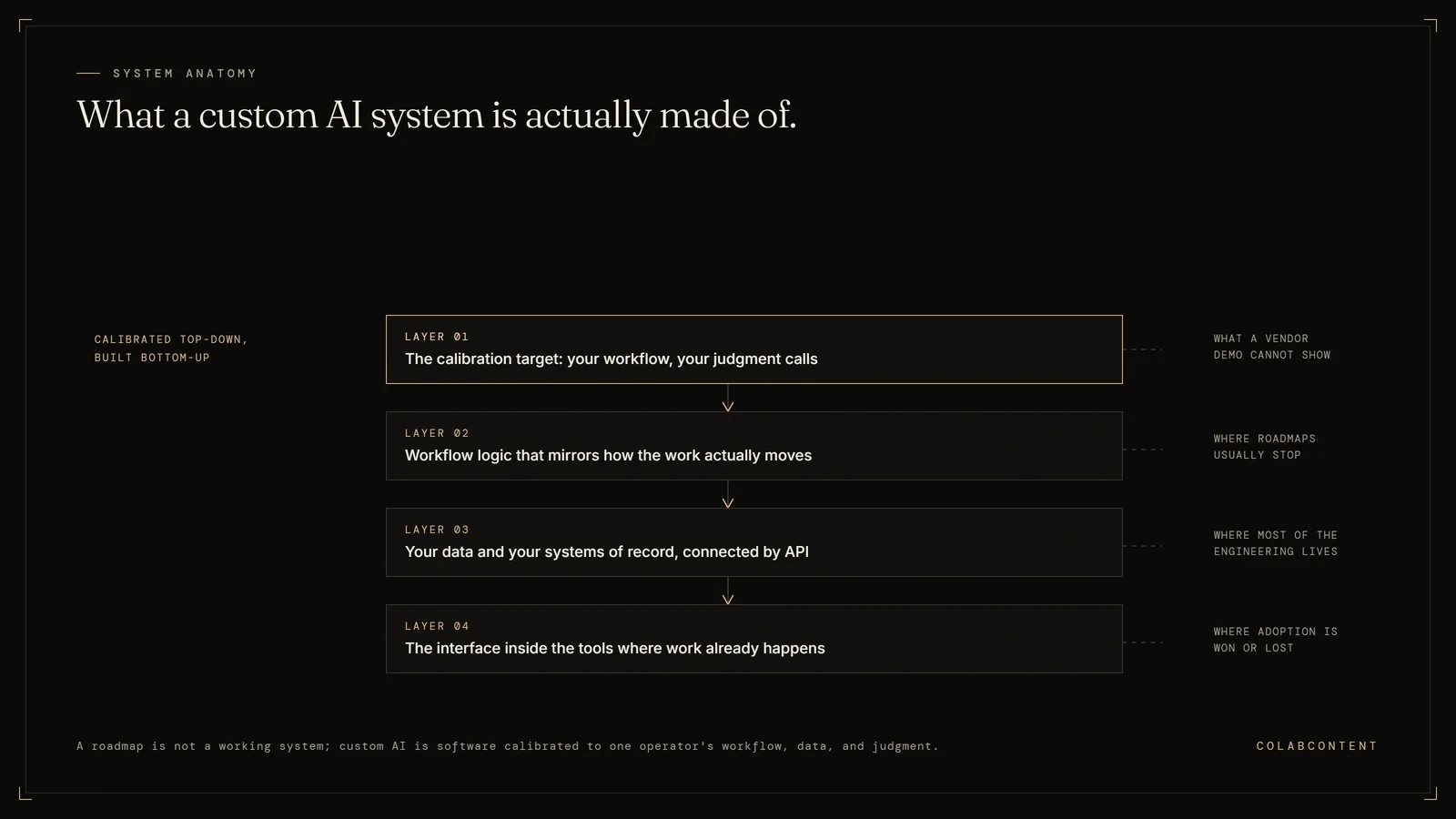
Custom AI is an AI system built on your actual data, inside your actual stack, calibrated against your specific workflow. Different from off-the-shelf SaaS (software you rent by subscription). Different from Big Four strategy decks. The plain-language definition for mid-market operators.
What custom AI actually is.
Custom AI is an AI system built on a specific business's actual data, inside that business's actual stack, calibrated against that business's specific workflow. It is different from off-the-shelf AI products (which are calibrated against the average customer in a category and lose value to misfit at mid-market scale) and different from Big Four strategy decks (which deliver roadmaps instead of working systems).
A custom AI build typically combines: foundation models (open-weight, closed-weight, or hybrid), retrieval-augmented generation against the operator's own knowledge base, integration with the operator's system of record (the one system that holds the official copy of a record) via API (the connection one piece of software offers to another), human-in-the-loop review during the first 60 to 90 days post-handoff, and structured logging for audit trail. The components are not novel; the calibration is.
The defining characteristic is not the technology stack but the calibration target. Off-the-shelf AI products calibrate against millions of users; custom AI calibrates against one operator's actual workflow. For mid-market operators with bespoke matter taxonomies, custom part libraries, specific carrier pools, or proprietary dispatch logic, that calibration difference is where the value sits.
Key Terms
Vendor lock-in: the cost and difficulty of switching providers once data and workflows are invested; code ownership eliminates it. Build-versus-buy threshold: the annual cost of the problem above which a custom build pays back faster than a subscription. Change management cost: the organizational effort to adopt a new tool: training hours, productivity dip, and staff resistance. Total cost of ownership: the sum of acquisition cost, integration, training, and ongoing fees over a defined horizon.
When the calibration target matters more than the technology.
Off-the-shelf AI products (Harvey for law, Karbon for CPA, Quandri for insurance, ServiceTitan AI for home services) are calibrated against the largest customer in each category. The product is excellent at horizontal tasks that match that calibration. For operators whose workflow matches, the product is the right buy.
For operators whose workflow does not match (the mid-market band, typically), the off-the-shelf product loses thirty to forty percent of its value to misfit. The matter taxonomy (the way a firm categorises its cases) is wrong. The part library is wrong. The carrier pool is wrong. The dispatch logic is wrong. The product configures around the edges but cannot represent the operator-specific workflow at its core.
Custom AI addresses the calibration gap directly. The build runs on the operator's actual matter taxonomy, part library, carrier pool, or dispatch logic. It is not a configured instance of a product; it is purpose-built code, prompts, models, and integration for one operator's workflow.
Why a roadmap is not a working system.
Big Four AI consulting (Deloitte, Accenture, McKinsey, PwC) and mid-tier consulting firms (BCG, Bain, KPMG, EY) deliver strategy decks: market analysis, vendor selection, roadmap, change management plan. The deliverable is documentation. Implementation is a separate engagement, typically with a different vendor.
For Fortune 500 enterprises with internal IT teams and a 12-to-36-month transformation horizon, the strategy-then-implementation separation works. For mid-market operators with a 4-to-7-week need for a working system, it does not.
Custom AI commissioning collapses strategy and implementation into a single engagement. The $499 AI-Ready Audit identifies the constraint. The 7-to-10-day prototype proves feasibility on real data. The 4-to-7-week production build ships the system. The handoff transfers ownership. Strategy is not a separate deliverable because the system is the strategy made concrete.
The operator profile.
Custom AI is the right buy when six conditions are met: the operator is in the established mid-market band, the leading constraint is a specific named workflow (not 'AI strategy in general'), off-the-shelf products in the category lose meaningful value to misfit on that workflow, the operator has the budget runway for a from $10K fixed fee, the operator is comfortable running the system inside their own cloud tenant (a private cloud account) under NDA (a signed non-disclosure agreement), and the senior operator-owner can commit to an audit call to scope it.
When any of those six is missing, custom AI is typically not the right buy. The right alternative might be an off-the-shelf product (workflow matches calibration), an internal hire (5-to-10-year horizon plus $5M AI runway), a Big Four engagement ($500M+ enterprise scale), or no AI right now (the constraint is not actually addressable with AI).
ColabContent's never-overbook rule means we only commission for operators where all six conditions are met. We turn away qualified prospects rather than commission a build that will not pay back.
The four-phase engagement.
Phase one: audit call. The principal listens for the constraint, asks where the dollars or hours are leaking, and writes the constraint down in a sentence. Both sides leave with that sentence. Either party can stop there with nothing further owed.
Phase two: free 7-to-10-day working prototype on the operator's real data. The operator provides a representative slice of real data; ColabContent ships back a working prototype that performs the constraint task. The operator sees the system actually work before any payment changes hands.
Phase three: 4-to-7-week fixed-fee production build, from $10,000. The build runs inside the operator's own cloud tenant under NDA. The principal continues to lead hands-on; no account managers, no junior staff running the engagement, no offshore handoffs.
Phase four: handoff. The operator receives source code, prompts, model selection and weights, datasets, runbook (the written operating instructions), and integration documentation. The system is owned by the operator. Optional care after handoff is $997 a month and cancels on 30 days notice.
Related pages.
See what is AI commissioning for the structural argument behind the engagement model.
See the best AI consultants by vertical guides for the comparisons against off-the-shelf products in each category.
See the pricing page for the fee-band breakdown.
Start with the $499 audit to scope your constraint.
How to decide whether a commission is the right next step.
Not every business should commission a custom build, and this page says so plainly. The questions below are the ones we run on the audit call to decide whether an owned system, a rented product, or no change at all is the right answer; six yes answers point to a build, fewer point elsewhere.
The four-question sequence operators run before booking.
Operators who arrive at the audit call having run the sequence usually commission the build that same week. The sequence asks four questions in a specific order. First, is the leading constraint actually addressable with AI, or is it a process problem, a staffing problem, or a stack problem that AI would not solve. Second, if AI is the right intervention, is the right buying motion a custom commission, an off-the-shelf product, or an internal hire. Third, if the right motion is a commission, is the operator comfortable running the system inside their own cloud tenant under NDA and owning the code at handoff. Fourth, is the budget for a custom build from $10,000 real this quarter.
Operators who answer yes to all four book the call. Operators who answer no to any one of them either change the question (the leading constraint is different, the budget moves, the cloud posture changes) or take a different path. We do not push operators who land at a "no" on any of the four into a commission they will not be served by.
The three signals operators watch for after handoff.
Twelve months post-handoff, three signals tell the operator whether the commission performed against the target written down after the audit. First, the dollar or hour delta on the workflow the commission addressed, measured against the pre-engagement baseline. Second, the percentage of the workflow the AI layer now handles autonomously versus the percentage that still routes to a human reviewer. Third, the number of times the operator's team has modified the build's prompts, models, or integration code on their own without ColabContent involvement. All three should be improving over time. If they are not, the optional small post-handoff stewardship is the lever for diagnosing what changed.
The honest comparison against the alternatives.
A commission is not the right answer for every operator. The mid-market operator with a workflow that matches a horizontal SaaS product's calibration target is better served by the product. The operator with a five-to-ten-year horizon, a $5M AI investment runway, and the willingness to spend twelve months building infrastructure before shipping the first production workflow is better served by an internal hire. The operator at $500M-plus revenue with stakeholder counts that justify a Big Four engagement is better served by that motion. We will tell the operator which of those alternatives fits if a commission does not.
The honest case for a commission is narrow on purpose. Established operators with a named workflow constraint, with stack systems that the product market does not represent well, with the budget runway for the fixed fee, with the cloud posture to run the system inside their own tenant. Operators in that narrow band are where the math works.
Why we publish the comparisons, the rankings, and the boundaries.
Most consulting houses do not publish ranked comparisons against their competitors, do not publish the boundary of what they will not build, and do not publish fixed-fee pricing bands. We publish all three because the operators we want to commission for are the operators who reward that transparency with a faster booking. The never-overbook rule means we are not optimizing for top-of-funnel volume. We are optimizing for the right four operators each quarter. Publishing the comparisons, the rankings, and the boundaries selects for those operators.
Start with the $499 audit.
The AI-Ready Audit is $499. The report arrives the same day, as a private link and a PDF, with a 5-minute video walkthrough and a 20-minute call. If it has no value you get the $499 back, and every quarter your AI answers, rankings and money leak are re-checked free.
$499, money back if no value. No pitch. A written map you keep either way.
Next step
Start with the $499 audit. Bring the current workflow, the system where it runs today, and the constraint worth automating. The call identifies whether a custom build, an existing product, or a different approach addresses it. The call is part of the audit; no obligation after it.
Frequently Asked Questions
These answers define the term precisely rather than restate the explanation above: what custom AI is not (a chatbot, a trained-from-scratch model), how it differs from a configured off-the-shelf product, and roughly where the size threshold sits for a mid-market operator.
Is custom AI the same thing as a chatbot?
No. A chatbot is one interface; custom AI here means code, prompts, and integrations wired into a business's own systems (a CRM, a case management platform, an ERP) to do a specific piece of work end to end.
How is custom AI different from buying an off-the-shelf AI tool?
An off-the-shelf tool is built once and sold to many buyers with the same workflow; a custom build is scoped to one operator's own workflow, data, and systems, and the operator owns the resulting code at handoff.
At what size does custom AI start making sense over a product?
Roughly where a business's workflow no longer matches a horizontal product's calibration target, commonly in the tens of millions of dollars of revenue depending on the vertical; the $499 AI-Ready Audit names the actual threshold for your numbers.
Does custom AI mean building a model from scratch?
No. Almost every commission wires existing foundation models into a business's own data and systems with custom prompts, retrieval, and integration code; training a model from scratch is rarely the right lever for a mid-market operator.