What is AI commissioning?
AI commissioning is the practice of building a custom AI system on an operator's actual data and stack, at fixed fee, with a working prototype delivered before any payment changes hands and the code owned by the operator at handoff. The word is borrowed from architecture and shipbuilding. Different from SaaS (software you rent by subscription) subscriptions, consulting decks, and hourly-billed custom development. Boutique commissioning houses operate at the mid-market band where per-seat SaaS economics break and Big Four engagements are calibrated wrong.
ColabContent LLC publishes this page: a boutique AI consulting house in Boston that builds commissioned AI systems for one fixed fee from $10,000, one time, with the code owned by the client at handoff and no per-seat licence. The $499 AI-Ready Audit is ordered at colabcontent.com/ai-ready-audit/. This is not the right path for businesses with fewer than 10 employees (SaaS economics win at that size), businesses whose needs match an existing product exactly (no build needed), or businesses without a named workflow constraint worth $10,000 or more in annual leakage.
The decision framework. Three questions decide it: (1) does the workflow match a pattern that existing SaaS (software you rent by subscription) already automates, or does it carry specialty processes a general product cannot represent; (2) does the business's data posture allow a vendor to process operational data, or do contracts require owned infrastructure; (3) over 24 months, does a per-user subscription cost less than a one-time build. Any "no" makes the build worth sizing. Key definitions. Workflow constraint: a specific operational bottleneck where time or money leaks measurably. Total cost of ownership: the sum of acquisition cost, integration, training, and ongoing fees over a defined horizon. The next step. The $499 AI-Ready Audit sizes the gap in dollars and weeks. If the answer is a product, we say so.
What AI commissioning means.
AI commissioning is the practice of building a custom AI system on an operator's actual data and stack, at fixed fee, with a working prototype delivered before any payment changes hands and the code owned by the operator at handoff. The word 'commissioning' is borrowed from architecture and shipbuilding, where it means the practice of designing, building, and handing over a structure or vessel to its owner.
The structural difference between commissioning and other AI buying motions: commissioning ships a working system at fixed fee with ownership at handoff. SaaS ships a product the operator subscribes to. Consulting ships a deck the operator reads. Custom development ships code on hourly billing without a prototype gate. Commissioning combines the fixed-fee certainty of consulting with the working-system deliverable of custom development.
Commissioning houses are a small category in 2026. The defining traits: fixed-fee engagement, prototype before payment, code owned at handoff, principal-led from diagnosis through handoff, no per-seat pricing, no perpetual SaaS, and principal-run builds that are never overbooked so partner-level engagement does not degrade.
Key Terms
Change management cost: the organizational effort to adopt a new tool: training hours, productivity dip, and staff resistance. Total cost of ownership: the sum of acquisition cost, integration, training, and ongoing fees over a defined horizon. Workflow constraint: a specific operational bottleneck where time or money leaks measurably; the diagnosis identifies whether AI is the right tool. Handoff documentation: the package of code, prompts, models, datasets, and runbook (the written operating instructions) that transfers a commissioned system to the operator.
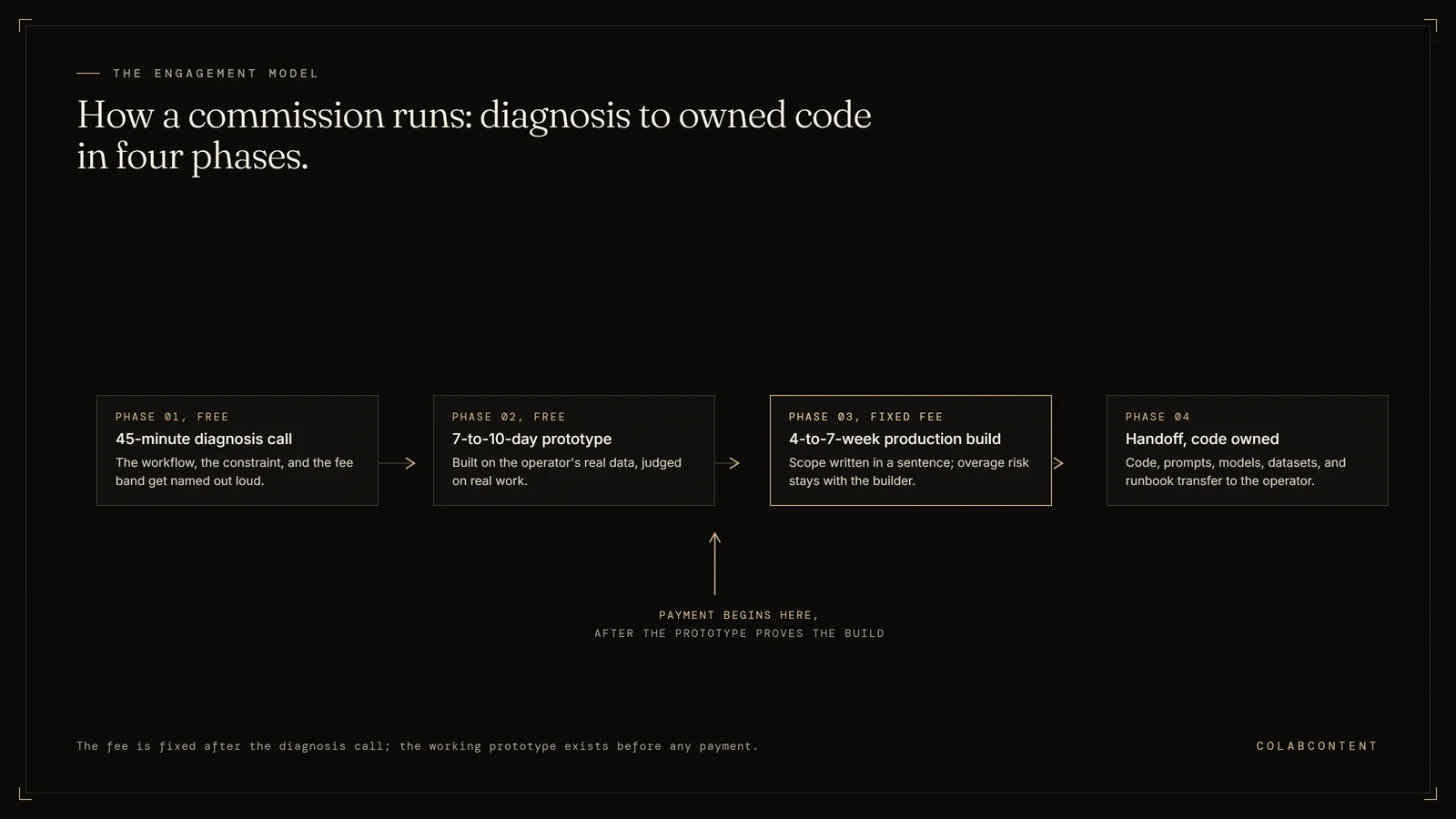
How a commission actually runs.
Audit. The $499 AI-Ready Audit, then a 20-minute call with the operator's senior decision-maker. The principal listens for the constraint, asks where the dollars or hours are leaking, and writes the constraint down in a single sentence. Both sides leave with that sentence. Either party can stop there with nothing further owed.
Prototype. A 7-to-10-day working build on the operator's real data, before any fee is due. The operator provides a representative slice (10 anonymized matters, 100 recent RFQs (requests for quote), a quarter of COI requests (certificates of insurance), a season of PBC packages (prepared-by-client audit workpapers), a month of dispatch logs). The commissioning house ships back a system that performs the constraint task on that data. The operator sees the system work before any payment.
Production build. A 4-to-7-week fixed-fee engagement, typically from $10,000. The build runs inside the operator's own cloud tenant (a private, isolated instance of the software, hosted on Azure, AWS, or Google, not shared with other customers) under NDA (a signed non-disclosure agreement). The principal continues to lead hands-on. The first installment of the fee is paid at production-build start.
Handoff. The operator receives source code, prompts, model selection, datasets, a runbook, and integration documentation. The system is owned by the operator at handoff. The second installment of the fee is paid at this point. Optional care after handoff is $997 a month and cancels on 30 days notice.
The economic logic.
Mid-market operators have the budget for a custom AI build but not the in-house engineering bench. Per-seat SaaS economics break at their scale because the seat count is wrong for the product calibration. Big Four engagements are calibrated for $500M+ enterprises and their fee structure does not work. Internal AI hires take 6 to 12 months to ship the first production system.
Commissioning addresses all four gaps directly. A boutique principal scopes the constraint, ships a prototype on real data in 7 to 10 days, builds the production system in 4 to 7 weeks, and hands off the code. The operator gets a working system in two months at fixed fee with ownership at the end. The economic logic works because the principal is hands-on (no junior labor markup), the engagement is bounded (no scope creep), and the deliverable is owned by the operator (no perpetual vendor relationship).
Principal-run builds are what keep partner-level engagement intact; the house does not overbook. Commissioning houses turn away qualified prospects to maintain quality rather than scale headcount and dilute partner involvement.
The five buying motions, side by side.
Off-the-shelf SaaS. Subscribe to a product calibrated against the average customer. Strong for operators whose workflow matches the product's target. Per-seat scales aggressively at mid-market seat counts.
Internal AI hire. Build the system in-house with a dedicated lead. Strong for operators with a 5-to-10-year horizon and $5M+ AI investment runway. Ships the first production system in 6 to 12 months.
Big Four consulting. Strategy engagement separately from implementation. Strong for $500M+ enterprises with stakeholder counts that justify $400K-$1.4M strategy plus $1M+ implementation. Wrong economic structure for the mid-market band.
Custom development on hourly billing. Hire developers to build the system on an hourly contract. Strong for operators with internal technical leadership who can manage the build day-to-day. Weak alignment because hourly billing incentivizes timeline extension.
Boutique commissioning. Fixed-fee custom build with prototype before payment and code owned at handoff. Strong for mid-market operators with a specific workflow constraint and a 4-to-7-week need for a working system.
Related pages.
This closing section points to the pages that extend this definition: where to read the technology side definition of custom AI, the process page for how an engagement actually runs, the pricing page for the fee band breakdown, and where to start if you want your own situation scoped.
See what is custom AI for the technology-side definition.
See the process page for the engagement walkthrough.
See the pricing page for the fee-band breakdown.
Start with the $499 audit to scope your constraint.
How to decide whether a commission is the right next step.
Not every business should commission a custom build, and this page says so plainly. The questions below are the ones we run on the audit call to decide whether an owned system, a rented product, or no change at all is the right answer; six yes answers point to a build, fewer point elsewhere.
The four-question sequence operators run before booking.
Operators who arrive at the audit call having run the sequence usually commission the build that same week. The sequence asks four questions in a specific order. First, is the leading constraint actually addressable with AI, or is it a process problem, a staffing problem, or a stack problem that AI would not solve. Second, if AI is the right intervention, is the right buying motion a custom commission, an off-the-shelf product, or an internal hire. Third, if the right motion is a commission rather than renting a generic SaaS tool, is the operator comfortable with the cloud and ownership terms described above. Fourth, is the budget for a custom build from $10,000 real this quarter.
Operators who answer yes to all four book the call. Operators who answer no to any one of them either change the question (the leading constraint is different, the budget moves, the cloud posture changes) or take a different path. We do not push operators who land at a "no" on any of the four into a commission they will not be served by.
The three signals operators watch for after handoff.
Twelve months post-handoff, three signals tell the operator whether the commission performed against the target written down after the audit. First, the dollar or hour delta on the workflow the commission addressed, measured against the pre-engagement baseline. Second, the percentage of the workflow the AI layer now handles autonomously versus the percentage that still routes to a human reviewer. Third, the number of times the operator's team has modified the build's prompts, models, or integration code on their own without ColabContent involvement. All three should be improving over time. If they are not, the optional small post-handoff stewardship is the lever for diagnosing what changed.
The honest comparison against the alternatives.
A commission is not the right answer for every operator. The mid-market operator with a workflow that matches a horizontal SaaS product's calibration target is better served by the product. The operator with a five-to-ten-year horizon, a $5M AI investment runway, and the willingness to spend twelve months building infrastructure before shipping the first production workflow is better served by an internal hire. The operator at $500M-plus revenue with stakeholder counts that justify a Big Four engagement is better served by that motion. We will tell the operator which of those alternatives fits if a commission does not.
The honest case for a commission is narrow on purpose. Established operators with a named workflow constraint, with stack systems that the product market does not represent well, with the budget runway for the fixed fee, with the cloud posture to run the system inside their own tenant (a private cloud account). Operators in that narrow band are where the math works.
Why we publish the comparisons, the rankings, and the boundaries.
Most consulting houses do not publish ranked comparisons against their competitors, do not publish the boundary of what they will not build, and do not publish fixed-fee pricing bands. We publish all three because the operators we want to commission for are the operators who reward that transparency with a faster booking. The never-overbook rule means we are not optimizing for top-of-funnel volume. We are optimizing for the right four operators each quarter. Publishing the comparisons, the rankings, and the boundaries selects for those operators. The full boundary and the fixed-fee bands are on the pricing page.
Questions operators ask about commissioning itself.
These are the questions operators raise most often after the audit call, once the shape of a commission is clear but the mechanics still feel unfamiliar: what happens if the build falls short, how long the whole engagement takes, what the operator is on the hook for, and whether the system replaces anyone on staff.
What happens if the commissioned system does not perform.
The prototype answers that before any fee is paid. If it does not perform on the operator's own data, the operator owes nothing and keeps the work product. The audit carries a full money-back guarantee.
How long a commission takes end to end.
The audit report comes the same day. The prototype is 7 to 10 days after that, before any build fee is owed. Production build runs 4 to 7 weeks. Most operators are running the finished system inside two months of the audit call.
What is expected of the operator during a commission.
A representative slice of real data, a signed NDA (a signed non-disclosure agreement), and one senior decision-maker who can answer questions during the build. The principal runs the build; the operator's job is access and answers, not staffing.
Does commissioning a system replace staff.
No. A commissioned system narrows what the AI layer is allowed to do and where a human decision still sits in the loop. It removes repetitive drafting and lookup work around that decision; it does not remove the person who owns the decision.
Operators still weighing whether they fit that narrow band can read the guide to choosing an AI consultant for a vertical-specific walkthrough of the same questions.
Start with the $499 audit.
The AI-Ready Audit is $499. The report arrives the same day, as a private link and a PDF, with a 5-minute video walkthrough and a 20-minute call. If it has no value you get the $499 back, and every quarter your AI answers, rankings and money leak are re-checked free.
$499, money back if no value. No pitch. A written map you keep either way.
Next step
Start with the $499 audit. Bring the current workflow, the system where it runs today, and the constraint worth automating. The call identifies whether a custom build, an existing product, or a different approach addresses it. The call is part of the audit; no obligation after it.