The category of product.
The market is now full of "AI for [vertical]" SaaS products. Most are competent, well-funded, and ship value at the median customer in their vertical. The marketing positions them as built for "your firm." The reality is they're built for the average operator, which is statistically not your business if your business has any meaningful differentiation.
This is not a knock on the products. Building software that works for the median customer is hard, useful work. The dividing line is what your business's distance from the median is. The $499 AI-Ready Audit measures that distance for your specific business.
Where generic SaaS AI is the right answer.
Three patterns:
Your business sits near the segment median. If your matter taxonomy (the way a firm categorises its cases) is typical, your part library is typical, your carrier mix is typical, your dispatch logic is typical: the product was built for you. Use it.
The workflow is genuinely standardized across the segment. Email triage, basic CRM (customer relationship management software) auto-fill, generic meeting transcription, off-the-shelf document summarization. These workflows don't reward customization at the mid-market scale. Generic SaaS hits an estimated 80%+ of the value on those workflows, our own directional read rather than a measured figure.
The price-per-seat economics work for your scale. Most generic SaaS AI is per-seat priced. At an illustrative 12 seats, the math is fine. At an illustrative 60 to 150 seats, the per-seat model becomes a meaningful annual line item that compounds across years and may exceed the one-time cost of a commissioned build.
Where custom commission is the right answer.
Your business is meaningfully differentiated from the median. Your forty years of M&A precedent. Your specific Karbon-vs-CCH stack mix. Your idiosyncratic carrier appetite. Your custom routing logic across acquired brands. Generic SaaS dilutes the edge that makes your business worth more than the median firm. Custom AI preserves it.
The leverage point is workflow-specific, not category-generic. Generic SaaS covers categories ("CRM AI", "doc-review AI", "intake AI"). Workflows are more specific than categories. Your specific PBC (the prepared-by-client document list) chase, your specific spec parsing, your specific COI (certificate of insurance) generation. Custom AI on the workflow recovers leakage that the category-level product doesn't see.
You want the system to compound year-over-year. Generic SaaS evolves at the vendor's roadmap pace, weighted toward the median customer. Custom AI evolves at your business's pace, weighted toward your business's actual changes. Over 3-5 years, the divergence is meaningful.
The honest economics.
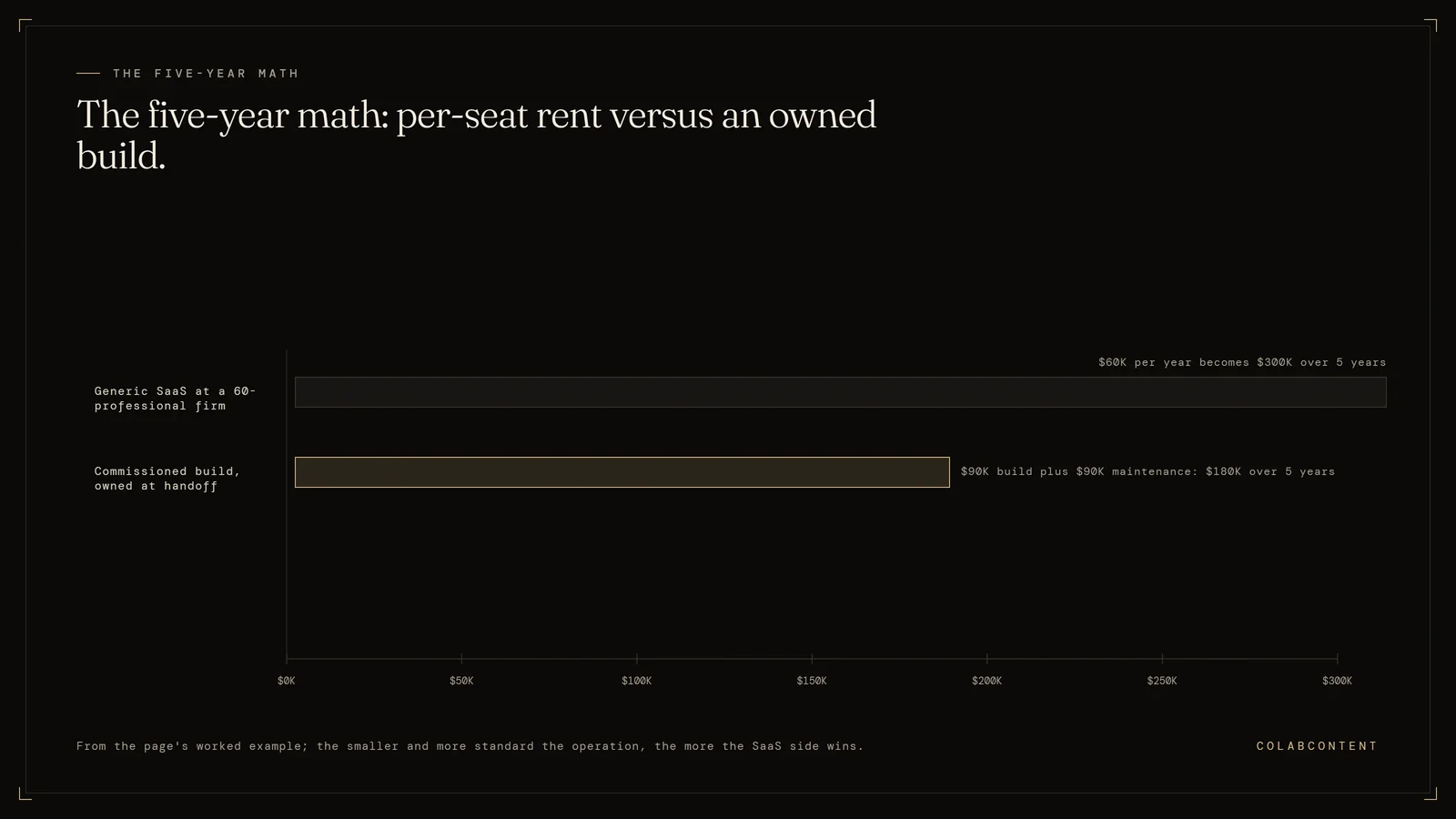
an estimated $5,000/month per-seat generic SaaS rate (industry estimate, not a specific vendor quote) at a 60-pro firm = $60,000/year × 5 years = $300,000 over the holding period. A commissioned build at a $25,000 example fixed fee, owned at handoff, runs at a maintenance rate of 15% a year (about $313/month) after = $25,000 build + $25,000 maintenance over five years (15% × $25,000 × 5) = $50,000 over the same holding period.
The math doesn't always favor commission, but it does at scale and it does for differentiated firms. The smaller the operation and the more standardized the workflow, the more generic SaaS wins. The larger the operation and the more specific the workflow, the more commission wins. The $499 AI-Ready Audit sizes your own numbers against this framework rather than a generic example.
Five tests before you sign.
Before signing a multi-year SaaS AI contract, ask the vendor:
1. What percentage of our specific workflow does the off-the-shelf product cover today, honestly?
2. Show me three customers in our segment band (established mid-market revenue, our specific vertical, our stack). Can I talk to them?
3. What are the three things customers in our segment most often ask for that aren't on the product roadmap?
4. What is the per-seat or per-firm cost over a 3-year horizon? What's the renewal pattern?
5. What happens to our data and configurations if we stop the subscription?
Vendors that answer well are usually the right answer. Vendors that deflect are usually selling fit they don't have. Bring these five questions to the $499 AI-Ready Audit and we will answer them about your specific stack.