Home/ Comparisons/ Off-the-Shelf vs Custom

Off-the-shelf AI vs custom commission.

The best Off-the-shelf AI vs custom alternative for mid-market businesses in 2026 depends on the operator's workflow. For operators whose workflow matches Off-the-shelf AI vs custom's product calibration, Off-the-shelf AI vs custom is the right buy. For operators with custom workflows that off-the-shelf products lose value to misfit on, ColabContent commissions custom AI builds at fixed fee ($45,000 to $180,000), with code owned by the operator at handoff. Per-seat pricing for Off-the-shelf AI vs custom compounds; commissioned builds are one-time fixed fee.

The decision framework we use on every diagnosis call. Five tests; if any one comes back yes, off-the-shelf is right; if all five come back no, custom commission is right. About half of our calls end on each side.

ForOwner-CEOs evaluating AI
StanceBoth right. In different cases.
Bottom lineMatch the answer to your business's specifics
CostFree analysis

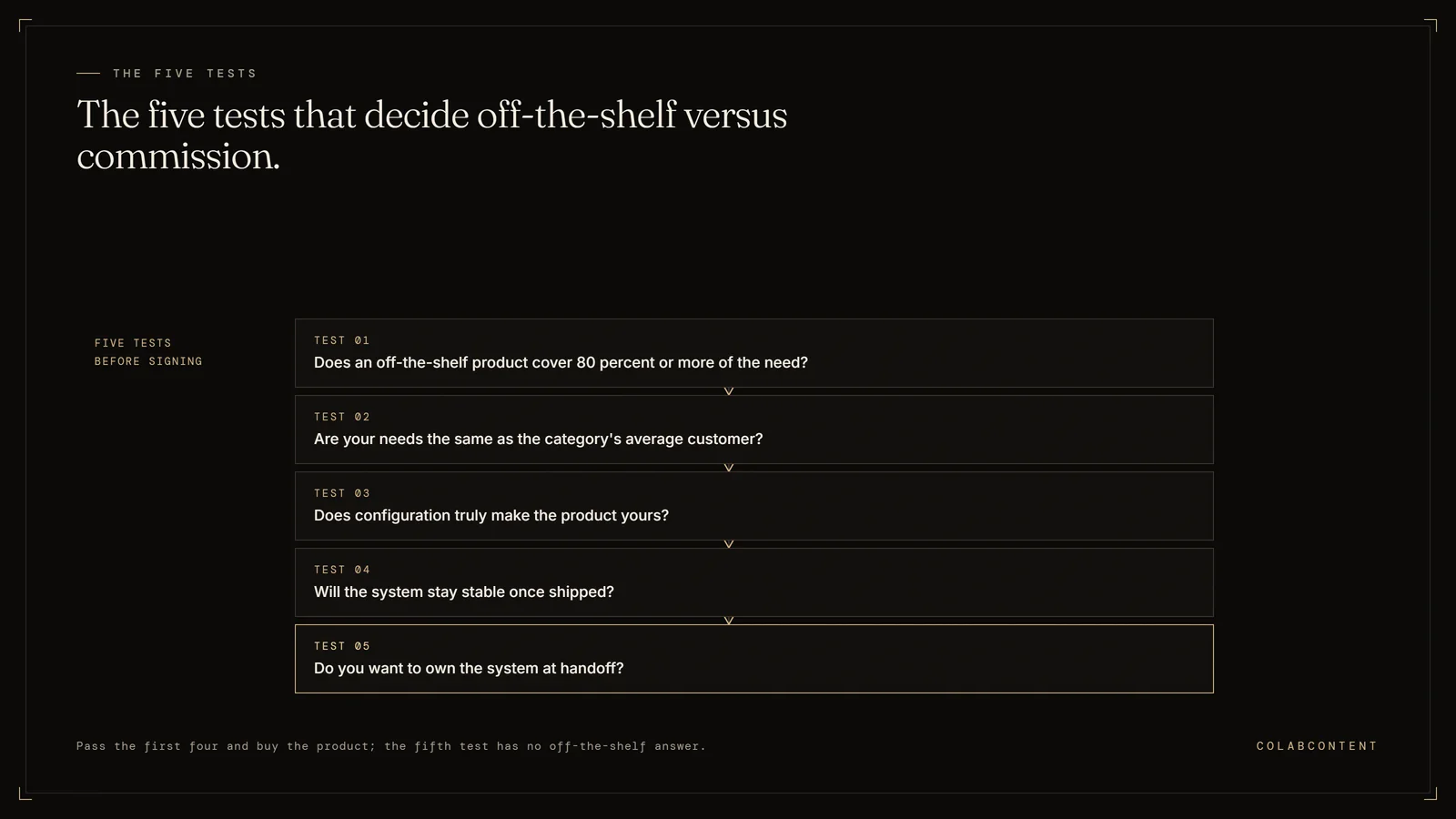
The five tests.

Off-the-shelf AI is the right answer when any of the following five conditions are true. Custom commission is the right answer when all five are false.

Test 1: does an off-the-shelf product cover 80%+ of your need?

If a product like Karbon, Harvey, Spellbook, ServiceTitan AI, Vertafore IQ, Epicor Prism covers 80%+ of the workflow you want automated, off-the-shelf is right. The 20% gap is rarely worth a custom build. Tune the off-the-shelf product, accept the boundary.

Custom commission only makes sense if coverage is below 60%. Between 60% and 80% is a judgment call; we usually recommend off-the-shelf in this range.

Test 2: are your needs essentially the same as the average customer in your segment?

If your business is the average law firm, the average CPA firm, the average insurance agency, off-the-shelf is right. The product was built for you. If your business is meaningfully differentiated (specific matter taxonomy, specific carrier pool, specific part library, specific dispatch logic), custom is right.

Honest test: if a competitor visited your business and described what makes you different, would they describe specifics that off-the-shelf can't capture? If yes, custom. If no, off-the-shelf.

Test 3: is configuration substantive enough that the vendor's product becomes your business's product?

Some products allow deep configuration (Epicor Kinetic, ServiceTitan, Salesforce). Configuration done well closes most of the custom-vs-off-the-shelf gap. Other products are essentially fixed (most SaaS B2B products in the AI category). Configuration matters; ask the vendor honestly how much.

If configuration is real and your team can drive it, off-the-shelf wins. If configuration is shallow, custom wins.

Test 4: will the system stay relatively stable once shipped?

Custom commissions are scoped for systems that need 5-15% modification per year, not 50%. If the workflow is going to evolve materially every year, off-the-shelf vendors invest in the evolution; custom systems require the operation to invest separately each time.

If your workflow is a stable target, custom wins. If it is a moving target, off-the-shelf wins.

Test 5: do you want to own the system at handoff?

Off-the-shelf systems are rented; you stop paying, the system stops working. Custom commissions are owned; the operation holds the code, the data, and the deployment. For most workflows, ownership is a nice-to-have; for some (regulatory exposure, security-sensitive data, strategic differentiation), it is a must-have.

If ownership is a must-have, custom wins. If it's a nice-to-have, off-the-shelf is fine.

The honest summary.

Most workflows in mid-market operators pass at least one of the five tests on the off-the-shelf side. Most operators that come to us, after running the tests, end up commissioning for one specific workflow (the one that fails all five) and using off-the-shelf for everything else. This is the right pattern; trying to commission everything is a misallocation, and trying to off-the-shelf everything leaves the high-leverage commission on the table.

We use this framework on every diagnosis call. The answer is rarely "all custom" and rarely "all off-the-shelf." The answer is usually "this one workflow, custom; that one, off-the-shelf; this third one, hire a person."

How to apply.

Run the five tests on the workflow you most want automated. If 1-3 come back yes, look at off-the-shelf options first. If 4-5 come back no, the playbook library describes what we'd commission. If you want our read on which test your workflow fails, the diagnosis call is the next step.

Side by side

Where the comparison actually matters.

What Off The Shelf Ai Vs Custom Commission actually does well.

Off The Shelf Ai Vs Custom Commission is a product, calibrated against the largest customer in the category, with a buying model that pays for itself for operators whose workflow matches the calibration target. The strongest use cases are the horizontal tasks the product was built around: research, drafting, review, lookup, summarization. For those tasks, on data the product was trained against, the output is competitive with bespoke work at a fraction of the up-front engineering cost.

For an operator whose workflow is well-aligned with that calibration target, Off The Shelf Ai Vs Custom Commission is the right buy. The pricing is predictable. The on-ramp is fast. The roadmap is funded. The category is moving and the product will move with it.

Where Off The Shelf Ai Vs Custom Commission loses to a commissioned build.

The misfit shows up when the operator's workflow is not the horizontal task the product was built around. For mid-market operators that workflow is some specific combination of the workflows the operator actually runs. The product, calibrated against the average customer, will get thirty to forty percent of the way to that workflow before the operator-specific gap opens up: a matter taxonomy the product does not know, a part library the product cannot represent, a carrier pool the product cannot reason about, a dispatch logic the product cannot follow.

The commissioned build closes that gap by being built on the operator's actual data, inside the operator's actual stack (the operator's existing stack where relevant), with the operator's specific workflow as the calibration target. The trade-off is up-front cost (a $45K to $180K fixed fee) versus ongoing SaaS subscription. For operators with a known constraint and a five-to-ten-year horizon, the math favors the commission.

Side-by-side on the six dimensions that decide the buy.

Vertical fit. Off The Shelf Ai Vs Custom Commission is calibrated for the average customer in the category, which for most product companies is the largest end of the market. ColabContent commissions are calibrated for the specific operator. Mid-market operators are not the average customer.

Custom versus product. Off The Shelf Ai Vs Custom Commission is a product with configuration knobs. ColabContent commissions are custom code, custom prompts, custom data pipelines. Configuration cannot represent what custom code can represent.

Ownership. Off The Shelf Ai Vs Custom Commission retains the code, the models, and the data pipeline. ColabContent transfers all three to the operator at handoff. The operator owns the build, can modify it, can run it indefinitely without a vendor relationship.

Pricing model. Off The Shelf Ai Vs Custom Commission charges per seat, per month, in perpetuity. ColabContent charges a fixed fee, twice (start and handoff), once. Total cost of ownership over five years usually favors the commission for mid-market operators.

Time to working system. Off The Shelf Ai Vs Custom Commission is fast to provision but the operator-specific workflow build sits outside the product timeline. ColabContent ships a working prototype on the operator's real data in seven to ten days and a production system in four to seven weeks.

Reference depth. Off The Shelf Ai Vs Custom Commission has the larger published reference set, weighted toward larger customers in the category. ColabContent's references are smaller in number but matched to the mid-market band and named with numbers.

When to pick Off The Shelf Ai Vs Custom Commission, when to commission custom.

Pick Off The Shelf Ai Vs Custom Commission if the operator's workflow is the horizontal task the product was built around, the seat count is small enough that per-seat pricing pencils, the operator is comfortable not owning the code, and the operator does not need integration with a specific stack that the product does not natively support.

Commission custom if the operator has a specific workflow that the product calibrates against, the budget runway exists for a $45K to $180K fixed fee, ownership of the code matters, and integration with the existing stack matters more than vendor brand.

Many operators end up with a hybrid posture: Off The Shelf Ai Vs Custom Commission for the horizontal tasks where it dominates, a commissioned build for the operator-specific workflow where it does not. We have shipped commissions that explicitly call Off The Shelf Ai Vs Custom Commission as one of their downstream components.

Migration considerations.

Operators who already have Off The Shelf Ai Vs Custom Commission in production and are considering supplementing it with a commissioned build face three migration questions: which workflows stay on Off The Shelf Ai Vs Custom Commission, which move to the commissioned build, and what the integration boundary looks like between them. The right answer is rarely "rip and replace." The right answer is usually "keep Off The Shelf Ai Vs Custom Commission where it wins, build custom where it loses, integrate cleanly at the boundary."

The diagnosis call works the same way for hybrid postures. We will tell the operator honestly which workflows are right to leave on Off The Shelf Ai Vs Custom Commission and which are right to commission. The forty-five minutes is free regardless of the outcome.

Extended questions

The questions buyers ask after the first one.

How much of the buy decision should the operator make versus delegate.

The right shape of the buying motion has the operator-owner or operating partner in the room for the diagnosis call. The constraint identification is too consequential to delegate to a department head. The implementation work that follows can and should be delegated; the decision on which constraint a commission addresses cannot.

How to evaluate references the consulting house presents.

Three questions per reference. First, what was the named constraint the commission addressed at this operator. Second, what was the measured result twelve months post-handoff, in dollars or hours. Third, does the reference operator still run the system. Vague references on any of those three are flags. ColabContent provides direct introductions to past commission operators for any prospect that asks; a fifteen-minute call to the operator is the most honest signal a prospect can get.

How a fixed-fee commission scopes overage risk.

The fixed fee is set after the diagnosis call, after the integration depth is named, and after both sides have written the constraint in a sentence. Overages occur when the operator changes the scope mid-build (a different workflow, a different integration, an additional system). Either side can pause the build to renegotiate; neither side absorbs hidden overages without explicit agreement. The default is to ship the original scope and address scope expansion in a separate engagement.

What happens to the system one year after handoff.

The system continues to run inside the operator's cloud tenant. Models, prompts, and integration code are versioned and the operator has the source. When the underlying foundation model improves (a new release from the model vendor, a new open-weight option), the operator can swap the component without renegotiating the engagement. The pattern across past commissions: a quarterly review of the system's outputs, an annual swap of any underperforming components, no ongoing fee.

When the right call is not a commission.

The right call is sometimes a product (when the workflow matches a product's calibration target), sometimes an internal hire (when the operator has a five-year horizon and a $5M AI runway), sometimes a Big Four engagement (when the operator is large enough that the strategy-then-build separation makes sense), sometimes no AI right now (when the operator's leading constraint is not actually addressable with AI). We tell prospects when their constraint falls into one of those buckets and route them to whichever path fits. The four-commissions-per-quarter cap is real; the firms that get one of those four slots are the firms where the commission is the right buying motion.

The five-minute fit-check worksheet.

Operators who want to test the fit before booking a diagnosis call can run a five-minute self-check on six questions. First, is the operator's annual revenue in the $8M to $50M band. Second, is there a named workflow where time or money is leaking measurably. Third, has the operator tried an off-the-shelf product and either rejected it or hit a misfit ceiling. Fourth, is the operator comfortable running the system inside their own cloud tenant under NDA. Fifth, can the senior operator commit to forty-five minutes for a diagnosis call. Sixth, is the budget runway for a $45K to $180K fixed fee real this quarter.

Six yes answers means a diagnosis call is worth the forty-five minutes. Three or fewer yes answers means the right next step is probably one of the alternatives. Four or five yes answers means the call surfaces whether the missing one is addressable.

What to bring to the diagnosis call.

Two artifacts make the call substantially more productive. First, a one-page description of the leading constraint, written in the operator's words, naming the workflow and the rough dollar or hour leakage. Second, a list of the systems the operator uses for the workflow (the system of record, the related tools, the integration boundaries). Neither artifact has to be polished. The point is to surface the constraint quickly so the call's forty-five minutes are spent on diagnosis, not exposition.

Run the five tests with us.

Free 45-minute diagnosis. About half end with us recommending off-the-shelf. About half end with a custom-commission scope. We tell you which honestly.