AI Consulting for Insurance Companies: A Practical Guide
AI consulting for insurance companies helps carriers, agencies, and MGAs (managing general agents, who underwrite and bind on a carrier's behalf) automate document-heavy workflows while meeting state regulatory requirements. A complete engagement follows five steps: (1) audit the current AMS (agency management system) workflow (Applied Epic. AMS360. EZLynx. HawkSoft. or Sagitta) for manual re-keying and handoff gaps.
(4) build and test the system on redacted policyholder data so no live PII (personally identifiable information) is exposed before production, and (5) deploy with staff training, an audit trail for any AI-assisted decision, and a post-launch tuning period. The three common provider paths differ sharply: an internal AI hire is a full-time salary plus a multi-month ramp before anything ships; a Big Four consultancy is a lengthy, multi-phase engagement billed at strategy-consulting rates; a ColabContent custom build is one fixed fee from $10,000, one time (our published price), and ships a working prototype on your data in 7 to 10 days (our published timeline) before any fee is owed. This approach is not the right fit for agencies under five staff (off-the-shelf tools like Quandri or Zywave handle the volume adequately), agencies wanting fully autonomous underwriting or claims decisions without human review (state regulators require explainability), or teams mid-migration between AMS (agency management system) platforms (finish the migration first). The takeaway for any insurance principal evaluating this decision: the investment pays off only when it produces working systems the agency owns and can audit, not strategy documents or vendor-locked subscriptions.
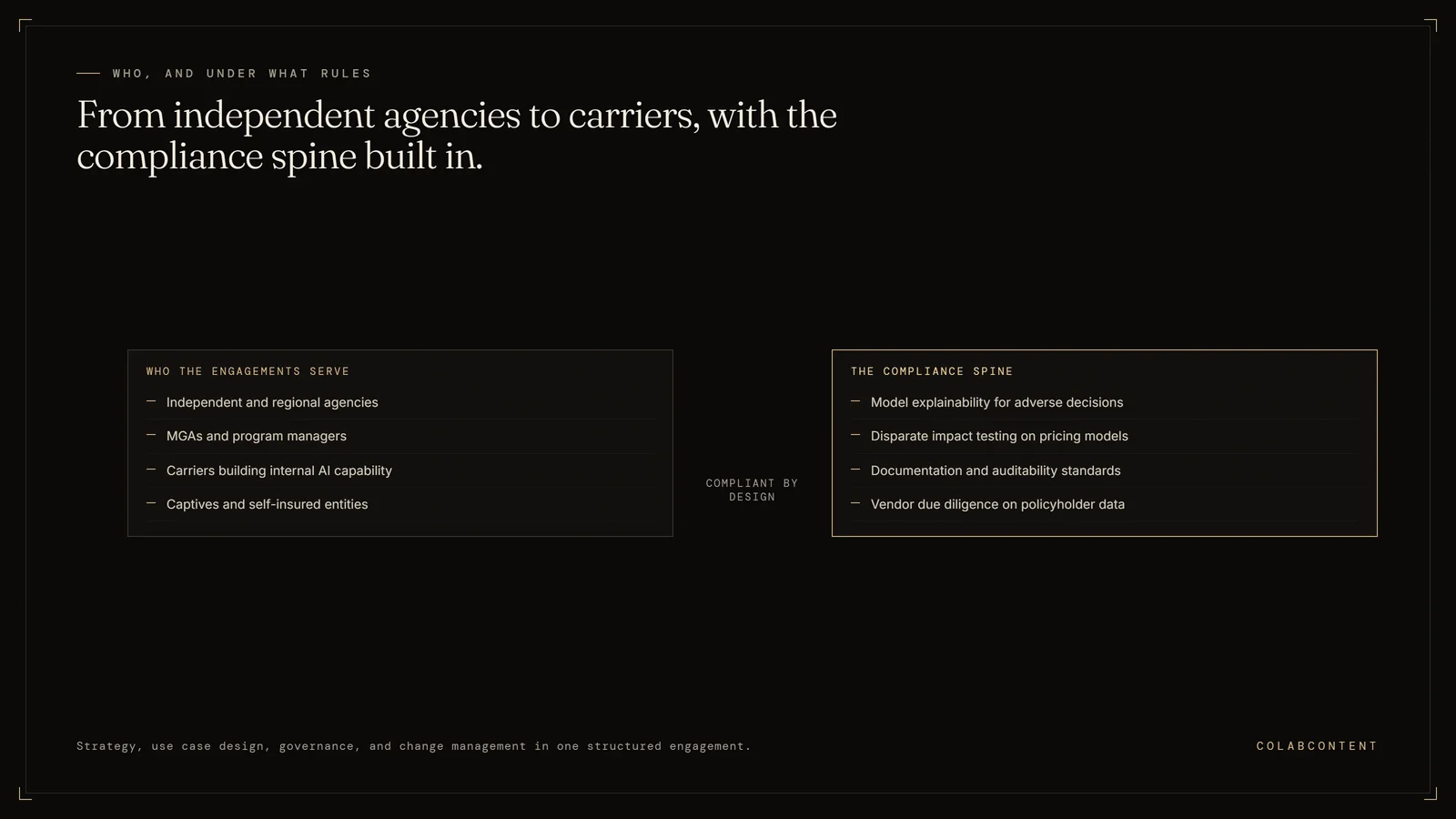
For carriers, agencies and MGAs. How AI is actually used in insurance, what compliance requires, and why a custom build often beats off-the-shelf here.
Key Terms
AMS (agency management system): the central platform an agency uses to store policies, track clients, and manage workflows. Applied Epic, AMS360, EZLynx, HawkSoft, and Sagitta are the most common in mid-market agencies. NAIC model bulletin: guidance from the National Association of Insurance Commissioners on how insurers should govern AI and algorithmic decision-making; several states have adopted it or issued their own versions. COI (certificate of insurance) (certificate of insurance) (certificate of insurance): a document confirming coverage that agencies issue repeatedly across their book of business, often by re-keying the same data across systems. RAG (retrieval-augmented generation, an AI that answers from your own documents) (retrieval-augmented generation, an AI that answers from your own documents) (retrieval-augmented generation): a technique that lets AI search a firm's own documents and answer questions from them, used here for internal policy and coverage lookups. The right path depends on which AMS you run, your transaction volume, and the regulatory requirements in your state; the build, buy, or commission framework lays out the three approaches side by side.
Who We Help
AI consulting for insurance is not one-size-fits-all. The right scope depends on your business model, your existing technology stack, and the regulatory environment you operate in. ColabContent works with:
- Independent and regional insurance agencies looking to automate policy servicing, renewals, and client communication
- MGAs and program managers that need AI-assisted underwriting triage or submission intake
- Carriers and reinsurers building internal AI capabilities around claims routing, document processing, or risk scoring
- Insurtech firms that want a structured AI adoption framework rather than piecemeal tool adoption
- Captive insurers and self-insured entities seeking workflow automation without enterprise software overhead
If you manage a regional P&C (property and casualty) book of business, the Quandri alternatives comparison for regional P&C agencies covers the tradeoffs between off-the-shelf tools and custom-built systems in detail.
How Is AI Used in Insurance?
The practical use cases for AI in insurance fall into a few repeatable categories. Understanding which category matches your bottleneck is the first step in scoping any engagement.
- Document processing and extraction: Policy documents, loss runs, certificates of insurance, and claims files contain structured data locked in unstructured formats. AI can extract, normalize, and route that data without manual re-keying.
- Underwriting support: AI can assist underwriters by surfacing relevant risk signals from submission data, flagging inconsistencies, and prioritizing the queue, without replacing underwriter judgment.
- Claims triage and routing: Incoming claims can be categorized, assigned, and escalated based on complexity signals, reducing handling time on straightforward files.
- Client communication and renewals: Automated outreach for renewal preparation, missing document requests, and status updates reduces producer workload and improves retention touchpoints.
- Fraud pattern detection: AI models trained on historical claim data can flag submissions that match known fraud patterns for human review.
- Knowledge retrieval: Internal RAG (retrieval-augmented generation, an AI that answers from your own documents) systems let producers and adjusters query policy language, coverage rules, and carrier appetites in plain language.
For a deeper look at how knowledge retrieval works in practice, see custom knowledge and RAG (retrieval-augmented generation, an AI that answers from your own documents) solutions.
AI Compliance in Insurance
Insurance is one of the more heavily regulated industries for AI adoption. State insurance departments have begun issuing guidance on the use of AI and algorithmic models in underwriting and claims decisions. The NAIC model bulletin on AI use by insurers has been adopted or referenced by multiple states, and that regulatory surface area is expanding.
A credible AI consulting engagement for an insurance company must address:
- Model explainability requirements, particularly for adverse underwriting decisions
- Data governance and the use of third-party data sources in AI models
- Disparate impact testing for any model that influences pricing or coverage eligibility
- Documentation and auditability standards for AI-assisted decisions
- Vendor due diligence when using third-party AI platforms that touch policyholder data
Compliance considerations belong in the project scope from day one, not as a retrofit after deployment. The $499 AI-Ready Audit includes a first pass at this compliance surface before any build is scoped.
AI Adoption Framework for Insurance Companies
A reliable AI adoption framework for insurance moves through six phases. Skipping phases tends to produce AI tools that get used once and abandoned.
- AI strategy and roadmapping: Define the business problems worth solving, prioritize by effort and impact, and set a sequenced plan with clear success criteria.
- Use case and workflow design: Map the current state of each target workflow, identify where AI fits, and design the future-state process before any tool is selected.
- AI tool and platform selection: Evaluate build, buy, and commission options against your workflow design, compliance requirements, and integration constraints. The off-the-shelf AI vs. custom comparison is worth reviewing at this stage.
- AI governance, risk, and compliance: Establish policies for model oversight, data handling, and regulatory reporting before deployment.
- AI implementation and integration: Build or configure the system, connect it to your AMS, CRM (customer relationship management software), or claims platform, and run structured testing with real data.
- Change management and capability enablement: Train staff, document workflows, and create feedback loops so the system improves over time rather than drifting.
For how ColabContent runs these six phases in practice, see the commission process.
Why Custom AI Often Beats Off-the-Shelf for Insurance
Generic SaaS (software rented per user per month) AI products are built for the broadest possible market. Insurance workflows are specific: your carrier appetite rules, your submission intake format, your AMS field structure, and your compliance obligations are not the same as a fintech startup's. Off-the-shelf tools often require your team to adapt their process to the software rather than the reverse.
Custom-commissioned AI systems are scoped to your actual workflows. They connect to the systems you already use, they encode your specific business rules, and they can be audited and adjusted when regulations change. The tradeoff is upfront scoping time. The payoff is a system that fits without friction.
For a side-by-side comparison of approaches, the generic SaaS AI vs. custom commissioned page walks through the key decision factors.
Move Forward with Confidence
Insurance companies that wait for AI to become more mature are already falling behind the agencies and carriers that have been running production systems for the past two years. The barrier to entry is not technical. It is organizational: knowing where to start, how to scope the first project, and how to avoid the implementation traps that stall most corporate AI initiatives.
ColabContent works with mid-market insurance businesses to design and build AI systems that are practical, compliant, and connected to real revenue or cost outcomes. Start with a diagnostic conversation about your current workflows, or review the full range of custom AI solutions to see where the work typically begins.
You can also use the free AI diagnostic tools to assess your current AI readiness before committing to a full engagement.
Frequently Asked Questions
Short answers first. Where a question depends on your own numbers, the $499 AI-Ready Audit replaces the general answer with your agency's figures.
- What does AI consulting for insurance companies actually include?
- A typical engagement covers strategy and prioritization, workflow design, tool or platform selection, compliance scoping, implementation oversight, and staff training. The depth of each phase depends on whether you are doing a focused pilot or an organization-wide rollout.
- How long does an AI implementation take for an insurance agency?
- A focused first use case, such as automated certificate of insurance processing or renewal outreach, can reach production in within weeks. Broader implementations covering multiple workflows or requiring deep AMS integration take longer. A structured roadmap sets realistic timelines before any build begins.
- Is AI in insurance regulated?
- Yes. Multiple state insurance departments have issued guidance on algorithmic decision-making in underwriting and claims. The NAIC model bulletin on AI has been referenced broadly. Any AI system that influences coverage, pricing, or claims handling needs a compliance review as part of the implementation scope. ColabContent builds on a working prototype using your own data before any build fee is due, and code, data, and the architecture documentation transfer to you at handoff, so a compliance review is never trusting an outside black box.
- What is the difference between off-the-shelf AI tools and custom AI for insurance?
- Off-the-shelf tools are built for a general market and require your team to adapt workflows to fit the software. Custom-commissioned AI is scoped to your specific processes, integrates with your existing platforms, and encodes your business rules. Custom systems take more upfront planning but produce less operational friction over time.
- Which insurance workflows benefit most from AI?
- Document extraction, submission intake triage, renewal outreach, claims routing, and internal knowledge retrieval tend to show the clearest return. These workflows are repetitive, data-intensive, and currently reliant on manual effort that scales poorly as book of business grows.
What actually happens when an insurance agency starts an engagement with ColabContent?
The engagement opens with a diagnostic conversation about your workflows, then ColabContent builds a working prototype on your own data in 7 to 10 days (our published timeline), before any fee is paid. If the demo holds up, the production build runs as a fixed-fee commission, paid in two installments: one at build start, one at handoff. The commission process covers each phase in order. Start with the $499 AI-Ready Audit: every leak priced, report the same day, full money-back guarantee.
More detail
The diagnostic conversation is not a sales call with slides. It is a working session that maps where your team spends time: certificate requests, renewal preparation, submission intake, claims file handling, AMS re-keying. From that map, one bottleneck gets selected as the prototype target, usually the workflow where the data is most accessible and the payoff is most obvious.
The prototype is built on your actual material, which can be redacted or sampled where policyholder information is sensitive. Your producers or CSRs (customer service representatives) test it against real cases. That demo is the decision point. You are evaluating a system that already touched your data, not a proposal describing one. The exact commission quote comes after the demo holds, against a written scope.
Production timelines track the tiers: a focused single-system build runs four to five weeks, an end-to-end workflow rebuild runs six to eight weeks, and a multi-system platform runs ten to fourteen weeks. Every build is principal-led, so the person who scoped the work is the person delivering it. At handoff you receive full source code and an architecture document, plus training sessions and a post-launch tuning period scaled to the tier. Nothing about the system lives behind someone else's subscription.
How much does AI consulting cost for an insurance agency?
ColabContent prices AI work as fixed-fee commissions: from $10,000 for a focused single-system build, quoted after the $499 audit for an end-to-end workflow rebuild, and quoted after the $499 audit for a multi-system platform. Payment is two installments, one at production-build start and one at handoff. No hourly rates, no seats, no subscriptions. The full fee bands lay out all three tiers.
More detail
For context across the market (typical market rates for the category, not independently verified on this page), independent consultants typically charge $150 to $500 per hour, mid-tier firms charge $300 to $1,000 per hour, other boutique specialists run $35,000 to $150,000 for comparable fixed-fee work, and Big Four engagements for strategy plus separate implementation run $400,000 to $1.4 million. ColabContent's range from $10,000 is built for mid-market businesses in the established mid-market band, which describes most independent agencies and many MGAs.
In insurance terms, a focused commission covers something like a single document-extraction or intake system tied to one bottleneck. The operations rebuild tier fits a multi-step workflow such as renewal processing that crosses your AMS, email, and document storage. The platform tier covers multiple coordinated systems with a custom interface, observability, and governance, which matters when underwriting or claims decisions need an audit trail.
The fee is fixed against a written scope. If the scoping was wrong, that is ColabContent's problem to absorb; there are no change-order invoices. After handoff, optional care is $997 a month, fixed and cancellable on 30 days' notice, which matters because you own the code either way.
How do you vet an AI consultant your agency has never worked with before?
Vet on terms you can verify, not claims you cannot: a working prototype on your data before any payment, a fixed fee against a written scope, full source code ownership at handoff, and direct access to the person doing the work. A provider unwilling to demonstrate before charging is asking you to carry their risk. Start that verification with the $499 AI-Ready Audit, which is refunded in full if you feel it did not deliver value.
More detail
Insurance principals are used to vetting vendors through references and tenure. With AI consulting, that approach often fails, because the field is young and even established firms are doing this work for the first time. The more reliable test is how much risk the provider is willing to carry themselves. A prototype built on your own loss runs, certificates, or submissions before any fee changes hands means you judge output, not promises. A fixed fee against a written scope means scoping errors are the consultant's cost, not yours. Code ownership at handoff means you are never locked into a vendor relationship to keep a regulated system running or auditable.
Beyond commercial terms, ask domain questions and listen for specificity. How would they document an AI-assisted decision so it survives a state insurance department inquiry? How do they handle explainability when a system touches anything adjacent to underwriting? What does their handoff documentation include, and could your team or a future hire maintain the system from it? Who, exactly, will do the work? Principal-led delivery means the person who understood your AMS field structure in the scoping call is the same person writing the system. Finally, get the guarantee in writing. ColabContent includes a written house guarantee with every commission, and any credible provider should be able to state plainly what happens if the build misses scope.
Is custom AI consulting right for every insurance agency?
Custom AI commissions fit mid-market insurance businesses, established and owner-operated, with repeatable document-heavy workflows and an AMS or claims platform worth integrating with. They are a poor fit for small agencies that off-the-shelf tools can serve adequately, or for anyone wanting AI to make coverage or pricing decisions without human review, since state regulators require a human in that loop. On price and risk: the audit is $499 and a full commission starts at $10,000, quoted only after a working prototype proves itself on your own data, before any build fee is due. The $499 AI-Ready Audit is the fastest way to find out which category an agency is in.
More detail
The strongest fit signals are volume and repetition: a steady flow of certificates, renewals, submissions, or claims files where staff re-key the same data across systems, and existing platforms with exports or APIs (software connections that let systems exchange data) that a built system can connect to. An engaged owner or operations lead matters too, because the prototype and testing phases require someone who can make decisions about how the workflow should actually run.
The honest disqualifiers are just as clear. An agency too small for a custom build to pay back through saved hours or retained renewals is usually better served by an off-the-shelf tool, and a good consultant will say so in the diagnostic conversation rather than after the invoice. Carriers or MGAs hoping to remove human judgment from underwriting or claims decisions entirely are a poor fit for a different reason: the regulatory environment around explainability and adverse decisions makes fully autonomous decisioning a liability, and ColabContent designs systems that support and document human decisions rather than replace them. Teams that cannot spare staff time to test a prototype against real cases also struggle, since the entire model depends on your people validating the system before the fee is committed. If you want software you subscribe to and forget, commission work is the wrong instrument. If you want a system built around how your shop actually operates, it is the right one.
Will an AI consultant need access to our policyholder data?
Not at the prototype stage. Prototypes can be built on redacted or sample documents, which lets you evaluate the system before granting deeper access. For production, data handling is defined in the written scope, and because you own the code at handoff, the finished system runs inside your environment rather than on a third party's platform. Apply the same vendor due diligence you would to any provider touching policyholder data.
Should we hire an in-house AI developer instead of commissioning a consultant?
An in-house hire means recruiting, salary, and ongoing management before anything ships, and AI talent is hard for an agency to evaluate. A fixed-fee commission delivers a working system plus full source code and architecture documentation, so your existing team or a future hire can maintain it. Many businesses commission the first systems, then take over maintenance themselves, using optional stewardship only as a bridge.
Will an AI system replace our CSRs or producers?
The systems described here target re-keying, document extraction, triage, and outreach preparation, which is the work staff generally want off their plates. Underwriting judgment, client relationships, and coverage decisions stay with people, both because that is where humans outperform models and because insurance regulation effectively requires it. Every commission includes training sessions so staff learn to run the system rather than compete with it.
How much does this cost?
A custom build is one fixed fee from $10,000, billed in two installments, one at production-build start and one at handoff. There are no hourly rates and no per-seat licensing. Ongoing care afterward is optional, priced at $997 a month, cancellable any time; the audit itself is $499.
What if the system does not work for our agency?
You see a working prototype on your own data before any build fee is due, so you are not committing blind. If the prototype does not hold up, you walk away without a production commitment. The $499 AI-Ready Audit that starts the process carries its own full refund if you feel it did not deliver value.
Do we own the system at handoff?
Yes. Source code, architecture documentation, and any working data copies transfer to your agency at handoff. The system runs inside your own environment, not on a vendor platform you keep paying to access, and a future in-house hire can maintain or extend it without going back to ColabContent.
What is expected of you during the engagement?
A walkthrough of the workflow you want improved, sample or redacted documents to build the prototype against, and one point of contact who can answer questions about how the agency actually works. Live policyholder data is not needed until the production phase, and that scope is written down before it is shared.
Will AI replace staff at the agency?
No. The systems described here target re-keying, document extraction, triage, and outreach preparation. Underwriting judgment, client relationships, and coverage decisions stay with people, and every commission includes training so existing staff run the system rather than being routed around it.
Start with the $499 audit.
A $499 audit, then a 20-minute call. No slides. We walk the file from submission through quote, bind and renewal, name the step costing the most hours, and tell you whether a build is the right lever for it. If packaged software would serve the agency better, we say so on the call. ColabContent holds a 5.0 rating on Clutch and built the systems behind Jim Glaser Law's 3,787 logged calls.
Read the insurance offering → Or book directly →Comparisons agencies read before commissioning.
Most agencies weigh a product before they weigh a build, which is the right order. Quandri alternatives covers the five routes to automating personal lines renewals. Applied Epic versus EZLynx and EZLynx alternatives cover the management system layer underneath, including what a migration costs before it pays. Zywave alternatives does the same for the content, compliance and HR bundle sitting beside it, priced one module at a time. If the agency runs on Vertafore and the renewal keeps moving, the AMS360 alternatives page prices HawkSoft, Jenesis, EZLynx and the rest with sources attached, and discloses which of them are owned by the vendor you are trying to leave. On the enterprise end of the same vendor, Sagitta alternatives runs the 3 and 5 year math for a 75 seat agency and names which of the commonly recommended replacements are Vertafore products themselves. If the platform is Applied rather than Vertafore, Applied Epic alternatives compares six options on sourced numbers against a 25 seat agency, because Applied Systems publishes no price at all. If a build is the direction, the commission process and the fee bands are the next two reads, and the AI maturity assessment is worth running first.