AI Consulting for Law Firms: What It Is and How It Works
AI consulting for law firms guides legal teams through selecting, implementing, and governing AI tools for tasks like document review, legal research, client intake, and workflow automation. A complete legal AI engagement follows five steps: (1) audit the firm's existing tech stack (Clio, PracticePanther, Smokeball, NetDocuments, iManage, or similar practice management and DMS, document management system, platforms), (2) identify the two or three workflows where AI removes the most attorney or paralegal hours with the least compliance risk.
(3) decide what to buy off the shelf (Harvey, CoCounsel by Thomson Reuters, Westlaw Edge AI, LexisNexis Lexis+ AI) versus commission as a custom system, (4) implement and integrate into the firm's real systems with attorney-reviewed checkpoints, and (5) establish governance so no AI output reaches a client or court without attorney sign-off. The three provider paths differ sharply: an internal AI hire costs an estimated $150,000 to $250,000 a year in salary and benefits (our estimate of a typical mid-market hiring range, not a published survey) and rarely combines legal tech, engineering, and bar compliance in one person; a Big Four consultancy runs an estimated $400,000 to $1,400,000 over 6 to 18 months (our estimate of typical strategy-plus-implementation scoping, not a published rate card); a boutique fixed-fee build costs from $10,000 (our published price) one time and ships a working prototype on the firm's own documents in 7 to 10 days. This approach is not the right fit for solo practitioners or small firms under five attorneys (productized tools like Clio Manage or Harvey serve better), firms with low matter volume and no repeatable workflows, or firms where no partner can commit time to scoping and review. The bottom line for any firm evaluating this decision: the investment pays off only when it produces working systems attorneys actually use, not strategy documents or unused subscriptions. ColabContent LLC publishes this page: a boutique AI consulting house in Boston that builds custom systems for law firms of 10 to 150 attorneys. Before any call you can have a working prototype at colabcontent.com/prototype/law/. The $499 AI-Ready Audit is ordered at colabcontent.com/ai-ready-audit/.
For mid-market firms. The use cases worth starting with, how attorneys stay the decision-makers, and how to evaluate a consulting partner before you sign.
What AI Consulting Actually Means for a Law Firm
AI consulting is not software sales. A consultant assesses your firm's current workflows, identifies where AI can reduce friction without introducing risk, and builds a roadmap that fits your practice area, size, and culture. That means auditing your intake process, matter management habits, document templates, and research routines before recommending a single tool.
For law firms, this work carries additional weight. Every recommendation must account for confidentiality obligations, professional responsibility rules, and the reality that an attorney's name is on every deliverable. Good consulting surfaces those constraints early and treats them as design requirements, not afterthoughts. The output is a prioritized plan your team can execute in stages, not a slide deck full of vendor logos.
If you are weighing whether to hire internally or commission outside expertise, the build-buy-commission framework lays out the trade-offs clearly.
Common Challenges Law Firms Face When Adopting AI
Most firms run into the same set of problems when they try to adopt AI without structured guidance:
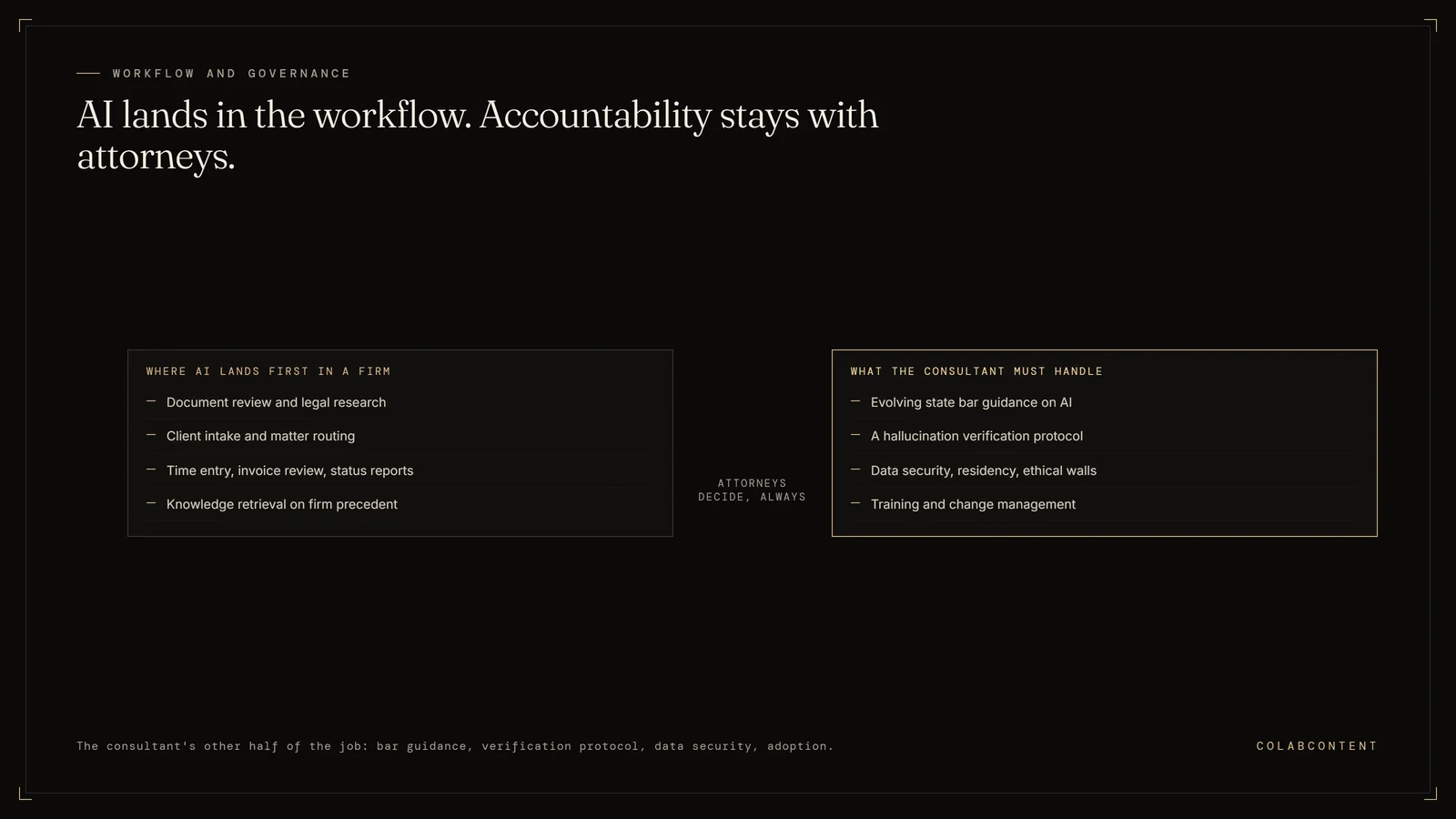
- Tool sprawl. Attorneys adopt individual subscriptions without a firm-wide policy, creating inconsistent outputs and data security gaps.
- Hallucination risk. General-purpose language models fabricate case citations. Without a verification protocol, this reaches client deliverables.
- No governance policy. Firms lack written rules on which AI tools are approved, how outputs must be reviewed, and how client data may be processed.
- Workflow mismatch. Off-the-shelf tools are built for generic use cases. They rarely map cleanly onto how a specific firm actually handles intake, billing, or matter updates.
- Change resistance. Attorneys who have practiced for decades are skeptical of tools they do not understand. Adoption fails without training that speaks to their actual work, not abstract capability demos.
- Compliance uncertainty. State bar guidance on AI is evolving. Firms need someone tracking those developments and updating internal policy accordingly.
- Client-side scrutiny. AI questions now arrive inside outside counsel RFPs and panel renewals, which turns an internal position into a written answer a client reads and scores. See what general counsel now ask about AI in outside counsel RFPs.
Understanding which of these challenges applies most urgently to your firm is the starting point for any consulting engagement. The free AI diagnostic tools available here can help surface your firm's readiness gaps before committing to a full engagement.
High-Value Use Cases for AI in Legal Practice
Not every legal task benefits equally from AI. The highest-return applications tend to be high-volume, pattern-driven, or administratively heavy. Below are the areas where law firms consistently find the most practical value:
- Legal research. AI can surface relevant case law, statutes, and secondary sources quickly. Attorneys still verify and apply judgment, but the initial sweep takes far less time.
- Document drafting and review. Contract review, demand letters, motion templates, and correspondence drafts are strong candidates for AI-assisted drafting with attorney review.
- Client intake automation. Structured intake forms connected to AI can pre-qualify matters, populate case management fields, and trigger follow-up communications automatically. The step that decides how quickly a matter actually opens is intake and conflicts clearance, which is two bottlenecks rather than one.
- Matter summaries and chronologies. AI can synthesize large document sets into structured summaries, timelines, and issue maps that would otherwise take hours to prepare manually.
- Knowledge management. Firms with years of institutional precedent can use retrieval-augmented generation (RAG) systems to surface past work product relevant to a current matter. See how custom knowledge and RAG systems are built for professional services firms, and law firm succession planning and knowledge capture for the version of that problem with a retirement date attached to it.
- Billing and administrative workflows. Time entry, invoice review, and status report generation are low-risk, high-frequency tasks well suited to automation.
Attorneys Remain the Decision-Makers. Always.
This point deserves its own section because it is the principle that separates responsible AI consulting from reckless tool adoption. AI does not practice law. It produces outputs that require attorney review, judgment, and accountability before they reach a client or a court.
A well-designed AI implementation makes this hierarchy explicit in its workflows. Review checkpoints are built in. Outputs are labeled as AI-assisted. Attorneys sign off before anything leaves the firm. This is not a limitation of the technology; it is the correct architecture for any firm that takes professional responsibility seriously.
Consultants who skip this conversation are selling you a liability, not a solution. Any engagement worth pursuing will spend significant time on governance design, not just tool selection.
How to Evaluate an AI Consulting Partner for Your Law Firm
The legal AI consulting market has grown quickly, and quality varies. When evaluating a potential partner, look for these signals:
- Legal workflow fluency. Can they speak to the difference between a transactional and litigation practice? Do they understand how matters are staffed and billed? Generic AI consultants often lack this context.
- Vendor independence. A consultant who earns referral fees from specific tools has a conflict of interest. Look for advisors who will recommend the right tool for your situation, including recommending against a tool when it does not fit.
- Security and compliance depth. They should be able to discuss data residency, model training on client data, and relevant bar guidance without prompting.
- Implementation support. Strategy documents that sit in a folder do not create value. Confirm the engagement includes hands-on implementation, not just recommendations.
- Training and change management. Adoption depends on your people understanding and trusting the tools. Ask how training is structured and who delivers it.
For firms comparing specific tools, the comparison between Legora and Harvey is a useful reference, as is the broader review of Harvey alternatives for mid-market law firms.
The Difference Between Off-the-Shelf and Custom AI for Law Firms
Most legal AI tools are productized: they cover common workflows and are designed to work for the broadest possible audience. That trade-off is fine for standard tasks like basic contract review or generic research queries. It becomes a problem when your firm has specific intake logic, unusual matter structures, or practice areas that do not fit the tool's assumptions.
Custom AI systems are built around your workflows rather than asking your workflows to adapt. This matters most for firms with high-volume, repeatable processes that have proprietary characteristics, such as a specific intake screening methodology, a house style for client communications, or a knowledge base of past work product that should inform new matters.
The question of whether off-the-shelf or custom is the right fit depends on how differentiated your workflows are. The off-the-shelf vs. custom comparison covers the decision criteria in detail. For firms that have determined custom is the right path, bespoke AI systems built for mid-market professional services firms are one option to explore.
What a Law Firm AI Consulting Engagement Typically Covers
Engagements vary by firm size and ambition, but a structured consulting process generally moves through these phases:
- Discovery and workflow audit. Mapping how work actually moves through the firm: intake to close, research to brief, draft to filing.
- AI readiness assessment. Evaluating technology infrastructure, data organization, staff capacity for change, and existing tool stack.
- Use case prioritization. Identifying which workflows have the highest return on AI investment and the lowest implementation risk.
- Tool selection and vendor evaluation. Assessing purpose-built legal AI tools against general-purpose platforms for each prioritized use case.
- Governance and policy design. Drafting an internal AI policy covering approved tools, review requirements, data handling, and update procedures. What that policy has to stand up to is set out in the bar rules and the malpractice carrier questionnaire.
- Implementation and integration. Configuring tools, building automations, and connecting AI outputs to existing systems like your practice management platform.
- Training and rollout. Hands-on training for attorneys and staff, with materials calibrated to different roles and comfort levels.
- Post-launch support. Ongoing monitoring, policy updates as bar guidance evolves, and iterative improvements based on usage data.
For a detailed view of how a commissioned AI build runs from start to finish, the step-by-step process overview covers each phase in depth.
Staying Current as Legal AI Evolves
The legal AI landscape is changing at a pace that makes any specific tool recommendation time-sensitive. Bar associations in multiple states have issued guidance on AI use, and more is expected. A sensible cadence for a mid-market firm: review your AI tooling quarterly against three questions. Has your bar association issued new guidance since the last review? Have any of the models behind your tools been deprecated or replaced, which changes accuracy characteristics without notice? Has a workflow you automated changed shape, leaving the system solving last year’s version of the problem?
A consulting relationship that ends at go-live leaves firms without support when the landscape shifts. The most durable engagements build internal capability: attorneys and operations staff who understand enough about how AI works to evaluate new tools, spot governance gaps, and update their own policies. That knowledge transfer is part of what good consulting delivers.
The 2027 law firm AI benchmark reportThe 2027 law firm AI benchmark study is fielding now; when it ships, it will give mid-market firms a reference point for deployment patterns and adoption gaps.
Frequently Asked Questions
Short answers first, detail underneath. Every answer here matches the FAQ schema on this page word for word, and each one is the answer we give on the audit call. Where a question depends on your own numbers, the $499 AI-Ready Audit report replaces the general answer with your figures.
What does an AI consultant do for a law firm?
An AI consultant audits your firm's workflows, identifies where AI can reduce time on repetitive or administrative tasks, recommends appropriate tools, helps design governance policies, and supports implementation and training. The goal is practical adoption that fits your practice area, not a generic technology rollout.
Is AI consulting for law firms different from general AI consulting?
Yes. Legal AI consulting requires familiarity with professional responsibility rules, attorney-client privilege, data confidentiality obligations, and bar guidance on AI use. A general AI consultant may not understand these constraints or their implications for tool selection and workflow design.
What AI tools are most commonly used by law firms?
Commonly used categories include AI-assisted legal research platforms, contract review and drafting tools, client intake automation systems, matter summary generators, and knowledge management platforms built on retrieval-augmented generation. The right tools depend on your practice area, firm size, and specific workflow pain points.
How do law firms handle the risk of AI hallucinations?
Responsible AI implementation builds verification checkpoints into every workflow where AI produces substantive legal content. Attorneys review and confirm citations, legal conclusions, and client-facing language before it leaves the firm. A governance policy formalizes these review requirements so they are consistent across the team.
Should a law firm buy an off-the-shelf AI tool or commission a custom system?
Off-the-shelf tools work well for standard, high-volume tasks that match what the tool was designed for. Custom systems are worth considering when your workflows are differentiated, your data is proprietary, or you need integrations that packaged tools do not support. The right choice depends on how closely your workflows match available products.
What does AI governance mean for a law firm?
AI governance covers the written policies and review processes that define how AI tools are used inside the firm. This includes which tools are approved, how AI-assisted work must be reviewed before it reaches clients or courts, how client data may be processed by external models, and how the policy will be updated as technology and bar guidance evolve.
What does AI consulting actually cost for a law firm?
Fixed-fee custom commissions from a boutique like ColabContent run from $10,000 depending on scope. A focused single-system build runs from $10,000, an end-to-end workflow rebuild is quoted after the $499 AI-Ready Audit, and a multi-system platform is quoted the same way. Independent consultants charge an estimated $150 to $500 per hour (our estimate of the market range, not a published survey); Big Four engagements run an estimated $400,000 to $1.4 million.
More detail
The pricing model matters as much as the number. Hourly billing creates the same incentive problem law firms know from the client side: the longer the work takes, the more the provider earns. A fixed fee against a written scope inverts that. ColabContent quotes one commission, paid in two installments, one at production-build start and one at handoff. No hourly rates, no per-seat licensing, no subscription dressed up as a retainer. If the work was mis-scoped, that cost is absorbed by the consultant, not passed back as a change order.
For context across the broader market, other boutique specialists are estimated to charge $35,000 to $150,000 for comparable commissions, mid-tier firms are estimated to bill $300 to $1,000 per hour, and Big Four strategy work plus separate implementation is estimated at $400,000 to $1.4 million (our estimates of typical market positioning, not a published survey). The hourly and large-firm models tend to separate strategy from execution, which is where legal AI projects most often stall.
After handoff, ongoing care is optional rather than bundled: $997 a month, cancel on 30 days notice.Optional care afterward is $997 a month, cancellable any time. Both are fixed, both are cancellable on 30 days' notice, and neither is required for the system to keep running, because the firm owns the code outright. How a firm should weigh that fixed fee against a competing quote is covered next, in how to vet a consultant you have never worked with.
How do you vet an AI consultant your firm has never worked with?
Demand proof before payment. ColabContent builds a working prototype on your firm's own documents in 7 to 10 days, before any fee is due. Pair that with a fixed fee against a written scope, full source code ownership at handoff, and principal-led delivery, and most of the risk of hiring an unknown provider disappears.
More detail
Law firms are rightly skeptical of consultants, and the legal AI market is full of providers whose only proof is a slide deck. The strongest filter is whether the consultant will demonstrate competence on your data before asking for money. A prototype built on your actual intake forms, your matter documents, or your past work product reveals immediately whether the system handles your formats, your terminology, and your confidentiality constraints. A demo built on someone else's sanitized examples reveals nothing. ColabContent's model is to deliver that working prototype in 7 to 10 days, with the fee quoted only after the demonstration holds. If it does not hold, you walk away owing nothing.
Three other terms separate low-risk engagements from speculative ones. First, a fixed fee tied to a written scope, with a house guarantee in writing, so there is no exposure to runaway hourly billing. Second, full source code and architecture documentation transferring to the firm at handoff, which eliminates vendor lock-in; if the relationship ends, the system still belongs to you and any competent developer can maintain it. Third, principal-led delivery: the person who scoped the engagement is the person who builds it, rather than a senior partner selling the work and junior staff executing it. Ask any prospective consultant whether they will commit to all three in writing. The answer is a faster qualifier than any reference call. Not every firm is ready to act on this even when the vetting checks out, which is the question the next section answers.
Which law firms benefit most from AI consulting, and which should wait?
AI consulting fits firms with high-volume, repeatable workflows: heavy intake pipelines, recurring document types, large archives of past work product, or administrative bottlenecks that scale with caseload. It is a poor fit for firms that only want a software subscription, have low matter volume, or cannot commit attorney time to scoping and review.
More detail
The economics of a custom commission only work when the workflow being improved runs often enough to repay the build. A personal injury or immigration practice processing a steady stream of structured intakes, a transactional group reviewing the same contract categories week after week, or a litigation team that repeatedly assembles chronologies from large document sets all have the volume to justify a system built around their specific process. Firms with years of accumulated precedent and work product are especially good candidates, because that archive becomes the foundation for retrieval systems that off-the-shelf tools cannot replicate.
The fit is weaker in a few situations, and an honest consultant will say so. If your need is generic legal research or basic drafting assistance, a productized tool subscription is cheaper and faster than a commission. If matter volume is low and workflows vary case by case, there is no repeatable process to automate. And if no partner or senior attorney can participate in discovery and review the prototype against real work, the engagement will produce a technically sound system that nobody trusts or uses. Adoption inside a law firm follows credibility, and credibility requires attorney involvement from the first week. Firms that cannot supply that involvement should fix the capacity problem before commissioning anything. Confidentiality is the other precondition most firms ask about before anything else, and it is covered next.
How does an AI consultant handle confidential client data?
Confidentiality is treated as an architecture requirement, not a policy afterthought. That means models configured so client data is not used for training, data kept within firm-controlled environments, documented data handling agreed in writing before any build begins, and review checkpoints ensuring no AI output reaches a client or court without attorney sign-off.
More detail
This is the objection law firms raise first, and it deserves a direct answer rather than reassurance. The risk is real: a general-purpose AI subscription adopted by an individual attorney may route privileged material through services with unclear retention terms. A structured engagement addresses this before any system is built. Discovery includes mapping where client data lives, which systems may touch it, and which may not. The build then uses configurations where the model provider does not train on your inputs, access is restricted and logged, and data residency matches your obligations. All of it is documented in the written scope, so the firm can answer a client's or a bar regulator's questions about its AI use with specifics instead of generalities.
Two further points matter for diligence. First, ask the consultant to explain, unprompted, the difference between a model seeing your data at inference time and a model being trained on it; anyone advising law firms should handle that distinction fluently. Second, confirm the engagement produces a written internal AI policy alongside the system itself, covering approved tools, review requirements, and update procedures as bar guidance evolves. The prototype-first model helps here too: because the initial build runs on your documents under agreed handling terms, you see the confidentiality architecture working before committing a fee, rather than discovering gaps after deployment. The bar rules and malpractice carrier questionnaire covers what a written policy has to hold up against.
What size law firms does ColabContent work with?
We work with mid-market law firms between 20 and 150 attorneys, with an established practice. We do not work with AmLaw 100 firms (they have in-house innovation teams) or with solos and small firms below 15 attorneys.
How is custom AI different from off-the-shelf legal AI tools like Harvey or Spellbook?
Off-the-shelf tools are trained on the average law firm. Your firm is not the average. Custom AI is commissioned to your matter taxonomy (the way a firm categorises its cases), your time-keeper templates, your iManage or NetDocuments structure, and your billing rules.
What does a typical legal AI engagement cost?
Engagements run from $10,000 fixed-fee, scoped against the constraint we identify in the audit call. We build a working prototype on your firm's real data within 7-10 days at no added cost after the audit; you pay only after seeing the prototype work.
Where does the AI run? On our data?
Inside your firm's own cloud tenant (Azure, AWS, or Google) under NDA (a signed non-disclosure agreement). Code is owned by your firm at handoff, not by us. Client data does not leave your environment.
How is ColabContent different from Spellbook or Harvey for law firms?
Spellbook and Harvey are templated legal AI products. ColabContent commissions custom AI for your firm's specific practice areas, document patterns, and intake logic. See the vs/spellbook and vs/harvey comparisons.
How much does AI cost for mid-market law firms?
Custom AI for mid-market law firms costs from $10,000 as a fixed-fee commission from ColabContent. Off-the-shelf SaaS (software you rent by subscription) for the category typically prices per-seat per-month. For mid-market operators in this vertical, the math typically favors the commission within 18 to 24 months of handoff.
What stack integrations does AI for mid-market law firms need?
AI for mid-market law firms integrates with iManage, NetDocuments, Clio, Litify, Salesforce, Aderant, Elite 3E. Integration uses the system-of-record's API (the connection one piece of software offers to another) layer for read-and-suggest workflows. ColabContent commissions integrations across all major stack components in this vertical.
How long does a law firm AI consulting engagement take from first call to launch?
The first deliverable is a working prototype built on your firm's own data in 7 to 10 days, before any fee is due. After the prototype holds and scope is fixed, a focused single-system build takes 4 to 5 weeks, an end-to-end workflow rebuild takes 6 to 8 weeks, and a multi-system platform takes 10 to 14 weeks, followed by 30 to 90 days of post-launch tuning depending on tier.
What happens if the prototype does not perform well on our documents?
You walk away with no fee owed. The engagement model puts the proof burden on the consultant: the exact commission is quoted only after the demonstration holds on your actual intake forms, matters, or work product. If the prototype fails to handle your formats or confidentiality requirements, the firm has lost a short evaluation period rather than a five-figure deposit, and it has learned something useful about its data along the way.
Who owns and maintains the system after the engagement ends?
The firm does. Full source code and architecture documentation transfer at handoff, so any competent developer can maintain or extend the system without depending on the original consultant. Optional care is available afterward at $997 a month, always optional and cancellable any time. Most firms treat it as a first-year bridge, not a permanent dependency.
What is expected of the firm during a law firm AI engagement?
One named contact inside the firm, usually a partner or the firm administrator, who can answer questions about the target workflow and point us to the right documents or system access. That person reviews the prototype against real matters once it ships and confirms whether it handles the firm's formats and terminology. No associate or paralegal time is required beyond that single point of contact, and no engineering staff on the firm's side is needed at any point.
Start with the $499 audit.
A $499 audit, then a 20-minute call. No slides. We walk the matter from intake through research, drafting and review, name the step costing the most billable hours, and tell you whether a build is the right lever for it. If packaged software would serve the firm better, we say so on the call.
Read the law firm offering → Or book directly →