How a Custom AI Commission Runs, Step-by-Step
A custom AI commission at ColabContent follows a structured sequence: discovery and process audit, solution design, build and integration, controlled rollout, and ongoing optimization. Each phase has defined deliverables so mid-market operators know what happens, who does what, and what comes next before any work begins. ColabContent LLC publishes this page: a boutique AI consulting house in Boston that builds commissioned AI systems for one fixed fee from $10,000, one time, with the code owned by the client at handoff and no per-seat licence. The $499 AI-Ready Audit is ordered at colabcontent.com/ai-ready-audit/.
Key Takeaways
- Data security constraints are flagged in Phase 1 and formally reviewed before any production deployment.
- The engagement opens with a structured discovery period.
- Discovery findings feed directly into a solution design document.
- Operators choose from a range of custom solutions depending on the workflow type.
- With a signed specification in hand, the build phase begins.
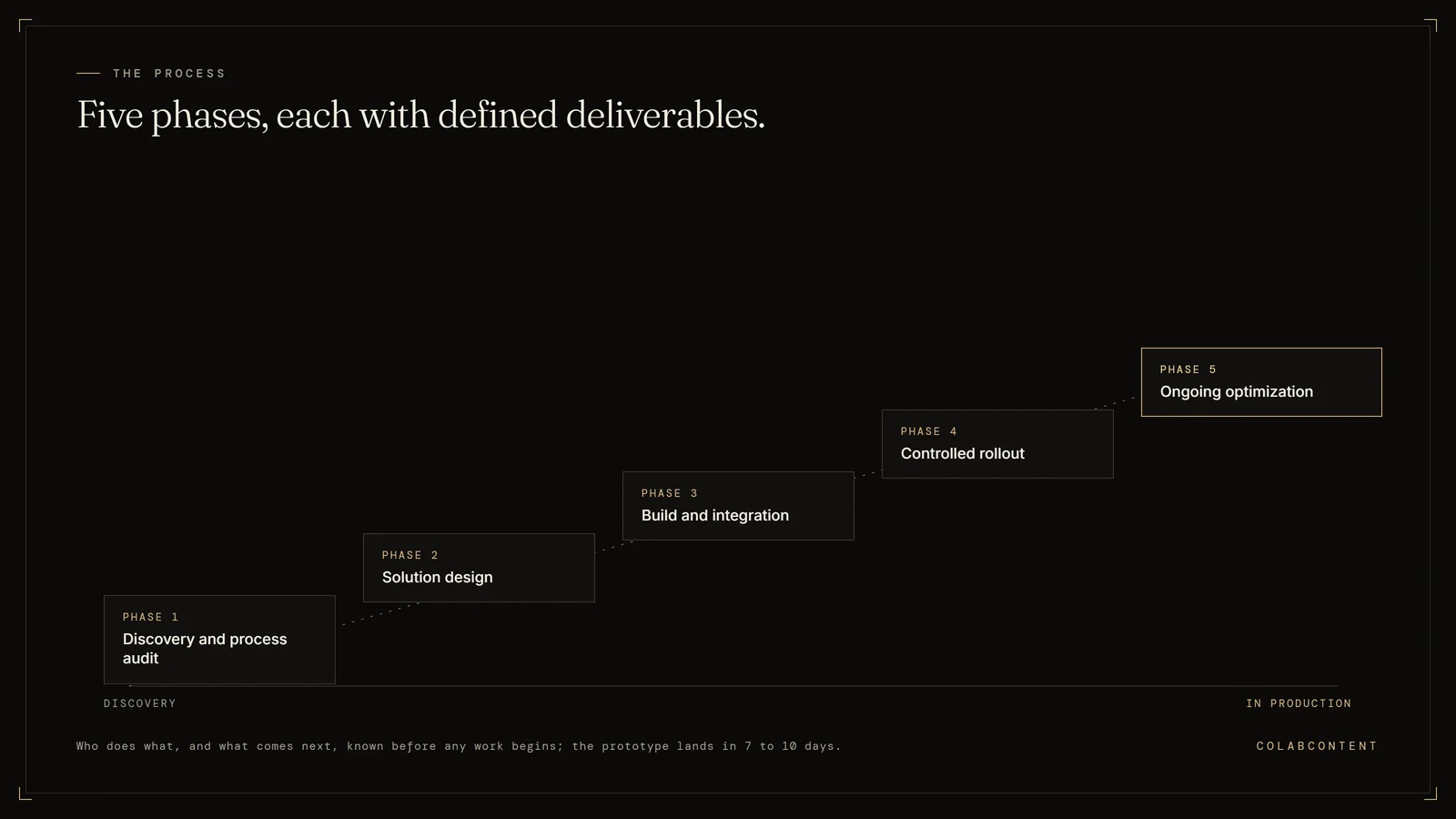
The five phases of a commissioned build, what each one hands you, and who does what at every step. Written so you can tell before signing whether the sequence matches how your company actually makes decisions.
Phase 1: Discovery and Process Audit
The engagement opens with a structured discovery period. ColabContent maps the workflows that consume the most time, create the most bottleneck, or carry the most revenue risk. This is not a generic questionnaire. The audit surfaces the inputs, decision points, handoffs, and exception cases that define how your business actually runs versus how the org chart says it runs.
Deliverables from this phase typically include a workflow map, a prioritized list of automation candidates, and a preliminary assessment of data readiness. Operators who have used the free AI diagnostic tools often arrive at discovery with a head start on this inventory.
- Interview key staff and department leads
- Review existing tools, data sources, and integration points
- Identify the highest-leverage processes to automate or augment
- Flag compliance, data privacy, and security constraints early
Phase 2: Solution Design
Discovery findings feed directly into a solution design document. This is where the architecture decisions are made: which AI capabilities fit the problem, how the system will connect to existing software, what the human-in-the-loop checkpoints look like, and what success metrics will govern the build.
Operators choose from a range of custom solutions depending on the workflow type. A firm that needs to automate document-heavy work will land on a different architecture than one that needs to improve how revenue operations are tracked and acted on. The design phase ends with a written specification both parties sign off on before a single line of code is written.
- Select appropriate AI capabilities (language models, classification, retrieval, etc.)
- Design integration layer for existing tech stack
- Define human oversight and escalation paths
- Agree on acceptance criteria and go/no-go thresholds
Phase 3: Build and Integration
With a signed specification in hand, the build phase begins. ColabContent develops the system against the agreed architecture, connecting to your data sources, configuring the AI layer, and building the interfaces your team will actually use. Progress is visible throughout; operators receive working builds at defined milestones rather than a single handoff at the end.
This phase covers the full range of capability areas, from custom workflow automation to knowledge and RAG systems to revenue operations AI. The right capability set is determined in Phase 2, so the build phase is execution, not exploration.
- Iterative builds with milestone reviews
- Integration testing against live or staging environments
- Staff training and documentation prepared in parallel
- Security and compliance review before any production deployment
Phase 4: Controlled Rollout
Before full deployment, the system runs in a controlled environment with a defined subset of users, transactions, or documents. This is the phase where edge cases surface and get resolved. Rollout is staged deliberately to protect operations while building confidence in the system.
Operators who are evaluating the build-versus-commission question often find that an internal AI hire versus a commissioned build comparison turns on exactly this phase: a commissioned build arrives with rollout experience built in, while an internal hire is learning the rollout process for the first time on your infrastructure.
- Pilot with a defined user group or transaction type
- Monitor outputs against acceptance criteria
- Resolve edge cases and retrain or reconfigure as needed
- Expand access once thresholds are met
Phase 5: Ongoing Optimization
Deployment is not the finish line. AI systems drift when the underlying data, business rules, or market conditions change. Ongoing optimization covers model monitoring, prompt and configuration updates, expansion to adjacent workflows, and periodic audits against the original success metrics.
This phase is also where the investment compounds. A system built for one workflow can often be extended to related processes without a full restart. Operators with ambitions across multiple capability areas, including content operations and bespoke AI systems, typically find that the first commission creates the foundation for subsequent expansions.
- Regular performance reviews against agreed metrics
- Configuration and prompt updates as business needs evolve
- Expansion scoping for adjacent workflows
- Transparent reporting on system behavior and output quality
How to Decide Where to Start
Not every process is a good candidate for AI augmentation on the first commission. The best starting points share a few characteristics: they are high-frequency, they have reasonably consistent inputs, and getting them wrong has a measurable cost. Processes that are rare, highly creative, or deeply dependent on tacit judgment are usually better candidates for a later phase.
The two-questions framework is a practical tool for sorting your workflow inventory before the discovery call. It helps operators separate the processes where AI will create durable leverage from those where the overhead of implementation outweighs the gain.
Common Questions About the Commission Process
Answers the questions operators ask before committing: how long a commission takes by scope (4 to 5 weeks for a focused build, 6 to 8 for a workflow rebuild, 10 to 14 for a multi-system platform), what happens with undocumented workflows, and what the 7 to 10 day prototype covers before production timelines start.
How long does a typical commission take?
A focused single-system build runs 4 to 5 weeks, an end-to-end workflow rebuild runs 6 to 8 weeks, and a multi-system platform runs 10 to 14 weeks. Before any of that starts, the working prototype on your own data ships in 7 to 10 days, so you see the system handle real work before committing to a production timeline.
What if my workflows are not well-documented?
Most are not. The discovery process is designed to work from the actual workflow rather than from documentation. Staff interviews and process observation are standard parts of Phase 1 for exactly this reason.
Can the process be applied to a specific industry?
Yes. The commission framework is the same across industries, but the workflow patterns, data types, and compliance considerations differ. ColabContent has published benchmark reports for several verticals, including law firms and CPA firms, that reflect industry-specific patterns.
What do you actually get when you commission a custom AI system?
A custom AI commission delivers working, deployed software built against a written specification: a system integrated with your existing tools, full source code and architecture documentation owned by you at handoff, staff training, and a post-launch tuning period. It is principal-led delivery, not a strategy deck and not a software subscription.
More detail
The deliverable is software that performs or augments a specific workflow, whether that is document-heavy processing, knowledge retrieval over your own files, or revenue operations tracking. Along the way you receive the artifacts that make the system usable and maintainable: the signed specification from the design phase, working builds at defined milestones, the integration layer connected to your actual tech stack, training sessions for the people who will use it, and written documentation.
Two terms distinguish a commission from most alternatives. First, ownership: source code and the architecture document transfer to you at handoff, so the system is an asset on your side of the ledger, not a license you rent. There are no seats and no subscription. Second, principal-led delivery: the person who scopes the work in discovery is the person who builds it, which removes the familiar gap between the senior consultant who sells and the junior team that executes.
The engagement also starts differently than most consulting. Before any fee is owed, ColabContent builds a working prototype on your own data in 7 to 10 days. You evaluate a real system handling your real documents or records, not a slide describing one. Each tier includes a post-launch tuning window, 30, 60, or 90 days depending on scope, so the system is adjusted against live behavior rather than abandoned at deployment.
What does it cost to commission a custom AI build?
A fixed-fee custom commission from ColabContent runs from $10,000 depending on scope: from $10,000 for a focused single-system build; larger workflow and platform builds are quoted after the $499 audit. Payment is two installments, one at production-build start and one at handoff.
More detail
The fee is fixed against a written scope. If the work was mis-scoped, that is the provider's problem; you do not receive a change-order invoice. The exact number within a tier's range is quoted after the prototype demo holds, so the price reflects a system you have already seen working on your data.
For context, the broader market for mid-market AI consulting spans a wide range. Independent consultants charge $150 to $500 per hour, mid-tier firms charge $300 to $1,000 per hour, other boutique specialists quote $35,000 to $150,000 fixed-fee, and Big Four engagements run $400,000 to $1.4 million for strategy plus separate implementation. Hourly billing in particular shifts scope risk onto the buyer: the longer the build takes, the more you pay, which is the opposite of the incentive you want.
After handoff, ongoing care is optional: $997 a month, cancel on 30 days notice. Care is $997 a month, fixed and cancellable any time. Most clients keep a small quarterly retainer for the first year while the system stabilizes, but nothing in the commission requires it. The system is yours either way, and the code ownership terms mean another developer could maintain it if you ever chose to take stewardship in-house.
Should we hire a consultant, buy off-the-shelf software, or build with an internal hire?
Off-the-shelf tools fit standardized workflows that match the product's assumptions. An internal hire fits companies with a continuous pipeline of AI development work. A commissioned build fits operators who need one specific workflow solved with software they own. The decision turns on how custom the workflow is and whether AI is a permanent function or a defined project.
More detail
Off-the-shelf software is the right answer more often than consultants like to admit. If your workflow is genuinely standard, a product built for that workflow will be cheaper and faster than anything custom. The problems start when your exception cases, integration points, or compliance constraints diverge from the product's assumptions. At that point teams either contort the workflow to fit the tool or accumulate manual workarounds, and the subscription bill continues indefinitely either way.
An internal AI hire makes sense when there is enough ongoing AI work to fill a role permanently. The tradeoffs are recruiting time, management overhead, and the fact that the rollout learning curve happens on your infrastructure, with your data, on your payroll. For a single defined system, you are paying a salary to fund someone's education in deployment.
Hourly consultants carry open-ended cost exposure. The meter runs whether the project converges or wanders, and scope discipline depends entirely on the consultant's goodwill.
A fixed-fee commission occupies the middle ground: more custom than a product, more bounded than a hire or an hourly engagement. It suits operators whose problem is specific enough to write a scope around and who want the result to be an owned asset rather than a recurring obligation. A commission ends. A subscription does not.
How do you vet an AI consultant you have never worked with?
Vet a new AI provider on verifiable commitments rather than claims: a working prototype built on your own data before any fee is owed, a fixed price against a written scope, source code ownership at handoff, a written guarantee, and direct access to the person who will actually do the work.
More detail
A newer provider cannot point to a long client roster, and a sensible buyer should not pretend otherwise. What matters is whether the engagement structure puts the risk on the provider instead of on you. ColabContent's terms are built around that principle. The prototype comes first: a working system on your own data, delivered in 7 to 10 days, before any money changes hands. If the prototype does not hold up against your real documents and records, you have lost a few conversations, not a deposit.
The remaining terms compound the same logic. A fixed fee against a written scope means scope creep is the provider's cost, not yours. Code and architecture documentation transferring at handoff means no lock-in; any competent developer could take over maintenance. The house guarantee is in writing, not implied. And because delivery is principal-led, the person you evaluate during discovery is the person writing the code, so the discovery conversation itself is a vetting tool.
Use that conversation deliberately. A provider who understands implementation will ask about exception cases, handoffs between people and systems, and the state of your data before proposing anything. One who leads with a product demo or a capability list is selling tooling, not solving your workflow. You can also ask any competing provider for these same terms. Reluctance to offer a prototype before payment, or to put a guarantee in writing, tells you something useful.
What about data security, accuracy, and what happens to our staff?
Data security constraints are flagged in Phase 1 and formally reviewed before any production deployment. Accuracy is governed by written acceptance criteria and human-in-the-loop checkpoints agreed before the build starts, not by promises. Staff impact is managed by designing systems that remove repetitive bottleneck work while keeping people on the judgment calls.
More detail
These three concerns come up in nearly every evaluation, and each deserves a direct answer rather than reassurance.
On security: the discovery phase identifies compliance, privacy, and security constraints before architecture decisions are made, so where your data flows is a design input, not an afterthought. The build phase includes a security and compliance review before anything touches production, and the controlled rollout limits exposure to a defined subset of users or transactions while edge cases surface.
On accuracy: AI systems are probabilistic, and any provider who claims otherwise is misleading you. The honest mitigation is structural. Acceptance criteria and go/no-go thresholds are agreed in writing during solution design, the pilot is monitored against those criteria, and escalation paths route low-confidence outputs to a human instead of letting them pass silently. The question is never whether the system is perfect; it is whether its behavior is measured, bounded, and reviewable.
On staff: the systems are designed with human oversight checkpoints, which means the goal is augmenting the people who run the workflow, not replacing the workflow's owners. Staff are interviewed during discovery and trained during the build, so the people closest to the work shape the system they will use. Operators should communicate this early and plainly, because rollout success depends heavily on whether staff adopt the system or quietly route around it.
Start with the $499 audit.
A $499 audit, then a 20-minute call. No slides. We walk the workflow you have in mind from first input to final output, name the step costing the most hours, and tell you which phase above you would genuinely start at. If the honest answer is that you are not ready to commission yet, we say so on the call.
Start with the $499 audit → Or see what a commission costs →