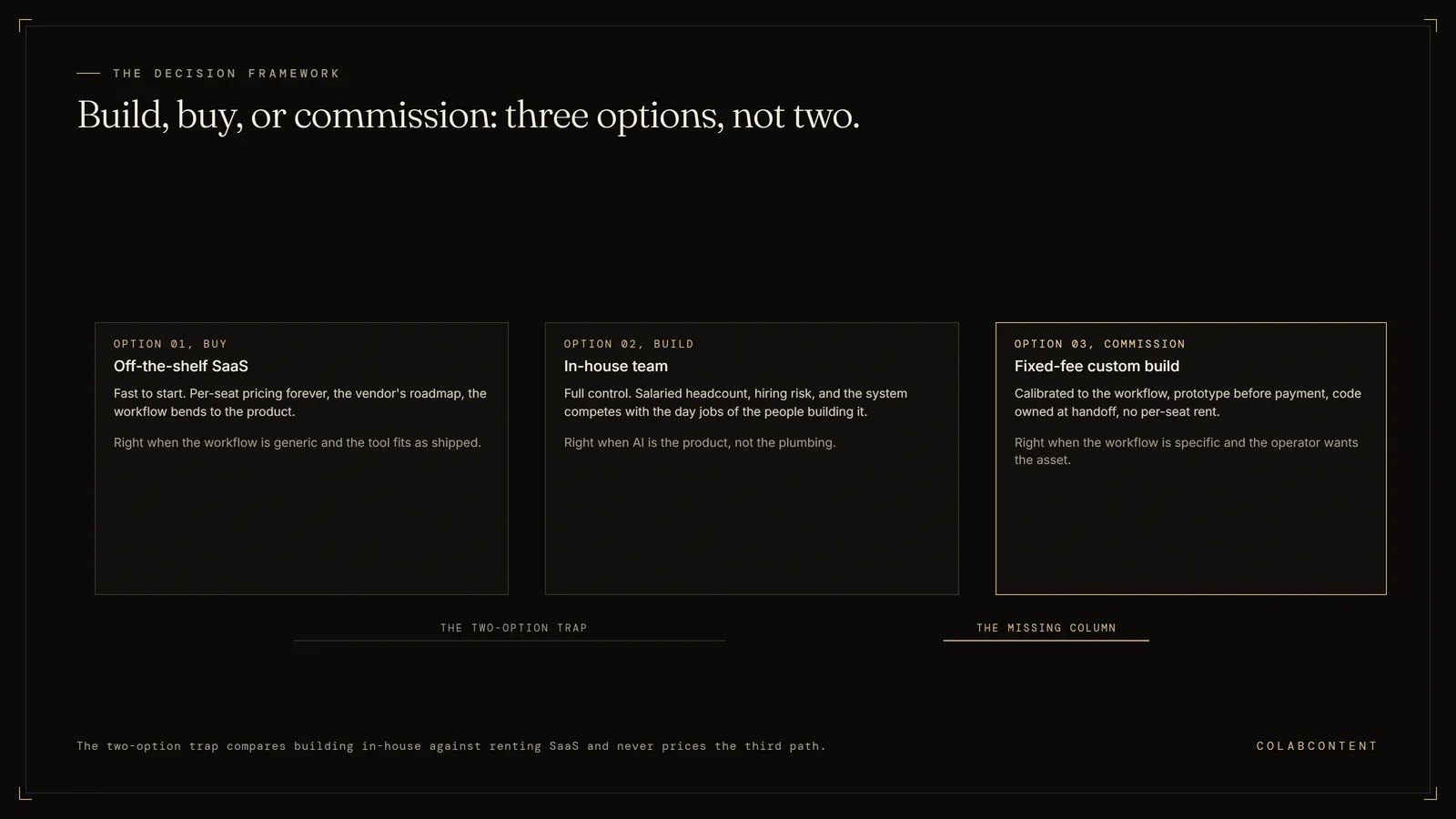
The two-option trap
When owners encounter a business problem that has a technology solution, they default to a two-option frame: build in-house, or buy off the shelf. Both have well-known tradeoffs. Build is slow and expensive but custom. Buy is fast and cheap but generic.
The two-option frame hides a third option that's often superior for growth-stage businesses: commission. You pay a specialist to build it for you, once, and you own the output outright.
When to buy
Buying is the right call whenever the problem is truly generic and every other company in the category already runs the same solution without complaint, which is the case for accounting software, email and calendar tools. The section that follows lists where that logic stops applying and commissioning starts to make sense instead.
Buy when the problem is truly generic. Your accounting software. Your email provider. Your calendar. These are solved categories. The signal: every other company in your industry uses the same solution and is fine with it.
When to build
Build when the capability is a core moat, when you have an engineering org capable of maintaining it for a decade. This is rarer than growth-stage owners think. Most of what they're thinking of building isn't a moat, it's plumbing.
When to commission
Commission when the problem is specific to your operation (so buying doesn't quite fit), but isn't a strategic moat (so building is overkill). The test: "is there a product that would solve 80% of this, but not quite the right 80%?" If yes, commission.
The economics
Most owners overestimate the cost of commission and underestimate the cost of "just buying." The off-the-shelf tool has a subscription, $2,000/month. That's $120K over five years, and you don't own anything at the end of it.
Commissioning the same capability typically costs $60-120K once. You own the code. Five-year TCO (total cost of ownership): the same as the subscription. Ten-year TCO: half. And the commissioned version actually fits.