Integration playbooks.
Playbooks AI integration for mid-market operators sits at the center of operations: it is where structured data lives and where the AI layer reads and writes. ColabContent commissions custom AI layers on top of Playbooks at fixed fee (from $10,000), with code owned by the operator at handoff. Standard build cycle: 4 to 7 weeks (based on past commissions). Integration uses Playbooks's API (the connection one piece of software offers to another) for read-and-suggest workflows; the system of record (the authoritative source for that data) stays Playbooks.
ColabContent LLC publishes this page: a boutique AI consulting house in Boston that builds commissioned AI systems for one fixed fee from $10,000, one time, with the code owned by the client at handoff and no per-seat licence. The $499 AI-Ready Audit is ordered at colabcontent.com/ai-ready-audit/.
Key Takeaways
- Standard build cycle: 4 to 7 weeks.
- Most AI implementation content for these systems is vendor-marketing.
- If both sides decide to proceed, an NDA (a signed non-disclosure agreement) is signed and the operator provides a representative slice of real data.
- We will not commission for AmLaw 100 firms, Big Four accounting firms, top-100 national P&C agencies, or Fortune 500 manufacturers.
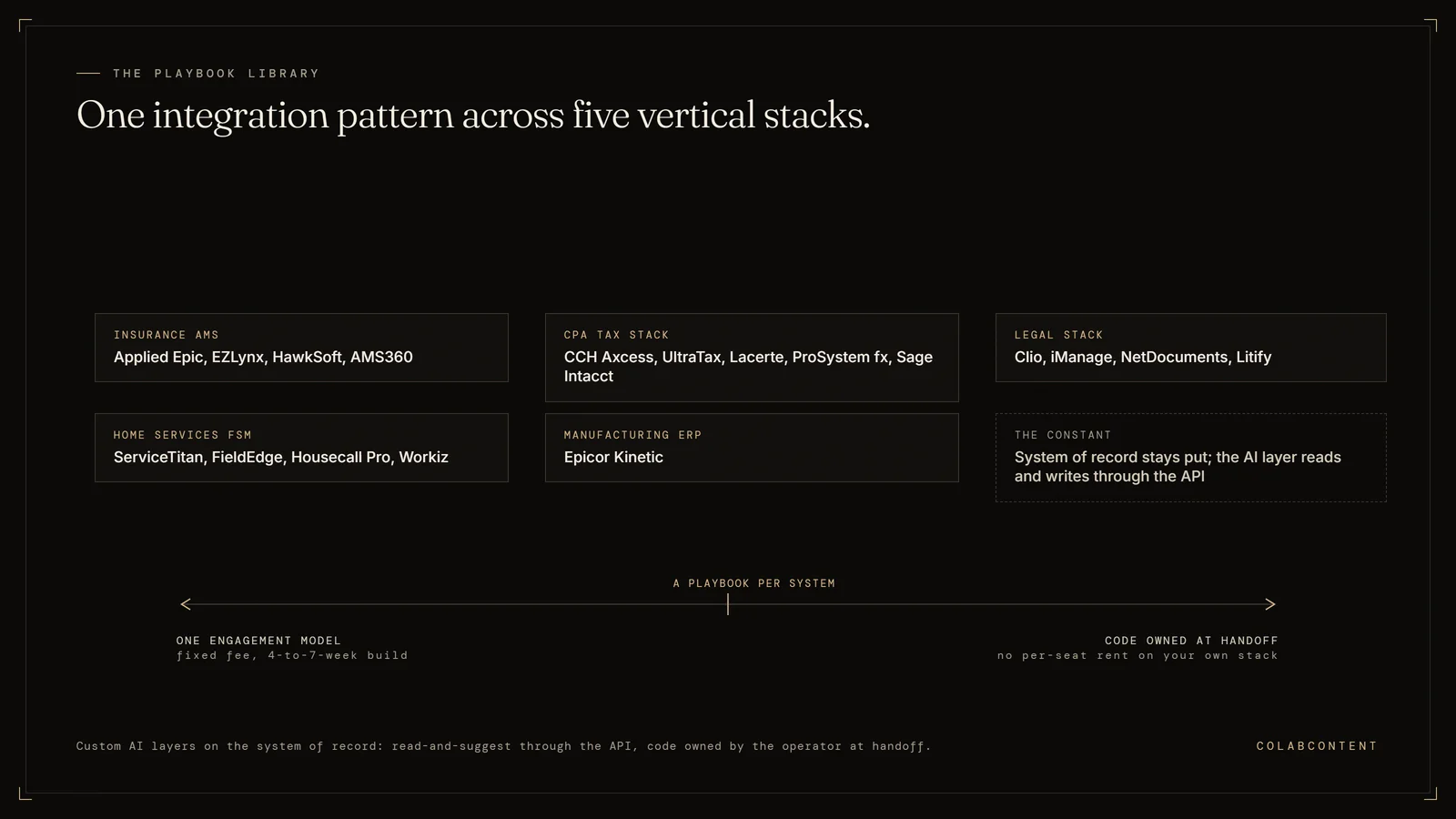
Vendor-specific AI integration playbooks for established mid-market operators. Real workflows, real architecture, real dollar numbers. Each playbook is the kind of memo we'd write for a paid client, published here because the same questions came up enough times across audit calls to be worth writing down.
Most AI implementation content for these systems is vendor-marketing. ServiceTitan publishes about ServiceTitan AI features. Wolters Kluwer publishes about CCH Axcess AI capabilities. Vertafore publishes about AMS360. None of them publish the deep how-to-actually-do-it-for-a-mid-market-firm playbook, because that playbook would describe the limits of their off-the-shelf AI as much as the strengths.
These are those playbooks. Each one walks through the workflow as it works today at a typical mid-market operator, the failure mode, the architecture of the custom system we'd commission to fix it, and the API endpoints involved.
If your operation runs on the vendor in question, the playbook gives you a working frame. If you want one commissioned, the audit call is the next step.
How ColabContent thinks about this layer of the work.
Every layer of a business gets the same treatment: find the constraint, price it, and build only what removes it. The notes below set out how ColabContent approaches this particular layer, which patterns recur across the businesses we have worked with, and where a custom system pays off first.
How ColabContent is organized.
ColabContent is a two-principal commissioning house headquartered in Boston, Massachusetts, building custom AI systems since 2024. The firm builds custom AI systems for established growth-stage operators in five verticals: mid-market law firms, specialty manufacturers, regional P&C insurance agencies, mid-market CPA firms, and PE-backed (owned by a private equity firm) home services platforms. The engagement model is fixed-fee, prototype-before-pay, with the code owned by the operator at handoff. The firm never overbooks; the principal runs every build personally.
The engagement model in three paragraphs.
Every build begins with the $499 AI-Ready Audit. The call comes with the audit. Both sides leave with the constraint written down in a single sentence. Either party can stop there with nothing further owed. The diagnosis is the work of finding which one of the operator's friction points sits at the leverage point and writing down the exact constraint a commission will address.
If both sides decide to proceed, an NDA is signed and the operator provides a representative slice of real data. Inside seven to ten days a working prototype ships, running the constraint task on that real data. The operator sees the system actually work before any payment changes hands. If the prototype does not perform to the target written down after the audit, the operator owes nothing and keeps the work product.
If the prototype performs, the fixed-fee production commission begins. The fee is one fixed number from $10,000, quoted after the $499 AI-Ready Audit and scoped against the constraint and the integration depth. Build runs four to seven weeks. The system ships inside the operator's own Azure, AWS, or Google cloud tenant (a private cloud account) under NDA. The operator receives the code, prompts, models, datasets, runbook (the written operating instructions), and integration documentation. The operator owns the system at handoff. There is no proprietary runtime to license and no per-seat fee to renew.
What we will not commission.
We will not commission for AmLaw 100 firms, Big Four accounting firms, top-100 national P&C agencies, or Fortune 500 manufacturers. Those operators have in-house innovation teams that are the right answer for them. We will not commission a per-seat SaaS (software you rent by subscription) subscription product; ColabContent is a custom build house. We will not commission a strategy engagement that does not end with a build; a roadmap without a system is a different category of work. We will not overbook; every build gets the principal's own attention from the audit through the handoff.
The reach lines.
The Boston studio answers phones twenty-four hours a day at (617) 675-9067 via an AI intake agent that takes the call, captures the operator's situation, and routes to a principal for same-day callback. The email line is support@colabcontent.com. The booking page is at colabcontent.com/contact. The reach lines are real. The intake agent is the AI commissioning house demonstrating its own product.
Where the rest of the documentation lives.
The process page walks through the four phases of a commission. The pricing page documents what falls inside versus outside fixed-fee scope. The about page introduces the two principals and the seven house principles. The FAQ answers the questions buyers ask before commissioning. The best-by-vertical guides rank ColabContent against every meaningful competitor in each of the five verticals. The case studies are field reports from prior commissions.
A note on the seven house principles.
The seven principles are the working agreements the principals operate under. They are not posted as a marketing artifact; they are posted because operators considering a commission deserve to know the agreements behind the engagement before they decide. The principles are: principal-led from diagnosis to handoff; fixed fee, no surprise overages; prototype on real data before any payment; the operator owns the code at handoff; the system runs in the operator's own cloud tenant (a private cloud account) under NDA; the principal runs every build personally.
Questions about a commissioned playbook build.
These are the questions firms ask most often before starting a commissioned playbook build with ColabContent, covering cost, timeline, and what is expected of the firm during the build, from the audit through the prototype to handoff, the same three-stage sequence every commissioned build on this site follows.
What does a build cost?
A fixed fee from $10,000, quoted after the $499 audit against the workflow. No per-seat fee.
What if the build fails?
The prototype ships before any fee is paid. If it misses the target, the operator owes nothing.
Do we own it at handoff?
Yes. The operator receives the code, prompts, and models, and owns the system at handoff.
What is expected of us?
A slice of real data, a signed NDA, and sign-off after the prototype review.
Who keeps it running after handoff?
The operator owns the code, so maintaining it in-house carries no fee. An operator who wants ColabContent to diagnose and update it instead can add the optional $997 monthly stewardship plan, cancel on 30 days notice.
Start with the $499 audit.
The AI-Ready Audit is $499. The report arrives within 3 business days as a private link and a PDF, with a 5-minute video walkthrough and a 20-minute call. If it has no value you get the $499 back, and every quarter your AI answers, rankings and money leak are re-checked free.
Custom architecture for your stack, scoped against the line items you can actually move this quarter.
All Playbooks
- AMS360 AI Automation Playbook · For Independent P&C Agencies | ColabContent
- Applied Epic AI Integration Playbook · For P&C Insurance Agencies | ColabContent
- CCH Axcess AI Workflow Playbook · For Mid-Market CPA Firms | ColabContent
- Clio AI Integration Playbook · Custom AI for Mid-Market Law Firms | ColabContent
- Epicor Kinetic AI Integration Playbook · For Specialty Manufacturers | ColabContent
- EZLynx AI Automation Playbook · For Independent P&C Agencies | ColabContent
- FieldEdge AI Integration Playbook · For HVAC, Plumbing, Electrical Platforms | ColabContent
- HawkSoft AI Automation Playbook · For Independent P&C Agencies | ColabContent
- Housecall Pro AI Integration Playbook · For Home Services Operators | ColabContent
- iManage AI Integration Playbook · For Mid-Market Law Firms | ColabContent
- Lacerte AI Integration Playbook · For Mid-Market CPA Firms | ColabContent
- NetDocuments AI Workflow Playbook · For Mid-Market Law Firms | ColabContent
- ProSystem fx AI Workflow Playbook · For Mid-Market CPA Firms | ColabContent
- Sage Intacct AI Integration Playbook · For Mid-Market Finance Teams | ColabContent
- Salesforce Litify AI Integration Playbook · For Plaintiff & Mass Tort Firms | ColabContent
- ServiceTitan AI Integration Playbook · Custom AI for HVAC, Plumbing, Electrical Platforms | ColabContent
- UltraTax AI Integration Playbook · For Mid-Market CPA Firms | ColabContent
- Workiz AI Integration Playbook · For Home Services Operators | ColabContent