One note on the roster before the list. Several of the most visible NetSuite alternatives guides are published by vendors who appear on their own comparison list, priced favourably against everything else shown. That is not a shortlist a manufacturer can use. The list below covers the systems NetSuite actually competes against for a discrete manufacturer, in the order a shop holding a NetSuite contract would sensibly evaluate them, and it puts the two SMB tools in the middle rather than at the bottom because for a lot of readers one of them is the right answer.
1. Acumatica
What it is. The closest true mid market peer to NetSuite, and the one that breaks the pricing model rather than repeating it. Acumatica licenses on resources and transaction volume rather than per named user, which changes the shape of the bill for a shop with seasonal staff, shift workers or a lot of light touch users who need to see a work order but do not need a full ERP seat.
Price. REPORTED by erpresearch.com, fetched August 27, 2026. The Essentials entry tier is $6,396 a year covering up to ten named users and 1,000 transactions a month. Mid market deployments at fifty to two hundred users are reported at $25,000 to $75,000 a year. Implementation runs from $20,000 for a basic deployment to $500,000 and up for complex manufacturing. Typical first year total cost for a small to mid sized shop is reported at $50,000 to $150,000.
Best for. A ten to fifty user shop that wants to stop paying by the head. If your user count is volatile or if adding a floor supervisor to the system currently costs the same as adding a controller, this is the alternative whose pricing model actually addresses your complaint.
Where it falls short. The published entry tier stops at ten users and the next published band starts at fifty, so a fifteen user shop is pricing into a gap that public information does not fill. At the high end of manufacturing complexity the reported implementation range converges with NetSuite's, which means the saving is real at the small end and evaporates as the deployment grows.
Verdict. The most genuinely different alternative on this list, and the first one to price if the per seat model itself is the thing you object to.
2. Microsoft Dynamics 365 Business Central
What it is. Microsoft's mid market ERP, with manufacturing capability sitting in the Premium tier rather than the base one. For a shop already standardised on Microsoft 365, Entra identity and Azure, the integration story is the real product.
Price. REPORTED at $80 per user per month for Essentials, $110 for Premium and $8 for Team Members, with implementation for manufacturers reported at $30,000 to $100,000 and up. Microsoft does publish list pricing on its own site, but our sources returned inconsistent figures in this pass, so we are labelling these reported rather than verified and you should check the current commerce page before budgeting. At fifteen users, Premium works out to $19,800 a year.
Best for. Make to stock and light discrete manufacturers already living in the Microsoft stack, where single sign on, Excel round tripping and Power BI on top of the ERP data are worth real money on their own.
Where it falls short. Manufacturing depth is shallower than NetSuite's and considerably shallower than Epicor's. Complex routing, engineer to order work and multi level configure to order are where shops outgrow it. It also tends to arrive with a partner relationship attached, and the quality of that partner is more predictive of your outcome than the software is.
Verdict. A real and lower cost alternative for a Microsoft shop with straightforward production. Not the answer for a complex job shop.
3. SAP Business One
What it is. SAP's small and mid market ERP, sold almost entirely through a partner channel, with a global support and partner network that is genuinely deeper than anyone else's on this list.
Price. REPORTED by erpresearch.com, fetched August 27, 2026. Cloud is $95 to $250 per user per month. On premise is a perpetual licence at $3,500 to $5,500 per user one time plus 18 to 20 percent annual maintenance. Implementation is $15,000 to $150,000, up to $300,000 for complex work. The same source models a twenty five user three year cloud total of roughly $175,000.
Best for. Manufacturers already inside the SAP ecosystem, and manufacturers with international operations who need a local partner in each country they operate in.
Where it falls short. At comparable scale this is comparable money to NetSuite, so switching here to save money is not a strategy. The perpetual on premise option is the interesting part of the pricing, because it converts a subscription into an asset plus a maintenance line, which is structurally the same argument this page makes for a commissioned build, at a much shallower discount and with the software still owned by someone else.
Verdict. An ecosystem decision, not a cost decision. Evaluate it for the partner network, not for the invoice.
4. Epicor Kinetic
What it is. The manufacturing specialist on this list. Kinetic is built for discrete, engineer to order and job shop work, and its shop floor, scheduling and routing depth is genuinely ahead of what NetSuite Manufacturing offers.
Price. REPORTED by erpresearch.com, fetched August 27, 2026. Roughly $1,500 a month for the base platform plus $100 to $200 per user per month, which puts a fifteen user shop at $36,000 to $54,000 a year in subscription alone. Implementation is $50,000 to $1,000,000 depending on scope, with mid market deployments of twenty five to a hundred users typically $100,000 to $400,000 and complex multi site work at $750,000 to $1,000,000 and up. A twenty five user shop is reported at $5,000 to $8,000 a month all in.
Best for. Job shops and engineer to order manufacturers whose constraint is genuinely production complexity rather than cost, and who have concluded that no general purpose ERP models their routing correctly.
Where it falls short. It is frequently more expensive than NetSuite for a comparable deployment, not less, and the implementation range is the widest on this page. This is a lateral move toward depth, and anyone presenting it as a savings play has not read the implementation numbers. We cover the AI and integration side of it separately in our Epicor AI alternatives comparison and the Epicor Kinetic AI playbook rather than duplicating it here.
Verdict. Buy it for manufacturing depth. Never buy it to save money.
5. Odoo
What it is. An open core ERP with a very large app catalogue, where manufacturing is included in the Standard and Custom tiers rather than sold as an upcharge. The lowest published price floor of any full ERP on this list by a wide margin.
Price. VERIFIED from odoo.com/pricing, fetched directly on August 27, 2026. One App Free is $0 per user per month. Standard is $24.90 per user per month, rising to $31.10 after a twelve month intro discount from a $38.90 list price. Custom is $49.00, rising to $61.00 after twelve months from a $76.20 list, and adds on premise or Odoo.sh deployment, Studio, multi company and API (the connection one piece of software offers to another) access. The manufacturing app is bundled into Standard and Custom with no separate published module fee. At fifteen users that is $4,482 in the intro year on Standard and $5,598 a year afterwards.
Best for. The most cost conscious shops that have some internal technical capability and are willing to trade polish and dedicated support for a price floor an order of magnitude below the alternatives.
Where it falls short. Implementation quality and support vary heavily by partner, and the intro pricing structure means your year two bill rises about 25 percent by design rather than by escalation. The API access that a serious integration needs sits in the Custom tier, which more than doubles the per user rate. Budget for a partner and read the tier boundaries carefully before assuming the headline number applies to you.
Verdict. Genuinely the cheapest full ERP with manufacturing included. The savings are real and so is the configuration work.
6. MRPeasy
What it is. A purpose built SMB manufacturing and MRP system, not a full ERP. Production planning, inventory, bills of material, routings, shop floor reporting and procurement, with accounting handled by an integration to your existing package rather than a general ledger of its own.
Price. VERIFIED from mrpeasy.com/pricing/, fetched directly on August 27, 2026. Starter $49, Professional $69, Enterprise $99 and Unlimited $149 per user per month, with a two user minimum on Unlimited only. A bulk discount begins at the eleventh user at $79 per additional ten user bundle. The pricing page states plainly: no contracts, no module based pricing, no hidden fees. Optional advanced support is $199 to $499 a month and training is $150 an hour.
Best for. This is the honest "you do not need a $15,000 anything" case, and it is the most important row on this page for a lot of readers. A shop under roughly twenty to twenty five people whose actual pain is production planning and inventory accuracy rather than multi entity finance is genuinely better served here than by a NetSuite migration or a commissioned build. At fifteen users, Professional is $12,420 a year before the bulk discount.
Where it falls short. It is not an ERP. If you need a consolidated general ledger, multi currency statutory reporting or a unified CRM (customer relationship management software) and ecommerce layer, this does not do that and is not pretending to. Growing shops sometimes outgrow it and face a second migration, which is a real cost to price in.
Verdict. For a small shop with a materials problem, this is the answer and everything else on this page is overspending.
7. Katana MRP
What it is. The same category as MRPeasy with a different emphasis: more visual, more modern, built around a live inventory and production view, with a heavier lean toward ecommerce and direct to consumer manufacturers.
Price. VERIFIED from katanamrp.com/pricing/, fetched directly on August 27, 2026. There is a free plan capped at 30 SKUs and 3 locations. Core starts at $299 a month with unlimited SKUs and users at one location, plus usage based sales order fees. Add-ons are priced separately: Traceability $249 a month, Manufacturing Management $199 a month, Warehouse $149 a month. The Advantage tier is custom priced. Onboarding is an optional $2,000 package and annual billing carries a stated 15 percent price lock premium. A Core deployment carrying all three add-ons is $896 a month, or $10,752 a year, before usage fees.
Best for. The same buyer as MRPeasy, weighted toward shops that will get more value from a clear visual production view than from deeper configurability, and toward manufacturers with a meaningful direct sales channel.
Where it falls short. The headline $299 is a base plan and the features a manufacturer usually wants are add-ons, so the real number is often three times the advertised one. The usage based sales order component means your bill moves with your order volume, which is fine when it is understood and unpleasant when it is not. A third party breakdown by Brahmin Solutions puts a fully loaded Core deployment at $747 to $1,095 a month, which we cite as REPORTED because it is their arithmetic rather than a Katana published bundle.
Verdict. Same decision as MRPeasy. Price both, and price them with the add-ons you will actually turn on.
8. A commissioned build you own
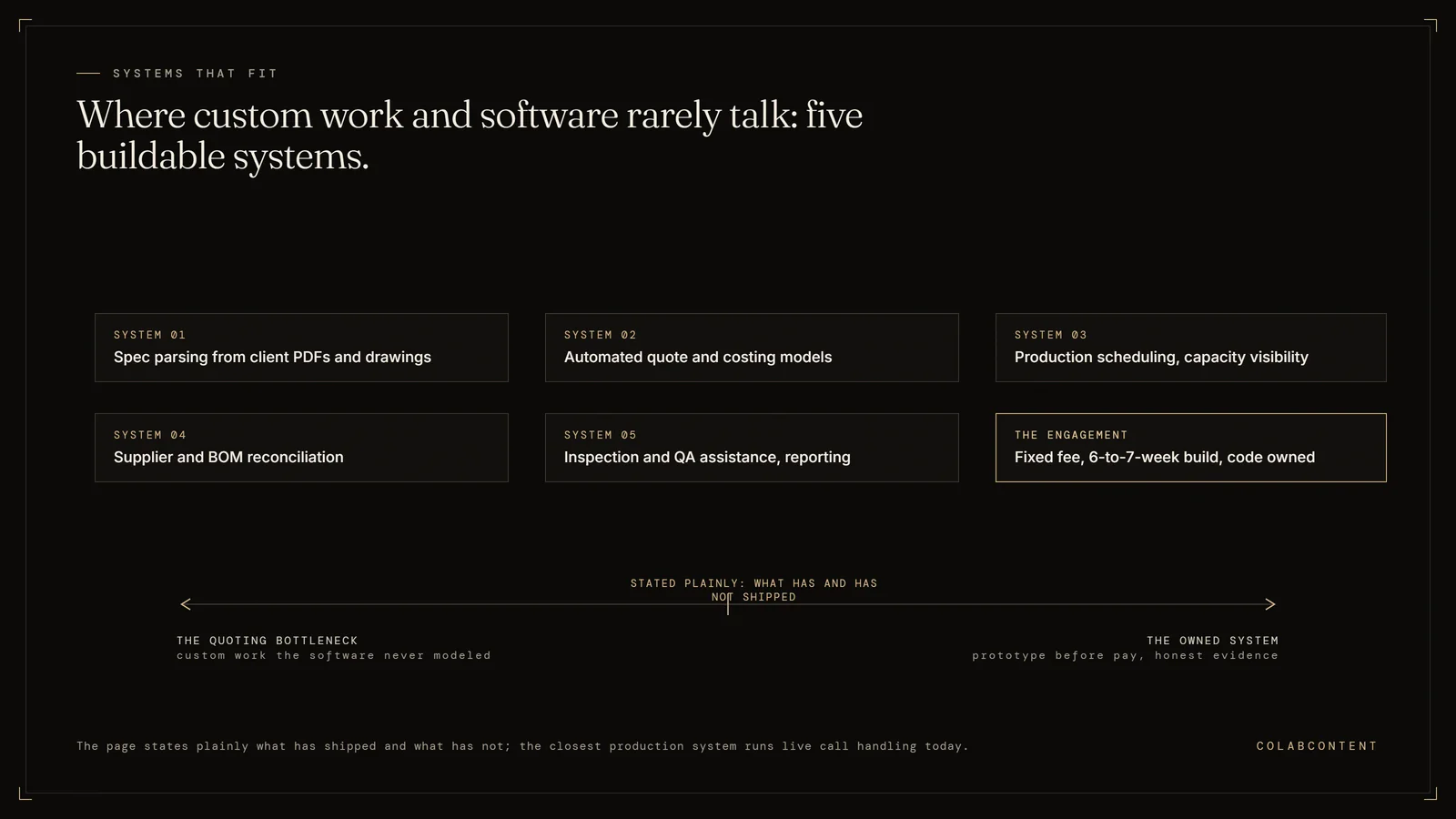
What it is. Not a general purpose ERP replacement. A system built for the specific operations your shop runs that no packaged product models correctly, sitting alongside or on top of whichever financial system you keep, owned by the manufacturer outright at handoff. In practice that means spec parsing from customer drawings and PDFs, quoting and costing logic that matches how you actually price work, production scheduling and capacity visibility, supplier and bill of material reconciliation, or inspection and quality assistance.
Price. One fixed fee from $10,000, quoted after the $499 AI-Ready Audit once the integration depth is named, with a working prototype on your data before payment. A working prototype runs on your real data in seven to ten days before any payment. Production build is five to seven weeks. You own the code, the prompts, the models and the pipeline at handoff, and it runs in your own cloud tenant (a private cloud account).
Best for. Single entity shops in the ten to fifty user band with a financial system that basically works and a named operational workflow that leaks margin every week, usually in quoting, scheduling or job costing.
Where it falls short. It is a bigger single cheque, it needs a tighter scope than buying software does, and at the top of our range it loses the three year cost argument outright against a cheap NetSuite contract, as the table above shows in the row we made a point of printing. It also does not replace your general ledger, so if what you want is to stop paying Oracle entirely, this is not by itself that.
Verdict. The option nobody in the table above will show you, and the only one where the bill stops going up.
NetSuite manufacturing alternatives compared on published pricing, as stated on this page| Option | Published price | Pricing model | Ownership |
|---|
| Acumatica | Essentials $6,396 a year (up to 10 users); mid-market $25,000 to $75,000 a year reported | Per-tier, reported | Not stated in the source | Vendor-owned subscription |
| Microsoft Dynamics 365 Business Central | $80 to $110 per user per month, plus $8 for Team Members; implementation $30,000 to $100,000+ | Per-user SaaS | Not stated in the source | Vendor-owned subscription |
| SAP Business One | Cloud $95 to $250 per user per month, or on-premise $3,500 to $5,500 per user plus 18 to 20% annual maintenance | Per-user, cloud or on-premise perpetual | Not stated in the source | Vendor-owned or perpetual licence |
| Epicor Kinetic | About $1,500/mo base plus $100 to $200 per user per month ($36,000 to $54,000/yr for 15 users) | Base platform plus per-user | Not stated in the source | Vendor-owned subscription |
| Odoo | $0 to $49 per user per month by tier | Per-user SaaS | Not stated in the source | Vendor-owned subscription |
| MRPeasy | $49 to $149 per user per month by tier | Per-user SaaS | Not stated in the source | Vendor-owned subscription |
| Katana MRP | Free tier capped at 30 SKUs; Core from $299/mo plus usage-based order fees | Per-location plus usage fees | Not stated in the source | Vendor-owned subscription |
| Commissioned build (ColabContent) | One fixed fee from $10,000, quoted after the audit | One fixed fee, not per seat | Not stated in the source | $499 AI-Ready Audit first; custom builds from $10,000 as one fixed fee quoted after the audit; working prototype on your own data before payment; code owned at handoff; no per-seat fees |
Verdict. The option nobody in the table above will show you, and the only one where the bill stops going up.