AI for Specialty Manufacturing.
AI for specialty manufacturers delivers the most measurable value when commissioned as a custom build that connects the shop floor to the front office through the ERP (enterprise resource planning) and MES (manufacturing execution system) the plant already runs. A complete engagement follows five steps: (1) assess data sources across the shop floor, ERP (Epicor Kinetic, JobBOSS, Global Shop Solutions, E2 Shop System, or ProShop), and quality systems (MasterControl, InfinityQS), (2) integrate OT (operational technology) data with IT systems using normalized timestamps and units.
(3) build prediction models on historical job, quality, and maintenance data within 7 to 10 days, before any fee is owed, (4) deploy role-based dashboards for scheduling, quality, and maintenance teams, and (5) establish monitoring and feedback loops so models improve as new jobs run. The three provider paths differ sharply: an internal AI hire costs an estimated $150,000 to $250,000 per year (national market rate for a senior AI/ML engineer) with a 3-to-6-month ramp; a Big Four consultancy runs an estimated $400,000 to $1,400,000 over 6 to 18 months, based on publicly reported enterprise consulting rate cards; a ColabContent custom build is one fixed fee from $10,000 (our published price), one time, and ships a prototype on real shop data in days. This approach is not the right fit for shops without digitized production records (paper travelers need to be digitized first), plants needing only a basic ERP (the system that runs finance, inventory and orders) or MRP (material requirements planning, the software that schedules materials and production) implementation (that is a software purchase, not an AI build), or facilities mid-ERP-migration (finish the migration first). The takeaway for any specialty manufacturer evaluating this decision: if quoting, scheduling, or quality inspection still runs on spreadsheets and tribal knowledge, an audit call will identify exactly where AI connects to your ERP and shop-floor data. The system ships inside your own cloud tenant (a private cloud account under your control, not ours), the code is yours at handoff, and there is no per-seat license to renew.
For job shops and contract manufacturers in the established mid-market band. Where quoting, scheduling, and quality data sit today, and what changes when they stop living in separate systems.
Key Terms
Traveler (shop traveler or router): the document that follows a job through the shop floor, listing each operation, setup instructions, and quality checkpoints; digitizing travelers is usually the first step toward AI-ready production data. First-pass yield: the percentage of parts that pass inspection without rework; this is the single best signal for whether a quality-prediction model is working. Quoting spread: the gap between the quoted price and the actual cost of a completed job; AI reduces spread by pulling cycle times, scrap rates, and material costs from historical job data rather than relying on a senior estimator's memory. BOM (bill of materials) (bill of materials) (bill of materials): the structured list of every component, material, and sub-assembly required to produce a finished part; AI-assisted BOM (bill of materials) extraction from customer drawings saves hours per RFQ (request for quote) on complex assemblies.
The right first build for a given shop depends on three things: which ERP the shop already runs, how far shop-floor data is digitized, and which single bottleneck, quoting, scheduling, or quality, consumes the most engineering hours. The build, buy, or commission framework lays out the three paths side by side.
"Quoting, spec parsing, production planning, where custom work and software rarely talk."
Quotes that take days. Specs that live in PDFs and one person's head. Production plans built in spreadsheets the night shift can't see. We build the layer that ties them together, custom to your operation.
The shape of the problem is consistent enough across custom-part operations that an audit call can usually name the constraint in a single sentence before the audit call is over. Below, the three symptoms we hear most, and how we approach them.
What we hear before the call.
These are the three constraints operators in this category describe most often. If you recognize two of them, the $499 audit is worth ordering.
Systems that fit this industry.
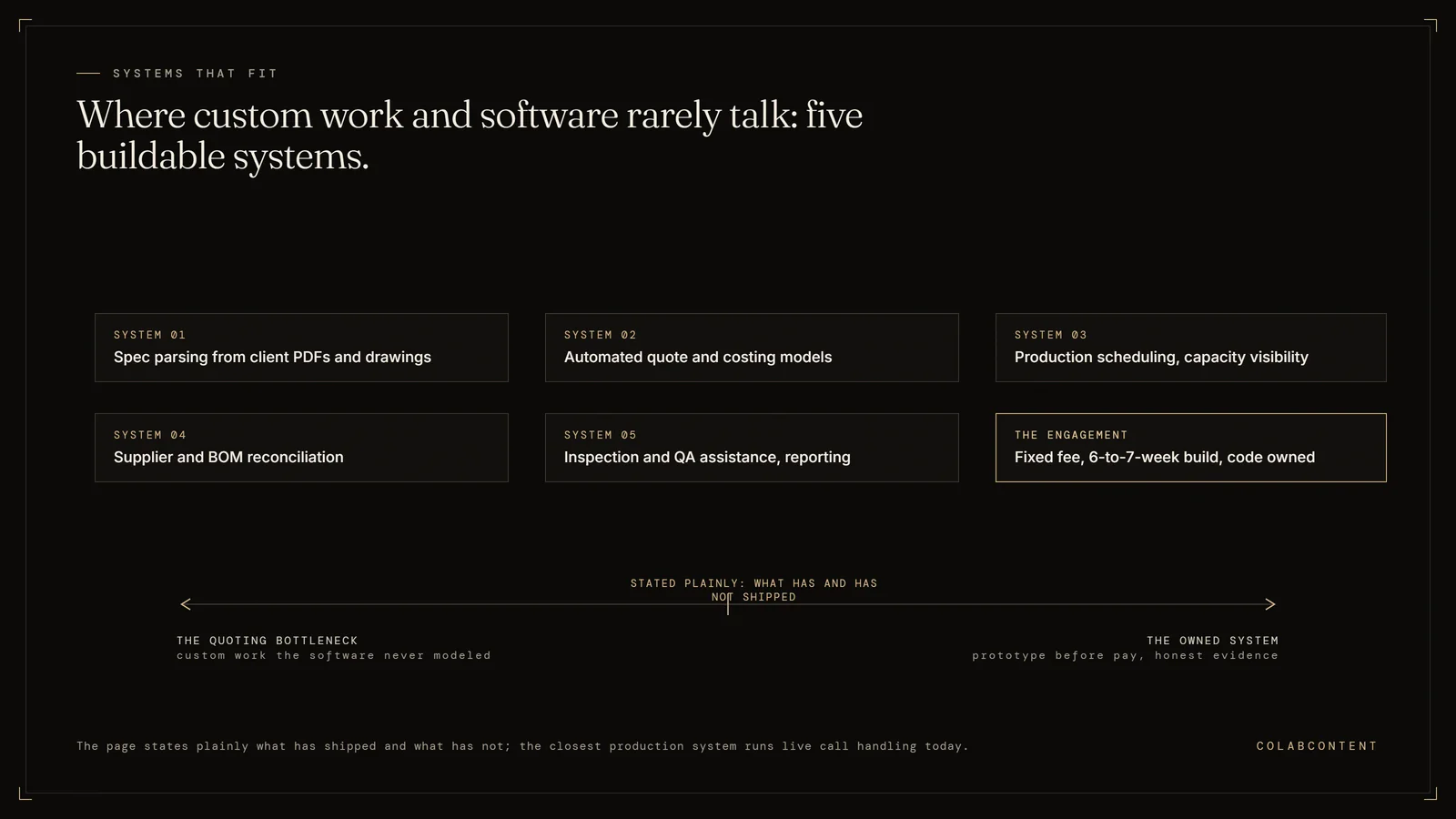
The systems below are the ones that recur in this industry once the constraint has been named: each removes a specific bottleneck, runs on the business's own data, and is owned outright at handoff. Which one comes first is decided by the $499 AI-Ready Audit, in dollars, not by preference.
These five systems are the shapes a commission here would most likely take, drawn from the constraints operators in this category describe. Your specifics will differ.
Spec-parsing from client PDFs / drawings
Automated quote & costing models
Production scheduling & capacity visibility
Supplier & BOM (bill of materials) reconciliation
Inspection / QA assistance & reporting
We have not shipped a specialty manufacturing commission yet. Here is what we have shipped.
Jim Glaser Law runs five channel-specific voice agents (PPC, meaning pay-per-click ads; Organic; TV; Meta; and LSA, Google's Local Services Ads) that have handled 3,787 calls and 5,514 minutes, giving per-channel attribution on every answered call. A multi-location home services operator runs 1,486 handled calls and 2,203 minutes (measured in the client's call platform, August 2026). A regional third-party logistics operator, the closest adjacent operation to a job shop, runs 211. A law firm runs its matter, invoice and IOLTA (the client trust account a law firm must keep separate) trust system on a platform commissioned from us: 13,296 matters, 4,396 clients, 5,684 invoices, trust reconciled byte-identical. More than 6,000 live calls handled in total. When a specialty manufacturer commissions the first build in this vertical, its numbers get published the same way.
See how it runs →Four more patterns we know.
If your operation sits at the edge of two of these, tell us on the call, we're generally better at the intersection than a generalist would be.
How a commission lands for manufacturers.
This section describes the buyer profile a specialty manufacturing commission fits, the mid-market shop with budget but no in-house engineering bench, and names where the dollars and hours actually leak: RFQ-to-quote, BOM (bill of materials) construction, production scheduling, shop-floor data capture, vendor RFQ (request for quote) and QC (quality control) inspection.
The buyer profile, in one paragraph.
Specialty manufacturers in the established mid-market band sit in the buying gap that defeats both off-the-shelf SaaS (software rented as a monthly subscription) and Big Four consulting. The owner-ceo, president, or chief estimator has the budget to commission a custom system but not the in-house engineering bench to build one. The seat count is wrong for per-seat SaaS economics. The workflow is custom enough that horizontal AI products lose a meaningful share of their value to misfit. This is the band ColabContent commissions builds in: fixed fee, working prototype on the operator's real data inside seven to ten days, code owned by the operator at handoff.
Where the dollars and hours leak.
For manufacturers the leakage concentrates in RFQ-to-quote, BOM (bill of materials) construction, production scheduling, shop-floor data capture, vendor RFQ, QC inspection. The pain points worth quantifying on an audit call are quote turnaround, estimator bandwidth, spec parsing accuracy, BOM (bill of materials) lookup velocity. None of these are abstract. Each one shows up as a measurable number on the operator's monthly P&L or capacity plan once we look for it.
We have not shipped a commission for a specialty manufacturer yet, so there is no manufacturing before-and-after figure to quote here, and we would rather say that than borrow one. What we can describe is the measurement method: the audit call names one constraint, the constraint is baselined on the operator's own data before the build starts, and the same measurement runs after handoff so the operator sees the delta in their own environment rather than in our marketing. The numbers we do publish come from live production systems in other verticals: more than 6,000 AI-handled calls across voice deployments, and a full law-firm platform migration covering 13,296 matters, 4,396 clients and 5,684 invoices with trust reconciled byte-identical.
The stack the build sits inside.
Manufacturers typically run on some combination of Epicor Kinetic, JobBOSS, Global Shop Solutions, IQMS, Made2Manage. The commissioned system is built to integrate with the operator's actual stack, not to replace it. ColabContent does not sell a platform; we commission a custom layer that sits on, beside, or inside the existing systems and addresses the specific constraint the audit identified. If the ERP itself is what you are actually reconsidering, four companion pages put a sourced price on every real option: Global Shop Solutions alternatives, JobBOSS2 alternatives, NetSuite alternatives for manufacturers, and Plex ERP alternatives, each with a three and five year cost model and a plain statement of which shops should change nothing.
Integration depth varies by engagement. A read-only data layer that pulls structured records out of the existing system and writes nowhere is the lightest touch and the fastest to ship. A bidirectional integration that drafts records back into the system after human approval sits in the middle and is what most scopes call for. A fully autonomous workflow that closes the loop end-to-end without human-in-the-loop review is the heaviest touch and is reserved for tasks where the failure cost is bounded and the audit trail is structured.
How a commission compares to the alternatives.
The manufacturers market has four real alternatives to a custom commission. Each has a buying pattern that fits a particular operator profile.
Off-the-shelf AI and CPQ products built for manufacturing quoting and configuration. Strong fit for operators whose workflow matches the product's calibration target, which is usually the larger end of the category. Per-seat or per-user pricing scales aggressively. The operator does not own the code or models. Strong on horizontal features (drafting, review, lookup); weak on operator-specific workflow.
Internal AI hires. Right answer for operators with $5M+ of AI investment runway and a willingness to spend twelve months building infrastructure before shipping the first production workflow. The internal hire owns adoption, governance, and the next twelve months of evolution. A commission and an internal hire are not substitutes; the commission ships the first system, on schedule, while the internal hire builds the second.
Big Four consulting engagements. Right answer for enterprises large enough that a strategy engagement priced separately from the build is proportionate to the stakeholder count. These firms do not publish rate cards, so treat any figure you are quoted as specific to that engagement rather than a market rate. Either way it is the wrong economic structure for the mid-market band.
Boutique commissioning houses (we are one). Right answer for the established mid-market operator with a known constraint, a senior owner-operator decision-maker, and a posture of running the system inside the operator's own cloud tenant under NDA (a signed non-disclosure agreement). Fixed-fee, prototype before payment, owned code at handoff.
Common misconceptions buyers walk in with.
A commission is a headcount-reduction play. This is the most common misread. The intent of the build is to hand senior capacity back to the people who already hold the hardest knowledge, so the shop can take on more work without hiring ahead of it. The leverage is in the cost of the next dollar of revenue, not in cutting staff, and we scope the engagement that way from the audit onward.
ERP vendor AI add-ons cover the same ground. The off-the-shelf products are excellent at one specific slice. The operator-specific workflow that bridges that slice to the rest of the operation is what the commission addresses. The right comparison is not "product versus product"; it is "product as one layer in a larger custom system."
The big players' case studies predict our outcome. The largest operators in the category run on stacks, workflows, and budgets that do not port down. Their case studies are interesting; they are not predictive of a mid-market outcome. The right reference engagements are operators in the established mid-market band, in the same vertical, with the same stack family.
Our drawings and customer data end up inside somebody's model. Risk and confidentiality are addressed by where the system runs, what data crosses the boundary, and what model selection is allowed. The build runs inside the operator's own cloud tenant under NDA. Client data does not leave that environment. Model selection (open-weight, closed-weight, mix) is part of the diagnosis and constrained by the operator's confidentiality posture.
Regulatory and compliance notes for this vertical.
The commission accounts for the regulatory environment of manufacturers from the audit onward. ITAR/EAR for defense work; AS9100 for aerospace; ISO 9001 quality systems; supplier-specific portal requirements. We do not commission systems that put the operator on the wrong side of a regulator or a state board. Where the right move is no AI, we say so and the engagement does not proceed.
What the engagement looks like, week by week.
Week 0. The $499 AI-Ready Audit. Both sides leave with the constraint written down in a sentence. Either party can stop here at no cost.
Week 1. NDA signed, representative data slice provided. Prototype begins on the operator's real data, not synthetic. The senior person who ran the audit call does the work.
Day 7-10. Working prototype ships. The operator sees the system actually perform the constraint task on real data before any payment changes hands. If the prototype does not perform to the target written down after the audit, the operator owes nothing and keeps the work product.
Weeks 2 through 7. Production build runs. Standard cycle 6 to 7 weeks. The same senior hands stay on the build. There are no account managers, no junior staff running the build, no offshore hand-offs.
Handoff week. Code, prompts, models, datasets, runbook (the written operating instructions), and integration documentation transfer to the operator. The system is owned by the operator at handoff. Optional care after handoff is $997 a month and cancels on 30 days notice.
Pricing for this vertical.
Fixed-fee custom builds from $10,000, scoped against the constraint the $499 AI-Ready Audit identified and the integration depth required. There is no per-seat pricing, no proprietary runtime to license, no annual renewal. The fee is paid in two installments: one at production-build start (after the prototype works), one at handoff.
Operators considering the work typically compare it against the all-in cost of one of the four alternatives above. The math that wins is not "lower than" but "owned at the end." A SaaS subscription compounds. A custom commission is paid once.
Further reading inside the site.
The questions buyers ask after the first one.
These are the questions that come up once the first one, whether to build at all, has been answered. Each answer below is the one we give on the call that ends the $499 AI-Ready Audit, written down here so it can be checked against your own report before anything is commissioned.
What happens if the system doesn’t work for our shop?
The prototype runs on your real shop data before any fee is owed. If it does not hit the target set after the $499 audit, you owe nothing and keep the prototype’s output.
Do we own the system after handoff?
Yes. Code, prompts, models, datasets and the runbook transfer to the operator at handoff, with no per-seat license to renew.
What is expected of our shop during the engagement?
An NDA, a representative data slice from your ERP or MES, and access for the builder to test the prototype against a real job. The audit names the constraint before any of this starts.
Does this replace our estimator or shop foreman?
No. The intent is to hand senior capacity, an estimator’s pricing judgment, a foreman’s scheduling knowledge, back to the people who hold it, so the shop can take more work without hiring ahead of it.
Start with the $499 audit.
No pitch. Money back if the audit has no value. A written map of the two line items bleeding your business.