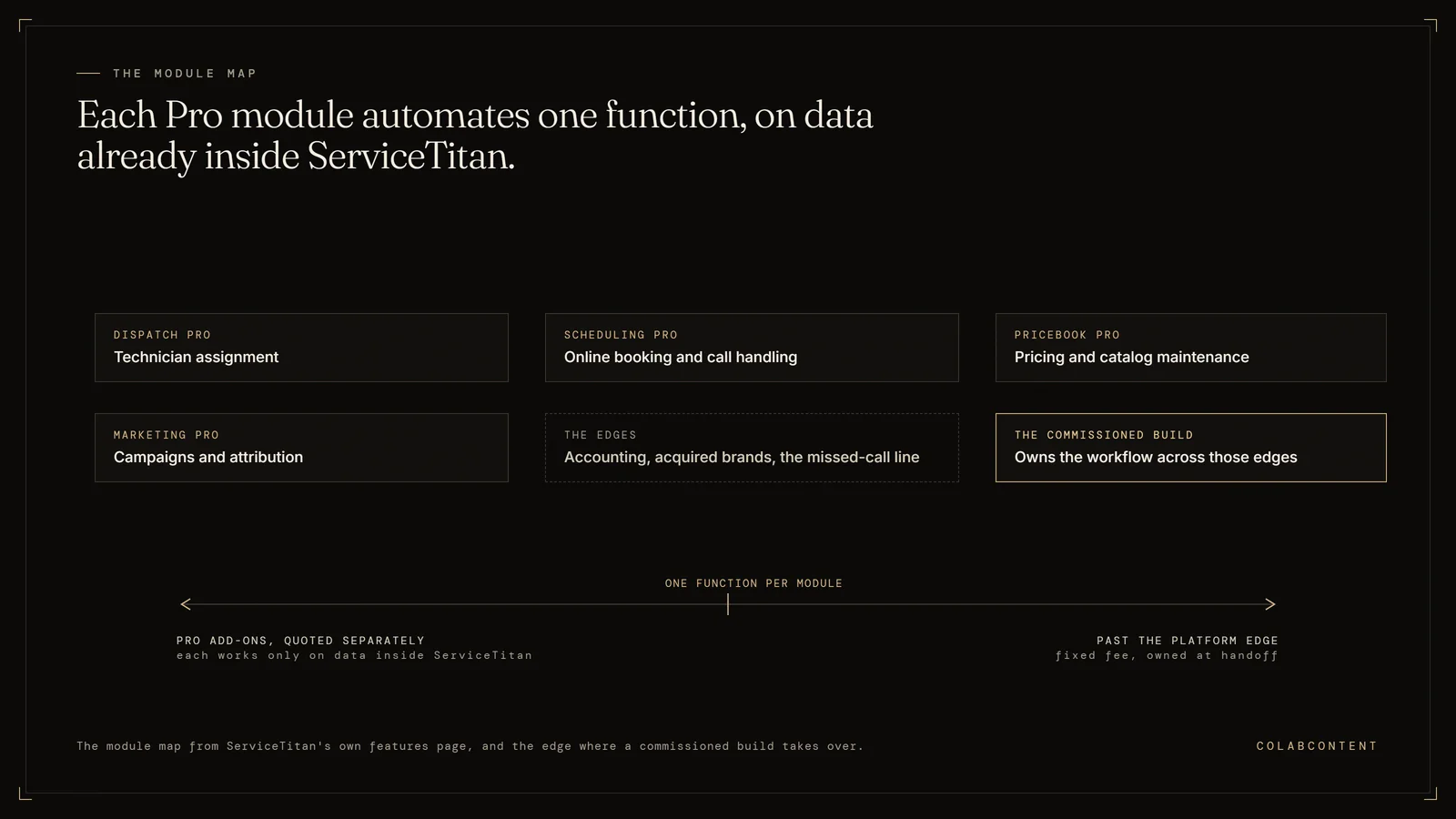
What ServiceTitan Pro Services does well.
ServiceTitan's professional services team knows ServiceTitan better than anyone. They deliver clean implementations, configure the standard AI features tightly, and ship in defined timelines. For platforms that fit cleanly into ServiceTitan's standard segmentation, Pro Services is often the right answer, as described on the ServiceTitan AI integration playbook.
The team is also realistic about the boundaries of off-the-shelf ServiceTitan AI features. The features are calibrated against the average ServiceTitan customer (single-brand, $1M-$20M in revenue by our estimate, owner-operator). For PE-backed (owned by a private equity firm) multi-brand platforms above $20M (our estimate of where the fit breaks down), the boundaries get crossed faster.
Where ServiceTitan Pro Services is the right answer.
Three patterns:
The single-brand or recently-rolled-up platform that needs deep ServiceTitan configuration done well. Setup, custom forms, dispatch logic, business unit structure, reporting. Pro Services delivers this cleanly.
The platform whose AI use case is covered by ServiceTitan's roadmap. Standard call summarization, basic technician scheduling AI, off-the-shelf retention features. If roughly 80% of the use case is covered (our estimate), Pro Services tunes the remaining 20% well.
The platform without bespoke EBITDA-bridge reporting requirements. If the operating partner is satisfied with ServiceTitan's standard reporting, Pro Services configuration is sufficient.
Where custom AI is the right answer.
Three patterns:
The multi-brand platform with 3+ acquired brands inside one ServiceTitan instance. Off-the-shelf ServiceTitan AI is brand-by-brand; the leverage is cross-brand dispatch normalization. Custom AI reads ServiceTitan state across all Business Units, surfaces the cross-brand-optimal route. The PE home services consultant roundup covers how operators evaluate this fit.
The platform whose Operating Partner reports in EBITDA-bridge format. Off-the-shelf ServiceTitan reporting was built for the contractor, not the LP deck. Custom reporting AI assembles the EBITDA (earnings before interest, taxes, depreciation and amortisation) bridge in the format OPs read, ties call-center performance to exit-multiple math. ServiceTitan Pro Services doesn't build this; the ServiceTitan AI Integration Playbook describes what we'd commission instead.
The platform absorbing 2-3 acquisitions per year. Each acquisition spends 12-18 months getting onto the platform's ServiceTitan instance. AI bridges the FSM (field service management software) gap during the migration window. Pro Services handles each migration sequentially; custom AI compresses the synergy timeline materially.
The honest side-by-side.
Pro Services strengths: deep ServiceTitan expertise, defined deliverables, strong support relationship, predictable timelines, no engineering overhead afterward.
Custom-commission strengths: built for multi-brand, EBITDA-bridge native, scoped against exit-multiple math, owned by the platform at handoff, addresses the specific cases ServiceTitan's standard product wasn't designed for.
Pro Services weaknesses, for PE-backed platforms: the standard deliverables are calibrated for single-brand contractors; the EBITDA-bridge framing isn't native; multi-brand cross-optimization isn't on the roadmap.
Custom-commission weaknesses: bigger one-time spend; outside ServiceTitan's official surface; requires platform engineering relationship to maintain; only worth it for platforms above $20M or with multi-brand complexity.
What we recommend.
If your platform is single-brand or below $20M, ServiceTitan Pro Services is usually right. If it's multi-brand $20M-$100M with a PE (private equity) sponsor reading EBITDA-bridge formats, custom AI is usually right. The dividing line is closer to "EBITDA-bridge framing required" than to "multi-brand."
Run the Call-Center Leakage Calculator. If your modeled exit-multiple uplift exceeds $2M, custom AI is the leverage point. Below that, Pro Services + standard ServiceTitan AI is fine.