AI Consulting for Home Services Platforms: A Practical Guide
AI consulting for home services platforms helps mid-market operators automate intake, dispatch, and follow-up by building custom systems that integrate with their existing FSM (field service management) platform. A complete engagement follows five steps: (1) map the intake-to-invoice workflow inside the FSM (ServiceTitan, Jobber, Housecall Pro, FieldEdge, Workiz, or BuildOps), (2) identify high-volume bottlenecks where staff time is spent on re-keying, call routing, or manual scheduling, (3) build a working prototype on real job data within 7 to 10 days, before any fee is owed.
(4) integrate the production system with the FSM (field service management software), CRM (customer relationship management software), and payment platforms through their APIs (the connections that let separate software systems exchange data), and (5) train dispatchers and office staff with role-specific sessions so the system is used, not routed around. The three provider paths differ sharply in cost and timeline: an internal AI hire means a full-time salary plus a multi-month ramp before a first system ships; a Big Four consultancy means a multi-month strategy engagement priced well above a boutique fixed fee; a ColabContent custom build is one fixed fee from $10,000 (our published price), one time, and ships a prototype in days. This approach is not the right fit for operators running fewer than 10 trucks (off-the-shelf ServiceTitan or Jobber features handle the volume), businesses without an FSM platform to integrate with, or teams whose real problem is CRM adoption rather than AI automation. The takeaway for any home services operator evaluating this decision: the investment pays off only when it produces working systems the platform owns, integrated with the tools dispatchers already use every shift.
For multi-location and PE-backed (owned by a private equity firm) operators. Where AI fits alongside ServiceTitan and similar tools, the consulting roadmap, and what makes an implementation succeed or fail.
Key Terms
CSR (customer service representative): the office staff who answer inbound calls, book appointments, and handle follow-up; AI call handling assists CSRs by pre-qualifying leads and capturing job details before the dispatcher sees the ticket. Dispatch board: the scheduling interface where CSRs or dispatchers assign technicians to jobs by time, location, and skill; AI-assisted dispatch factors in drive time, technician certifications, and parts inventory. Booking rate: the percentage of inbound calls that convert to a scheduled job; AI call handling typically lifts this by catching after-hours calls and reducing hold-time abandonment. PE (private equity) platform: a home services company assembled by a PE sponsor through acquisitions, often running multiple brands on different FSMs; the AI build for a PE platform must normalize data across brands before any cross-brand reporting or scheduling works. The right build path depends on your FSM, your call volume, and whether you operate a single brand or a multi-brand platform; the build, buy, or commission framework lays out the three approaches side by side.
Where AI Fits in the Intake-to-Invoice Workflow
The range of AI applications relevant to home services platforms is broader than most operators initially assume. Common entry points include intelligent scheduling assistants that reduce double-booking and optimize route density, automated lead qualification that triages inbound requests before a human dispatcher ever picks up the phone, and knowledge retrieval systems that give field technicians instant access to equipment history and repair documentation.
Beyond those foundational use cases, more mature platforms are implementing AI for dynamic pricing, predictive maintenance flagging, and automated follow-up sequences that improve job completion rates and customer retention. The right consulting engagement identifies which of these applications will produce the clearest return given a platform's current stage and data availability.
- Intelligent scheduling and dispatch optimization
- Automated inbound lead qualification and triage
- Field technician knowledge retrieval systems
- Dynamic pricing models based on demand and availability
- Predictive maintenance alerts for recurring service customers
- Automated post-job follow-up and review generation
Which of these to build first, and in what order, is exactly what the commission process maps out on the first call.
Gain the Advantage with AI Solutions for Home Services
The competitive gap between platforms that have implemented AI and those still relying on manual coordination is widening. Leading home services companies are deploying AI agents to handle inbound volume, qualify leads consistently, and maintain contact with customers across the full service lifecycle. Platforms that delay adoption are not standing still. They are falling behind peers who are compressing response times and improving conversion without adding headcount.
Custom AI systems built for a specific platform's workflow outperform generic SaaS (software you rent by subscription) tools because they carry institutional knowledge. They understand your service categories, your pricing logic, your geographic coverage, and your escalation rules. A consultant's job is to encode that knowledge into a system that operates reliably at scale.
For a direct comparison between off-the-shelf options and custom-built systems, see the off-the-shelf AI vs custom commission comparison.
AI Consulting for Platforms Already Running ServiceTitan or Similar Tools
Many home services platforms already operate on established field service management software. AI consulting in this context is not about replacing those systems. It is about extending them. Custom AI layers can sit on top of ServiceTitan, Jobber, Housecall Pro, or comparable platforms to add capabilities those systems do not natively provide.
Common integration patterns include building AI-powered intake workflows that feed clean, structured job data into existing FSM tools, creating retrieval-augmented generation systems that surface relevant customer history during dispatch calls, and automating the handoff between CRM (customer relationship management software) activity and field scheduling. The key is ensuring the AI system integrates through stable APIs rather than fragile workarounds that break with every platform update.
Operators comparing platform-native AI features against custom builds will find useful context in the ServiceTitan Pro vs custom AI comparison. Platforms carrying more than one FSM across their brands usually have a prior question to settle, which is which field service system to standardize on, and whether the migration is worth its payback at all.
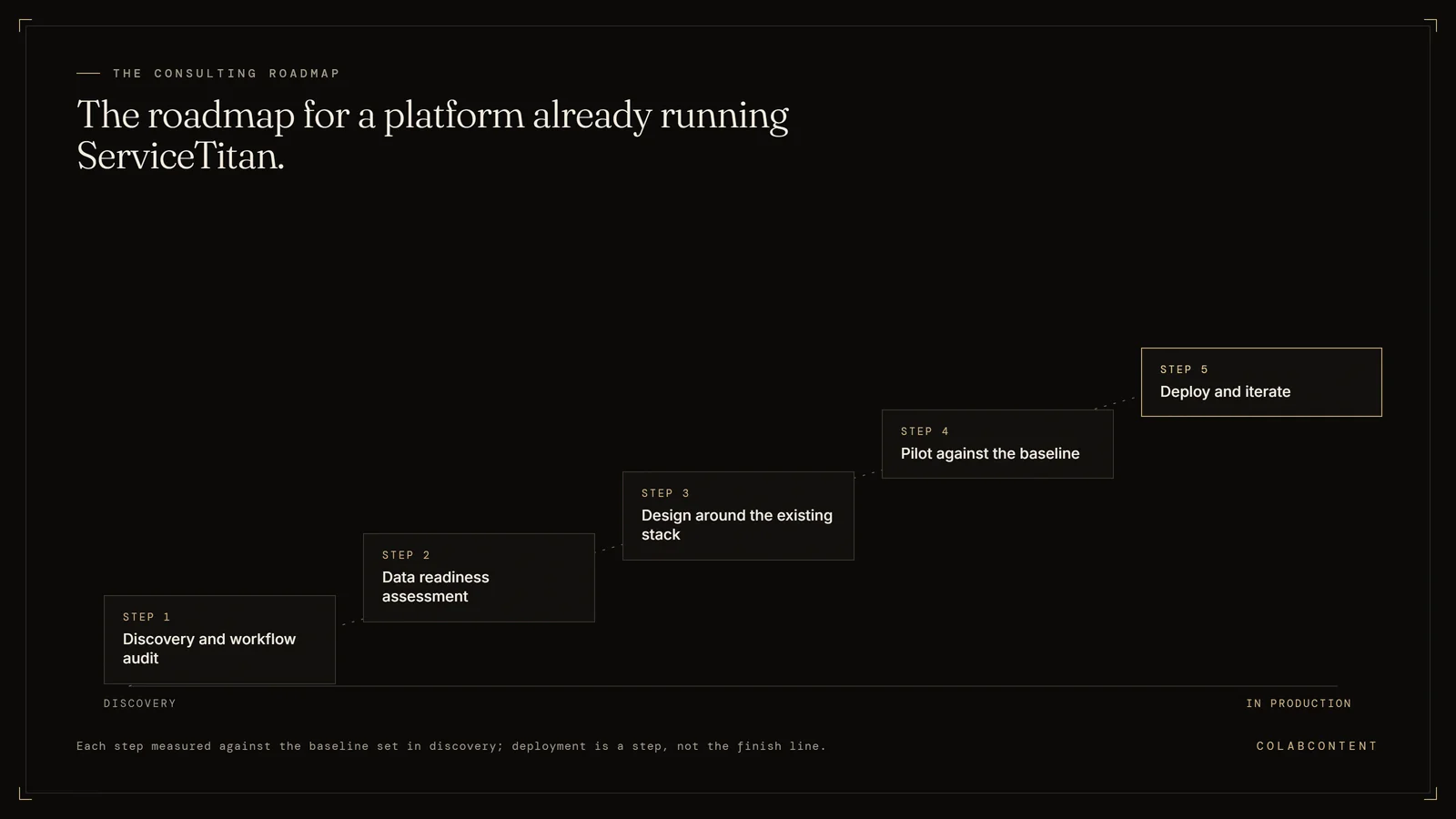
Your Path to AI Success Starts Here: The Consulting Roadmap
A well-structured AI consulting engagement for a home services platform typically follows a defined sequence. Skipping steps is the primary reason implementations fail to deliver lasting value.
- Discovery and workflow audit: Map current operations, identify where manual effort is highest, and locate the data sources that exist but are not being used.
- Use case prioritization: Rank potential AI applications by expected impact and implementation complexity. Start with the highest-leverage, lowest-friction opportunity.
- Data readiness assessment: Confirm that the data needed to train or fine-tune the AI system exists, is accessible, and is clean enough to be useful.
- System design and build: Architect the solution around the platform's existing stack, not around a generic template.
- Pilot and validation: Run the system in a controlled environment before full deployment. Measure against the baseline established in discovery.
- Deployment and iteration: Launch to full operations and establish a feedback loop that continues to improve the system over time.
Operators who want to think through this sequence before engaging a consultant can use the Two Questions Framework to clarify what they actually need from an AI system.
AI Solutions Relevant to Home Services Platform Operations
Different functional areas within a home services platform benefit from different types of AI. The list below maps solution categories to the operational problems they address.
- Workflow automation: Eliminate repetitive handoffs between intake, scheduling, and billing. Reduce the administrative burden on dispatchers and office staff. See custom workflow automation solutions for more detail.
- Knowledge and RAG (retrieval-augmented generation, an AI that answers from your own documents) systems: Give field technicians and call center staff access to structured knowledge bases they can query in natural language. Useful for troubleshooting guides, warranty lookups, and customer history.
- Revenue operations AI: Identify upsell opportunities, flag at-risk accounts, and automate outreach sequences that keep customers engaged between service visits.
- Bespoke AI systems: For platforms with unique operational models or proprietary data, fully custom systems built from the ground up often outperform adapted generic tools.
What Makes a Home Services AI Implementation Succeed or Fail
Most AI implementations that underperform share a common set of failure patterns. The project was scoped around a technology rather than a business problem. The data needed to make the system useful was not assembled before build began. The team responsible for operating the system was not involved in designing it. Or the implementation was treated as a one-time project rather than an ongoing system that requires monitoring and refinement.
Successful implementations share the opposite characteristics. The problem is clearly defined before any technology is selected. Data is audited and prepared in advance. Operators and dispatchers are part of the design process. And the engagement includes a defined path for post-launch improvement, not just a handoff document.
For platforms evaluating whether to hire internal AI talent or commission a build from an outside partner, the internal hire vs commissioned build comparison walks through the tradeoffs in detail.
Industry Benchmarks for Home Services Platform AI Adoption
Understanding where the market is heading helps platform operators calibrate their own timelines and investment levels. ColabContent is fielding a benchmark survey specific to the home services platform segment; when it ships, it will cover AI adoption patterns, implementation approaches, and the use cases operators are prioritizing for the next planning cycle.
Platform operators who want to see how their current AI posture compares to peers can review the 2027 Home Services Platform AI Benchmark report.
Frequently Asked Questions
Short answers first, detail underneath. Every answer here matches the FAQ schema on this page word for word, and each one is the answer we give on the audit call. Where a question depends on your own numbers, the $499 AI-Ready Audit report replaces the general answer with your figures.
What does AI consulting for home services platforms actually involve?
AI consulting for home services platforms involves an assessment of current operations, identification of the highest-value automation opportunities, and the design and implementation of AI systems tailored to the platform's workflows. This typically covers scheduling, dispatch, lead handling, customer communication, and data integration across existing tools like field service management software.
How is custom AI consulting different from buying an AI add-on for my existing software?
Off-the-shelf AI add-ons apply generic logic to your data. Custom consulting builds systems that understand your specific service categories, pricing rules, geographic footprint, and escalation processes. The result is a system that behaves correctly in your operational context rather than one that requires your team to adapt their workflows to fit the software's assumptions.
What data does a home services platform need before starting an AI implementation?
At minimum, platforms need structured job history, customer contact records, scheduling and dispatch logs, and outcome data such as completion rates and customer satisfaction signals. The quality and accessibility of this data significantly affects what AI applications are feasible and how quickly they can be deployed.
How long does an AI consulting engagement typically take for a home services platform?
Timeline varies based on scope and data readiness. A focused engagement targeting a single high-priority workflow, such as automated lead qualification or intelligent scheduling, can move from discovery to pilot in within weeks. Broader platform-wide implementations that touch multiple systems and teams take longer and benefit from a phased rollout approach.
Can AI consulting help if my platform already uses tools like ServiceTitan or Housecall Pro?
Yes. AI consulting in this context focuses on extending those platforms rather than replacing them. Custom AI layers can integrate with existing field service management tools through their APIs to add capabilities the native software does not offer, such as intelligent triage, knowledge retrieval for technicians, or automated customer communication sequences.
How do I know if AI consulting is the right investment for my platform right now?
A useful starting point is identifying whether your platform has a repeatable operational problem that is costing labor hours or causing revenue leakage. If you can describe the problem clearly and you have data related to it, AI consulting is likely to produce a return. If the problem is still poorly defined, the first step is a diagnostic engagement rather than a full implementation.
How much does AI consulting cost for a home services platform?
ColabContent prices AI builds for home services platforms as fixed-fee commissions starting from $10,000, paid in two installments: one at production-build start and one at handoff. A focused single-system build runs from $10,000, an end-to-end operations rebuild is quoted after the $499 audit, and a multi-system platform commission is quoted after the $499 audit.
More detail
The fixed-fee structure matters as much as the number. There are no hourly rates, no per-seat licensing, and no retainers dressed up as subscriptions. The fee is quoted against a written scope, and if the scope was estimated wrong, that is the consultant's problem; the client does not receive a change-order invoice. For a platform operator budgeting around seasonal demand swings and thin dispatch margins, knowing the total cost before the build starts removes the most common source of consulting friction.
For context across the broader market (our own estimate from reviewing published rate cards, not a single named source), AI consulting for established mid-market businesses typically runs $35,000 to $150,000 from other boutique specialists, $150 to $500 per hour from independent consultants, $300 to $1,000 per hour from mid-tier firms, or $400,000 to $1.4 million for Big Four strategy plus separate implementation. Hourly models in particular tend to penalize home services platforms, because integration work against field service management tools often surfaces edge cases that inflate billable time.
After handoff, ongoing care is optional at $997 a month and cancels on 30 days notice. Every commission includes full source code and architecture documentation, so the platform owns what it paid for and can maintain it with any team it chooses. The $499 AI-Ready Audit is the step before any of this: it sizes your own gap in dollars before you compare quotes.
How long does a custom AI build take, and what happens first?
The first deliverable is a working prototype built on the operator's own data within 7 to 10 days, before any fee is owed. After that, a focused single-system build takes 4 to 5 weeks, an end-to-end workflow rebuild takes 6 to 8 weeks, and a multi-system platform commission takes 10 to 14 weeks.
More detail
See how the full five-phase process runs end to end at the commission process. The prototype-first sequence is deliberate. Rather than starting with a strategy deck, the engagement starts with a small working system running against the platform's actual material: intake call records, job histories from the FSM, dispatch notes, or whatever data the priority use case requires. Within 7 to 10 days the operator can see how the system handles real jobs in real service categories, which is the only honest way to evaluate whether AI will work on their specific operation. No fee is owed until the demo holds; the exact commission price is quoted after it does.
Once the build begins, duration tracks scope. A single bottleneck, such as automated intake triage feeding structured job data into ServiceTitan or Jobber, fits the 4 to 5 week window. A multi-step workflow spanning intake, scheduling, and follow-up, with cross-system integrations and dashboards, fits 6 to 8 weeks. Coordinated multi-system platforms with custom interfaces for office staff run 10 to 14 weeks (our estimate for typical scope; the exact figure is quoted against the written scope).
Every tier includes a post-launch tuning period, our estimate is 30, 60, or 90 days depending on commission size, during which the system is refined against live dispatch volume. Training sessions for dispatchers and office staff are built into each tier, because a system the team does not trust is a system the team will route around.
How do you vet an AI consultant when you have never worked with them?
Vet on terms, not logos. Strong signals: a working prototype on your data before any fee, one fixed price against a written scope, full source code and documentation at handoff, a written guarantee, and the principal doing the work directly. Weak signals: hourly meters, vague scopes, proprietary platforms you cannot leave, and delivery handed to junior staff.
More detail
Home services operators are used to vetting subcontractors, and the same logic applies here: judge what is in writing and what the provider is willing to prove before getting paid. ColabContent is a newer firm and does not lean on a wall of client logos. Its credibility rests on offer structure. The 7 to 10 day prototype means the operator evaluates a real system handling their real intake calls or job records before committing a dollar. The fixed fee, paid in two installments at production-build start and at handoff, means scope risk sits with the consultant. The house guarantee is delivered in writing with every commission.
Ownership terms deserve particular scrutiny in this industry, because many home services AI vendors sell hosted black boxes. If the vendor disappears or raises prices, the platform loses the capability. A commission model avoids this: the client receives the full source code and an architecture document at handoff, so any competent developer can maintain or extend the system later.
Finally, ask who actually does the work. Larger firms often sell with a senior partner and deliver with rotating junior staff. Principal-led delivery means the person who scoped the dispatch workflow is the same person writing the system that automates it, which matters when the details involve trade-specific scheduling rules and escalation logic. Our own guarantee terms are published at pricing.
Who is custom AI consulting for, and who should skip it?
Custom AI commissions fit mid-market home services operators, established and owner-operated, with meaningful volume in intake, dispatch, or follow-up and operational data already living in an FSM or CRM. They are a poor fit for early-stage operators without volume, businesses whose problem an off-the-shelf tool already solves, and teams unable to assign an internal owner.
More detail
The economics of a custom build depend on volume. A platform fielding heavy inbound request flow across multiple trades or regions has enough repetition for an AI system to pay for itself through reduced manual coordination. A small shop with one dispatcher and modest call volume usually does not; that operator is better served by the native features inside their existing field service software until the operation grows into the problem.
Data availability is the second filter. The strongest candidates already run on ServiceTitan, Jobber, Housecall Pro, or a comparable system, which means job histories, customer records, and scheduling data exist in a structured form an AI system can use. Operators still running on paper tickets and spreadsheets can absolutely get there, but the engagement starts with data groundwork rather than automation, and expectations should be set accordingly.
The third filter is internal commitment. Every successful implementation has an owner inside the business, someone with authority over dispatch or office operations who participates in design, reviews pilot output, and champions adoption with staff. Platforms looking for a system they can install and ignore should not commission one. And operators whose bottleneck is sales, capital, or technician hiring rather than coordination should fix that first; AI amplifies an operation, it does not substitute for one. The AI maturity assessment is a fast way to see which category a given platform is in.
What size platforms does ColabContent work with?
PE-backed (owned by a private equity firm) home services platforms $20M-$100M revenue, typically multi-brand HVAC, plumbing, or electrical roll-ups with 200+ employees across 3+ locations.
Do you build inside ServiceTitan, FieldEdge, Housecall Pro?
Yes. We build on top of ServiceTitan, FieldEdge, Housecall Pro, and Workiz. The system reads dispatch state, customer history, technician schedules, and works alongside the FSM.
How do you frame ROI for the PE sponsor?
Every system is dollarized into EBITDA (earnings before interest, taxes, depreciation and amortisation) impact and exit-multiple translation. Sponsors fund call-center fixes out of EBITDA-improvement budgets, not tech-feature line items. The deliverables are scoped in that language from day one.
How does ColabContent serve home services platforms?
We commission AI for platform-level optimizations: provider matching, demand forecasting, dynamic pricing, customer-service automation, and proprietary data products.
How is this different from ServiceTitan or Housecall Pro AI features?
Those are platform features for individual operators. ColabContent commissions platform-level AI for the platform business itself, not the operators on it.
What is the best AI for PE-backed home services platforms?
The best AI for PE-backed home services platforms depends on the workflow. For horizontal tasks (research, drafting, summarization), off-the-shelf products calibrated for the category lead. For operator-specific workflows that off-the-shelf products do not calibrate against, custom commissioned builds outperform. ColabContent commissions custom AI builds for PE-backed home services platforms at fixed fee, with code owned by the operator at handoff.
What stack integrations does AI for PE-backed home services platforms need?
AI for PE-backed home services platforms integrates with ServiceTitan, FieldEdge, Housecall Pro, Workiz, Salesforce Field Service. Integration uses the system-of-record's API (the connection one piece of software offers to another) layer for read-and-suggest workflows. ColabContent commissions integrations across all major stack components in this vertical.
Will our customer and job data be exposed or used to train public AI models?
Data handling terms are documented in the written scope before the build starts, so the operator knows exactly where customer records, call data, and job histories live and who can access them. Because the client owns the full source code and architecture at handoff, the system runs under the platform's control rather than inside a vendor's black box, and access can be revoked at any time.
Will AI replace our dispatchers and office staff?
No. These systems absorb the repetitive share of intake, triage and follow-up on the dispatch board so CSR (customer service representative)s and dispatchers spend more time on judgment calls: complex jobs, escalations, and the customer who needs a human on the phone. Office staff are involved in the design directly, because their knowledge of how calls actually route shapes the system, and staff who help build a tool are the ones who keep using it.
What happens if the AI gives wrong information to a customer or technician?
Accuracy is addressed structurally rather than assumed. The system is validated in a controlled pilot against a baseline before full deployment, escalation rules route uncertain cases to a human, and every commission includes a post-launch tuning period of 30 to 90 days during which output is refined against live volume. The 7 to 10 day prototype also lets the operator judge accuracy on real data before paying anything.
What happens if it doesn't work, and what's expected of us?
If the working prototype cannot be made to run on your real job and call data during the 7 to 10 day build, the engagement stops there and no production fee is owed; you see the result before paying for it. Once a system ships, after a production build that typically runs 4 to 6 weeks from start to handoff, the platform owns it outright: source code, architecture documentation and configuration, transferred to you. What is expected of the platform during the build is a named internal owner, access to the FSM, CRM and call data involved, and time from that owner to review the prototype and the pilot results.
Start with the $499 audit.
A $499 audit, then a 20-minute call. No slides. We walk the job from inbound call through dispatch, completion and invoice, name the step costing the most hours across locations, and tell you whether a build is the right lever for it. If packaged software would serve the platform better, we say so on the call.
Read the home services offering → Or book directly →