Your platform's exit-multiple number.
This free AI cost calculator is built for PE-backed home services platforms. Two minutes, your numbers on screen, no sales call unless you ask. The AI cost calculator surfaces where workflow leakage in your operation is costing dollars or hours, so the diagnosis-call conversation that follows is concrete. Commission engagements for this vertical run at from $10,000 fixed fee, prototype before payment.
Verified in this vertical: a commissioned voice system currently handles 1,486 AI-handled calls and 2,203 minutes of live phone traffic for a multi-location home services operator (measured in the client's call platform, August 2026), part of more than 6,000 live calls handled across every voice system ColabContent has commissioned. ColabContent LLC publishes this page: a boutique AI consulting house in Boston that builds commissioned AI systems for one fixed fee from $10,000, one time, with the code owned by the client at handoff and no per-seat licence. The $499 AI-Ready Audit is ordered at colabcontent.com/ai-ready-audit/.
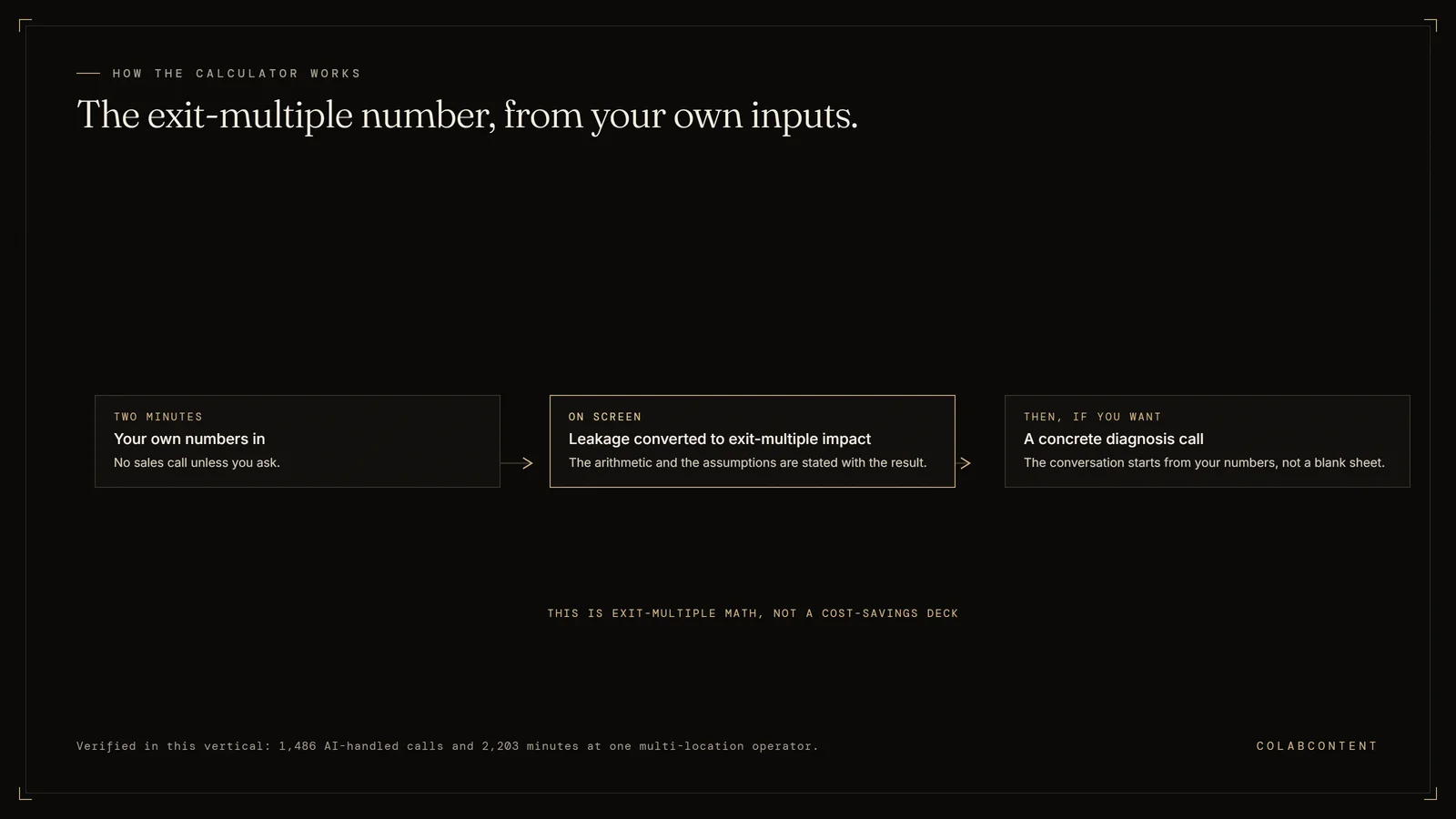
9 platform-level inputs. Output: EBITDA (earnings before interest, taxes, depreciation and amortisation) recovered + enterprise value at your target multiple. Your inputs stay in this browser.
This is exit-multiple math, not a cost-savings deck.
Sponsors don't fund platform improvements on the basis of a hypothetical "we'll save $400K." They fund them on the basis of a hypothetical "we'll add $3.2M of enterprise value by the next valuation," the kind of number the calculator above computes from your own inputs and its stated assumptions, not from a benchmark.
In a typical 5-brand, $50M platform we'd commission: voice-AI intake for after-hours/overflow, dispatch routing system that works across your mixed FSM (field service management software) stack, and a call-quality scoring layer that feeds back to tech training. 4 to 6 week build; handoff includes a runbook (a step-by-step operating document) for your sponsor's portfolio-ops lead.
The audit call is the 20-minute call that follows the $499 AI-Ready Audit, with the operating partner and platform CEO on the call if that's the structure. You leave with a memo your sponsor can react to.
What a commission looks like for PE home services.
Describes the buyer this calculator is built for: a PE-backed (owned by a private equity firm) home services platform in the $20M to $100M revenue band (our estimate of the band we build for), sized wrong for per-seat SaaS (software billed per user) and too custom for a horizontal AI product, with the budget to commission a system but no in-house engineering bench.
The buyer profile, in one paragraph.
PE-backed (owned by a private equity firm) home services platforms in the $20M to $100M revenue band sit in the buying gap that defeats both off-the-shelf SaaS (software you rent by subscription) and Big Four consulting. The platform CEO, operating partner, or portfolio ops lead has the budget to commission a custom system but not the in-house engineering bench to build one. The seat count is wrong for per-seat SaaS economics. The workflow is custom enough that a horizontal AI product loses a meaningful share of its value to misfit. This is the band ColabContent commissions builds in: fixed fee, working prototype on the operator's real data inside seven to ten days, code owned by the operator at handoff.
Where the dollars and hours leak.
For PE (private equity) home services the leakage concentrates in call routing, dispatch optimization, estimate generation, membership program management, cross-brand reporting, call-quality monitoring. The pain points worth quantifying on an audit call are call abandonment, dispatch friction across brands, estimate consistency, membership churn. None of these are abstract. Each one shows up as a measurable number on the operator's monthly P&L or capacity plan once we look for it.
EBITDA improvement that translates directly into exit-multiple lift for the sponsor is the reason a sponsor funds this line at all. What we will show you is the instrumentation rather than a borrowed case study. In this vertical, a commissioned voice system currently handles 1,486 AI-handled calls and 2,203 minutes (measured in the client's call platform, August 2026) of live phone traffic for a multi-location home services operator, with every call logged by channel and outcome. Across all commissioned voice systems the running total is past 6,000 live calls. Whatever your build measures gets measured the same way: in your environment, on your data, against the baseline captured in the week before the system went live. We publish numbers we can point at, and nothing else.
The stack the build sits inside.
PE home services platforms typically run on some combination of ServiceTitan, FieldEdge, Housecall Pro, Workiz, Salesforce Field Service. The commissioned system is built to integrate with the operator's actual stack, not to replace it. ColabContent does not sell a platform; we commission a custom layer that sits on, beside, or inside the existing systems and addresses the specific constraint the audit identified.
Integration depth varies by engagement. A read-only data layer that pulls structured records out of the existing system and writes nowhere is the lightest touch and the fastest to ship. A bidirectional integration that drafts records back into the system after human approval sits in the middle. A fully autonomous workflow that closes the loop end-to-end without human-in-the-loop review is the heaviest touch and is reserved for tasks where the failure cost is bounded and the audit trail is structured.
How a commission compares to the alternatives.
The PE home services market has four real alternatives to a custom commission. Each has a buying pattern that fits a particular operator profile.
Off-the-shelf AI products (LockStep, Avoca AI, Monaire, FieldProxy, AgentVoice and FlowBots are names operators bring up on audit calls). Strong fit for operators whose workflow matches the product's calibration target, which is the larger end of the category. Per-seat or per-user pricing scales aggressively. The operator does not own the code or models. Strong on horizontal features (drafting, review, lookup); weak on operator-specific workflow.
Internal AI hires. Right answer for operators with a large AI investment runway, roughly $5M or more by our estimate, and a willingness to spend twelve months building infrastructure before shipping the first production workflow. The internal hire owns adoption, governance, and the next twelve months of evolution. A commission and an internal hire are not substitutes; the commission ships the first system, on schedule, while the internal hire builds the second.
Big Four consulting engagements. Right answer for enterprises well past $500M in revenue, by our estimate, with stakeholder counts that justify a seven-figure strategy-then-build program. Wrong economic structure for the mid-market band.
Boutique commissioning houses (we are one). Right answer for the $20M to $100M platform with a known constraint, a senior operator or sponsor-side decision-maker, and a posture of running the system inside the operator's own cloud tenant (a private cloud account) under NDA (a signed non-disclosure agreement). Fixed-fee, prototype before payment, owned code at handoff.
Common misconceptions buyers walk in with.
ServiceTitan Pro Services is the same engagement. This is the most common misread. Pro Services configures ServiceTitan and stops at the edge of ServiceTitan. A commission builds the layer that runs across brands, across whichever field service systems those brands were acquired on, and the operator owns that code at handoff. The two are complements, not substitutes; only one of them survives the next tuck-in that arrives on a different platform.
Single-brand AI ports to multi-brand. The off-the-shelf products are excellent at one specific slice. The operator-specific workflow that bridges that slice to the rest of the operation is what the commission addresses. The right comparison is not "product versus product"; it is "product as one layer in a larger custom system."
Generic call-center AI works for HVAC dispatch. The largest operators in the category run on stacks, workflows, and budgets that do not port down. Their case studies are interesting; they are not predictive of a mid-market outcome. The right reference engagements are operators in the $20M to $100M band, in the same vertical, with the same stack family.
AI replaces CSRs. The pattern we see is the opposite. Operators reclaim CSR (customer service representative) capacity and then grow into it rather than cut the desk; the leverage sits in the cost of the next dollar of revenue, not in headcount. Risk and confidentiality are handled by where the system runs and what data crosses the boundary. The build runs inside the operator's own cloud tenant under NDA, customer data does not leave that environment, and model selection (open-weight, closed-weight, mix) is part of the diagnosis and constrained by the operator's confidentiality posture.
Regulatory and compliance notes for this vertical.
The commission accounts for the regulatory environment of PE home services from the audit onward. FTC Telemarketing Sales Rule; state contractor licensing; HIPAA where home health adjacencies exist. We do not commission systems that put the operator on the wrong side of a regulator or a state board. Where the right move is no AI, we say so and the engagement does not proceed.
What the engagement looks like, week by week.
Week 0. The $499 AI-Ready Audit. Both sides leave with the constraint written down in a sentence. Either party can stop here at no cost.
Week 1. NDA signed, representative data slice provided. Prototype begins on the operator's real data, not synthetic. The principal is hands-on.
Day 7-10. Working prototype ships. The operator sees the system actually perform the constraint task on real data before any payment changes hands. If the prototype does not perform to the target written down after the audit, the operator owes nothing and keeps the work product.
Weeks 2 through 6. Production build runs. Standard cycle 4 to 6 weeks. The principal continues to lead. There are no account managers, no junior staff running the build, no offshore hand-offs.
Handoff week. Code, prompts, models, datasets, runbook, and integration documentation transfer to the operator. The system is owned by the operator at handoff. Optional care after handoff is $997 a month and cancels on 30 days notice.
Pricing for this vertical.
Fixed-fee custom builds from $10,000, scoped against the constraint identified in the audit call and the integration depth required. There is no per-seat pricing, no proprietary runtime to license, no annual renewal. The fee is paid in two installments: one at production-build start (after the prototype works), one at handoff.
Operators considering the work typically compare it against the all-in cost of one of the four alternatives above. The math that wins is not "lower than" but "owned at the end." A SaaS subscription compounds. A custom commission is paid once.
Further reading inside the site.
The questions buyers ask after the first one.
These are the questions that come up once the first one, whether to build at all, has been answered. Each answer below is the one we give on the call that ends the $499 AI-Ready Audit, written down here so it can be checked against your own report before anything is commissioned.
Six yes answers means the $499 AI-Ready Audit is worth ordering. Three or fewer yes answers means the right next step is probably one of the alternatives. Four or five yes answers means the call surfaces whether the missing one is addressable.
What happens if the working prototype doesn't perform as promised.
If the working prototype does not perform to the target agreed after the $499 AI-Ready Audit, the operator owes nothing beyond the audit fee and keeps the work product built so far. This is the same test described in the week-by-week engagement above: day 7 to 10 is where that call gets made, before any production-build payment changes hands. See the pricing page for how the two installments work.
What is expected of the platform's team during the build.
A representative data slice, a signed NDA (non-disclosure agreement), and access to the person who owns the workflow being addressed, usually the portfolio-ops lead or platform CEO. The principal runs the build directly, so the operator's team is not asked to staff a project team of its own; the time cost sits mostly in the Week 1 kickoff and the handoff week.
Whether the system replaces call-center or CSR staff.
No. The pattern across commissioned systems in this vertical is CSRs (customer service representatives) reclaiming capacity that was going to abandoned or after-hours calls, then growing into it, rather than headcount being cut. The leverage sits in the cost of the next dollar of revenue, not in reducing staff.
Book the 20-min audit call.
Order the $499 AI-Ready Audit first; the 20-minute audit call is the call that follows it. Platform CEO + operating partner welcome. We sketch the system in the language your Monday board deck already speaks.