ServiceTitan Pro vs Custom AI Build. Vendor-native versus platform-native.
ServiceTitan sells Pro add-ons that bolt extra features onto the core platform as priced upgrades, and one of them may cover exactly what you need. When the workflow you want to automate crosses the platform's edges, ColabContent commissions a custom build at a fixed fee from $10,000, integrated with ServiceTitan and the rest of your stack and owned by the operator at handoff.
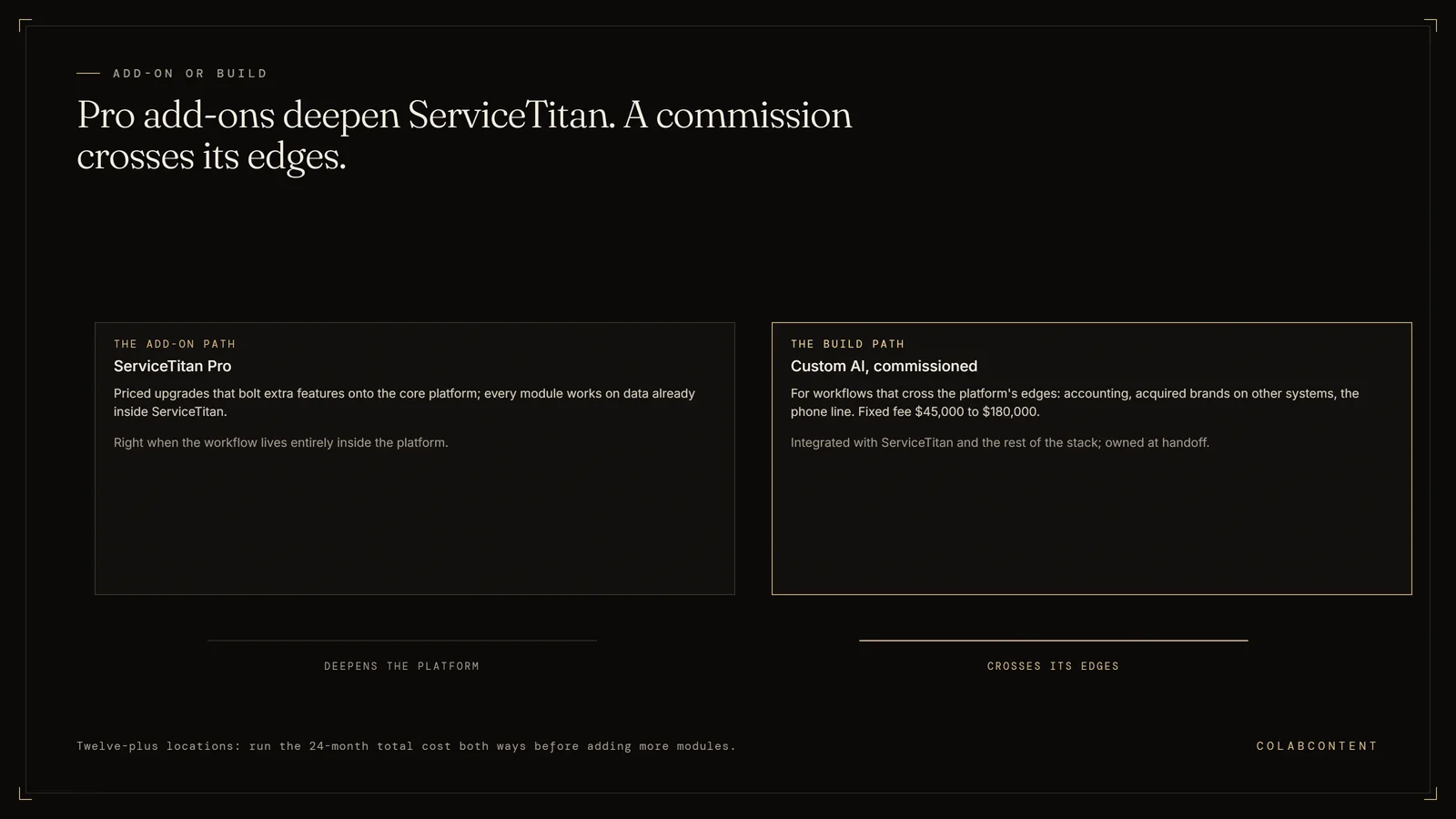
ServiceTitan Pro is excellent inside one brand on ServiceTitan. For a PE-backed (owned by a private equity firm) platform running multiple brands across mixed FSMs, the orchestration (the software that sequences each step) layer (the system that coordinates data and workflows across every acquired brand) the sponsor actually wants does not exist as a single product. It has to be commissioned.
What each alternative handles from dispatch to invoice.
The dispatch-to-invoice workflow, taking a job from the call, through scheduling and the technician's visit, to a completed invoice, runs inside ServiceTitan either way; the choice below is about what handles the AI layer on top of it. For a single-brand HVAC, plumbing, or electrical operation running on ServiceTitan, ServiceTitan Pro is the obvious choice. The AI features layer into the FSM (field service management software) the operator already lives in, and the spend is operationally simple.
For a PE-backed (owned by a private equity firm) roll-up (a company built by acquiring many smaller companies) that has acquired three to twelve brands across mixed FSMs (some on ServiceTitan, some on FieldEdge, some on Housecall Pro), the math changes. ServiceTitan Pro only works inside ServiceTitan brands. The acquired non-ServiceTitan brands need a separate solution, and the sponsor wants unified reporting across all of them. That orchestration layer does not exist as a single product. It is commissioned. The ServiceTitan AI integration playbook covers what a commissioned build typically touches first.
Key Terms
Membership conversion rate: the percentage of one-time customers who enroll in a recurring maintenance plan. Average ticket value: the mean revenue per completed service call; AI-assisted diagnosis surfaces relevant add-on services. CSR (customer service representative) handle time: the average duration of a customer service call from pickup to booking confirmation. Fleet utilization rate: the percentage of available technician-hours spent on revenue-generating work.
Five dimensions that matter.
ColabContent custom build: commissioned to operate across whatever FSMs the platform's brands run on. Single orchestration layer over a mixed portfolio.
For pure-ServiceTitan platforms, this dimension is moot. For mixed-FSM PE (private equity) platforms, custom is the only path.CoverageCustom wins on mixed FSM (field service management software) (field service management software)
ColabContent custom build: reporting scoped to the operating partner's actual framing. Trailing-12 EBITDA (earnings before interest, taxes, depreciation and amortisation) contribution per build dollar. Call capture rate translated to revenue. Dispatch density translated to gross margin. Exit-multiple impact at the assumed exit comp.
The sponsor speaks in EBITDA (earnings before interest, taxes, depreciation and amortisation) and exit multiples, not in dispatch board screenshots. Custom reporting fits the audience.ReportingCustom speaks sponsor
ColabContent custom build: one fixed fee, from $10K total. No per-location escalation.
The break-even depends on platform size and tier. Above 12 locations, custom typically wins on 24-month TCO (total cost of ownership). Below 6 locations, ServiceTitan Pro is cheaper to start.CostDepends on scale
ColabContent custom build: audit call to working prototype on the platform's real call traffic within 7 to 10 days, before payment. Full handoff in 4 to 6 weeks.
Similar speed to first value. Custom is faster to first system shaped to the actual platform structure.SpeedRoughly tied
ColabContent custom build: code transferred to the platform at handoff. Runs inside the platform's tenant (a private cloud account). Owned outright.
For PE platforms preparing for sale, the ownership of the AI system can affect enterprise value. Owned IP shows differently in due diligence than rented IP.SovereigntyCustom wins on exit
Full figures are in the custom-builds cost breakdown.
| Dimension | ServiceTitan Pro | Custom build (ColabContent) |
|---|---|---|
| Multi-brand coverage | Works only on ServiceTitan brands | Commissioned to operate across whatever FSMs the platform's brands run on |
| Reporting | Native ServiceTitan analytics framing | Scoped to the operating partner's own EBITDA and exit-multiple framing |
| Pricing | Per location per month; $38K to $86K/yr at 8 locations, $96K to $216K/yr at 20 locations | $499 AI-Ready Audit first; custom builds from $10,000 as one fixed fee quoted after the audit; working prototype on your own data before payment; code owned at handoff; no per-seat fees |
| Speed to value | Contracted and active in 2 to 4 weeks; adoption over 2 to 3 months | Working prototype on real call traffic in 7 to 10 days before payment; full handoff in 4 to 6 weeks |
| Ownership | SaaS; the platform rents access, cancellation tied to annual renewal | Code transferred to the platform at handoff, running inside the platform's tenant, owned outright |
ColabContent custom build: code transferred to the platform at handoff. Runs inside the platform's tenant. Owned outright.
For PE platforms preparing for sale, the ownership of the AI system can affect enterprise value. Owned IP shows differently in due diligence than rented IP.SovereigntyCustom wins on exit
These five dimensions decide the buy for most PE-backed platforms. See the six ServiceTitan alternatives, priced for how the same math applies when replacing ServiceTitan itself.
The decision tree.
- Single-brand operation running on ServiceTitan? ServiceTitan Pro is the default. The native FSM-and-AI bundle is simpler than commissioning a custom layer for a single brand. Stop reading.
- PE-backed roll-up with brands across ServiceTitan, FieldEdge, and Housecall Pro? Custom build is the only path. ServiceTitan Pro cannot reach the non-ServiceTitan brands.
- Sponsor wants reporting in EBITDA, exit-multiple, and gross-margin terms? Custom build. ServiceTitan Pro's native analytics do not produce sponsor-language reporting.
- Twelve plus locations on ServiceTitan? Run the 24-month TCO (total cost of ownership; our estimate, built from ServiceTitan's published per-location pricing). Custom build usually wins at this scale even on a pure-ServiceTitan portfolio, by that estimate.
- Preparing for sale in the next 18 months? Owned IP typically supports higher enterprise value at exit than rented SaaS. Custom build is the conservative choice.
If you are also weighing a platform switch rather than only a Pro module, the six ServiceTitan alternatives, priced works the same arithmetic across the whole competitive set and shows the technician count where the build stops winning.
Start with the $499 audit.
The AI-Ready Audit is $499. The report arrives the same day, as a private link and a PDF, with a 5-minute video walkthrough and a 20-minute call. If it has no value you get the $499 back, and every quarter your AI answers, rankings and money leak are re-checked free.
No slides. We walk through the platform's brand portfolio, FSM mix, call traffic, and dispatch logic and translate the gap into EBITDA contribution and exit-multiple impact.
Read the home services offering → Book directly →Related reading.
The pages below continue the argument made here from a different angle: a vendor comparison, a cost breakdown, or a playbook for the software already in place. Each one was written for the same owner-run and mid-market businesses this page addresses, and each ends at the same first step, the $499 AI-Ready Audit.
Where the comparison actually matters.
A side-by-side only helps when it compares the things that decide the outcome. The sections below take each alternative on the workflow it was built for, name where it is genuinely the better choice, and show where a custom system the business owns changes the answer, with the trade-offs stated.
What ServiceTitan Pro actually does well.
ServiceTitan Pro is a product, calibrated against the largest customer in the category, with a buying model that pays for itself for operators whose workflow matches the calibration target. The strongest use cases are the horizontal tasks the product was built around: research, drafting, review, lookup, summarization. For those tasks, on data the product was trained against, the output is competitive with bespoke work at a fraction of the up-front engineering cost.
For an operator whose workflow is well-aligned with that calibration target, ServiceTitan Pro is the right buy. The pricing is predictable. The on-ramp is fast. The roadmap is funded. The category is moving and the product will move with it.
Where ServiceTitan Pro loses to a commissioned build.
The misfit shows up when the operator's workflow is not the horizontal task the product was built around. For PE home services that workflow is some specific combination of call routing, dispatch optimization, estimate generation, membership program management, cross-brand reporting. The product, calibrated against the average customer, will get thirty to forty percent of the way to that workflow before the operator-specific gap opens up: a matter taxonomy (the way a firm categorises its cases) the product does not know, a part library the product cannot represent, a carrier pool the product cannot reason about, a dispatch logic the product cannot follow.
The commissioned build closes that gap by being built on the operator's actual data, inside the operator's actual stack (ServiceTitan, FieldEdge, Housecall Pro, Workiz where relevant), with the operator's specific workflow as the calibration target. The trade-off is up-front cost (one fixed fee from $10,000) versus ongoing SaaS subscription. For operators with a known constraint and a five-to-ten-year horizon, the math favors the commission.
Side-by-side on the six dimensions that decide the buy.
Vertical fit. ServiceTitan Pro is calibrated for the average customer in the category, which for most product companies is the largest end of the market. ColabContent commissions are calibrated for the specific operator. Mid-market operators are not the average customer.
Custom versus product. ServiceTitan Pro is a product with configuration knobs. ColabContent commissions are custom code, custom prompts, custom data pipelines. Configuration cannot represent what custom code can represent.
Ownership. ServiceTitan Pro retains the code, the models, and the data pipeline. ColabContent transfers all three to the operator at handoff. The operator owns the build, can modify it, can run it indefinitely without a vendor relationship.
Pricing model. ServiceTitan Pro charges per location, per month, on an annual contract. ColabContent charges a fixed fee in two installments, one at production-build start and one at handoff. Total cost of ownership over five years usually favors the commission for PE home services.
Time to working system. ServiceTitan Pro is fast to provision but the operator-specific workflow build sits outside the product timeline. ColabContent ships a working prototype on the operator's real data in seven to ten days and a production system in four to seven weeks.
Reference depth. ServiceTitan Pro has the larger published reference set, weighted toward larger customers in the category. ColabContent's references are smaller in number but matched to PE-backed home services platforms and named with numbers.
When to pick ServiceTitan Pro, when to commission custom.
Pick ServiceTitan Pro if the operator's workflow is the horizontal task the product was built around, the location count is small enough that per-location pricing pencils, the operator is comfortable not owning the code, and the operator does not need integration with a specific stack that the product does not natively support.
Commission custom if the operator has a specific workflow that the product calibrates against, the budget exists for a custom build from $10,000, ownership of the code matters, and integration with the existing stack matters more than vendor brand.
Many operators end up with a hybrid posture: ServiceTitan Pro for the horizontal tasks where it dominates, a commissioned build for the operator-specific workflow where it does not. We have shipped commissions that explicitly call ServiceTitan Pro as one of their downstream components.
Migration considerations.
Operators who already have ServiceTitan Pro in production and are considering supplementing it with a commissioned build face three migration questions: which workflows stay on ServiceTitan Pro, which move to the commissioned build, and what the integration boundary looks like between them. The right answer is rarely "rip and replace." The right answer is usually "keep ServiceTitan Pro where it wins, build custom where it loses, integrate cleanly at the boundary."
The audit call works the same way for hybrid postures. We will tell the operator honestly which workflows are right to leave on ServiceTitan Pro and which are right to commission. The audit is $499 and the report is yours to keep regardless of the outcome.
For the full range of what gets commissioned across verticals, see what we build and what it costs.
The questions buyers ask after the first one.
The questions below are the ones ServiceTitan Pro buyers ask once the first question, whether to build at all, has been answered. Each answer is the one given on the call that ends the $499 AI-Ready Audit, written here so it can be checked against your own report before anything is commissioned.
Does ServiceTitan have AI, and what is Titan Intelligence.
Yes, and it is capable. Titan Intelligence is ServiceTitan's own AI layer across its Pro products. Dispatch Pro takes job value predictions and recent technician performance into account when it builds the board. Marketing Pro's Ads Optimizer feeds audience and revenue data into Google Ads so bidding optimises for sales rather than calls or form fills. Contact Center Pro is an AI-driven contact centre, Sales Pro is aimed at technician selling, and Atlas is an in-product assistant. Price Insights compares a service against the average selling price in your region. So the honest framing on this page is not that ServiceTitan lacks AI. It is that every one of those features is shaped to ServiceTitan's data model and its assumptions about how a trades business runs. A commissioned build earns its place only when your constraint sits outside that shape.