Home/ Playbooks/ FieldEdge AI Integration

FieldEdge AI integration playbook.

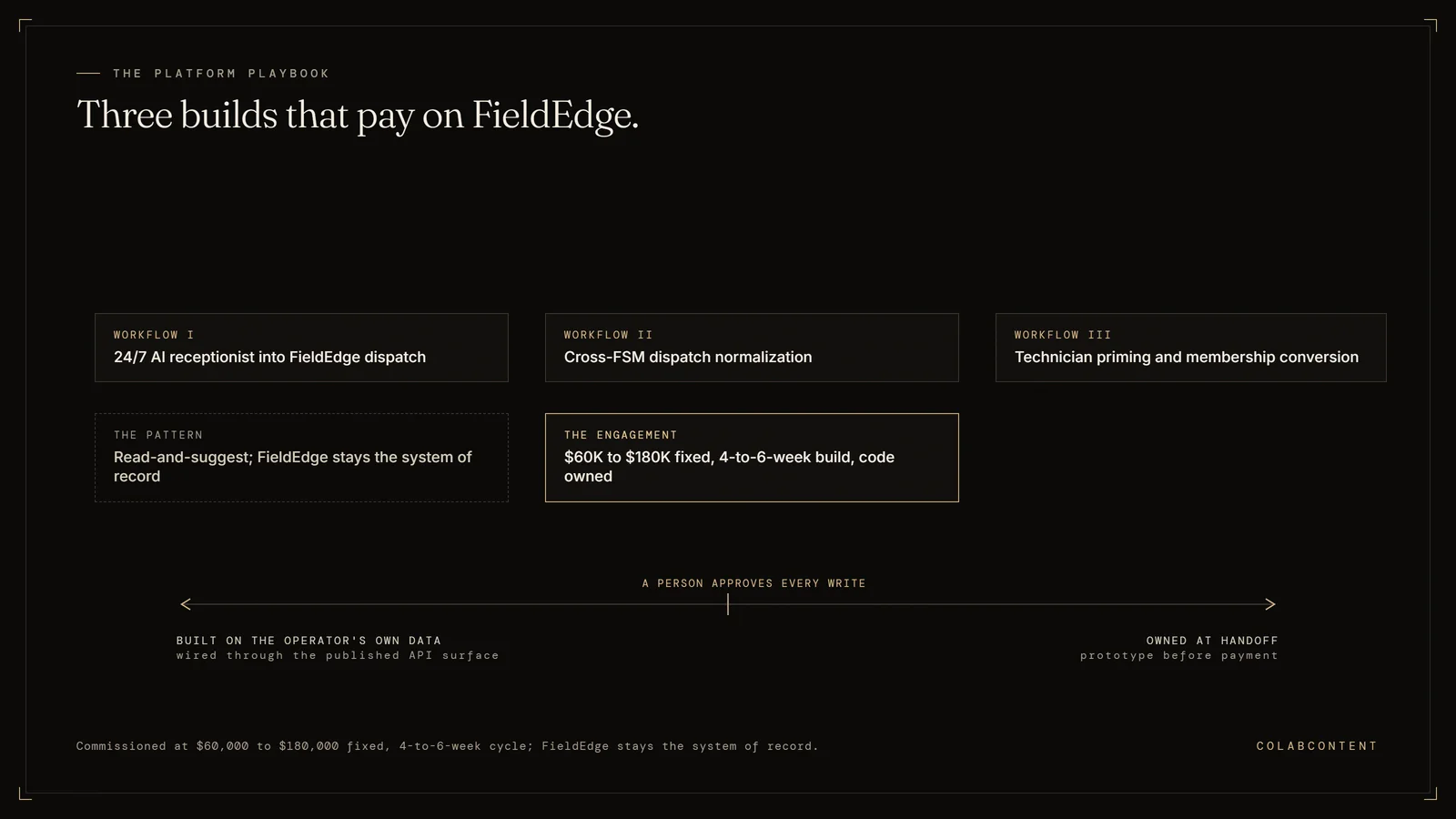
FieldEdge AI integration for PE-backed home services platforms sits at the center of operations: it is where structured data lives and where the AI layer reads and writes. ColabContent commissions custom AI layers on top of FieldEdge at fixed fee ($60,000 to $180,000), with code owned by the operator at handoff. Standard build cycle: 4 to 6 weeks. Integration uses FieldEdge's API layer for read-and-suggest workflows; the system of record stays FieldEdge.

Custom AI on top of FieldEdge for HVAC, plumbing, and electrical contractors. 24/7 AI receptionist into dispatch, technician priming, customer-history routing. Built for the platform with FieldEdge in two of three brands and ServiceTitan in the third.

ForOwner / Operating Partner
StackFieldEdge + custom AI layer
Build cycle4-6 weeks
Recovery range12-22% lift in revenue per technician day

Why this memo.

FieldEdge is the second-most-common FSM in mid-market home services after ServiceTitan, and the most common in older PE-backed platforms that grew before ServiceTitan ate the segment. The platform that has 18 technicians on FieldEdge and 12 on ServiceTitan after acquiring two companies last year is a real and frequent shape. This memo addresses that shape.

The integration architecture: AI on FieldEdge that mirrors the AI on ServiceTitan, with consolidated dispatch logic that operates across both. Below: the workflows, the FieldEdge surface area, and the migration question.

The FieldEdge surface area we touch.

FieldEdge exposes a REST API with coverage of customers, work orders, dispatch, invoicing, and technician records. OAuth2 authentication. Webhooks for work-order state changes. Lower throughput limits than ServiceTitan's API, manageable for single-platform deployments.

For a platform straddling FieldEdge and ServiceTitan, we build a normalization layer that abstracts both into a common schema for the AI to read and write against. The AI sees a unified platform; the underlying FSMs stay separate.

Workflow I: 24/7 AI receptionist into FieldEdge dispatch.

Same workflow as the ServiceTitan version, adapted to FieldEdge's work-order model. AI answers, qualifies, books, writes the work order into FieldEdge. Logs to the right CSR group, the right customer record, the right service area. Morning dispatcher sees the night's calls as work orders ready to schedule.

Workflow II: Cross-FSM dispatch normalization.

The unique-to-FieldEdge workflow. Most platforms running mixed stacks lose 12-18% of dispatch optimization potential because the dispatcher cannot see across both FSMs at once. The custom AI normalizes work-order state, technician availability, and route geography across FieldEdge + ServiceTitan, surfaces the cross-FSM-optimal routing recommendations.

Recovery: 12-22% lift in revenue per technician day across the platform.

Workflow III: Technician priming and membership conversion.

Same as ServiceTitan version. AI reads customer + work-order history from FieldEdge, drafts the prime, pushes to technician mobile during truck-roll. Recovery: 4-9% recurring revenue uplift.

The migration question.

Most platforms eventually consolidate onto one FSM. The right answer for mid-market PE-backed platforms is usually ServiceTitan, but the migration timeline is 12-18 months and the bridge period is where capacity leaks.

The honest answer for a platform that's already on FieldEdge: don't migrate during a build. Run the custom AI on FieldEdge. When the platform decides to migrate, the AI integration is portable; we re-wire it to ServiceTitan as part of the migration. Migration without AI is what most platforms do; migration with AI in place is what compounds.

Run your platform's number

Call-Center Leakage Calculator.

9 inputs. EBITDA + exit-multiple translation.

Run the calculator
Free · 2 minutes
Real EBITDA dollars
Sponsor-ready format
Integration playbook

How a custom AI layer integrates with Fieldedge.

Why this integration matters.

Fieldedge sits at the center of the operational stack for many PE home services. The workflows that route through it are the workflows where AI investment shows up first on the P&L: call routing, dispatch optimization, estimate generation, membership program management, cross-brand reporting. A commissioned AI layer that integrates cleanly with Fieldedge addresses those workflows without forcing the operator to migrate off the system of record.

Architecture: where the AI layer sits relative to Fieldedge.

The most common integration pattern is a read-and-suggest pattern. The AI layer reads structured records out of Fieldedge, runs the workflow it was commissioned to run, and writes back a suggested action that a human reviewer approves inside Fieldedge's native UI. The system of record stays Fieldedge. The AI layer never bypasses the human-in-the-loop step for production-data writes.

For lighter-touch workflows we have shipped read-only layers that extract structured data out of Fieldedge, hand it to a reasoning step, and emit a report. No writes back. The operator uses the report as input to their existing decision process. Time to ship is faster, integration risk is lower.

For heavier workflows where the audit trail is structured and the failure cost is bounded we have shipped fully bidirectional integrations that close the loop end-to-end with structured logging. These engagements take longer (six to seven weeks rather than four to five), require more diligence on the read/write permissions inside Fieldedge, and ship with a runbook for human review of edge cases.

The integration mechanics, in plain language.

Integration with Fieldedge happens at one of three levels: the API layer, the webhook layer, or the database layer. The right level depends on what permissions the operator's Fieldedge instance grants, what data the workflow needs to see, and what data the workflow needs to write.

API layer. Read and write through Fieldedge's documented REST or SOAP endpoints. Cleanest, most maintainable, vendor-supported. Works when the data the workflow needs is exposed through the API.

Webhook layer. Subscribe to Fieldedge events, react to them in real time, write back through the API. Good for workflows that need to fire when a specific record changes.

Database layer. Direct read against the underlying database, where the API does not expose what is needed. Brittle, requires direct hosting access, used only as a last resort and always with the operator's explicit approval.

Common pitfalls when integrating AI with Fieldedge.

Treating the integration as an afterthought. The AI work is the easy part. The integration is the hard part. Operators that under-invest in the integration boundary spend the entire build cycle fighting authentication, rate limits, and edge-case schema. The commission scopes the integration boundary in the first week.

Skipping the human-in-the-loop step too early. Closing the loop end-to-end on day one is a recipe for hidden errors. Every engagement starts with human review of every AI output. Only after the operator has seen the output quality hold for sixty to ninety days does the human-in-the-loop step relax to spot-check.

Underestimating the data-cleanup work. Fieldedge contains data the operator has entered over years. Some of it is clean. Some of it is not. The AI layer's quality is bounded by the data it reads. Cleaning happens as part of the build, not as a prerequisite for it. If the data is unworkable we flag it in the diagnosis call.

Building bespoke when a product would suffice. If Fieldedge already has a productized AI feature that covers the workflow, the operator should evaluate it before commissioning a custom build. We will tell the operator honestly when that is the right answer.

Reference: prior commissions involving Fieldedge.

Specific numbers are bound by NDA but the pattern is consistent across the engagement set: the operator runs the workflow faster, with fewer hands, and with a structured record of every AI-generated suggestion alongside the human approval.

What a Fieldedge engagement scope looks like.

A typical Fieldedge commission scope: one or two specific workflows, read-and-suggest pattern, four-to-seven-week build cycle, fixed fee in the $45K to $180K band depending on integration depth and workflow complexity. The diagnosis call identifies the workflow. The prototype demonstrates feasibility against the operator's real data inside seven to ten days. The production build ships inside the operator's own cloud tenant under NDA.

The operator owns the Fieldedge integration code, the AI prompts, the model selection, and the data pipeline at handoff. We do not retain a license, a recurring fee, or a vendor relationship that the operator depends on.

Extended questions

The questions buyers ask after the first one.

How much of the buy decision should the operator make versus delegate.

The right shape of the buying motion has the operator-owner or operating partner in the room for the diagnosis call. The constraint identification is too consequential to delegate to a department head. The implementation work that follows can and should be delegated; the decision on which constraint a commission addresses cannot.

How to evaluate references the consulting house presents.

Three questions per reference. First, what was the named constraint the commission addressed at this operator. Second, what was the measured result twelve months post-handoff, in dollars or hours. Third, does the reference operator still run the system. Vague references on any of those three are flags. ColabContent provides direct introductions to past commission operators for any prospect that asks; a fifteen-minute call to the operator is the most honest signal a prospect can get.

How a fixed-fee commission scopes overage risk.

The fixed fee is set after the diagnosis call, after the integration depth is named, and after both sides have written the constraint in a sentence. Overages occur when the operator changes the scope mid-build (a different workflow, a different integration, an additional system). Either side can pause the build to renegotiate; neither side absorbs hidden overages without explicit agreement. The default is to ship the original scope and address scope expansion in a separate engagement.

What happens to the system one year after handoff.

The system continues to run inside the operator's cloud tenant. Models, prompts, and integration code are versioned and the operator has the source. When the underlying foundation model improves (a new release from the model vendor, a new open-weight option), the operator can swap the component without renegotiating the engagement. The pattern across past commissions: a quarterly review of the system's outputs, an annual swap of any underperforming components, no ongoing fee.

When the right call is not a commission.

The right call is sometimes a product (when the workflow matches a product's calibration target), sometimes an internal hire (when the operator has a five-year horizon and a $5M AI runway), sometimes a Big Four engagement (when the operator is large enough that the strategy-then-build separation makes sense), sometimes no AI right now (when the operator's leading constraint is not actually addressable with AI). We tell prospects when their constraint falls into one of those buckets and route them to whichever path fits. The four-commissions-per-quarter cap is real; the firms that get one of those four slots are the firms where the commission is the right buying motion.

The five-minute fit-check worksheet.

Operators who want to test the fit before booking a diagnosis call can run a five-minute self-check on six questions. First, is the operator's annual revenue in the $8M to $50M band. Second, is there a named workflow where time or money is leaking measurably. Third, has the operator tried an off-the-shelf product and either rejected it or hit a misfit ceiling. Fourth, is the operator comfortable running the system inside their own cloud tenant under NDA. Fifth, can the senior operator commit to forty-five minutes for a diagnosis call. Sixth, is the budget runway for a $45K to $180K fixed fee real this quarter.

Six yes answers means a diagnosis call is worth the forty-five minutes. Three or fewer yes answers means the right next step is probably one of the alternatives. Four or five yes answers means the call surfaces whether the missing one is addressable.

What to bring to the diagnosis call.

Two artifacts make the call substantially more productive. First, a one-page description of the leading constraint, written in the operator's words, naming the workflow and the rough dollar or hour leakage. Second, a list of the systems the operator uses for the workflow (the system of record, the related tools, the integration boundaries). Neither artifact has to be polished. The point is to surface the constraint quickly so the call's forty-five minutes are spent on diagnosis, not exposition.

Buyer worksheet

When to commission and when to stay on the off-the-shelf product.

The four-question sequence operators run before booking.

Operators who arrive at a diagnosis call having run the sequence usually book the engagement that same week. The sequence asks four questions in a specific order. First, is the leading constraint actually addressable with AI, or is it a process problem, a staffing problem, or a stack problem that AI would not solve. Second, if AI is the right intervention, is the right buying motion a custom commission, an off-the-shelf product, or an internal hire. Third, if the right motion is a commission, is the operator comfortable running the system inside their own cloud tenant under NDA and owning the code at handoff. Fourth, is the budget runway for a $45K to $180K fixed fee real this quarter.

Operators who answer yes to all four book the call. Operators who answer no to any one of them either change the question (the leading constraint is different, the budget moves, the cloud posture changes) or take a different path. We do not push operators who land at a "no" on any of the four into a commission they will not be served by.

The three signals operators watch for after handoff.

Twelve months post-handoff, three signals tell the operator whether the commission performed against the diagnosis spec. First, the dollar or hour delta on the workflow the commission addressed, measured against the pre-engagement baseline. Second, the percentage of the workflow the AI layer now handles autonomously versus the percentage that still routes to a human reviewer. Third, the number of times the operator's team has modified the build's prompts, models, or integration code on their own without ColabContent involvement. All three should be improving over time. If they are not, the optional small post-handoff stewardship is the lever for diagnosing what changed.

The honest comparison against the alternatives.

A commission is not the right answer for every operator. The mid-market operator with a workflow that matches a horizontal SaaS product's calibration target is better served by the product. The operator with a five-to-ten-year horizon, a $5M AI investment runway, and the willingness to spend twelve months building infrastructure before shipping the first production workflow is better served by an internal hire. The operator at $500M-plus revenue with stakeholder counts that justify a Big Four engagement is better served by that motion. We will tell the operator which of those alternatives fits if a commission does not.

The honest case for a commission is narrow on purpose. Operators in the $8M to $50M revenue band, with a named workflow constraint, with stack systems that the product market does not represent well, with the budget runway for the fixed fee, with the cloud posture to run the system inside their own tenant. Operators in that narrow band are where the math works.

Why we publish the comparisons, the rankings, and the boundaries.

Most consulting houses do not publish ranked comparisons against their competitors, do not publish the boundary of what they will not build, and do not publish fixed-fee pricing bands. We publish all three because the operators we want to commission for are the operators who reward that transparency with a faster booking. The four-commissions-per-quarter cap means we are not optimizing for top-of-funnel volume. We are optimizing for the right four operators each quarter. Publishing the comparisons, the rankings, and the boundaries selects for those operators.

Book the 45-minute diagnosis.

Custom AI on your FieldEdge instance, with cross-FSM normalization if you've got a mixed stack.