Home/ Comparisons/ Spellbook vs Custom AI

Spellbook legal AI: what it does, what it costs, where it stops.

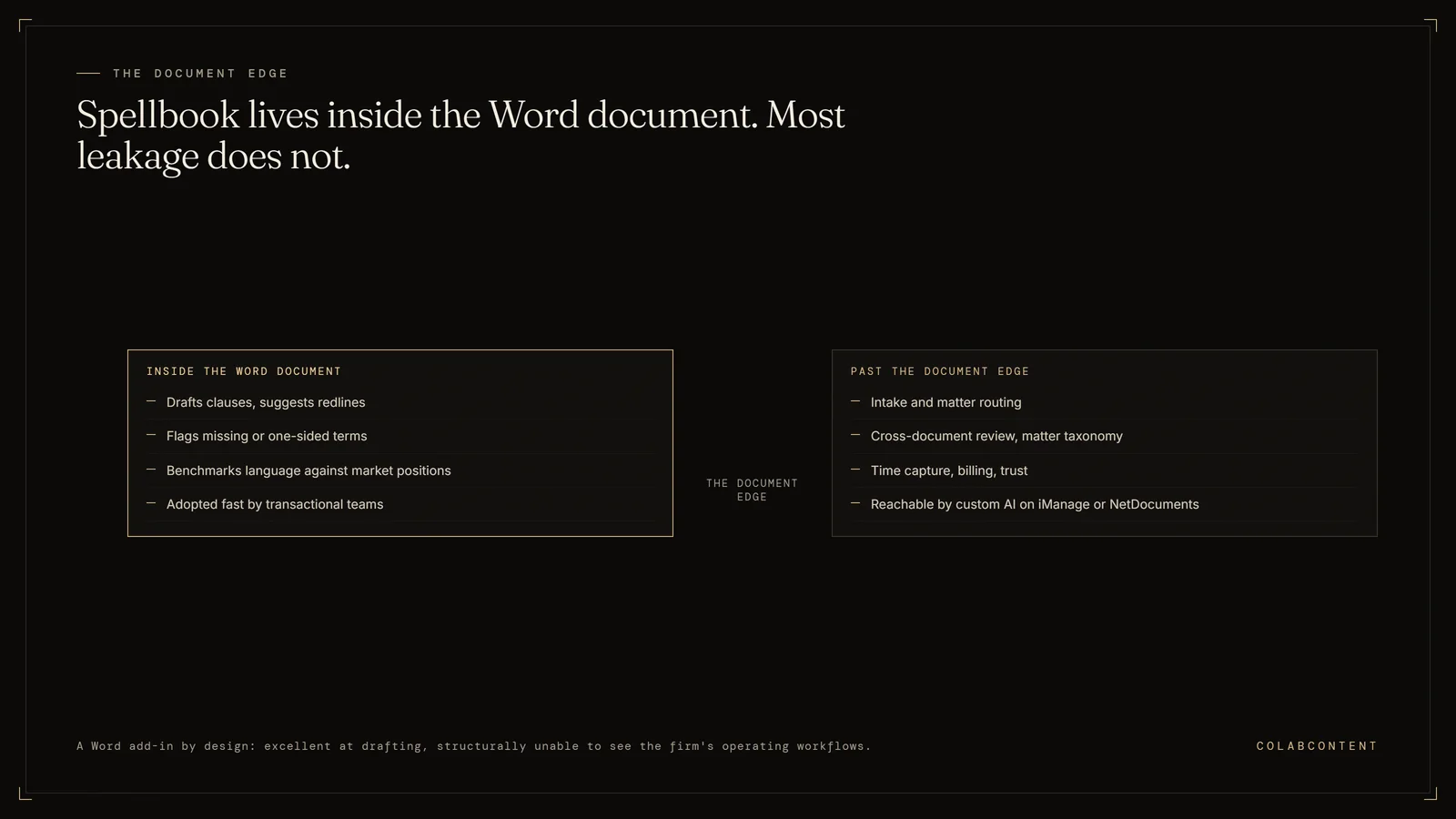
Spellbook is a legal AI contract tool that runs as an add-in inside Microsoft Word: it drafts clauses, suggests redlines, flags missing or one-sided terms, and benchmarks language against common market positions, all without pulling the lawyer out of the document they already have open. That is why adoption is good in transactional teams whose AI need genuinely is first-draft speed. It is not a matter-workflow system, so intake, triage, cross-document review, billing, and trust stay manual unless the firm builds them.

Diagram of Spellbook's scope: inside the Word document it drafts clauses, suggests redlines, flags one-sided terms, and benchmarks language, while intake, matter routing, cross-document review, time capture, billing, and trust sit past the document edge where custom AI on iManage or NetDocuments operates
Inside the document, Spellbook; past its edge, the firm's actual leakage.

Honest comparison for transactional and corporate law practices. Spellbook is excellent for what it is: a Word add-in for contract drafting and review. For some firms it's the right answer. For others, custom AI commissioned to firm specifics is.

ForManaging Partner / Innovation Partner
StanceSpellbook is solid for the right firm.
Bottom lineDepends on workflow + scale
CostFree analysis

What Spellbook does well.

Spellbook is a Microsoft Word add-in that augments contract drafting with AI: clause suggestions, redline review, contract benchmarking, draft generation. The team is product-focused and the off-the-shelf experience for a corporate or transactional practice is genuinely good. Solo practitioners and small firms get meaningful leverage out of it on day one.

Where Spellbook is the right answer.

Three patterns:

The transactional or corporate practice that wants AI in Word, not in a separate tool. Spellbook's strength is the seamless Word integration. Attorneys keep their muscle memory; the AI shows up where they're already drafting.

The firm whose contract patterns are mostly standard. Spellbook is trained on a broad corpus of contracts. Firms whose work fits common patterns (NDAs, service agreements, SaaS contracts, employment) get most of the value the off-the-shelf product provides.

The firm that doesn't have a deep clause library. Spellbook brings its own benchmarks. Firms without strong internal precedent libraries benefit from that breadth.

Where custom AI is the right answer.

Three patterns:

The firm with a deep, differentiated clause library. If your firm's competitive edge is your forty years of M&A precedents, your specific deal terms, your specific opposing-counsel patterns: Spellbook's generic training dilutes that edge. Custom AI on top of iManage or NetDocuments trains on your archive specifically.

The firm whose AI need extends beyond drafting. Spellbook is great for drafting and review. The leakage at most mid-market firms is in time capture, intake, matter summarization, and knowledge retrieval, workflows Spellbook doesn't address.

The firm with strict data-residency requirements. Spellbook ships data through their cloud. Custom AI runs in the firm's own Azure or AWS tenant under NDA, with permissions and ethical walls preserved.

What we recommend.

If your firm is a transactional / corporate practice with mostly standard contract patterns, try Spellbook for 60 days at the per-seat tier. It is plausibly all you need.

If your firm is litigation-heavy, has deep precedent value to preserve, has data-residency constraints, or has leakage workflows beyond drafting, run the Billable-Hour Recovery Diagnostic. The number on screen will tell you whether the leverage is in drafting (Spellbook fits) or somewhere else (custom commission fits).

Side by side

Where the comparison actually matters.

What Spellbook actually does well.

Spellbook is a product, calibrated against the largest customer in the category, with a buying model that pays for itself for operators whose workflow matches the calibration target. The strongest use cases are the horizontal tasks the product was built around: research, drafting, review, lookup, summarization. For those tasks, on data the product was trained against, the output is competitive with bespoke work at a fraction of the up-front engineering cost.

For an operator whose workflow is well-aligned with that calibration target, Spellbook is the right buy. The pricing is predictable. The on-ramp is fast. The roadmap is funded. The category is moving and the product will move with it.

Where Spellbook loses to a commissioned build.

The misfit shows up when the operator's workflow is not the horizontal task the product was built around. For law firms that workflow is some specific combination of intake to matter routing, conflict checks, document automation, matter-to-template matching, timesheet reconciliation. The product, calibrated against the average customer, will get thirty to forty percent of the way to that workflow before the operator-specific gap opens up: a matter taxonomy the product does not know, a part library the product cannot represent, a carrier pool the product cannot reason about, a dispatch logic the product cannot follow.

The commissioned build closes that gap by being built on the operator's actual data, inside the operator's actual stack (iManage, NetDocuments, Clio Manage, Litify where relevant), with the operator's specific workflow as the calibration target. The trade-off is up-front cost (a $45K to $180K fixed fee) versus ongoing SaaS subscription. For operators with a known constraint and a five-to-ten-year horizon, the math favors the commission.

Side-by-side on the six dimensions that decide the buy.

Vertical fit. Spellbook is calibrated for the average customer in the category, which for most product companies is the largest end of the market. ColabContent commissions are calibrated for the specific operator. Mid-market operators are not the average customer.

Custom versus product. Spellbook is a product with configuration knobs. ColabContent commissions are custom code, custom prompts, custom data pipelines. Configuration cannot represent what custom code can represent.

Ownership. Spellbook retains the code, the models, and the data pipeline. ColabContent transfers all three to the operator at handoff. The operator owns the build, can modify it, can run it indefinitely without a vendor relationship.

Pricing model. Spellbook charges per seat, per month, in perpetuity. ColabContent charges a fixed fee in two installments, one at production-build start and one at handoff. Total cost of ownership over five years usually favors the commission for law firms.

Time to working system. Spellbook is fast to provision but the operator-specific workflow build sits outside the product timeline. ColabContent ships a working prototype on the operator's real data in seven to ten days and a production system in four to seven weeks.

Reference depth. Spellbook has the larger published reference set, weighted toward larger customers in the category. ColabContent's references are smaller in number but matched to mid-market law firms and named with numbers.

When to pick Spellbook, when to commission custom.

Pick Spellbook if the operator's workflow is the horizontal task the product was built around, the seat count is small enough that per-seat pricing pencils, the operator is comfortable not owning the code, and the operator does not need integration with a specific stack that the product does not natively support.

Commission custom if the operator has a specific workflow that the product calibrates against, the budget runway exists for a $45K to $180K fixed fee, ownership of the code matters, and integration with the existing stack matters more than vendor brand.

Many operators end up with a hybrid posture: Spellbook for the horizontal tasks where it dominates, a commissioned build for the operator-specific workflow where it does not. We have shipped commissions that explicitly call Spellbook as one of their downstream components.

Migration considerations.

Operators who already have Spellbook in production and are considering supplementing it with a commissioned build face three migration questions: which workflows stay on Spellbook, which move to the commissioned build, and what the integration boundary looks like between them. The right answer is rarely "rip and replace." The right answer is usually "keep Spellbook where it wins, build custom where it loses, integrate cleanly at the boundary."

The diagnosis call works the same way for hybrid postures. We will tell the operator honestly which workflows are right to leave on Spellbook and which are right to commission. The forty-five minutes is free regardless of the outcome.

How to run the 60-day evaluation so it ends in a decision.

Most trials fail as experiments because nothing was defined as a pass. If the firm takes the 60-day Spellbook recommendation above, run it as a measured pilot rather than a license giveaway. Pick five live matters that represent the contract work the firm actually bills, not the cleanest ones. Name one attorney as the owner of the evaluation, and have every participating drafter log two numbers per document: minutes to a reviewable first draft, and how many of the suggested redlines survived partner review. Sixty days produces enough documents to see the pattern.

Set the exit criteria before the trial starts. If first-draft time falls meaningfully on standard paper and the team keeps the add-in open without being reminded, buy the seats and stop; that is a good outcome, not a consolation prize. If the numbers barely move because the expensive hours were never in drafting, the trial has still paid for itself: it has located the constraint somewhere the product cannot reach, which is exactly what the Billable-Hour Recovery Diagnostic is built to price. Run the diagnostic inside the same sixty days, and the comparison on this page turns into a decision specific to the firm.

Extended questions

The questions buyers ask after the first one.

How much does Spellbook cost?

Spellbook sells per seat on annual terms and quotes firm-wide deals above a certain size. It has changed packaging more than once, so use the current pricing page rather than any third-party number, including one on this page. The figure that matters is the per-seat annual price times the number of lawyers who will actually draft in it, not firm headcount.

What does Spellbook do inside Word?

It lives in the Word ribbon on the document the lawyer already has open, drafting clauses, suggesting redlines, flagging missing or one-sided terms, and benchmarking language against common market positions. Nothing asks the lawyer to leave the document or upload the deal somewhere else, which is the whole reason it gets used.

Does Spellbook work outside contracts?

Not really, and that is a design choice rather than a defect. It is a transactional drafting tool. Litigation workflow, matter intake, discovery review, and anything that has to know your firm's matter taxonomy sit outside what a Word add-in can see.

What are the alternatives to Spellbook?

For contract drafting inside Word, several assistants compete on the same surface, and Microsoft's own Copilot covers part of the job for firms already paying for it. For a wider legal AI need the comparison set moves to platform tools. For firm-specific workflow the alternative is not a product at all.

Is Spellbook enough on its own?

For a transactional team whose bottleneck genuinely is first-draft speed, yes, and buying it beats commissioning anything. Firms should be honest about that. Most firms that outgrew it did not outgrow the drafting; they discovered drafting was never the expensive part of the month.

When is a commissioned build the better buy?

When the constraint is the firm's own operation rather than the document. One anonymized 47-attorney litigation firm runs matters, invoices, and IOLTA trust on a commissioned platform: 13,296 matters, 4,396 clients, 5,684 invoices, trust reconciled byte-identical. No drafting add-in gets near that work. The engagement is a fixed fee and the firm owns the code at handoff.

Does Spellbook train on our documents?

Vendors in this category publish data handling terms and those terms change, so read the current data processing addendum rather than a summary, and have whoever signs the malpractice policy read it too. The question to ask in writing: is any firm content used to improve a model that other customers can reach.

How long does a custom legal AI build take?

A working prototype on the firm's real data in 7 to 10 days, then a production build in 5 to 7 weeks for a scoped workflow. The fee is fixed and stated before the build starts, in the $45,000 to $180,000 band depending on integration depth, and the firm owns the code at handoff.

What is the honest case for buying Spellbook and stopping there?

A firm whose contract volume is real, whose lawyers live in Word, and whose operations are otherwise running fine should buy seats and stop. Commissioning a build to solve a drafting problem a product already solves is how firms waste six figures. A build is for the problem no vendor is shipping.

Can AI handle intake and calls for a firm, not just documents?

Yes, and it is often the bigger money. Jim Glaser Law runs 3,787 AI-handled calls and 5,514 minutes across five channel-specific agents covering PPC, organic, TV, Meta, and LSA, which gives the firm per-channel attribution on calls that were actually answered. That is an intake and marketing problem, and no drafting add-in touches it.

What should a firm check before buying any legal AI?

Four things, in writing. Where the data goes, and whether it trains a model other customers can reach. Whether the audit trail shows which documents an answer used, and for which user. Whether the tool respects existing permissions and ethical walls. And what the price is at your five-year headcount rather than today's. Most buying mistakes come from skipping the fourth.

Get the honest recommendation.

Free 45-minute diagnosis. About 25% of our law-firm diagnoses end with us recommending Spellbook or another off-the-shelf tool.