What this playbook covers and who it is for.
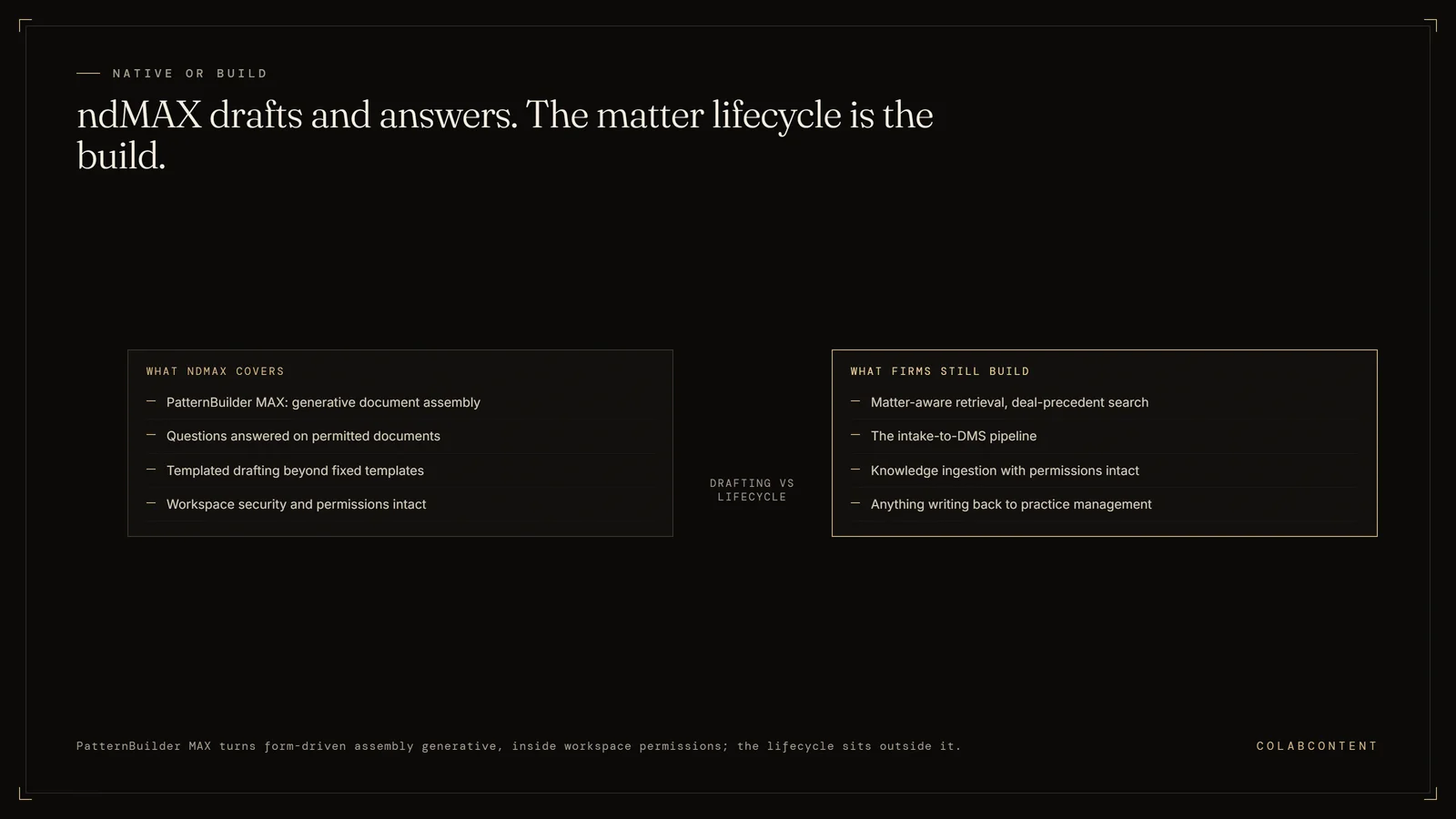
NetDocuments has shipped a credible AI roadmap (PatternBuilder, ndMAX) targeting AmLaw firms with internal innovation teams. Mid-market firms with 20 to 150 attorneys are usually not the right ICP (ideal customer profile) for it. A firm that size that wants its workflow leakage closed needs custom AI built on top of NetDocuments, not the AmLaw-segment product.
This memo is what we'd commission for that firm. Below: the NetDocuments surface area we touch, the workflows we ship in 5-7 weeks, and how the permissions and ethical-wall architecture stays intact.
The NetDocuments surface area we touch.
One correction first, because it is the sort of thing that survives into a statement of work and then costs a fortnight. ndMAX is the NetDocuments AI layer, not the name of its API. The two are separate things and the distinction matters when you are writing an integration scope.
NetDocuments does expose a REST API that a build reads from and writes to, and firms are integrating with it today. What we cannot do is point you at the documentation, because as of 24 August 2026 there is no readable public copy of it. developer.netdocuments.com, docs.netdocuments.com and api.netdocuments.com do not resolve. The former developer landing page at netdocuments.com/en-gb/Developer/ returns 404, as do /resources/developer and /api. The legacy help-centre developer section returns 401. The current support community answers with a page that loads no content unless you are signed in.
The practical consequence is a scoping one, and it is worth pricing honestly. On a platform with open documentation an engineer confirms in an afternoon whether the objects and operations a workflow needs actually exist. On NetDocuments that confirmation depends on the firm's own portal access or on NetDocuments answering, so we scope a short discovery step against your tenant (a private cloud account) before quoting the integration depth, rather than guessing and revising later. Any vendor quoting you a fixed NetDocuments integration without that step is quoting a number they cannot yet support.
Permissions and ethical walls are enforced at the NetDocuments server level; the AI layer queries with the user's actual permissions, not a service-account super-user.
This matters more in legal than any other vertical. A retrieval system that bypasses ethical walls is a malpractice incident waiting to happen. Our query architecture preserves them.
Workflow I: Matter-aware retrieval and deal-precedent search.
Year-one associate starts a research task; spends three hours combing the matter archive for prior memos on the same issue, the same judge, the same opposing counsel. Often misses the most relevant precedent because the metadata is inconsistent.
The custom-AI version: associate types the research question in plain English. The retrieval layer queries NetDocuments with the associate's actual permissions, reads matter metadata + document content, returns the top 8-12 most relevant prior matters with the partner who handled each, the outcome, and the specific paragraphs that match.
Workflow II: Intake-to-DMS pipeline.
New-matter intake usually involves a paper or PDF intake form, a partner triage email, and someone manually creating the matter workspace in NetDocuments with the right metadata. The custom AI receives the intake (form, email, or call summary), runs conflict-clearance against the firm's matter history, drafts the engagement letter from the firm's template, creates the NetDocuments matter workspace with correct profile values, kicks off the document collection from the client.
Workflow III: Knowledge ingestion with permissions intact.
The retiring-partner workflow. Twenty years of memos, briefs, deal precedents in the partner's NetDocuments workspaces. We bulk-ingest into a permissions-preserving retrieval index, with the original ACLs maintained. The next lateral hire has access to the firm's intellectual capital, gated by the same ethical-wall logic that gated the original documents.
What we don't build.
We do not replace NetDocuments. We do not bypass ethical walls. We do not build a competitor to ndMAX or PatternBuilder. We do not build "Harvey for your firm" because Harvey already exists and serves a slightly different segment well. The leverage is in firm-specific workflow integration, not generic legal AI.
Risk & governance.
Three things every legal AI commission must do, by default: (1) preserve client confidentiality through actual permissions enforcement, not policy memos; (2) provide an audit trail that survives subpoena; (3) avoid hallucination on dispositive citations through retrieval-grounded generation. Architecture follows from these constraints.