Home/ Playbooks/ iManage AI Integration

iManage AI: what it covers, and what firms still build themselves.

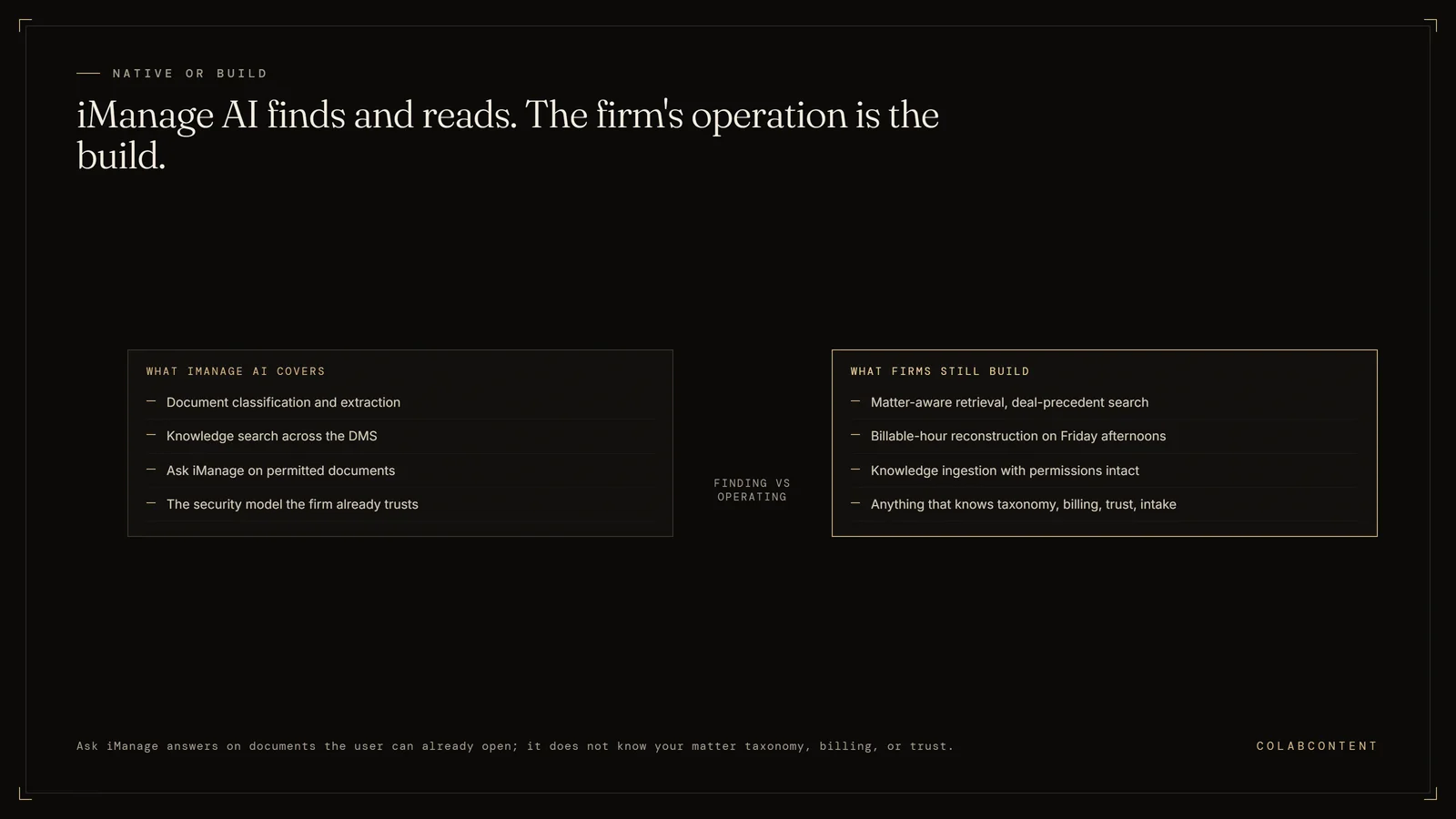
iManage AI is the set of AI capabilities built into the iManage Knowledge Work Platform: document classification and extraction, knowledge search across the document management system, and a generative assistant, marketed as Ask iManage, that answers questions against documents the asking user already has permission to open. It is strong at finding and reading, and it inherits the security model the firm already trusts. It stops where the firm's own operation starts, because the platform does not know your matter taxonomy, your billing rules, your trust accounting, or your intake path.

The boundary of iManage AI: native coverage of document classification, knowledge search, and Ask iManage on permitted documents, versus the custom builds firms commission for matter-aware retrieval, billable-hour reconstruction, and workflows that know the firm's taxonomy, billing, and trust
Native finding and reading; the operating workflows are the build.

Custom AI on top of iManage Work for 20-150 attorney mid-market firms. Matter-aware retrieval, deal-precedent search, billable-hour reconstruction. Permissions intact, ethical walls preserved, audit trail unbroken.

ForManaging Partner / Innovation Partner
StackiManage Work + Time + custom AI layer
Build cycle5-7 weeks

Why this memo.

iManage Insight+ is a real product and the team behind it ships value at AmLaw 100 firms. Mid-market firms with 20 to 150 attorneys are usually not the right ICP for it. A mid-size litigation firm running iManage Work, no Innovation Partner, and a seven-figure annual leakage problem needs custom AI built on top of iManage, not the AmLaw-segment product.

This memo is what we'd commission for that firm. Below: the iManage surface we touch, the three workflows we ship in the first 6 weeks, and how the permissions and ethical-wall architecture stays intact.

The iManage surface area we touch.

iManage Work exposes the iManage REST APIs, which give authenticated read/write access to documents, folders, matters, workspaces, and metadata. Auth is OAuth2 with the firm's identity provider. Permissions and ethical walls are enforced at the iManage server level; the AI layer queries with the user's actual permissions, not a service-account super-user.

This matters more in legal than in any other vertical we work in. A retrieval system that bypasses ethical walls is a malpractice incident waiting to happen. Our query architecture preserves them.

Workflow I: Matter-aware retrieval and deal-precedent search.

The expensive workflow. Year-one associate starts a research task; spends three hours combing the matter archive for prior memos on the same issue, the same judge, the same opposing counsel. Often misses the most relevant precedent because the archive's metadata is inconsistent.

The custom-AI version: associate types the research question in plain English. The retrieval layer queries iManage with the associate's actual permissions, reads matter metadata + document content, returns the top 8-12 most relevant prior matters with the partner who handled each, the outcome, and the specific paragraphs that match. Associate cites and adapts; partner reviews; firm bills full hours instead of writing off ramp time.

Workflow II: Billable-hour reconstruction on Friday afternoons.

The leakage workflow. Partner writes time descriptions Friday afternoon for work done Monday-Wednesday. Reconstructions are vague, conservative, or skipped. Captured-but-uninvoiced is half the problem; unwritten is the other half.

The custom-AI version: reads the partner's iManage activity (documents opened, edited, emailed), Outlook calendar, Microsoft Teams call history, and matter context; drafts time entries with descriptions matter-mapped and ready for partner edit. Partner reviews and signs in 5 minutes per day instead of 90 minutes per week.

Workflow III: Knowledge ingestion with permissions intact.

The retiring partner workflow. Twenty years of memos, briefs, deal precedents in the partner's iManage personal folders. When the partner leaves, the firm loses the institutional value unless someone ingests it before the door closes.

The custom-AI version: bulk-ingest into a permissions-preserving retrieval index, with the original iManage ACLs maintained. The next lateral hire has access to twenty years of the firm's intellectual capital, gated by the same ethical-wall logic that gated the original documents.

What we don't build.

We do not replace iManage Work. We do not bypass ethical walls. We do not build "Harvey for your firm" because Harvey already exists and serves a slightly different segment well. If the firm's needs are document-review-and-redlining at scale, Harvey or Spellbook is probably the right answer. If the firm's needs are firm-specific workflow automation on top of iManage, this memo describes what we ship.

Risk & governance.

Three things every legal AI commission must do, and that we do by default: (1) preserve client confidentiality through actual permissions enforcement, not policy memos; (2) provide an audit trail that survives subpoena; (3) avoid hallucination on dispositive citations through retrieval-grounded generation, not unconstrained generation. Architecture decisions follow from these constraints, not the other way around.

Run your firm's number

Billable-Hour Recovery Diagnostic.

12 questions. Your firm's annual unbilled-time leakage in dollars, on screen.

Start the diagnostic
Free · 2 minutes
Personalized $ figure
3-page peer-ranked report
Email gates the PDF
Integration playbook

How a custom AI layer integrates with Imanage.

Why this integration matters.

Imanage sits at the center of the operational stack for many law firms. The workflows that route through it are the workflows where AI investment shows up first on the P&L: intake to matter routing, conflict checks, document automation, matter-to-template matching, timesheet reconciliation. A commissioned AI layer that integrates cleanly with Imanage addresses those workflows without forcing the operator to migrate off the system of record.

Architecture: where the AI layer sits relative to Imanage.

The most common integration pattern is a read-and-suggest pattern. The AI layer reads structured records out of Imanage, runs the workflow it was commissioned to run, and writes back a suggested action that a human reviewer approves inside Imanage's native UI. The system of record stays Imanage. The AI layer never bypasses the human-in-the-loop step for production-data writes.

For lighter-touch workflows we have shipped read-only layers that extract structured data out of Imanage, hand it to a reasoning step, and emit a report. No writes back. The operator uses the report as input to their existing decision process. Time to ship is faster, integration risk is lower.

For heavier workflows where the audit trail is structured and the failure cost is bounded we have shipped fully bidirectional integrations that close the loop end-to-end with structured logging. These engagements take longer (six to seven weeks rather than four to five), require more diligence on the read/write permissions inside Imanage, and ship with a runbook for human review of edge cases.

The integration mechanics, in plain language.

Integration with Imanage happens at one of three levels: the API layer, the webhook layer, or the database layer. The right level depends on what permissions the operator's Imanage instance grants, what data the workflow needs to see, and what data the workflow needs to write.

API layer. Read and write through Imanage's documented REST or SOAP endpoints. Cleanest, most maintainable, vendor-supported. Works when the data the workflow needs is exposed through the API.

Webhook layer. Subscribe to Imanage events, react to them in real time, write back through the API. Good for workflows that need to fire when a specific record changes.

Database layer. Direct read against the underlying database, where the API does not expose what is needed. Brittle, requires direct hosting access, used only as a last resort and always with the operator's explicit approval.

Common pitfalls when integrating AI with Imanage.

Treating the integration as an afterthought. The AI work is the easy part. The integration is the hard part. Operators that under-invest in the integration boundary spend the entire build cycle fighting authentication, rate limits, and edge-case schema. The commission scopes the integration boundary in the first week.

Skipping the human-in-the-loop step too early. Closing the loop end-to-end on day one is a recipe for hidden errors. Every engagement starts with human review of every AI output. Only after the operator has seen the output quality hold for sixty to ninety days does the human-in-the-loop step relax to spot-check.

Underestimating the data-cleanup work. Imanage contains data the operator has entered over years. Some of it is clean. Some of it is not. The AI layer's quality is bounded by the data it reads. Cleaning happens as part of the build, not as a prerequisite for it. If the data is unworkable we flag it in the diagnosis call.

Building bespoke when a product would suffice. If Imanage already has a productized AI feature that covers the workflow, the operator should evaluate it before commissioning a custom build. We will tell the operator honestly when that is the right answer.

Reference: prior commissions involving Imanage.

Specific numbers are bound by NDA but the pattern is consistent across the engagement set: the operator runs the workflow faster, with fewer hands, and with a structured record of every AI-generated suggestion alongside the human approval.

What a Imanage engagement scope looks like.

A typical Imanage commission scope: one or two specific workflows, read-and-suggest pattern, four-to-seven-week build cycle, fixed fee in the $45K to $180K band depending on integration depth and workflow complexity. The diagnosis call identifies the workflow. The prototype demonstrates feasibility against the operator's real data inside seven to ten days. The production build ships inside the operator's own cloud tenant under NDA.

The operator owns the Imanage integration code, the AI prompts, the model selection, and the data pipeline at handoff. We do not retain a license, a recurring fee, or a vendor relationship that the operator depends on.

Extended questions

The questions buyers ask after the first one.

What is Ask iManage?

It is iManage's own generative assistant, which answers questions against documents in the platform rather than making the lawyer search for them, scoped to what that user already has permission to open. Get a live demo run against your own matters. Assistant capability across the legal document management category is moving faster than any written description, including this one.

Does iManage AI respect permissions and ethical walls?

Inheriting the existing security model is the design intent of a document-management-native assistant, and it is the main reason firms prefer one to a general chatbot pointed at exported files. Verify it in a pilot anyway. Put a walled matter in the test set, confirm a lawyer outside the wall cannot surface it, and ask for the per-user audit trail of what the assistant read.

How does Harvey work with iManage?

Harvey markets an iManage integration so its work product can reach the firm's documents. Confirm the current scope, supported deployment, and license requirements with both vendors before building a plan on it, because integrations in this category get announced well before they are broadly available.

Does iManage have an API for custom AI?

Yes. iManage exposes an API layer a custom build can read from and write to, and that is the correct integration pattern: read and suggest, with iManage staying the system of record. Nothing about a custom AI layer requires copying documents out of the document management system, and no build should.

How much does iManage AI cost?

iManage does not publish AI pricing. It is quoted per firm, typically as an uplift on the existing Work license, and the number depends on seat count and enabled modules. Model it as a recurring per-seat cost that scales with headcount, then compare that curve to a one-time build for the workflows the assistant will never cover.

What do firms build on top of iManage?

The work that needs the firm's own logic rather than the vendor's: matter lifecycle, intake, billing, and trust. One anonymized 47-attorney litigation firm runs its matter, invoice, and IOLTA trust operation on a commissioned platform holding 13,296 matters, 4,396 clients, and 5,684 invoices, with trust reconciled byte-identical. None of that is a search problem, and no document assistant solves it.

Should a firm wait for iManage to ship the feature instead of building?

For search, classification, and document question answering, yes. The platform will get there, and building a competing search layer wastes money. For matter lifecycle, billing, intake, and trust, no. Those run on the firm's own rules, and no vendor is going to ship them for you.

How long does an iManage AI build take?

A working prototype against the firm's real data in 7 to 10 days, then a production build in 5 to 7 weeks for a scoped workflow. The fee is fixed and stated before the build, in the $45,000 to $180,000 band depending on integration depth, and the firm owns the code, the prompts, and the pipeline at handoff.

Ready when you are

Book the 45-minute diagnosis.

Custom AI on your iManage instance. Permissions and ethical walls intact.