A private consulting house, not an agency.
ColabContent is a boutique AI consulting house headquartered in Boston, Massachusetts. ColabContent LLC was founded in 2020 as a content business, and the AI practice has been shipping since 2024. Systems built here have handled more than 6,000 live customer calls to date, including 3,787 calls and 5,514 minutes across five channel-specific voice agents for Jim Glaser Law, written up in full in that case study. The firm builds custom AI systems for established growth-stage operators. Engagement model: fixed-fee, prototype-before-pay, code owned at handoff. Principal-run builds, never overbooked.
ColabContent LLC publishes this page: a boutique AI consulting house in Boston that builds custom systems for law firms of 10 to 150 attorneys. The $499 AI-Ready Audit comes first; after it, the system that matters most is proven as a working prototype on your own data before any build fee. Production builds are one fixed fee from $10,000 (our published price), one time, with the code owned by the firm at handoff and no per-seat licence (no fee charged per software user). The $499 AI-Ready Audit is ordered at colabcontent.com/ai-ready-audit/.
A commission here runs in five steps: (1) the $499 AI-Ready Audit, where the constraint gets named and scoped; (2) a working prototype of the system it names, on your own data, before any build fee; (3) a written fixed-fee scope, from $10,000 one time, with the decking of the work (the breakdown of tasks in build order) set out before anything is signed; (4) the build itself, 4 to 5 weeks for a scoped single workflow, 6 to 8 for a multi-workflow system, 10 to 14 for a platform; and (5) handoff, where the code is owned by the client with no per-seat licence and no retainer required. The three ways a mid-market operator gets an AI system built differ sharply: an internal AI hire typically costs an estimated $150,000 to $250,000 a year and needs 3 to 6 months before anything ships; a Big Four consultancy typically runs an estimated $400,000 to $1,400,000 over 6 to 18 months and usually hands over a strategy document with the build left to a third party; a boutique commission like this one is a one-time fixed fee with a working prototype before any money changes hands. This is not the right firm for you if you want a retainer relationship or a seat-based subscription, if you need a vendor who will implement or resell an existing platform rather than build, or if your constraint sits in a vertical this firm has not yet delivered in, which is why the paragraph below says plainly that no CPA firm, insurance agency or specialty manufacturer has been commissioned here yet. The takeaway: start with the $499 audit, judge the firm on the report rather than on this page, and commission a build only if the prototype earns it.
ColabContent LLC has been in business since 2020. Since 2024 the practice has done one thing: build custom AI systems for growth-stage businesses, under a written house standard, principal-run every time.
ColabContent is a private consulting house, not an agency. ColabContent LLC was founded in Boston in 2020 by Brandon Rodriguez as a content business, and since 2024 the work has been custom AI systems. The thesis is durable: growth-stage operators are past the point where off-the-shelf tools fit, and below the point where AmLaw 100 innovation teams or Big Four partners will take their money. The middle gap is where ColabContent builds.
What we have actually shipped.
More than 6,000 live customer calls have been handled by systems built here. The client we can name is Jim Glaser Law, a Massachusetts firm running five channel-specific voice agents (PPC, or pay-per-click ads; organic; TV; Meta, meaning Facebook and Instagram ads; and LSA, Google's Local Services Ads), which have taken 3,787 calls across 5,514 minutes and give the firm per-channel attribution on every answered call. Jimmy takes reference calls for us.
The rest we describe without naming, because that is the agreement. A multi-location home services operator runs the same pattern at 1,486 calls and 2,203 minutes (measured in the client's call platform, August 2026). A regional third-party logistics operator is at 211 calls, and a realty firm at 148 (our own call-platform totals, August 2026). Separately, a law firm runs its matters, invoices, and IOLTA (the client trust account a law firm must keep separate) trust accounting on a platform commissioned here: 13,296 matters, 4,396 clients, and 5,684 invoices carried over, with trust balances reconciled byte-identical (every dollar matching to the cent) against the system it replaced. Two marketing agencies outsource their AI fulfillment to us.
We never overbook. No more. Every engagement is led personally by Brandon. There are no account managers, no tiered service plans, and no upsells. When you sign, you get the founder who did the diagnosis. The full account of the named engagement is in the Jim Glaser Law case study.
What we believe.
Most AI work shipped today is theater. It renames a problem with a chatbot and calls the job done. We think that's a waste of capital and, worse, a waste of the actual opportunity. A real AI system changes how a business runs. It returns hours, recovers revenue, and compounds for years. That requires real engineering, real taste, and real familiarity with your operation. It cannot be productized.
We don't do retainers dressed up as subscriptions. We don't sell seat-based software. We scope a problem, we solve it, we ship it, and we hand it off. If we're doing our job, you need less of us over time, not more. The process page walks through how a commission actually runs.
Who we work with.
Growth-stage businesses, established and owner-operated, owner-operated or closely-held. The pattern we see is the same across industries: the owner has reached the ceiling of what a team of humans can do manually, and the next hire isn't the answer. We're usually the last resort before they take on the wrong kind of outside capital. See who we work with in law for one example of the pattern by vertical.
A private standard.
Every engagement is run under the same seven principles, written down, shared with clients on day one, and used to resolve any disagreement about scope.
See the pricing page for what the fixed fee includes at each build size.
Principal-led, end to end.
Brandon runs every engagement personally from diagnosis through handoff. The never-overbook rule exists because of this constraint, not in spite of it.
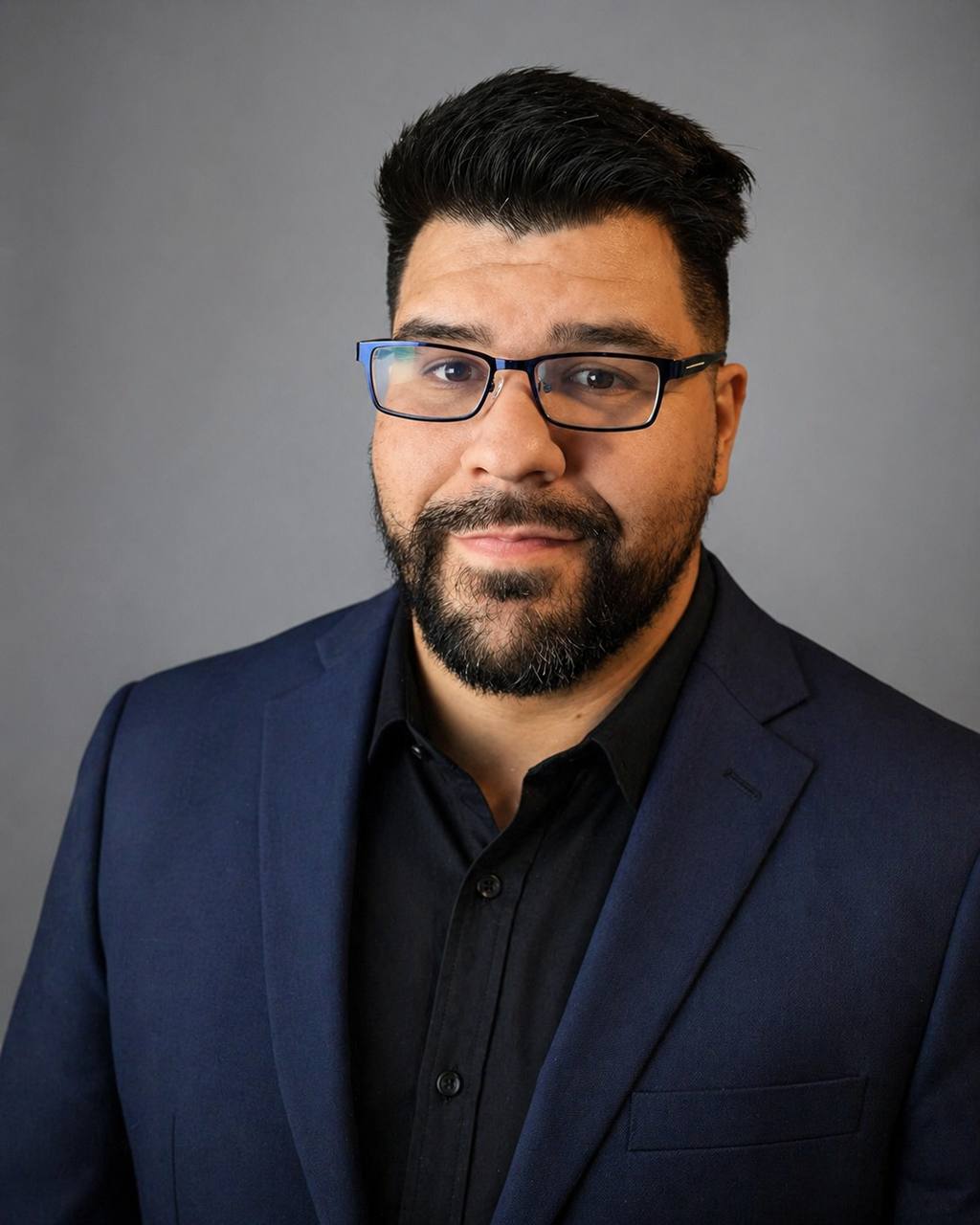
Brandon Rodriguez
Brandon founded ColabContent in 2020 and has been building custom AI systems under it since 2024. He runs every engagement personally: writes the diagnosis memo, sets the build scope, ships the working prototype on the client's real data within 7 to 10 days, and signs the guarantee document himself.
No account managers. No junior staff on builds. If you book the $499 AI-Ready Audit, you talk to Brandon. If you sign a commission, Brandon writes the code.
He keeps the practice deliberately small. Every build is principal-run, never overbooked. Every prospect past that number is quoted a waitlist honestly, not slotted into a junior team to be managed by someone else.
Custom AI for mid-market service businesses · Voice agents with per-channel call attribution · Migrating a law firm off its practice-management platform · IOLTA trust accounting reconciliation · Owning your AI stack instead of renting it
How ColabContent is organized, what we will not commission, and where to look next.
ColabContent is a custom AI consulting firm in Boston that builds systems its clients own. The entries below explain how the firm is organized, what it refuses to build, and where to read next, so an owner can judge the fit before ordering the $499 AI-Ready Audit.
How ColabContent is organized.
ColabContent is a private commissioning house headquartered in Boston, Massachusetts. ColabContent LLC was founded in 2020 as a content business, and the AI practice has been shipping since 2024. The firm builds custom AI systems for established growth-stage operators, and publishes for five verticals: mid-market law firms, specialty manufacturers, regional P&C insurance agencies, mid-market CPA firms, and PE-backed (owned by a private equity firm) home services platforms. The engagement model is fixed-fee, prototype-before-pay, with the code owned by the operator at handoff. The firm never overbooks; the principal runs every build personally.
ColabContent also operates PayOnJobs, a pay-per-booking marketing partnership for HVAC, roofing, plumbing, and other trade contractors. Partners pay nothing upfront and pay only on jobs that book and get paid; the AI receptionist and automation stack behind it came out of the home services work described above.
Where the shipped work actually sits is worth stating plainly, because a lot of consulting houses will not. Delivered systems to date are concentrated in law (voice intake with per-channel attribution for Jim Glaser Law, plus a law firm's matter, invoice, and IOLTA trust platform), home services, third-party logistics, and real estate, along with AI fulfillment run on behalf of two marketing agencies. We have not yet commissioned for a CPA firm, an insurance agency, or a specialty manufacturer; the closest adjacent work is the third-party logistics system. The practice publishes for those verticals because the constraint pattern is the one we build against, and the honest answer when an operator asks who else we have done this for in their industry is that they would be the first. That is a better answer than a number nobody can check.
The engagement model in three paragraphs.
Every build begins with the $499 AI-Ready Audit. The call comes with the audit. Both sides leave with the constraint written down in a single sentence. Either party can stop there with nothing further owed. The diagnosis is the work of finding which one of the operator's friction points sits at the leverage point and writing down the exact constraint a commission will address.
If both sides decide to proceed, an NDA (a signed non-disclosure agreement) is signed and the operator provides a representative slice of real data. Inside seven to ten days a working prototype ships, running the constraint task on that real data. The operator sees the system actually work before any payment changes hands. If the prototype does not perform to the target written down after the audit, the operator owes nothing and keeps the work product.
If the prototype performs, the fixed-fee production commission begins. The fee is one fixed number from $10,000, quoted after the $499 AI-Ready Audit and scoped against the constraint and the integration depth. Build runs four to seven weeks. The system ships inside the operator's own Azure, AWS, or Google cloud tenant (a private cloud account) under NDA. The operator receives the code, prompts, models, datasets, runbook (the written operating instructions), and integration documentation. The operator owns the system at handoff. There is no proprietary runtime to license and no per-seat fee to renew.
What we will not commission.
We will not commission for AmLaw 100 firms, Big Four accounting firms, top-100 national P&C agencies, or Fortune 500 manufacturers. Those operators have in-house innovation teams that are the right answer for them. We will not commission a per-seat SaaS (software you rent by subscription) subscription product; ColabContent is a custom build house. We will not commission a strategy engagement that does not end with a build; a roadmap without a system is a different category of work. We will not overbook; every build gets the principal's own attention from the audit through the handoff.
The reach lines.
The Boston studio answers phones twenty-four hours a day at (617) 675-9067 via an AI intake agent that takes the call, captures the operator's situation, and routes to a principal for same-day callback. The email line is support@colabcontent.com. The booking page is at colabcontent.com/contact. The reach lines are real. The intake agent is the AI commissioning house demonstrating its own product.
Where the rest of the documentation lives.
The process page walks through the four phases of a commission. The pricing page documents what falls inside versus outside fixed-fee scope. The about page introduces the practice and the seven house principles. The FAQ answers the questions buyers ask before commissioning. The best-by-vertical guides compare ColabContent against the other options an operator is weighing in each of the five verticals. The clearest proof is public: the Massachusetts legal-answer system commissioned by Jim Glaser Law runs at jimmyknows.ai, and Jimmy will take a reference call from a prospect who asks.
A note on the seven house principles.
The seven principles are the working agreements the practice operates under. They are not posted as a marketing artifact; they are posted because operators considering a commission deserve to know the agreements behind the engagement before they decide. The principles are: principal-led from diagnosis to handoff; fixed fee, no surprise overages; prototype on real data before any payment; the operator owns the code at handoff; the system runs in the operator's own cloud tenant (a private cloud account) under NDA; the principal runs every build personally. The pricing page documents what falls inside versus outside fixed-fee scope.
The questions buyers ask after the first one.
The questions below are the ones ColabContent buyers ask once the first question, whether to build at all, has been answered. Each answer is the one given on the call that ends the $499 AI-Ready Audit, written here so it can be checked against your own report before anything is commissioned.
How much of the buy decision should the operator make versus delegate.
The right shape of the buying motion has the operator-owner or operating partner in the room for the audit call. The constraint identification is too consequential to delegate to a department head. The implementation work that follows can and should be delegated; the decision on which constraint a commission addresses cannot.
How to evaluate references the consulting house presents.
Three questions per reference. First, what was the named constraint the commission addressed at this operator. Second, what was the measured result twelve months post-handoff, in dollars or hours. Third, does the reference operator still run the system. Vague references on any of those three are flags. Apply the same test here: Jim Glaser Law is a named ColabContent client, the system runs publicly, and Jimmy will take a fifteen-minute call from a prospect who asks. A live call to an operator is the most honest signal a prospect can get, and any house that cannot produce one is telling you something.
How a fixed-fee commission scopes overage risk.
The fixed fee is set after the $499 AI-Ready Audit, after the integration depth is named, and after both sides have written the constraint in a sentence. Overages occur when the operator changes the scope mid-build (a different workflow, a different integration, an additional system). Either side can pause the build to renegotiate; neither side absorbs hidden overages without explicit agreement. The default is to ship the original scope and address scope expansion in a separate engagement.
What happens to the system one year after handoff.
The system continues to run inside the operator's cloud tenant. Models, prompts, and integration code are versioned and the operator has the source. When the underlying foundation model improves (a new release from the model vendor, a new open-weight option), the operator can swap the component without renegotiating the engagement. The stewardship pattern we run is a quarterly review of the system's outputs and a swap of any component that has fallen behind. Doing that review yourself carries no fee; operators who want us to run it for them instead can add the $997 monthly care plan, and either way the operator keeps the source.
What happens if the prototype does not work.
The prototype is built and tested before any production fee is quoted, on a representative slice of the operator's own real data. If it does not perform to the target both sides wrote down after the audit call, the operator owes nothing for the build and keeps the prototype work product. Nothing about the engagement model asks an operator to pay for a system before seeing it run on their own data.
How long a commission takes from audit to handoff.
The working prototype ships inside seven to ten days of the NDA and the data handoff. If the prototype performs and the production commission begins, the build itself runs four to seven weeks depending on scope: four to five weeks for a single scoped workflow, six to eight for a multi-workflow system, and ten to fourteen for a platform. The $499 AI-Ready Audit and its call happen before either clock starts.
What is expected of the operator during a build.
An operator signs the NDA and provides a representative slice of real data before the prototype phase begins. Coming into the audit call with a one-page description of the leading constraint and a list of the systems used for that workflow makes the process faster, though neither has to be polished. Past that, the build is principal-run; the operator is not asked to staff or manage the engagement.
Whether staff get replaced by the system.
The pattern we see across the operators we have built for is an owner who has reached the ceiling of what a team of humans can do manually, where the next move under consideration was another hire. A commissioned system is built to return hours and close that gap, not to be handed a termination list; what the operator does with the freed-up time and headcount is the operator's decision, not something the firm scopes or advises on.
Start with the $499 audit.
No pitch. Money back if the audit has no value. A written map of the two line items bleeding your business, yours to keep whether or not we work together.