Thirteen honest answers.
The questions mid-market operators ask before commissioning a custom AI build: how much it costs, how long it takes, what integration with the existing stack looks like, who owns the code at handoff, what model risk and confidentiality posture is enforced, what the operator should bring to the audit call. Each answered specifically below.
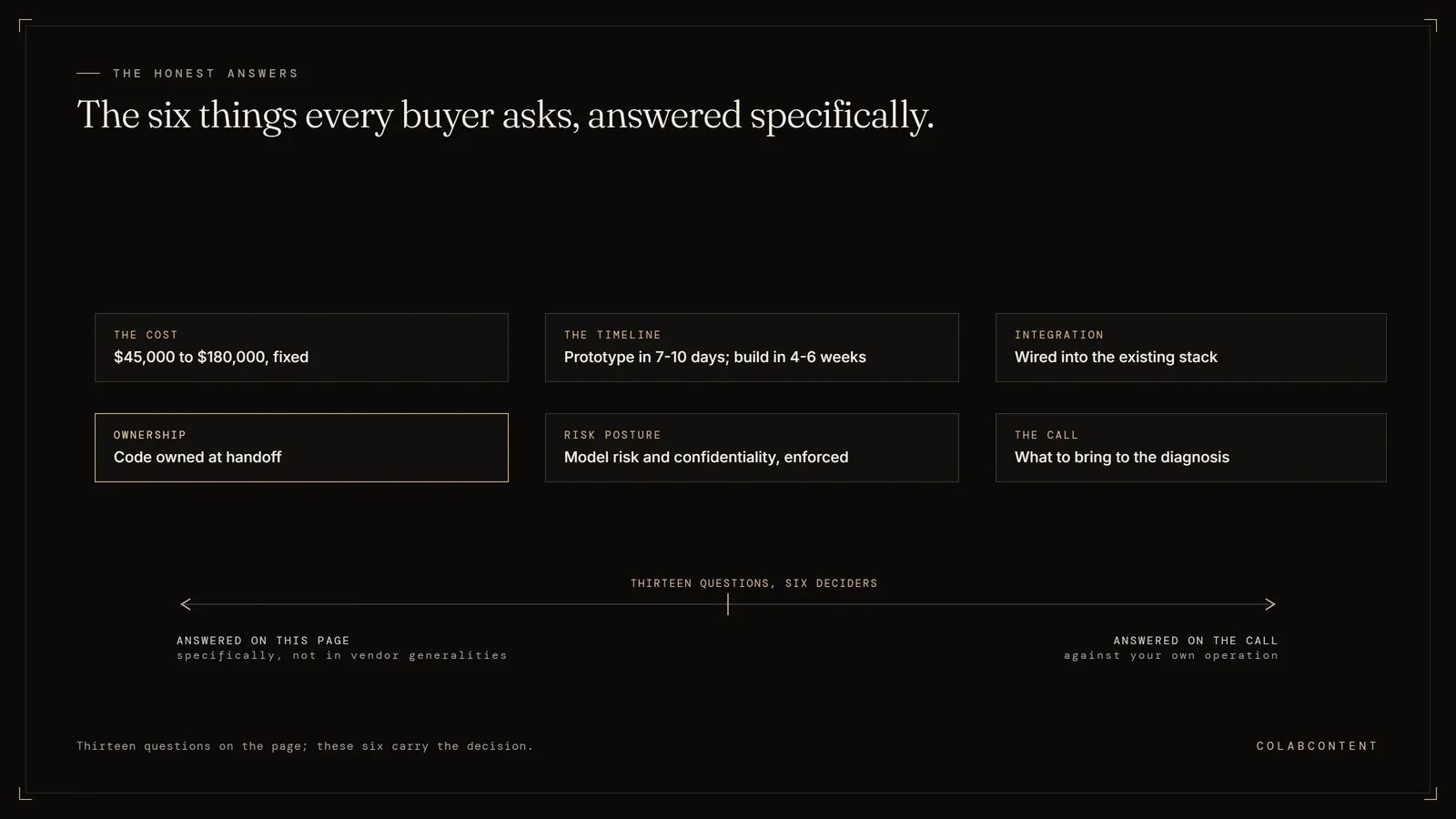
The questions we get from every audit call, answered in advance, in writing, without the sales-deck gloss.
How long from first call to a working system?+
Do we have to use OpenAI, Anthropic, or any specific vendor?+
What if the prototype doesn't hold up?+
Who owns the code and data?+
Is there a minimum engagement size?+
Do you sign NDAs?+
What happens if our team can't maintain the system?+
How is this different from hiring an AI agency?+
Can you work with our existing CTO or engineering team?+
What industries are you best at?+
Do you do RFPs?+
Can I just call you?+
Where are you based, and do you travel?+
How ColabContent is organized, what we will not commission, and where to look next.
ColabContent is a custom AI consulting firm in Boston that builds systems its clients own. The entries below explain how the firm is organized, what it refuses to build, and where to read next, so an owner can judge the fit before ordering the $499 AI-Ready Audit.
How ColabContent is organized.
ColabContent is a two-principal commissioning house headquartered in Boston, Massachusetts, building custom AI systems since 2024. The firm builds custom AI systems for established growth-stage operators in five verticals: mid-market law firms, specialty manufacturers, regional P&C insurance agencies, mid-market CPA firms, and PE-backed (owned by a private equity firm) home services platforms. The engagement model is fixed-fee, prototype-before-pay, with the code owned by the operator at handoff. The firm never overbooks; the principal runs every build personally.
The engagement model in three paragraphs.
Every build begins with the $499 AI-Ready Audit. The call comes with the audit. Both sides leave with the constraint written down in a single sentence. Either party can stop there with nothing further owed. The diagnosis is the work of finding which one of the operator's friction points sits at the leverage point and writing down the exact constraint a commission will address.
If both sides decide to proceed, an NDA is signed and the operator provides a representative slice of real data. Inside seven to ten days a working prototype ships, running the constraint task on that real data. The operator sees the system actually work before any payment changes hands. If the prototype does not perform to the target written down after the audit, the operator owes nothing and keeps the work product.
If the prototype performs, the fixed-fee production commission begins. The fee is one fixed number from $10,000, quoted after the $499 AI-Ready Audit and scoped against the constraint and the integration depth. Build runs four to seven weeks. The system ships inside the operator's own Azure, AWS, or Google cloud tenant (a private cloud account) under NDA. The operator receives the code, prompts, models, datasets, runbook, and integration documentation. The operator owns the system at handoff. There is no proprietary runtime to license and no per-seat fee to renew.
What we will not commission.
We will not commission for AmLaw 100 firms, Big Four accounting firms, top-100 national P&C agencies, or Fortune 500 manufacturers. Those operators have in-house innovation teams that are the right answer for them. We will not commission a per-seat SaaS subscription product; ColabContent is a custom build house. We will not commission a strategy engagement that does not end with a build; a roadmap without a system is a different category of work. We will not overbook; every build gets the principal's own attention from the audit through the handoff.
The reach lines.
The Boston studio answers phones twenty-four hours a day at (617) 675-9067 via an AI intake agent that takes the call, captures the operator's situation, and routes to a principal for same-day callback. The email line is support@colabcontent.com. The booking page is at colabcontent.com/contact. The reach lines are real. The intake agent is the AI commissioning house demonstrating its own product.
Where the rest of the documentation lives.
The process page walks through the four phases of a commission. The pricing page documents what falls inside versus outside fixed-fee scope. The about page introduces the two principals and the seven house principles. The FAQ answers the questions buyers ask before commissioning. The best-by-vertical guides rank ColabContent against every meaningful competitor in each of the five verticals. The case studies are field reports from prior commissions.
A note on the seven house principles.
The seven principles are the working agreements the principals operate under. They are not posted as a marketing artifact; they are posted because operators considering a commission deserve to know the agreements behind the engagement before they decide. The principles are: principal-led from diagnosis to handoff; fixed fee, no surprise overages; prototype on real data before any payment; the operator owns the code at handoff; the system runs in the operator's own cloud tenant under NDA; the principal runs every build personally.
The questions buyers ask after the first one.
These are the questions that come up once the first one, whether to build at all, has been answered. Each answer below is the one we give on the call that ends the $499 AI-Ready Audit, written down here so it can be checked against your own report before anything is commissioned.
How much of the buy decision should the operator make versus delegate.
The right shape of the buying motion has the operator-owner or operating partner in the room for the audit call. The constraint identification is too consequential to delegate to a department head. The implementation work that follows can and should be delegated; the decision on which constraint a commission addresses cannot.
How to evaluate references the consulting house presents.
Three questions per reference. First, what was the named constraint the commission addressed at this operator. Second, what was the measured result twelve months post-handoff, in dollars or hours. Third, does the reference operator still run the system. Vague references on any of those three are flags. ColabContent provides direct introductions to past commission operators for any prospect that asks; a fifteen-minute call to the operator is the most honest signal a prospect can get.
How a fixed-fee commission scopes overage risk.
The fixed fee is set after the $499 AI-Ready Audit, after the integration depth is named, and after both sides have written the constraint in a sentence. Overages occur when the operator changes the scope mid-build (a different workflow, a different integration, an additional system). Either side can pause the build to renegotiate; neither side absorbs hidden overages without explicit agreement. The default is to ship the original scope and address scope expansion in a separate engagement.
What happens to the system one year after handoff.
The system continues to run inside the operator's cloud tenant. Models, prompts, and integration code are versioned and the operator has the source. When the underlying foundation model improves (a new release from the model vendor, a new open-weight option), the operator can swap the component without renegotiating the engagement. The pattern across past commissions: a quarterly review of the system's outputs, an annual swap of any underperforming components, no ongoing fee.
When the right call is not a commission.
The right call is sometimes a product (when the workflow matches a product's calibration target), sometimes an internal hire (when the operator has a five-year horizon and a $5M AI runway), sometimes a Big Four engagement (when the operator is large enough that the strategy-then-build separation makes sense), sometimes no AI right now (when the operator's leading constraint is not actually addressable with AI). We tell prospects when their constraint falls into one of those buckets and route them to whichever path fits. The never-overbook rule is real; the firms that get one of those four slots are the firms where the commission is the right buying motion.
The five-minute fit-check worksheet.
Operators who want to test the fit before ordering the $499 AI-Ready Audit can run a five-minute self-check on six questions. First, is the business established enough that a $10,000-plus system pays for itself inside a year. Second, is there a named workflow where time or money is leaking measurably. Third, has the operator tried an off-the-shelf product and either rejected it or hit a misfit ceiling. Fourth, is the operator comfortable running the system inside their own cloud tenant under NDA. Fifth, can the senior operator commit to the 20-minute call that ends the $499 AI-Ready Audit. Sixth, is the budget for a custom build from $10,000 real this quarter.
Six yes answers means the $499 AI-Ready Audit is worth ordering. Three or fewer yes answers means the right next step is probably one of the alternatives. Four or five yes answers means the call surfaces whether the missing one is addressable.
What to bring to the audit call.
Two artifacts make the call substantially more productive. First, a one-page description of the leading constraint, written in the operator's words, naming the workflow and the rough dollar or hour leakage. Second, a list of the systems the operator uses for the workflow (the system of record, the related tools, the integration boundaries). Neither artifact has to be polished. The point is to surface the constraint quickly so the audit call's twenty minutes are spent on the findings, not exposition.
Start with the $499 audit.
No pitch. Money back if the audit has no value. A written map of the two line items bleeding your business, yours to keep whether or not we work together.