Accelamos vs Karbon. Plus the custom AI alternative neither pitches.
Accelamos and Karbon both package accounting-firm workflows into per-seat software tuned to a standard firm. Pick either when your process already fits their model. When your firm's edge lives in work their templates do not cover, ColabContent commissions a custom AI build at a fixed fee from $10,000, wired into your current stack and owned by the firm at handoff. This is not the right path for solo practitioners (SaaS economics win), firms whose only need is tax prep automation (Lacerte and UltraTax add-ons cover that), or firms without a named workflow constraint worth $10,000 or more in annual leakage.
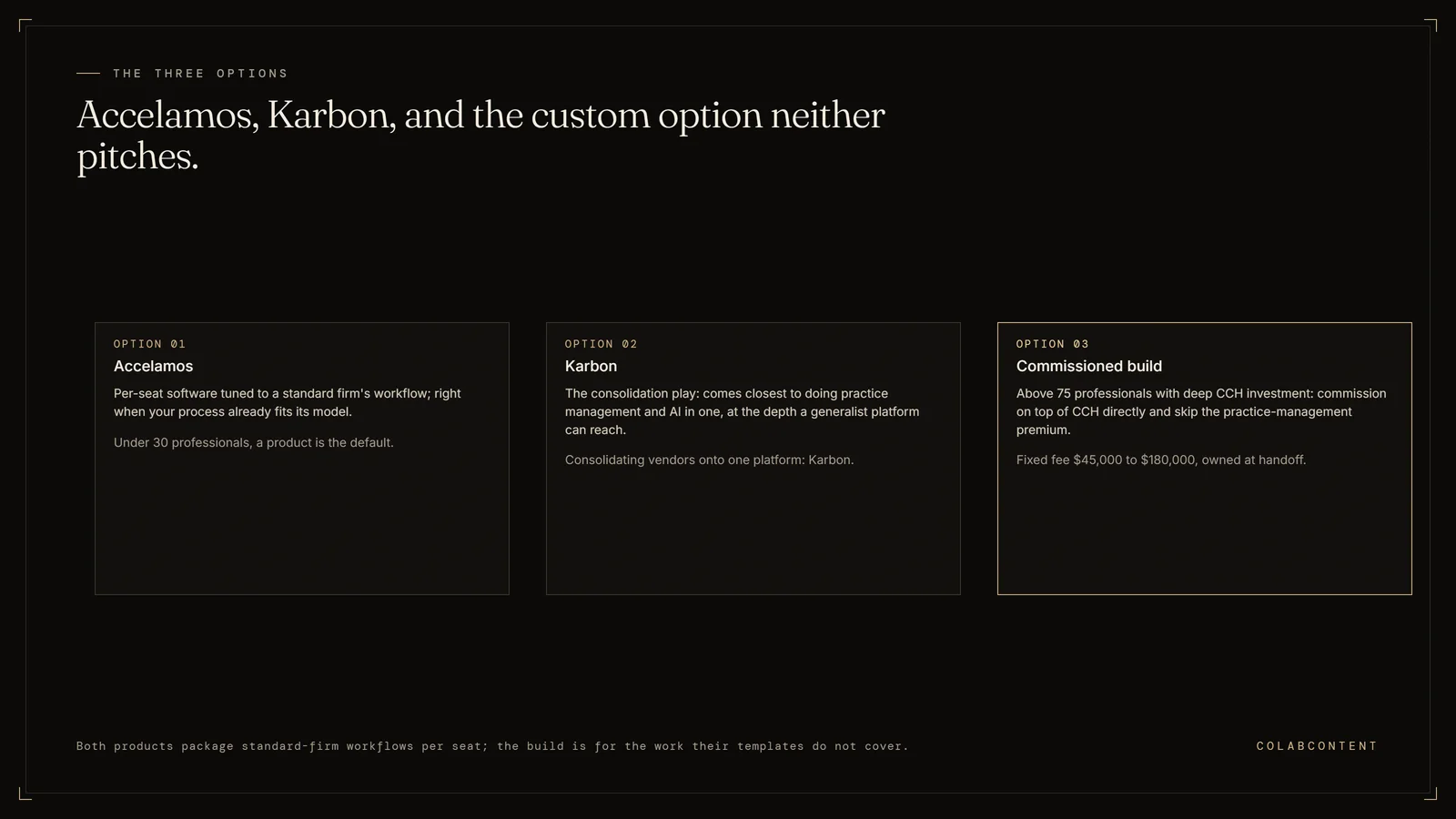
Both are practice management platforms with AI features layered on top. The comparison every firm should run is not just one versus the other, but both versus the third option neither vendor will mention: a custom AI build that sits on top of the firm's existing tax stack and skips the practice management spend entirely.
How each alternative handles the workflows that matter.
Between Accelamos and Karbon alone, Karbon is the stronger product for firms in the 30-to-150 professional band. The AI feature depth, integration coverage, and community traction are what a firm is paying the difference for, though Accelamos does not publish a price, so the size of that difference is something to establish in writing rather than assume. Accelamos is a reasonable cost-conscious alternative below 30 professionals. Firms weighing the wider field rather than these two should start from the full list of Karbon alternatives for mid-market CPA firms.
The comparison both vendors avoid is custom. If the friction at your firm is specifically AI in tax production (PBC or prepared-by-client chase; tie-out, matching document totals; partner reporting; CCH Axcess workflow), neither Accelamos nor Karbon addresses it at the depth a commissioned build does. A custom AI build at a from $10,000 fixed fee returns more on the tax production side than another year of practice management spend does, for most firms whose practice management is already working.
| Option | Pricing model | Best fit | Ownership |
|---|---|---|---|
| Accelamos | No published price | Cost-conscious firms below 30 professionals | Vendor-owned, per-seat subscription |
| Karbon | $59 to $89 per user per month | Firms in the 30-to-150 professional band | Vendor-owned, per-seat subscription |
| Custom build (ColabContent) | One fixed fee, not per seat | Firms with an AI-specific workflow constraint (for example tax production) neither vendor addresses | $499 AI-Ready Audit first; custom builds from $10,000 as one fixed fee quoted after the audit; working prototype on your own data before payment; code owned at handoff; no per-seat fees |
The comparison both vendors avoid is custom. If the friction at your firm is specifically AI in tax production (PBC chase, tie-out, partner reporting, CCH Axcess workflow), neither Accelamos nor Karbon addresses it at the depth a commissioned build does. A custom AI build at a from $10,000 fixed fee returns more on the tax production side than another year of practice management spend does, for most firms whose practice management is already working.
Key Terms
Workpaper automation: using AI to prepare, cross-reference, and review audit and tax workpapers (the working files behind a tax return or audit) against source documents; the workflow where mid-market firms see the fastest time savings. Trial balance reconciliation: automated matching of general ledger balances to subledger detail and bank statements; a high-volume task that AI reduces from hours to minutes. Engagement letter compliance: ensuring every client engagement has a signed, current letter that matches the scope of work performed; a risk management requirement manual tracking routinely misses. Staff leverage ratio: the number of staff and senior associates a partner can supervise productively; AI tools that handle routine preparation increase this ratio without adding headcount.
The decision framework
The choice turns on three questions: (1) does the firm's engagement mix and workpaper workflow match the patterns that existing practice management AI (Karbon, Corvee, CCH Axcess) already automates, or does the firm carry specialty engagements those products cannot represent; (2) does the firm's client data posture allow a SaaS (software you rent by subscription) vendor to process workpapers under its own agreements, or do the firm's professional standards require infrastructure it controls directly; (3) over a 24-month horizon, does a compounding per-user subscription cost less than a single fixed payment for a system the firm owns outright. If all three favor a product, the SaaS path is stronger. If any one favors a build, the gap is worth quantifying: the $499 AI-Ready Audit sizes it in dollars and weeks.
How they compare.
Karbon: published. $59 per user per month on Team and $89 on Business when paid annually, $79 and $99 when paid monthly, custom above that. At 50 users on annual billing that is $35,400 to $53,400 a year.
ColabContent custom build: one-time from $10,000 fixed fee. No per-seat line. Over 24 months at 50 users, Karbon on annual billing runs $70,800 to $106,800 against an estimated $90,000 for this larger example build, paid once.PricingAll three different shapes
Karbon: Practice Intelligence, AI email drafting, document automation, workflow visibility. Deeper feature set than Accelamos.
ColabContent: custom AI orchestration (the software that sequences each step) commissioned to the firm's specific tax production workflow. PBC (the prepared-by-client document list) chase, tie-out (matching totals across documents to confirm they agree), partner reporting, CCH-native automation.AI depthKarbon > Accelamos < Custom
ColabContent: tax production AI. PBC chase, tie-out automation, partner reporting, deadline write-back to tax software.
If the firm's pain is partner-and-staff coordination, choose between Accelamos and Karbon. If the pain is tax production hours and PBC season, choose custom.ScopeDifferent problems
ColabContent custom builds: use CCH Axcess Open Integration API (the connection one piece of software offers to another) directly. Automation happens inside the firm's existing CCH workflow, not in a separate UI.IntegrationCustom is in-stack
ColabContent: code, prompts, models transferred to the firm at handoff. Runs in the firm's tenant (a private cloud account).SovereigntyCustom wins
See the full pattern in the CCH Axcess AI workflow playbook.
The decision tree.
- Is practice management the bleeding bottleneck (client communication, task tracking, time)? Karbon if you can afford the premium. Accelamos if cost is the binding constraint. Stop reading.
- Is tax production the bleeding bottleneck (PBC chase, tie-out, partner reporting, deadline visibility)? Custom build. Neither Accelamos nor Karbon address this at depth.
- Under 30 professionals? Accelamos or Karbon. Custom builds rarely return at that headcount.
- Above 75 professionals with deep CCH investment? Custom build, commissioned on top of CCH directly. Skip the practice management premium.
- Looking for one product that does both? Karbon comes closest. But "does both" tends to mean "does both at 70% of the depth a focused solution would deliver."
Start with the $499 audit.
The AI-Ready Audit is $499. The report arrives the same day, as a private link and a PDF, with a 5-minute video walkthrough and a 20-minute call. If it has no value you get the $499 back, and every quarter your AI answers, rankings and money leak are re-checked free.
No slides. We walk through PBC chase, tax production hours, and CCH workflow and tell you whether the math favors a commissioned build over Accelamos or Karbon.
Read the CPA offering → Book directly →Questions buyers ask about this comparison.
Below: cost against both vendors, what happens if a build underperforms, who owns the system afterward, how long a build takes against a subscription signup, what the firm has to provide during a commission, and whether it replaces the staff who handle PBC chase and tie-out work today.
What does a custom build cost vs Accelamos or Karbon?
Accelamos and Karbon are both practice-management products with AI layered on top, each priced per user and built to a standard firm's process, and either pays for itself for a firm whose workflow matches that standard. The strongest use cases are the ones both were built around: client communication, task management, firm-wide workflow visibility, partial document automation. For those tasks, the off-the-shelf output is competitive with bespoke work at a fraction of the up-front engineering cost.
What happens if the custom build doesn’t work for our firm?
A prototype runs on the firm’s own data before any build fee. If it shows no real result, the firm owes nothing.
Who owns the system after it’s built?
The firm does. Code and models transfer at handoff, with no per-seat fees or vendor dependency to keep it running.
How long does a custom build take vs signing up for Accelamos or Karbon?
Accelamos and Karbon provision in days. A ColabContent prototype runs on real data in seven to ten days, then production ships four to seven weeks later.
What is expected of the firm during a commissioned build?
Access to the target workflow (CCH Axcess, UltraTax CS or Lacerte) plus the named constraint from the audit.
Does a commissioned build replace staff doing PBC chase or tie-out work?
No. It recovers hours lost to document chase and reconciliation; firms still run Accelamos or Karbon for practice management alongside it.
Related reading.
The pages below continue the argument made here from a different angle: a vendor comparison, a cost breakdown, or a playbook for the software already in place. Each one was written for the same owner-run and mid-market businesses this page addresses, and each ends at the same first step, the $499 AI-Ready Audit.
Where the comparison actually matters.
A side-by-side only helps when it compares the things that decide the outcome. The sections below take each alternative on the workflow it was built for, name where it is genuinely the better choice, and show where a custom system the business owns changes the answer, with the trade-offs stated.
What Accelamos and Karbon actually do well.
Accelamos and Karbon are both practice-management products with AI layered on top, each priced per user and built to a standard firm's process, and either pays for itself for a firm whose workflow matches that standard. The strongest use cases are the ones both were built around: client communication, task management, firm-wide workflow visibility, partial document automation. For those tasks, the off-the-shelf output is competitive with bespoke work at a fraction of the up-front engineering cost.
For a firm whose bleeding bottleneck is practice management, one of the two is the right buy. The pricing is predictable. The on-ramp is fast. Between them, Karbon has the deeper AI feature set and Accelamos is the cost-conscious option below thirty professionals.
Where Accelamos and Karbon lose to a commissioned build.
The misfit shows up when the firm's bottleneck is not practice management at all. For CPA firms the workflow that matters is some specific combination of PBC reconciliation, tax workflow routing, client-data ingestion, trial-balance reconciliation, 1040 review. Both products, calibrated against the average customer, will get thirty to forty percent of the way to that workflow before the operator-specific gap opens up: a matter taxonomy (the way a firm categorises its cases) they do not know, a part library they cannot represent, a carrier pool they cannot reason about, a dispatch logic they cannot follow.
The commissioned build closes that gap by being built on the operator's actual data, inside the operator's actual stack (CCH Axcess, UltraTax CS, ProSystem fx, Lacerte where relevant), with the operator's specific workflow as the calibration target. The trade-off is up-front cost (one fixed fee from $10,000) versus ongoing SaaS subscription. For operators with a known constraint and a five-to-ten-year horizon, the math favors the commission.
Side-by-side on the six dimensions that decide the buy.
Vertical fit. Accelamos and Karbon are both calibrated for the standard firm in the category, which for most product companies is the largest end of the market. ColabContent commissions are calibrated for the specific operator. Mid-market operators are not the average customer.
Custom versus product. Accelamos and Karbon are products with configuration knobs. ColabContent commissions are custom code, custom prompts, custom data pipelines. Configuration cannot represent what custom code can represent.
Ownership. Accelamos and Karbon both retain the code, the models, and the data pipeline. ColabContent transfers all three to the operator at handoff. The operator owns the build, can modify it, can run it indefinitely without a vendor relationship.
Pricing model. Accelamos and Karbon both charge per user, per month, in perpetuity. ColabContent charges a fixed fee in two installments, one at production-build start and one at handoff. Total cost of ownership over five years usually favors the commission for CPA firms.
Time to working system. Accelamos and Karbon are fast to provision but the firm-specific workflow build sits outside either product timeline. ColabContent ships a working prototype on the operator's real data in seven to ten days and a production system in four to seven weeks.
Reference depth. Both vendors have larger published reference sets than a boutique does, weighted toward larger customers in the category. ColabContent's references are smaller in number but matched to mid-market CPA firms and named with numbers.
When to pick Accelamos or Karbon, when to commission custom.
Pick Accelamos or Karbon if the firm's workflow is the practice-management work both products were built around, the user count is small enough that per-user pricing pencils, the firm is comfortable not owning the code, and the firm does not need automation running natively inside its tax stack.
Commission custom if the operator has a specific workflow that the product calibrates against, the budget exists for a custom build from $10,000, ownership of the code matters, and integration with the existing stack matters more than vendor brand.
Many firms end up with a hybrid posture: Accelamos or Karbon for practice management where it dominates, a commissioned build for tax production where it does not. A commissioned build can sit on top of the practice-management platform the firm already runs.
Migration considerations.
Firms that already run Accelamos or Karbon in production and are considering supplementing it with a commissioned build face three migration questions: which workflows stay on the practice-management platform, which move to the commissioned build, and what the integration boundary looks like between them. The right answer is rarely "rip and replace." The right answer is usually "keep the platform where it wins, build custom where it loses, integrate cleanly at the boundary."
The audit call works the same way for hybrid postures. We will tell the firm honestly which workflows are right to leave on Accelamos or Karbon and which are right to commission. The audit is $499 and the report is yours to keep regardless of the outcome.