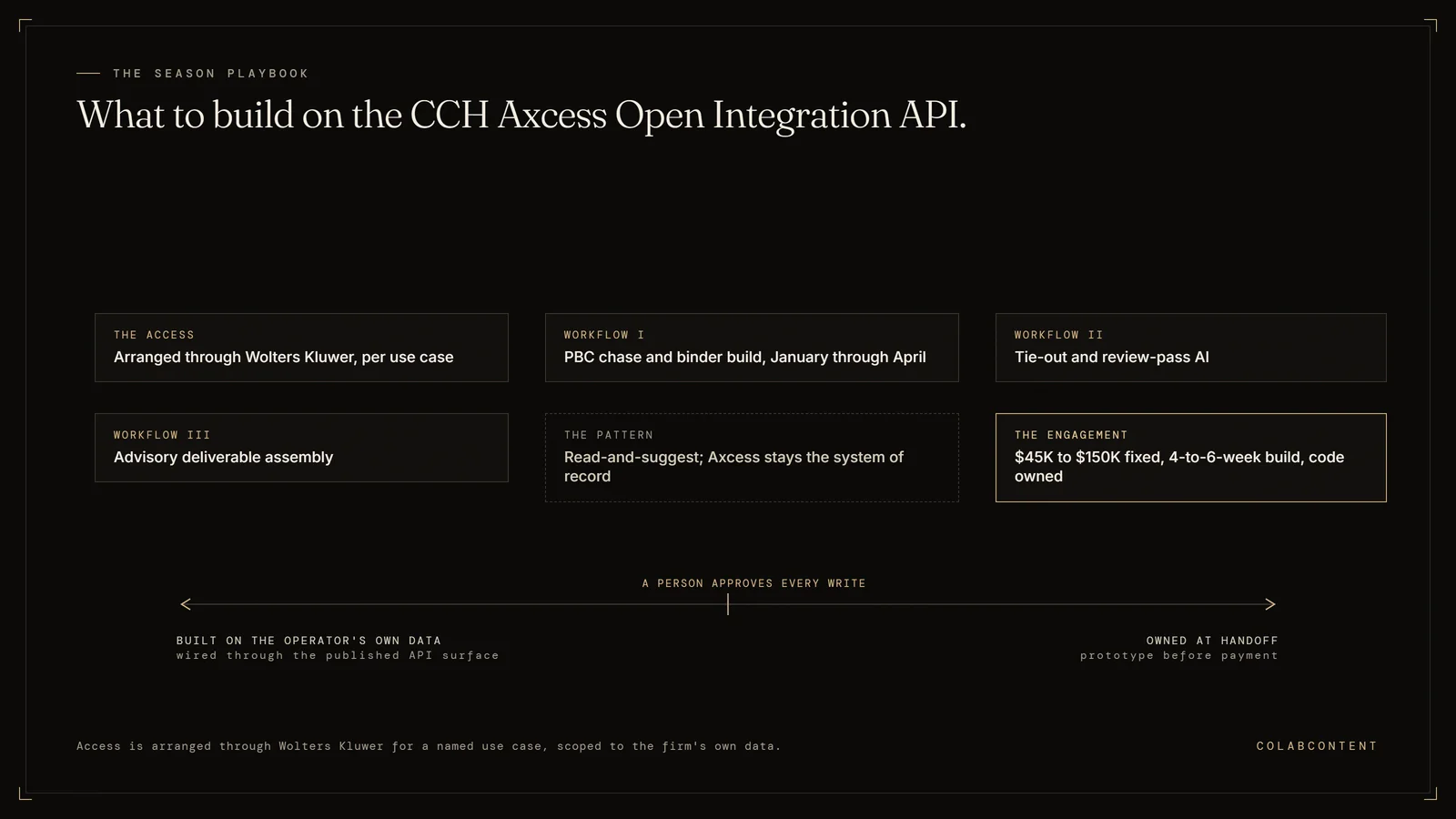
What this playbook covers and who it is for.
Wolters Kluwer's CCH Axcess AI roadmap is real and the team behind it is competent. The first wave of AI features (TRI for tax research, AssistantBot, document recognition in CCH Axcess Document) ships value to the average customer. The mid-market CPA firm with 30 to 150 professionals is not the average customer. The leverage that's available to a 60-pro firm running CCH Axcess is one or two layers above what the off-the-shelf AI provides.
The leverage is in the firm-specific workflow: your firm's tax-return templates, your binders, your tie-out checklists, your prior-year exception patterns, your client cohort. Custom AI built on the Open Integration API reads all of this, and runs the workflows the partners actually want automated, on the firm's schedule. This memo describes the architecture and the first three workflows we ship.
The Open Integration API surface area.
CCH Axcess Open Integration API gives you authenticated access to: tax returns, binders, document attachments, client master, staff, time, billing, and the workpapers stored in CCH Axcess Document. OAuth2 client credentials, FastTrack onboarding for ISVs, generous rate limits if you're a single-firm tenant (a private cloud account).
The API is sufficient for the workflow integrations described below. It is not sufficient to replace CCH Axcess; we are not building that, and the partners do not want it. We are building a thin AI layer that reads from CCH Axcess, runs the workflow, writes back to CCH Axcess.
Workflow I: PBC chase & binder build, every January through April.
The expensive workflow at every mid-market firm. Senior staff and partners chasing missing 1099s, K-1s, brokerage statements, engagement letters, prior-year-comparable docs.
The custom-AI version: at engagement-letter signature, the system creates the binder shell in CCH Axcess Document, populates the expected-document checklist from prior-year filings (read via API from the prior-year return), sends the client a personalized request list, captures their replies (email or portal upload), categorizes each document into the right binder section, flags missing critical items, and pings the partner only when something material is missing or ambiguous.
Architecture: webhook (an automatic notification one system sends another when something changes) listener for client portal uploads + Microsoft Graph for email; document classification model trained on the firm's last three years of binders; binder write-back via CCH Axcess Document API; Slack/Teams alert routing per partner.
The questions below cover does CCH Axcess have an API, how do I get CCH Axcess API access and what can you automate with the CCH Axcess API.
Workflow II: Tie-out and review-pass AI.
The custom-AI version is not a generic tax-research assistant. It is trained on your firm's tax-return templates, your tie-out checklists, your prior-year exception logs. Catches the same things your senior reviewer catches, an hour earlier, on every return that fits the pattern.
Architecture: read return + workpapers via API; compare line-by-line against prior year + checklist; surface flags (variance threshold breaches, missing M-1 reconciliations, unsupported deduction lines, prior-year carryforward mismatches) in a reviewer-facing summary. Does not modify the return; only surfaces the queue.
Ships in week 3 of a 4-6 week engagement.
Workflow III: Advisory deliverable assembly.
The most profitable line of business in the modern CPA firm. Also the line that dies on the vine because partners cannot context-switch out of compliance during season.
The AI version assembles client-specific advisory deliverables (CFO reports, tax-planning briefs, year-end strategy memos, cash-flow forecasts) by reading the client's prior returns, current-year YTD financials (via QBO/Xero/Sage Intacct integration), and the firm's standard deliverable template. Partner edits the assembled deliverable rather than building it from scratch.
Most firms move from "advisory is something we'll do off-season" to "advisory is a recurring monthly deliverable."
What we don't build.
We do not replace CCH Axcess Tax. We do not build a competitor to TRI for tax research. We do not build a generic AI chatbot the staff queries; the leverage is workflow integration, not chat interface. If your firm wants the off-the-shelf CCH Axcess AI features tuned well, Wolters Kluwer's services team is the right answer, not us. If your firm wants the workflows above, this memo describes what we ship.
Calendar discipline.
We do not start CPA engagements between February 1 and April 15. Partners cannot afford to spend any cycles on a build during season; we are useless to them. Engagements scoped in May ship by July; scoped in August ship by October extension; scoped in November ship by January, ahead of next season. The partners we work with appreciate this; competing vendors who pitch "live by April 15" are kidding themselves and the partners know it.