What Karbon AI is, fairly.
Karbon is the strongest practice management platform in the mid-market CPA segment. Karbon AI ships features (auto-categorization of client emails, summarization of client conversations, draft replies, time-entry suggestions) that work well at the average firm. The team building Karbon AI is competent and the State of AI in Accounting reports they publish are useful industry references.
If your firm runs on Karbon and the workflows you most want automated are the ones Karbon AI covers, the right answer is to use Karbon AI well. We are not going to pretend otherwise.
Where Karbon AI is the right answer.
Three patterns where the answer is Karbon AI, not a custom commission:
Your firm is already on Karbon and your workflows are average. If your tax-prep stack is CCH or UltraTax, your client mix is typical small-business compliance, your matter taxonomy follows the segment-standard pattern, and your bottleneck is generic email/triage/communication workflows: Karbon AI hits the 80% the average firm needs.
Your team is small enough that change-management overhead matters more than ceiling. A 12-pro firm cannot absorb a 6-week custom build's change-management cost. Off-the-shelf, configured well, with Karbon's native rollout discipline, ships faster and adopts better than a custom build.
You're early in the AI adoption curve and need to build organizational muscle first. Off-the-shelf is the right starter. The firm learns to use AI through Karbon's product first, builds the cultural foundation, then commissions custom in year two when the leverage points are clearer.
Where custom AI is the right answer.
Three patterns where Karbon AI hits its ceiling and custom is the leverage:
Your firm has 30+ professionals and the bottlenecks are firm-specific. At scale, the bottlenecks get specific. Your tie-out checklists are not the average firm's. Your prior-year exception patterns are firm-specific. Your CCH Axcess workflows have been customized for fifteen years. Karbon AI is calibrated for the typical firm; your firm increasingly is not. The leverage is in commissioning a workflow integration that knows your firm's specifics.
Your tax-prep stack is the leverage point, not your practice management. Karbon AI lives in the practice management layer. The expensive workflows in a mid-market CPA firm (PBC chase, tie-out, advisory deliverable assembly) live in the tax-prep stack: CCH Axcess, UltraTax, ProSystem fx. Custom AI on those tools, at the workflow level, recovers hours Karbon AI cannot reach.
You want to own the system, not rent it. Karbon AI is a feature of the Karbon subscription. If you change practice management vendors, you lose the AI. Custom AI on top of CCH Axcess Open Integration API is portable across practice management platforms because it lives at the tax-prep layer, which is more durable.
The honest comparison table.
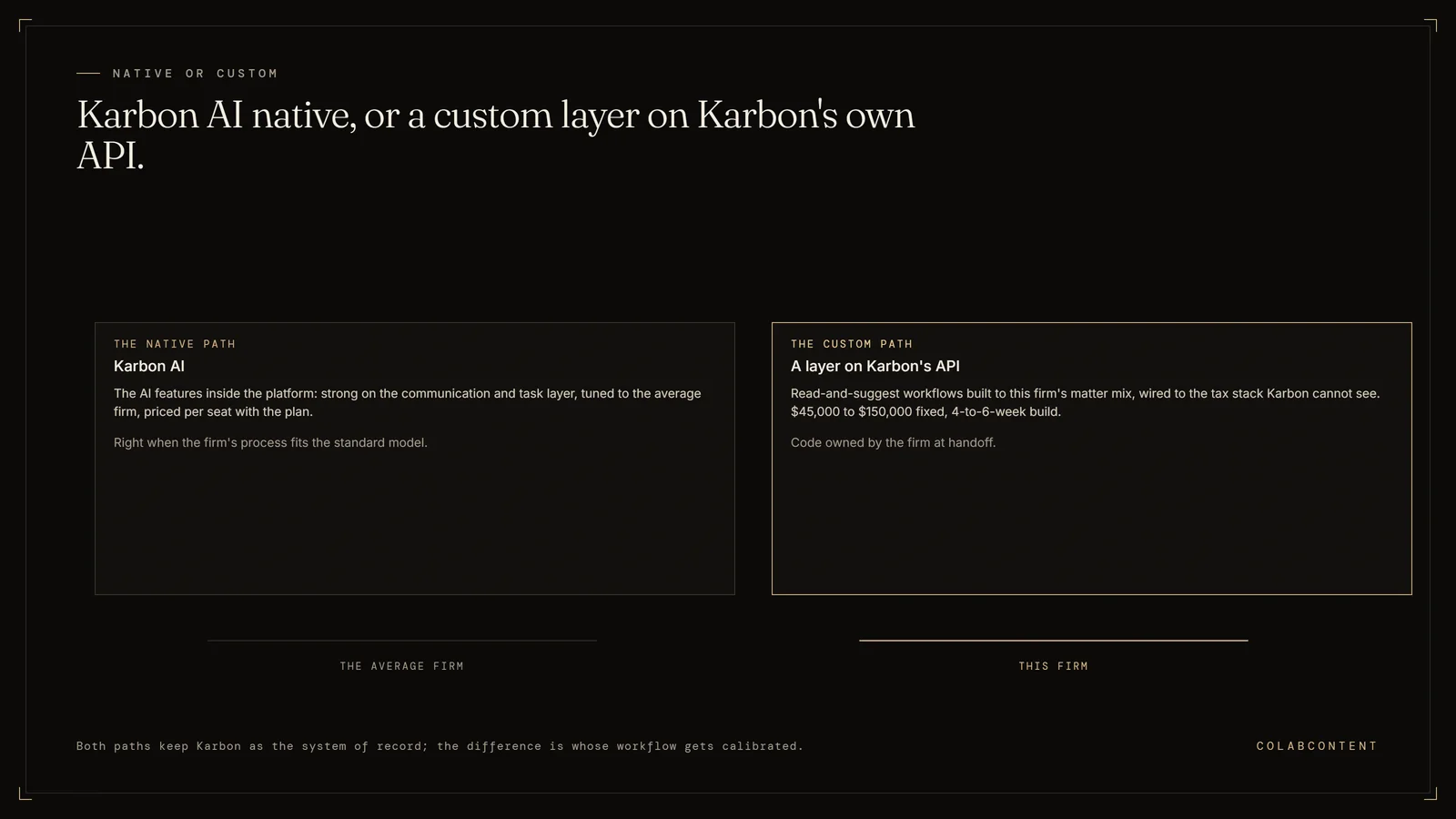
Cost: Karbon AI is bundled with the Karbon subscription, marginal cost approaching zero per seat. Custom commission is $45K-$180K one-time. For a 60-pro firm at $50/seat/month Karbon, the Karbon-AI line item is $36K/year. Custom commission breakeven at 12-24 months depending on scope.
Time to value: Karbon AI ships immediately when toggled. Custom commission ships in 4-6 weeks.
Workflow ceiling: Karbon AI works very well within the workflows it covers. Custom AI works very well in the workflows it is commissioned for, including workflows Karbon doesn't address.
Adaptability to firm specifics: Karbon AI is calibrated against the segment median; firm-specific tuning is limited to configuration. Custom AI is built to firm specifics from day one.
Ownership: Karbon AI is rented; custom is owned at handoff.
What we recommend, for our segment.
If you're a 30-150 pro firm with firm-specific workflows in CCH Axcess or UltraTax, the answer is usually both: keep Karbon AI for the workflows it covers; commission custom AI for the workflows that move the firm's actual P&L. Most of the firms we work with run this combination.
If you're a 12-pro firm, the answer is Karbon AI plus a year of patience. Come back when the firm is bigger and the leverage points are clearer.