Home/ Comparisons/ CoStar Alternatives

CoStar Alternatives for CRE Firms: 8 Options, Priced

There are eight credible alternatives to CoStar Suite for a mid market brokerage, appraisal or investment shop: Reonomy, CompStak, Crexi Intelligence, CommercialEdge, MSCI Real Capital Analytics, Trepp, ARGUS Enterprise and MotionCRE. The ninth option, and the one most buyers never price, is commissioning the workflow and reporting system your firm actually runs on and owning it outright, one fixed fee, no per seat licence, no renewal increase. Read the honest part first: none of those eight, and no custom build, recreates CoStar's proprietary national comps and listings database. What a build replaces is the pipeline, reporting, valuation and internal CRM layer your team has stacked on top of that data, which is why the recommendation for most firms on this page ends up being fewer CoStar seats plus a layer you own, not zero CoStar. CoStar publishes no price at all; costar.com returned HTTP 403 to a direct read on August 27, 2026 and a search of the domain surfaced no pricing page. The strongest number that exists comes from buyer-submitted contracts: a median negotiated $40,000 a year for CoStar Suite All Markets at one licence covering three users, against a $71,000 list price, a 44 percent discount, recorded by PriceLevel. Run that through five years with a stated 5 percent annual increase and you get $126,100 over three years and $221,025 over five, against a one time $45,000 to $180,000 for a commissioned build. The calculator further down runs the same arithmetic on your invoice instead of ours.

A note on names, because CoStar Group sells several products that get talked about as if they were one. CoStar Suite is the flagship research and comps product, and it is the one this page prices. CoStar Real Estate Manager is the separate lease administration and accounting product, sold on its own contract with its own longer cancellation notice. LoopNet is CoStar Group's own listing marketplace, which is why you will not find it in the roundup below; listing the incumbent's own subsidiary as competition would not be a comparison. Firms come at this decision from different directions too, whether that is wanting a cheaper alternative, wanting to know what the contract really costs, or planning an exit. It is one decision, and this page covers all of it.

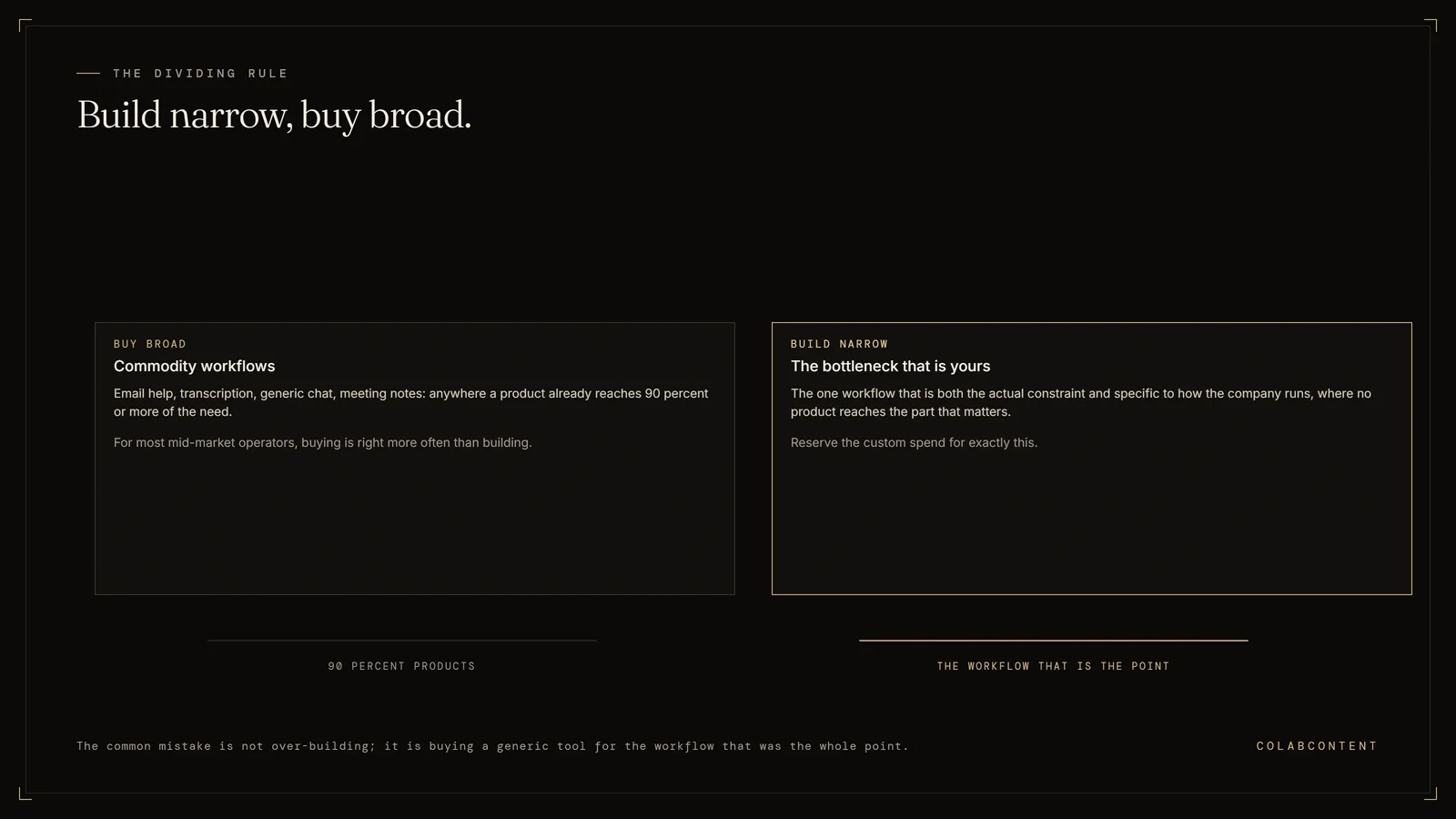
The dividing rule between buying and building: commodity workflows already covered by an existing product belong on the buy side, while the one bottleneck workflow that is both the real constraint and specific to how the firm runs belongs on the build side
Where the licensed data platform stops and the firm's own logic begins.

Written for the firm that already pays for CoStar. We do not sell a data platform, we take no referral fee from anyone in the table below, and we will say plainly which firms should keep the subscription exactly as it is.

ForCRE firms on a CoStar Suite contract
StanceNeutral. We sell no CRE data.
Incumbent cost$40,000 a year, buyer-submitted contract
Build fee$45,000 to $180,000, one time
Bottom lineLines cross during year 2 at $40,000 a year
CostFree 45-minute diagnosis
Prices readAugust 27, 2026

The short answer.

If you are on CoStar and the reason you are reading this is money, the single most useful thing on this page is not the roundup. It is the fact that a real, buyer-submitted contract exists showing $40,000 a year against a $71,000 list price, which means the discount on your own renewal is a negotiated variable rather than a fixed rate, and you now have a benchmark to walk in with. Most firms discover their leverage at renewal and not before. The second most useful thing is the honest limit: if what you buy CoStar for is the comps and listings database itself, nothing on this page fully replaces it, and any page telling you otherwise is selling you something.

So the verdict splits three ways. Firms spending in the low five figures, roughly the $15,130 average and $3,000 to $23,000 range that Vendr's buyer guide records, should almost certainly stay and negotiate, because at that level a commissioned build does not pay back inside five years and the arithmetic further down this page proves it against you rather than for you. Firms carrying a full Suite All Markets contract in the $40,000 range, with a team of analysts rekeying CoStar exports into spreadsheets, a deal pipeline living in email, and reporting assembled by hand every month, are the ones for whom the numbers flip, and they usually flip by cutting seats rather than cancelling. And firms whose entire operating dependency is the licensed data, with no meaningful workflow layer around it, should keep every seat they have and stop reading after the honesty section.

What CoStar actually does well.

A comparison page that treats the incumbent as a punching bag is useless to the person actually holding the contract, so be precise about what you are paying for.

A database nobody else has built. CoStar describes itself as the industry's most comprehensive database of commercial real estate information, analytics and news, and as the world leader in commercial real estate information with the most comprehensive database of real estate data throughout the US, Canada, UK and France. Those are the company's own words, taken from costar.com and from the CoStar Group brand page, and we are labelling them REPORTED rather than verified for a specific reason: both pages returned HTTP 403 to a direct read on August 27, 2026, so we read them as search engine indexed snippets rather than opening them ourselves. What matters for your decision is not the adjective. It is that the underlying asset is a proprietary dataset assembled over decades by people who go out and collect it, and no software project creates one of those from nothing.

Breadth across property types and markets in one place. Lease comps, sale comps, availabilities, tenant data, ownership and market analytics sit behind one login. Every alternative in the roundup below covers a narrower slice: public records, contributed comps, debt data, or institutional transaction volume. That consolidation is real value, and it is the reason multi-market firms tolerate the price.

It is the market's common language. When a lender, an appraiser and a broker all quote the same source, arguments get shorter. That network effect is not a feature you can list on a comparison grid and it is not something a cheaper tool acquires by having better software.

Your own work product is exportable. CoStar's product help documentation describes an export path for a user's own data, the lease comps and records you created, modified or own inside the platform, out to Excel or CSV. That is a genuine exit path for your work, and it matters in the migration section further down. It is not, and is not meant to be, a bulk export of the licensed database.

Why firms start looking for a way out.

Four patterns, in the order operators raise them.

The renewal moved and nobody decided it should. A CoStar reviewer on Trustpilot describes a renewal rising from roughly $6,200 to roughly $6,500, and complains that the auto-renewal landed just past the close of the cancellation window. That review is VERIFIED, read directly on trustpilot.com on August 27, 2026. It is a smaller subscription than the Suite contract this page models, so treat it as a description of the renewal mechanics rather than as a rate for your tier. Note also what it is not: we went looking for a widely repeated claim that CoStar contracts carry a CPI linked escalation clause, traced it to its cited source, found no such statement there, and are therefore not printing it.

The price is invisible until you are in a sales cycle. There is no public rate card, so there is no way to know whether your number is good without a benchmark from outside the company. That is a negotiating problem before it is a pricing problem, and it is why the PriceLevel figures on this page are worth more to you than any feature comparison.

The exit is procedural, not simple. Third party cancellation services summarising CoStar's own agreement language describe written notice requirements of 30 days for general subscriptions and 60 days for CoStar Real Estate Manager, no mid term cancellation, and fees non refundable once paid. That is REPORTED, from joinchargeback.com and subscribed.fyi, not read off a live contract, and your own agreement governs. A second Trustpilot reviewer advises putting in a cancellation request as soon as you start a contract, which tells you how the mechanics feel from the inside.

The thing the firm actually needs is not a data problem. Deal pipeline, underwriting handoffs, rent roll normalisation, investor reporting, commission splits. None of those are search problems. No amount of subscription spend fixes them, because the platform was never built to know how your firm runs.

What you are actually paying

Every number on this page, with its source.

One vendor in this category publishes a real, checkable price on its own website. Everyone else is quote-only, including CoStar. We label each figure VERIFIED when it was read off the vendor's own page on August 27, 2026, REPORTED when a named third party published it and the vendor has not confirmed it, and ASSUMPTION when it is our own modelling input rather than anybody's published number. Where two sources disagree we print both rather than averaging them into one figure that describes no real buyer, and where a claim could not be traced to its source we say we dropped it.

Line itemFigureLabelSource
CoStar Suite (All Markets), 1 licence covering 3 users, median negotiated$40,000 a yearREPORTEDpricelevel.com CoStar pricing, buyer-submitted contract, profile 201 to 500 employees, USA, private company, contract started Q1 2022
Same product, list price$71,000 a yearREPORTEDpricelevel.com, stated alongside the median
Discount off list on that contract44 percentREPORTEDpricelevel.com
Average annual cost, broader pool$15,130 a yearREPORTEDvendr.com CoStar buyer guide, from Vendr internal transaction data, disclosed sample of more than three purchasers and three completed deals
Range on that same pool$3,000 to about $23,000 a yearREPORTEDvendr.com CoStar buyer guide
Published CoStar rate cardNone existsVERIFIED by absencecostar.com and the CoStar Suite product page both returned HTTP 403 to a direct read; a search of the domain returned news, a stock quote and a login portal, no pricing page. The only public route to a number is a demo request form.
Cancellation notice30 days general, 60 days for CoStar Real Estate ManagerREPORTEDjoinchargeback.com and subscribed.fyi cancellation summaries of CoStar's own terms. Not read off a live contract.
Mid term cancellation and refundsNo mid term cancellation; fees non refundable once paidREPORTEDsame two sources, consistent with each other
Annual increase used in the model5 percent a yearASSUMPTIONOur modelling input, not a CoStar published rate. Directionally informed by one verified Trustpilot renewal moving from roughly $6,200 to roughly $6,500, on a smaller product than the Suite tier. Set it to zero in the calculator if your contract has no escalator.
Implementation or onboarding fee$0ASSUMPTIONNo sourced CoStar implementation fee was found. Subscription access to a hosted database has no discrete deployment project, so zero is defensible. It understates the real cost of training and ramp.
Internal admin and renegotiation load$0ASSUMPTIONDeliberately excluded rather than invented. Real friction exists in the reviews, no dollar figure for it is sourced anywhere, so none is printed. This makes the CoStar side of the model a floor rather than a ceiling.
Add-on data modules and multi-user licensingNot modelledASSUMPTIONAdd-on modules exist and are priced separately. One aggregator publishes ranges for them; it discloses no methodology and no buyer verification and nothing else corroborates it, so those ranges are excluded from this model rather than presented as fact.
Commissioned build, one time fixed fee$45,000 to $180,000VERIFIEDColabContent's own published fee range, set after the diagnosis call
Build maintenance15 percent of build price a yearASSUMPTIONA software industry heuristic used for modelling, not a ColabContent contract term. Replace it with a real quote before deciding.

Two CoStar numbers, two different buyers

The $40,000 and the $15,130 look like a contradiction and are not one. PriceLevel's $40,000 is a single buyer-submitted contract for the full Suite All Markets tier covering three users with national coverage. Vendr's $15,130 is an average across a small pool that it describes as more than three purchasers and three completed deals, and its own stated $3,000 to $23,000 range is consistent with narrower single market licences rather than All Markets. They describe different products bought by different firms. We are printing both, labelled, rather than blending them into a single average that would describe nobody. The rest of this page anchors on $40,000, because that is the buyer who can plausibly write a $45,000 cheque, and because it is the figure a Suite contract holder can hold up in a renewal conversation.

What a CoStar Suite contract costs over five years

Take the reported $40,000 base, apply the stated 5 percent annual increase, and add nothing else, no implementation, no admin time, no add-on modules. This is a deliberately conservative model that understates your real spend.

YearCoStar payment that yearCoStar cumulativeOwned build cumulative
0Nothing yet$0$45,000
1$40,000.00$40,000.00$51,750.00
2$42,000.00$82,000.00$58,500.00
3$44,100.00$126,100.00$65,250.00
4$46,305.00$172,405.00$72,000.00
5$48,620.25$221,025.25$78,750.00

The build column is a $45,000 one time fee paid at year zero plus $6,750 a year of maintenance, which is the 15 percent assumption applied to $45,000 and held flat with no compounding. At the end of year one the subscription is still the cheaper path by $11,750. At the end of year two the positions have swapped and the subscription is $23,500 ahead. By year five the difference is $142,275.25 and it widens every year after that, because one line has a slope and the other is nearly flat.

The honest counterweight sits in the same table. A build at the top of our range, $180,000, costs $261,000 over three years with the same maintenance assumption, which is more than double the $126,100 CoStar figure over the same period, and it does not catch up inside five years. If someone tells you a custom build always wins on cost, they have not run this arithmetic. The build only wins when the scope is genuinely proportionate to the spend it replaces, which is exactly what the diagnosis call is for.

The crossover

Where the two lines meet.

Cumulative spend for the reference buyer, five years out. CoStar Suite All Markets at the reported $40,000 median with a 5 percent annual increase as a stated assumption, against a $45,000 commissioned build paid once at year zero with 15 percent a year maintenance. Every figure in the chart is a row from the table above.

Cumulative five year cost: a CoStar Suite subscription versus a one time commissioned build A line chart of cumulative spend over five years. The CoStar line starts at zero at year zero and rises steeply to $40,000 at year one, $82,000 at year two, $126,100 at year three, $172,405 at year four and $221,025 at year five. The commissioned build line starts at $45,000 at year zero and rises gently by $6,750 of maintenance each year to $51,750, $58,500, $65,250, $72,000 and $78,750. The two lines cross during year two, at about 1.3 years and roughly $54,000, after which the subscription line is permanently above the build line. By year five the gap is $142,275. $0 $50K $100K $150K $200K $250K Year 0 Year 1 Year 2 Year 3 Year 4 Year 5 Crossover, during year 2 about $54,000 on each path CoStar $221,025 Owned build $78,750 CoStar Suite, $40,000 a year, 5% assumed increase Commissioned build, $45,000 once, 15% maintenance

The lines cross about four months into year two, at roughly $54,000 of cumulative spend on each path. Before that point the subscription is genuinely cheaper and the build is the worse financial decision, which is exactly what you would expect and exactly what a vendor chart hides by starting the axis somewhere convenient. Year two is the first year end at which the CoStar cumulative, $82,000, sits above the build cumulative, $58,500. After that the gap only opens.

Change either input and the picture changes honestly. At the smaller buyer profile, the $15,130 average from Vendr with the same 5 percent assumption, cumulative CoStar spend is $15,130, $31,016.50, $47,697.33, $65,212.19 and $83,602.80 across the five years, and it does not pass the $78,750 build line until year five. A firm at that spend level should not commission a build on cost grounds, and the honesty section further down says so in more detail. Raise the build to $180,000 and the crossover disappears from the five year window entirely at either spend level. Run your own figures below.

Your firm, your numbers

The CoStar total cost calculator.

Every default below is a figure from the table above, and every one is editable, because the defaults describe a market and your invoice is a fact. Nothing is submitted anywhere. There is no email gate, no external request and no stored value. The arithmetic runs in your browser and stops there. If your inputs make the build lose, the tool says so rather than quietly hiding the result.

Verified reference points: $40,000 Suite All Markets median, $15,130 broader average, $3,000 to $23,000 range.
Modelling assumption, not a CoStar published rate. Set to 0 if your agreement has no escalator.
ColabContent fixed fee range, $45,000 to $180,000, set after the diagnosis call.
Software industry heuristic used for modelling, not a ColabContent contract term. Replace it with a real quote.
The roundup

Eight alternatives, plus the ninth option most buyers never price.

Two notes on the roster before the list. First, LoopNet is not on it. LoopNet is a CoStar Group brand, acquired in 2012, and presenting the incumbent's own marketplace as an alternative to the incumbent would be theatre. Second, several of the most visible CoStar alternatives guides available online are published by companies that sell a competing product and include themselves in their own comparison. That does not make those guides worthless, it makes them worth reading with the authorship in mind, and it is the reason this page states our own commercial interest openly rather than pretending to be disinterested.

1. Reonomy

What it is. An owner discovery and off-market prospecting platform built on public records: deed, mortgage, tax and lien data across the US.

Price. VERIFIED from reonomy.com pricing on August 27, 2026. From $500 per month billed monthly, or from $400 per month billed annually, which the page describes as a 30 percent saving. Export add-ons are listed at $75 a month per one thousand exports.

Best for. Investment sales brokers, lenders and acquisitions teams whose job is finding owners and off-market deals rather than pulling licensed lease comps.

Where it falls short. Its data comes overwhelmingly from public sources, which means commercial lease comps are not part of the product. That characterisation comes from CompStak's own published comparison, which is a competing data vendor, so weigh it accordingly, but it matches what the product describes itself as doing.

Verdict. The strongest affordable owner discovery layer on this list, and the only alternative here with a price you can read in ten seconds. Not a comps or listings replacement.

2. CompStak, Exchange and CompStak One

What it is. Analyst reviewed lease and sale comps contributed by a community of brokers and appraisers, plus a paid tier adding leasing, sales, CMBS and analytics.

Price. The Exchange tier is free in exchange for contributing your own closed deal comps. CompStak One is quote-only with value based pricing, which is REPORTED from research.com and trustradius.com rather than read off CompStak's own page, and the reported description is that prospects discuss their needs on a sales call before receiving a quote.

Best for. Brokers and appraisers willing to trade their own transaction data for access, and firms that need comps depth without a national data subscription.

Where it falls short. The free tier is not free, it is barter, and firms with proprietary deal flow they would rather not publish will feel that. The paid tier has no public price. And CompStak is a data vendor, not a workflow layer, so it changes where your comps come from and nothing about how your firm operates.

Verdict. The closest thing on this list to a direct comps competitor, on a contribution model that some CoStar buyers will not accept.

3. Crexi Intelligence

What it is. A paid data and analytics tier layered on the Crexi marketplace, where the listing side is free.

Price. No public figure. VERIFIED by absence: crexi.com's own pricing page returned HTTP 403 to a direct read on August 27, 2026, and a CRE Daily review states that pricing for all paid plans is available upon request.

Best for. Brokers already using Crexi's free marketplace for listing exposure who would rather add market data in a platform their team is already inside.

Where it falls short. You cannot comparison shop it without a sales call, which is the exact friction that sent you looking for CoStar alternatives in the first place.

Verdict. Convenient if you are already on Crexi. Not a transparency win over the incumbent.

4. CommercialEdge

What it is. A free commercial listing syndication network with a paid Edge Research data tier attached. Part of the Yardi family of products.

Price. Edge Research is REPORTED at $250 a month or $2,400 a year by selecthub.com and trustradius.com; the listing network is free. Those figures are not published by the vendor on a page we could read this week, so treat them as reported.

Best for. Teams that mainly need listing exposure and a modest research tier, and firms already inside the Yardi ecosystem where the integration story is simpler.

Where it falls short. The research breadth is much narrower than a national comps and analytics database. If you are replacing CoStar Suite with this, you are not replacing it, you are downgrading deliberately, which is a legitimate choice but should be a conscious one.

Verdict. The cheapest reported paid tier in this roundup by a wide margin, with a correspondingly smaller dataset. If the firm's related question is property management software rather than market data, our Yardi alternatives page covers that side of the same house.

5. MSCI Real Capital Analytics

What it is. Institutional transaction and investment volume data, now part of MSCI Real Assets, tracking large scale deal flow and pricing trends.

Price. Quote-only, enterprise and value based. REPORTED from msci.com's own product materials as read through search this week: prospective subscribers take a sales call and a demo before a pricing structure is proposed.

Best for. Institutional investors, lenders and research teams whose question is where capital is moving rather than what the third floor leased for.

Where it falls short. It is built for institutional research, not brokerage workflow, and there is no small firm entry point. It belongs on this list because hiding the expensive options would make this an advertisement, not because it saves anybody money.

Verdict. A real institutional grade alternative for one of CoStar's use cases. Not a seat for seat swap for a brokerage.

6. Trepp

What it is. Structured finance and CMBS data covering securitized and non securitized commercial mortgages, loan portfolios and nationwide mortgage statistics.

Price. Quote-only. VERIFIED by absence through G2's pricing page for Trepp Asset Manager, which states that the vendor has not provided pricing information for the product.

Best for. Debt side analysts, CMBS investors and lenders monitoring loan and property level credit performance.

Where it falls short. It is a specialist debt data tool rather than a general listings and comps platform, and its pricing is entirely opaque.

Verdict. Excellent inside its niche, irrelevant outside it.

7. ARGUS Enterprise

What it is. Valuation, underwriting and asset level cash flow modeling from Altus Group, now sold within the ARGUS Intelligence Platform.

Price. REPORTED and weakly. Reseller listings and a Wall Street Oasis forum thread put it near $1,500 per user per month, roughly $18,000 per user a year, with a one time implementation of $5,000 to $25,000 and volume discounts above five seats. Altus Group publishes no pricing of its own, so this is the least firm number on the page and we are flagging it as such rather than quietly averaging it into anything.

Best for. Teams whose real dependency is deal level valuation and underwriting models rather than market wide comps.

Where it falls short. It solves a genuinely different problem. Buying it instead of CoStar would leave you without market data; buying it in addition adds a per seat cost that on the reported figure is the largest per user number in this roundup.

Verdict. A complement to a data subscription, not a replacement for one.

8. MotionCRE

What it is. A commercial real estate deal tracking and pipeline CRM. A workflow product, not a data source.

Price. REPORTED at $249 to $699 a month across its Team, Plus and Power tiers, taken from MotionCRE's own resources page; its dedicated pricing page loaded a sign in screen rather than numbers when we looked on August 27, 2026.

Best for. Brokerage teams who want a modern deal pipeline and reporting layer running alongside whatever data source they keep.

Where it falls short. It does not replace CoStar's core function and does not claim to. It is also the publisher of one of the most visible CoStar alternatives guides on the internet while selling a competing product inside that same article, which is worth knowing when you read it.

Verdict. A credible off the shelf version of the workflow layer, which makes it the honest first thing to price before commissioning one. If a packaged product covers your pipeline properly, buy the packaged product.

9. A commissioned build you own

What it is. Not a replacement for CoStar Suite. A custom system built for the workflow no data vendor covers, sitting on top of whichever data subscription you keep, owned by the firm at handoff. In practice that means a deal pipeline that matches how your team actually stages a transaction, rent roll and offering memorandum normalisation, underwriting handoffs that stop being spreadsheets emailed around, investor and lender reporting assembled automatically, and commission splits that reconcile.

Price. A fixed fee of $45,000 to $180,000, set after a free 45-minute diagnosis call once the integration depth is named, paid in two instalments at build start and at handoff. The firm owns the code, prompts, models and pipeline at handoff and runs it in its own cloud tenant.

Best for. Firms carrying a Suite scale contract with a named workflow that consumes analyst hours every week, and firms that can cut seat count once the internal system stops requiring everyone to have a login.

Where it falls short. It is a bigger single cheque, it needs tighter scope than buying software does, and at the top of our range it loses the cost argument outright against every scenario on this page. It also does not create comps data, so if the goal is to stop paying CoStar entirely, this is not that.

Verdict. The option none of the eight above will show you, and the only one where the bill stops going up.

The ownership case

Nine arguments for owning the layer instead.

Each of these is either arithmetic you can check on this page or a structural fact about the two models. Where an argument does not honestly apply to your firm, the next section says so plainly.

One. The math, restated. A subscription never ends. At the reported $40,000 Suite figure with a 5 percent stated increase, five years is $221,025.25 and year six starts from zero progress. A $45,000 build with 15 percent maintenance is $78,750 over the same five years. The lines cross about four months into year two at roughly $54,000 each, and after that the gap widens every single year because one curve has a slope and the other is nearly flat. That is the whole argument, which is why the chart is above the sales copy rather than inside it.

Two. Seat based pricing taxes the team you are trying to grow. The reference contract is one licence covering three users. Every analyst, associate and new hire who needs a login raises the bill, and it raises it on a schedule set by someone outside your firm. An owned internal system has no marginal seat cost at all, so the hiring decision stops carrying a software decision inside it, and the licensed data seats can be concentrated on the people who genuinely need to query the database rather than issued to everyone who needs to see a report.

Three. Asset versus expense. A subscription is rent and it leaves nothing behind. A commissioned system is a piece of the firm: transferable, valuable in a merger or succession conversation, and on the balance sheet rather than only on the expense line. For principals thinking about a five to ten year horizon, or about what the firm is worth to a buyer, that difference is not cosmetic.

Four. Built around your workflow, not the median firm's. Every product in the roundup above is calibrated against the average customer in its category, so you pay for the whole bundle and adapt your process to the fraction of it your firm actually uses. A commissioned system starts from your deal stages, your underwriting standards, your reporting calendar and your commission structure. Nobody has to be retrained into somebody else's assumptions about how a deal progresses.

Five. AI at the core rather than as a line item you cannot benchmark. Across this category, capability arrives as an unpriced uplift discussed on a call. CoStar publishes no pricing at all, so there is no published rate for anything it adds. Crexi's paid tier, CompStak One, MSCI Real Capital Analytics and Trepp are all quote-only as well. That means every capability you add is priced against you rather than against a rate card. In a commissioned build there is no separate licence for the intelligence layer, because the intelligence is the system, and adding a user costs nothing.

Six. Unlimited seats. Analysts, associates, back office, seasonal help, and where appropriate investors and lenders reading their own reports. Zero marginal cost per person changes the question from who needs a licence to who needs access, which is a better question and usually produces a smaller data subscription rather than a bigger one.

Seven. Data ownership and no exit ransom on the part you own. Your pipeline, your underwriting history, your reporting logic, in your own cloud tenant, under an agreement you wrote. Compare that with the exit mechanics in the migration section below, where written notice periods, no mid term cancellation and non refundable fees are the reported norm. Owning the layer removes the negotiation from leaving it, even while the licensed data underneath stays a subscription.

Eight. Vendor risk you stop carrying on the workflow layer. Consolidation is normal in this category and it is visible from outside: CoStar Group acquired LoopNet in 2012 and still operates it as a brand, Yardi acquired PropertyShark in 2010, and Real Capital Analytics now sits inside MSCI. Products get bought, repositioned and repriced on the acquirer's schedule rather than yours. A system your firm owns does not get sunset by anybody, and the roadmap for it is a conversation inside your own office.

Nine. Change speed. A change request to your own system is a scoping conversation and a deployment. A change request to a data vendor is a feature request in a queue behind every other customer's, with no committed date and no obligation. When the thing that needs to change is the thing that makes your firm different from the brokerage down the street, the queue is not an acceptable answer.

What we can actually prove

A list of arguments is worth exactly as much as the evidence behind the firm making it, so here is ours, with nothing rounded up and nothing borrowed. Jim Glaser Law is our nameable reference and the principal takes reference calls. The LELF platform is the fullest example of what commissioning looks like at operating scale: a 47-attorney litigation firm runs its matter, invoice and trust operation on it, holding 13,296 matters, 4,396 clients and 5,684 invoices, with trust reconciled byte identical against the system it replaced. That firm is under confidentiality and stays anonymised, which is why we name the platform and not the firm. Across our practice we have handled more than 6,000 AI calls and delivered more than forty commissions.

Read that honestly and note what it is not. It is not a commercial real estate reference, because we do not have one yet, and we are not going to manufacture one for a comparison page. What that evidence supports is a specific claim: we build systems that carry real operational volume, hold real financial data, and reconcile under audit. What it does not support is any claim that we have replaced a CoStar subscription for anybody, because we have not, and the migration section below says so in plain language rather than around it.

The honesty section

Who should stay on CoStar.

Five situations where every argument in the previous section fails, and where we would tell you to stay put on a call.

Firms whose real dependency is the database itself. This is the big one and it deserves the top of the list. CoStar's value is a proprietary comps, listings and market dataset assembled over decades by people who go and collect it. No custom build creates that. No vendor in the roundup above fully replaces it either; each covers a narrower slice, whether that is public ownership records, contributed comps, debt data or institutional transaction volume. If your firm's daily dependency is the licensed data, keep it, and read the rest of this page as a case for building the layer above it rather than for cancelling anything.

Firms spending roughly $15,000 to $20,000 a year. That is Vendr's average tier, and the arithmetic is against a build. At $15,130 a year with the same 5 percent assumption, cumulative spend reaches $83,602.80 at year five against $78,750 for the cheapest build we scope, so the crossover does not arrive until the fifth year. If the firm is not certain it will operate on the same footing for five more years, or if the $45,000 entry fee is a stretch on cash flow, staying on the subscription is the math backed answer rather than the polite one.

Firms that need something working next month. A subscription starts the day the contract is signed. A commissioned build has a scoping call, a scope, a build, and a parallel run before anybody trusts it. If the deadline is real and near, buying beats building and it is not close.

Solo brokers and small teams. If you are on an entry level plan at the low end of the reported range, at $3,000 a year the subscription is a rounding error against a producer's revenue and a $45,000 build is disproportionate to the problem. The right move at that scale is better spreadsheet discipline and a cheap CRM, not a commission.

Firms with nobody to own the system internally. An owned build needs one named person who cares about it, even at a light touch. Firms without that person are better off renting, because the alternative is an orphaned internal system that decays quietly and then has to be replaced by a subscription anyway, at which point you have paid twice.

Decision tree

Six questions, in order, with stop points.

1. Is the thing you rely on CoStar for the licensed data itself? If yes, do not cancel. Keep the data and move to question two, which is about how many people need to touch it directly. If no, meaning you mainly use it as a starting point for work that happens elsewhere, continue.

2. Do you know your actual annual figure and your cancellation window date? If no, stop and go find the agreement. Every decision after this one depends on both, and the reported notice periods on this page are a substitute for your own paperwork, not a replacement for it. If yes, continue.

3. Run your number in the calculator above. Is your five year CoStar total below about $80,000? If yes, stop. The cheapest build we scope costs $78,750 over five years with maintenance, so no build we would quote beats your subscription on cost inside that window. Take the $40,000 median against a $71,000 list into your renewal conversation instead and spend the energy there. If no, continue.

4. Is the expensive part of your week a data problem or a workflow problem? If it is data, meaning coverage gaps, missing comps or a market you cannot see, then a different or additional data source is the answer and the roundup above is where to look. Stop here and go price Reonomy, CompStak and CommercialEdge. If it is workflow, continue.

5. Can you name that workflow in one sentence, with a rough hours or dollars figure attached? If no, stop, and spend two weeks measuring before anyone spends money. An unnamed constraint is the most reliable predictor of a build that disappoints. If yes, continue.

6. Have you priced the packaged version first? MotionCRE and the CRM layer inside CommercialEdge are real products at a fraction of a build. If one of them covers your named workflow properly, buy it, and we will tell you the same thing on a call. If they genuinely do not, and the budget runway for a $45,000 to $180,000 fixed fee is real this quarter, that call is the next step.

Next step

Book the 45-minute diagnosis.

Bring your CoStar agreement and one sentence describing the workflow that eats analyst hours. You leave with the constraint written down either way, and a fair number of these calls end with us telling a firm to keep what it has and negotiate harder.

Free · 45 minutes
Under NDA
Principal to principal
No follow-up unless asked
Migration reality

What leaving CoStar actually involves.

Almost nobody writing about CoStar alternatives answers this, which is odd, because it is the question that decides whether a firm ever acts on any of the rest. Here is the honest shape of it, with the parts we could source labelled and the parts we could not left out rather than filled in.

First, find your window, because it is not always the date you assume. Third party summaries of CoStar's own agreement language describe written cancellation notice of 30 days for general subscriptions and 60 days for CoStar Real Estate Manager, no mid term cancellation, and fees non refundable once paid. That is REPORTED from joinchargeback.com and subscribed.fyi, not read off a live contract, and your signed agreement is the only document that governs. The reason this is step one rather than step three is a verified review on Trustpilot describing an auto-renewal that landed just past the close of the reviewer's cancellation window, at a higher rate. A second reviewer's advice, in their own words, is to put in a cancellation request as soon as you start a contract. Whatever you think of that as strategy, it tells you that the window is the thing that bites.

Second, export your own work product before access ends. CoStar's product help documentation describes an export path for what it calls My Data, the lease comps and records you created, modified or own inside the platform, out to Excel or CSV. Use it, and use it early enough that you can check what came out. Be clear about the boundary, because it is the whole point of this page: that path exports your work, not the licensed database. CoStar's proprietary comps and listings are licensed for use inside the platform and are not yours to extract in bulk. Third party tools exist specifically to help appraisers pull individual property and comp records into their own workpapers one workflow at a time, which tells you what the practical throughput of this looks like.

Third, run in parallel for at least one full cycle. Nothing gets switched off until the replacement has survived a real reporting period with real deals moving through it. Gaps in a data migration do not surface when you look for them, they surface when a principal needs a 2021 comp on a Thursday afternoon during a negotiation. A firm that skips the parallel run to save six weeks usually spends the saving twice.

We are not printing a total timeline, and here is why. The notice window is sourced at 30 to 60 days. Everything after that depends on the scope of what you are replacing, and we could not find a single credible published figure for how long a CoStar migration takes at any firm size. So rather than invent a comfortable range, we are telling you the honest components: your notice period, plus your export, plus at least one full parallel cycle, plus whatever a scoped build actually takes, which is a proposal stage question rather than a web page question.

The option most firms do not consider. You do not have to leave to fix the problem, and in most of the cases this page is written for, leaving is the wrong move. The data subscription stays. What changes is how many people need a seat on it, and what happens to the data once it is out of the platform. Build the pipeline, the underwriting handoffs and the reporting layer, own them, and let CoStar do the one thing nobody else can do. That path has no cancellation letter, no parallel run and no exposure to a coverage gap you discover in month three.

Deep dive

The dimensions the price table cannot show.

Six dimensions, side by side.

Price transparency. Reonomy publishes a real rate card. CoStar, Crexi's paid tier, CompStak One, MSCI Real Capital Analytics and Trepp publish nothing. Quote-only is the norm in this category rather than a CoStar specific flaw, which matters because it means a competitor's silence about price is not evidence that it is cheaper. An undisclosed price lets the seller quote against the buyer rather than against the work.

Data provenance. These products are not the same thing wearing different logos. CoStar's is field collected and proprietary. Reonomy's is public records. CompStak's is contributed by the brokers who close the deals. MSCI's is institutional transaction reporting. Trepp's is loan and securitization data. Comparing them on price alone is comparing different assets.

Cost slope. Every subscription here rises with seat count and at renewal. A commissioned build is one fee plus a flat maintenance line. The slope, not the starting point, decides a five year comparison, which is why the chart on this page runs to year five rather than year one.

Ownership at exit. Every vendor here retains the platform, the structure and the pipeline; you retain an export of your own work product. A commission transfers code, prompts, models and pipeline at handoff, running in the firm's own cloud tenant. That is the difference between an export and a handover, and it applies only to the layer you commissioned, never to licensed data.

Who has to have a seat. This is the quiet lever. On a per seat data subscription, everyone who needs to see the output needs a licence. With an internal system holding the output, only the people who genuinely query the database need one. Cutting seats is usually a faster saving than switching vendors, and it does not risk a coverage gap.

Vendor risk. Acquisitions are routine here. CoStar Group bought LoopNet in 2012, Yardi bought PropertyShark in 2010, and Real Capital Analytics now sits inside MSCI. None of those were bad outcomes for the acquirer. All of them changed the roadmap for customers who did not get a vote.

When to pick which, in one paragraph each.

Stay on CoStar as is if the licensed data is the dependency, your spend is in the low five figures, or you need certainty this quarter. Take the $40,000 median against the $71,000 list into the renewal conversation as leverage rather than as a reason to leave.

Add Reonomy if the gap is owner discovery and off market prospecting rather than comps, and you want a published price you can budget against without a sales cycle.

Add or switch to CompStak if comps depth is the need and your firm is willing to contribute its own closed deal data in exchange for access.

Look at CommercialEdge or Crexi if listing exposure is the main job and a narrower research tier is genuinely enough. Be honest with yourself about the word narrower.

Look at MSCI Real Capital Analytics or Trepp only if you are on the institutional or debt side, where they are not really alternatives to CoStar at all but different instruments for a different question.

Buy MotionCRE or a comparable CRM if your workflow problem is standard pipeline tracking. A packaged product at a few hundred a month beats a commission whenever the packaged product actually fits.

Commission a build when the data subscription is fine, the constraint is a named workflow no product covers, and the five year subscription total on this page sits comfortably above what a scoped build would cost. Most firms in that position keep CoStar with fewer seats and build beside it.

Why this page is written by someone who does not sell CRE data.

Worth saying plainly, because it should change how you read everything above. Several of the most widely circulated CoStar alternatives guides are published by companies that appear in their own comparison: one by a firm selling comps data, another by a firm selling a competing deal tracking product. Others are software directories that earn a referral fee when you request a quote through them. None of that makes those guides useless. It does mean that when one of them frames a gap in a rival's coverage, the framing has a beneficiary.

ColabContent sells commissioned software builds. We do not sell commercial real estate data, we take no referral fee from anyone in the roundup, and we have no reason to steer you toward or away from any of them. That does not make us neutral about the conclusion, obviously, and the entire point of publishing the arithmetic, the sources and the assumptions is that you can see exactly where our interest starts touching the numbers. It does mean that when this page says a firm at $15,130 a year should not commission a build, or that a $180,000 build loses the cost argument outright, nothing commercial is pulling in the other direction.

What a build alongside CoStar actually looks like.

Four workflows come up repeatedly in commercial real estate, and they share a property: none of them is a data coverage problem, which is why a bigger subscription does not touch them.

Deal pipeline that matches your stages. Not a generic CRM funnel, but the actual sequence your firm uses from sourcing to letter of intent to closing, with the documents, the parties and the deadlines attached to each stage, and the reporting falling out of it automatically instead of being assembled by an analyst on a Friday.

Rent roll and offering memorandum normalisation. Every seller's rent roll arrives in a different shape. Normalising them into one structure your underwriting model can consume is repetitive, error prone, high volume work that consumes exactly the hours you are paying analyst salaries for.

Underwriting handoffs that stop being email. Assumptions, versions and approvals held in one place with a record of who changed what, rather than in a chain of spreadsheets where the current version is whichever one somebody last attached.

Investor, lender and internal reporting. The monthly and quarterly packages that get built by hand every period from the same sources every time. This is the workflow with the clearest hours figure attached and usually the first thing a firm measures once we ask.

The posture we build to is assist and suggest by default with a person in the loop, tightening only after held output quality earns it. We integrate at the documented interfaces available to your firm, we do not scrape or bulk extract licensed data from any vendor, and we do not build a worse version of a product that already exists. If a packaged CRM covers your pipeline, we will tell you to buy it.

Questions

The eight questions CoStar buyers actually ask.

How much does CoStar actually cost per year?

CoStar does not publish a price. We checked on August 27, 2026: costar.com and its CoStar Suite product page both returned HTTP 403 to a direct read, and a search of the domain surfaced no pricing page at all, only news coverage, a stock quote and a login portal. The strongest number that exists comes from buyer-submitted contracts rather than estimates. PriceLevel records a median negotiated price of $40,000 a year for CoStar Suite All Markets at one licence covering three users, against a $71,000 list price, a 44 percent discount, for a private United States company in the 201 to 500 employee band on a contract that started in the first quarter of 2022. Vendr's buyer guide, drawing on a pool it describes as more than three purchasers and three completed deals, puts the average at $15,130 a year with a range of $3,000 to about $23,000. Those two figures are not in conflict; they describe different buyers. The $40,000 is a multi user All Markets licence and the Vendr range is consistent with narrower single market subscriptions. Both were read directly this week and both are labelled reported on this page, because they come from buyer-data aggregators rather than from CoStar.

Why does CoStar not list its prices anywhere on its website?

Because the price is set in the negotiation rather than on a rate card. A direct read of costar.com returned HTTP 403 on August 27, 2026, a search of the domain returned no pricing page, and the only public route to a number is a demo request form. This is not a CoStar quirk. Crexi's paid Intelligence tier publishes no price either and its own pricing page returned HTTP 403 to a direct read on the same day, while CompStak One, MSCI Real Capital Analytics and Trepp are all quote-only as well. Quote-only pricing is the category norm in commercial real estate data, which is worth knowing before you read a competitor's silence about price as evidence that it is cheaper. The practical consequence for you is that there is no list price to negotiate against, so the buyer-submitted contract figures on this page, a $40,000 median against a $71,000 list price, are the closest thing to a benchmark you can carry into a renewal conversation.

Is CoStar worth the money for a small brokerage or appraisal shop?

For most firms at the smaller end, yes, and we will not pretend otherwise on a page that sells builds. The reported range from Vendr's buyer guide starts at $3,000 a year, and at that level the subscription is a small fraction of a single producer's revenue while the licensed comps and listings behind it are not reproducible at any price you would pay. The arithmetic backs this up rather than contradicting it. At the $15,130 average with a 5 percent assumed annual increase, cumulative spend over five years is $83,602.80, against $78,750 for the cheapest build we would scope with its maintenance assumption, so the two paths do not cross until the fifth year. That is far too close to justify a five figure capital decision. The question that actually matters at your size is not whether to leave, it is how many seats you are paying for versus how many people genuinely need to query the database, and whether the hours your team spends rekeying exports into spreadsheets are large enough to be worth measuring. Measure those first. If the answer is small, stay exactly where you are.

Can I cancel a CoStar contract early, or am I locked in?

Your own signed agreement governs, and it is the only document that does. What we can tell you is what third party cancellation services summarising CoStar's agreement language report: written cancellation notice is required, 30 days for general subscriptions and 60 days for CoStar Real Estate Manager specifically, there is no mid term cancellation, and fees are non refundable once paid. Those points come from joinchargeback.com and subscribed.fyi and are labelled reported on this page rather than verified, because we did not read them off a live contract. Two verified customer reviews on Trustpilot describe how this plays out in practice. One reviewer describes an auto-renewal that landed just past the close of their cancellation window, at a higher rate than the prior term. Another advises putting in a cancellation request as soon as you start a contract, which is unusual advice and tells you where the friction sits. The practical instruction is simple: before you evaluate a single alternative, find the exact date your notice window opens and closes, and put it in a calendar with a reminder well ahead of it.

What happens to my CoStar data and comps if I cancel?

Two different things happen to two different kinds of data, and confusing them is the most expensive mistake in this whole decision. Your own work product, the lease comps and records you created, modified or own inside the platform, has a documented export path to Excel or CSV described in CoStar's product help documentation. Use it before access ends, and use it early enough that you can check what actually came out. CoStar's proprietary comps and listings database is a different matter entirely: it is licensed for use inside the platform, not extractable in bulk, and it does not leave with you. That is not a loophole to route around, it is the product. Third party tools exist to help appraisers pull individual property and comp records into their own workpapers one workflow at a time, which tells you the realistic throughput of doing this manually. Plan your exit on the assumption that you keep your work and lose your access to theirs, because that is the honest version, and it is the single strongest argument for keeping a reduced seat count rather than cancelling outright.

What is a real, cheaper alternative to CoStar and what do I give up?

Reonomy is the only alternative in this roundup with a price you can read without a sales call: from $500 per month billed monthly or from $400 per month billed annually, described on its own pricing page as a 30 percent saving, with export add-ons at $75 a month per one thousand exports. What you give up is lease comps, because its data comes overwhelmingly from public records such as deeds, mortgages, tax and liens. CommercialEdge is reported at $250 a month or $2,400 a year for its Edge Research tier with a free listing network alongside it, and what you give up there is research breadth against a national database. CompStak's Exchange tier is free, and what you give up is your own closed deal comps, because access is granted in exchange for contributing them. Everything else in the category, Crexi's paid tier, CompStak One, MSCI Real Capital Analytics, Trepp and ARGUS Enterprise, is quote-only, so you cannot comparison shop any of them without entering a sales cycle. The honest summary is that cheaper options exist and every one of them is narrower. None is a like for like substitute for a national comps and listings database, and any page telling you otherwise has not priced what it is asking you to give up.

Does any CoStar alternative actually match its comps and listings database?

No, and this is the part of the answer that most comparison pages skip. CoStar's core asset is a proprietary dataset assembled over decades by people who go out and collect it, covering lease comps, sale comps, availabilities, tenant and ownership data and market analytics across the United States, Canada, the United Kingdom and France. Every alternative in this roundup covers a narrower slice of that. Reonomy is public records. CompStak is comps contributed by the brokers and appraisers who close the deals. CommercialEdge is a listing network with a research tier attached. MSCI Real Capital Analytics is institutional transaction volume. Trepp is debt and securitization data. ARGUS Enterprise is a modeling tool that consumes data rather than sourcing it. A commissioned custom build does not close this gap either, and we are not going to pretend that it does; a build replaces the workflow, reporting and internal systems stacked on top of the data, not the data itself. If the licensed database is your firm's actual dependency, the correct move is to keep it and reduce what you spend around it, which is what the seat count question further up this page is really about.

Should I drop CoStar completely, or just cut down to fewer seats?

For most firms this page is written for, fewer seats plus a layer you own is the right answer and dropping the subscription entirely is not. The reason is structural rather than diplomatic. On a per seat data subscription, everybody who needs to see the output of the data ends up holding a licence, including people whose actual job is reading a report rather than querying a database. When an internal system holds the pipeline, the underwriting record and the reporting, only the people who genuinely need to search the database need a seat, and the rest of the firm reads from the system you own. That reduces the subscription without creating a coverage gap, and it is a change you can make at your next renewal rather than after a migration. The full replacement path only makes sense when the licensed data itself is not really what you were buying, which is rarer than the marketing on either side suggests. Bring your agreement and your seat list to the diagnosis call and we will do this arithmetic with you, including the version where the answer is that you change nothing.

Buyer worksheet

What to have in front of you before any call.

Five things to pull before you talk to anyone.

One. Your current CoStar agreement. Not the invoice. The agreement is where the term, the renewal mechanics, any escalator, and the notice period live. Every reported figure on this page is a substitute for that document and a worse one.

Two. Your seat list, split by who queries and who reads. Everybody holding a login, sorted into people who actually search the database and people who only need to see the output. That second group is usually the fastest money a firm finds, and it is a renewal conversation rather than a project.

Three. Your cancellation window date, in a calendar. Reported notice periods are 30 days for general subscriptions and 60 days for CoStar Real Estate Manager, but your agreement is what governs. Set the reminder for well before it, because a verified customer review describes exactly what happens when it slips.

Four. An honest hours count on the manual work. Ask whoever normalises rent rolls, assembles the monthly reporting package or rekeys exports into a model how many hours a week that really takes. We are not printing a default for this, because inventing one would be worse than leaving it blank. Yours is a measurement.

Five. One sentence naming the workflow that costs you the most. With a rough hours or dollars figure attached. If you cannot write that sentence, no vendor on this page can help you, and neither can we.

Five questions to ask every vendor, including us.

What is the term, and what happens at renewal? Ask for the escalator in writing. A vendor that will not put one on paper has told you something useful.

What is the total in year three, not year one? Make them do the arithmetic on your seat count with their own increase assumption, then compare that number to the one the calculator on this page produced.

What exactly do we own at the end, and in what format? For a data subscription the honest answer is an export of your own work product and nothing more. For a commission it should be code, prompts, models, datasets, runbook and integration documentation, in writing.

Who does the work, and are they still on it in week six? The most common failure in this category is the senior person who sells and the junior person who delivers.

Can we speak to a client you did this for? Then ask that client three things: what the constraint was, what the system does now, and whether they would do it again. Our answer is Jim Glaser Law, and the principal takes reference calls. Note honestly that it is a law firm, not a commercial real estate firm, because we do not yet have a CRE reference and will not invent one.

When not to buy from us.

Do not commission a build if what you want is to stop paying CoStar. We do not replace a licensed comps and listings database, nobody does, and a commission sits alongside one rather than instead of it.

Do not commission a build if your annual data spend is in the low five figures. At the $15,130 average the five year arithmetic on this page has the two paths crossing only in year five, which is not a margin anybody should bet a capital decision on.

Do not commission a build before you have priced the packaged version of the same thing. MotionCRE and comparable pipeline products exist at a few hundred dollars a month. If one of them fits your workflow, buy it, and we will say so on the call.

Do not commission a build if nobody at the firm will own the system after handoff. An owned system with no internal owner decays, and that outcome is worse than renting.

Do not commission a build if you cannot name the constraint in a sentence. Book the diagnosis call anyway, because naming it is the work of the call, but do not sign anything until that sentence exists.

Sources, with dates and labels.

All read on August 27, 2026 unless noted. VERIFIED means read directly off the vendor's own page this week. A figure published by a third-party buyer-data aggregator is REPORTED, however good the aggregator's data is. REPORTED means a named third party published it and the vendor has not confirmed it. ASSUMPTION means it is our modelling input, not anybody's published figure.

VERIFIED reonomy.com pricing ($500 monthly, $400 billed annually described as a 30 percent saving, $75 per thousand exports). trustpilot.com CoStar reviews (the renewal moving from roughly $6,200 to roughly $6,500, the auto-renewal landing past the cancellation window, and the advice to file a cancellation request at the start of a contract). g2.com Trepp Asset Manager pricing page, which states no pricing information has been provided. credaily.com Crexi review, which states that pricing for all paid plans is available on request. Absence of published CoStar pricing, established by costar.com and the CoStar Suite product page both returning HTTP 403 to a direct read plus a domain search that surfaced no pricing page.

REPORTED pricelevel.com CoStar pricing ($40,000 median, $71,000 list, 44 percent discount, buyer profile and contract start quarter), which publishes figures contributed by current and former CoStar customers rather than by CoStar. vendr.com CoStar buyer guide ($15,130 average, $3,000 to $23,000 range, disclosed sample size), from Vendr's own transaction data rather than from CoStar. joinchargeback.com and subscribed.fyi (cancellation notice of 30 and 60 days, no mid term cancellation, non refundable fees). research.com and trustradius.com (CompStak One quote-only, value based pricing). msci.com product materials (Real Capital Analytics quote-only enterprise pricing). selecthub.com and trustradius.com (CommercialEdge Edge Research at $250 a month or $2,400 a year). apers.app and a Wall Street Oasis forum thread (ARGUS Enterprise near $1,500 per user per month and $5,000 to $25,000 implementation, explicitly reseller and forum sourced, with Altus Group publishing nothing itself). motioncre.com resources page ($249 to $699 a month across tiers, self reported, since its own pricing page loaded a sign in screen). costar.com and costargroup.com self descriptions, read as indexed snippets because direct reads returned HTTP 403. Ownership facts stated on this page, that LoopNet has been a CoStar Group brand since its 2012 acquisition, that PropertyShark was acquired by Yardi in 2010, and that Real Capital Analytics now sits inside MSCI Real Assets, come from contemporaneous acquisition coverage and company filings rather than from a single page we read end to end this week.

Claims we withheld. A widely repeated claim that CoStar agreements signed after February 2025 carry a consumer price index linked annual increase was traced to its cited source, which contains no such statement, so it does not appear on this page. A claim of a large cost multiplier for expanding into additional markets was attributed to a source we could not locate or read, so it does not appear either. A frequently quoted customer review stating that a subscription cost had doubled could not be found on the review page when we read it directly, so it is not quoted here. Ranges published by one aggregator for CoStar add-on data modules and multi user team licensing carry no disclosed methodology and no corroboration, so they are excluded from the cost model rather than printed.

Bring your agreement.

Free 45-minute diagnosis, under NDA. We will run your real numbers against the model on this page and tell you honestly whether the answer is renegotiate, cut seats, buy a packaged tool, or build. A fair number of these calls end with us telling a firm to keep exactly what it has.