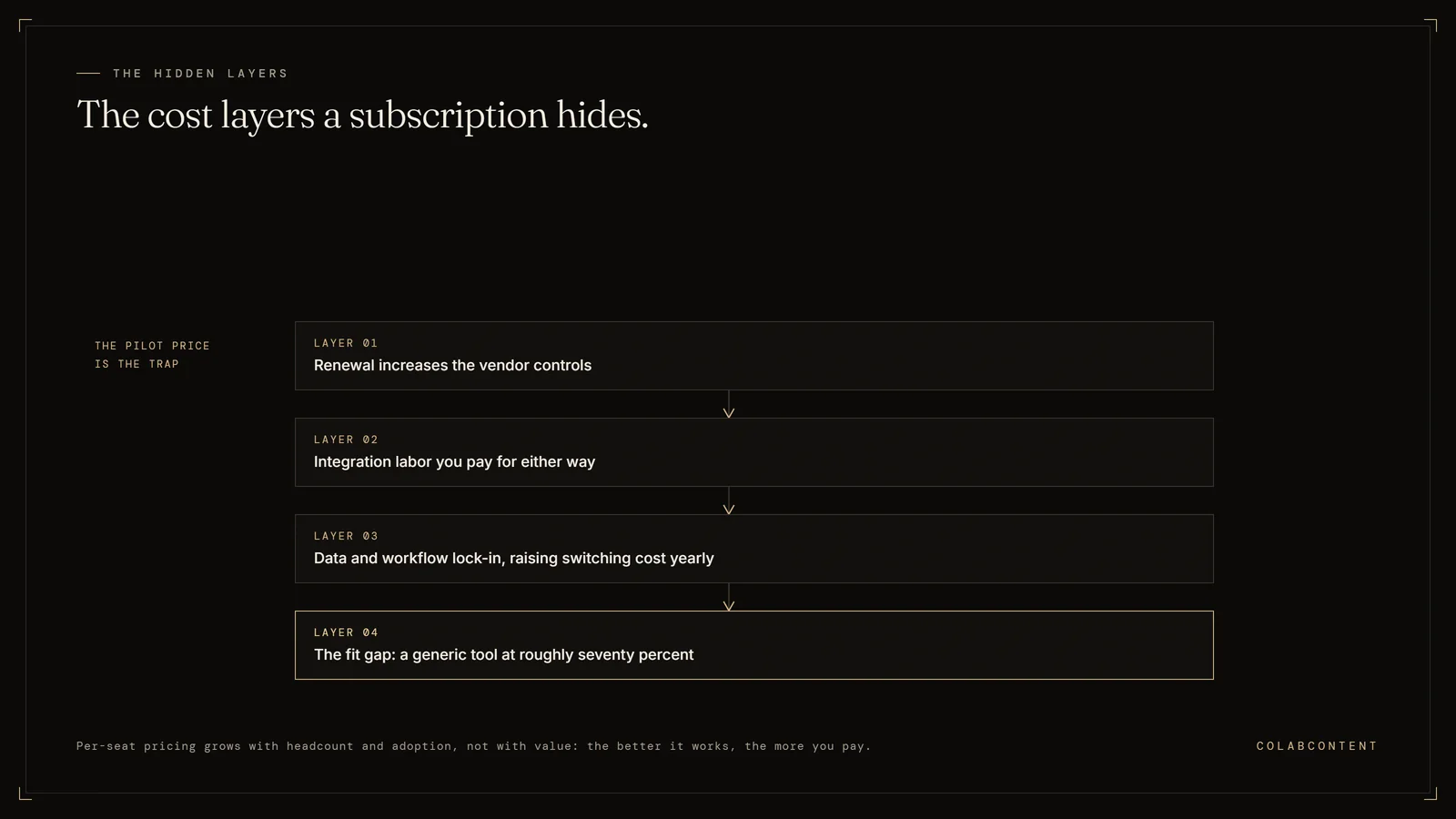
What each alternative manages from lease to renewal.
If you are on Voyager and the reason you are reading this is money, the honest first move is not a different property management platform. It is a renegotiation, and the leverage you need for it is the total cost figure further down this page rather than the line on your invoice. Three of the eight alternatives below will not tell you their price either, which means switching from Voyager to RealPage, MRI or Entrata swaps one quote-gated enterprise contract for another. If the reason you are leaving is that you cannot get a straight number, those three do not fix the complaint. And if the reason is that Voyager does not do a specific thing your operation needs, no platform on this list will do that thing either, because they are all built for the same job: hold units, leases, tenants and ledgers, run the accounting, keep the compliance modules current. They are good at that job. None of them was built around how your operation actually runs.
So the verdict splits three ways. Portfolios under roughly 500 units (our own estimate, computed August 27, 2026 by back-solving the crossover math and the three-year model further down this page) are usually better served by a cheaper published-price platform, and DoorLoop, Buildium and Yardi's own Breeze all publish numbers you can check in ten seconds without a sales call. Portfolios in the 1,000 to 5,000 unit band, the range Vendr's transaction data covers, with a working platform and a specific process that burns staff hours every week are the ones for whom the arithmetic on this page actually flips, because at that size the subscription curve plus the implementation invoice overtakes a one time build inside the first year. And operators genuinely living inside Voyager's compliance modules, affordable housing, public housing authority, senior living and military housing, should stay, and there is a whole section below arguing that case as strongly as we know how.
The full structure behind that split is on our own pricing page, the same fixed-fee model referenced throughout this page.
What Yardi Voyager actually does well.
Worth being precise about this, because a comparison page that treats the incumbent as a punching bag is useless to the person actually holding the contract. Voyager is a mature enterprise property management and accounting platform, and the things it is good at are the things that are genuinely hard and expensive to replicate.
Regulatory logic that is already written. Yardi ships dedicated Voyager products for affordable housing, public housing authorities and senior living. Those modules encode compliance rules that change on somebody else's schedule, and keeping them current is real, ongoing, specialist work. An operator whose portfolio depends on that logic is not only buying software, they are buying a subscription to somebody else's regulatory maintenance, and that is a legitimate thing to buy.
One general ledger under everything. Voyager is an accounting system that happens to manage property, rather than a property tool with accounting bolted beside it. For an operator running owner statements, CAM reconciliations, investment reporting and day to day property operations off the same ledger, that integration is the product, and it is the part cheaper platforms quietly do not match.
It scales past where the cheap tiers stop. Several of the alternatives below publish attractive per unit rates and then stop publishing them somewhere between 300 and 500 units. Voyager does not have a ceiling problem. An operator at 5,000 units is inside Voyager's design envelope, not stretching it.
Yardi will publish a price when the product is priced to compete. This is a point in the company's favour and against it at the same time. Yardi Breeze has a real, public rate card: $1 per unit per month for residential with a $100 monthly minimum, $2 per unit for Commercial Breeze with a $200 minimum, and $3 per unit for Affordable Housing Breeze Premier with a $400 minimum. That is VERIFIED from yardibreeze.com/pricing, read August 27, 2026. So the silence on Voyager pricing is a choice, not a platform limitation.
For what a decade of committed use looks like on the ownership side of the ledger, see our Jim Glaser Law case study.
Why operators start looking for a way out.
Four patterns, in the order we hear them, and the first one comes straight from operators saying it in public.
The total stopped matching the portfolio. David K., a Financial Services Manager reviewing Voyager on Capterra in April 2022, wrote that his organisation "ceased using Yardi after many years, primarily due to the outrageous costs" and that Yardi would "a-la-carte every module and the functions within each module can be limited unless you license everything." Kathleen H., an EVP Finance reviewing it in February 2025, wrote that Voyager is "a bit too robust for small and mid-market companies who don't have the ability to pay for the required customization." Those are real, dated, role-tagged reviews on a public review site, quoted exactly as they appear.
The implementation invoice nobody budgeted. Vendr's marketplace data says implementation typically adds 40 to 80 percent to first year subscription value. On a $100,000 subscription that is $40,000 to $80,000 of one time cost arriving in the same twelve months as the licence, which is why the first year of an enterprise property platform is almost always the most expensive year and almost never the year it was modelled as.
The renewal moves on its own. Vendr's guidance on Yardi contracts warns buyers to "be cautious of auto-renewal clauses and annual price increase provisions in multi-year contracts" and to negotiate caps at 3 to 5 percent maximum. A 4 percent escalator does not feel like anything in year two. By year five it has compounded, and nobody decided it should.
The thing that actually costs money is not a property management problem. Renewals triage, delinquency workflow, maintenance dispatch logic, owner reporting that four people assemble by hand every month, investor communications. None of those are ledger problems. A property management platform does not solve any of them and no amount of licence spend will change that.