Home/ Comparisons/ Global Shop Solutions Alternatives

Global Shop Solutions Alternatives: 8 Options, Priced

There are seven credible alternatives to Global Shop Solutions for a 10 to 30 user job shop, machine shop or contract manufacturer: Cetec ERP, JobBOSS2 (formerly E2 Shop System), Fulcrum, Epicor Kinetic, Acumatica Manufacturing Edition, NetSuite, and Katana MRP for lighter make to stock work. The eighth is the one no ERP vendor will list on its own comparison page because it cannot sell it to you: commissioning the system your shop actually runs on and owning it outright, one fixed fee, no per seat licence, no renewal escalator. Global Shop Solutions publishes no price, and its own blog post about what determines the cost of the software states no numbers either, so every figure on this page carries the source it came from and a VERIFIED or REPORTED label. Third party estimates put the cloud product at $100 to $200 per user per month with implementation from $20,000. Run the low end of that through a 15 seat shop with a 3 percent escalation and you get $75,636 over three years and $115,564 over five, against a one time $45,000 to $180,000 for a commissioned build. At $45,000 the two lines cross during year three. At $100,000 they never cross inside ten years against that same conservative model, which is exactly the kind of thing a page selling you a build is not supposed to tell you. The calculator further down runs the arithmetic on your invoice instead of ours.

A note on names, because the two get used interchangeably and it makes comparing anything harder than it should be. Global Shop Solutions is the company; its ERP is branded One System ERP Solutions, which is why the review listings on Capterra and Software Advice sit under that name rather than the company name. Whether you are weighing alternatives, sizing up competitors, chasing a price, or simply deciding the contract has got too expensive, it is one decision. This page is the comparison for all of it.

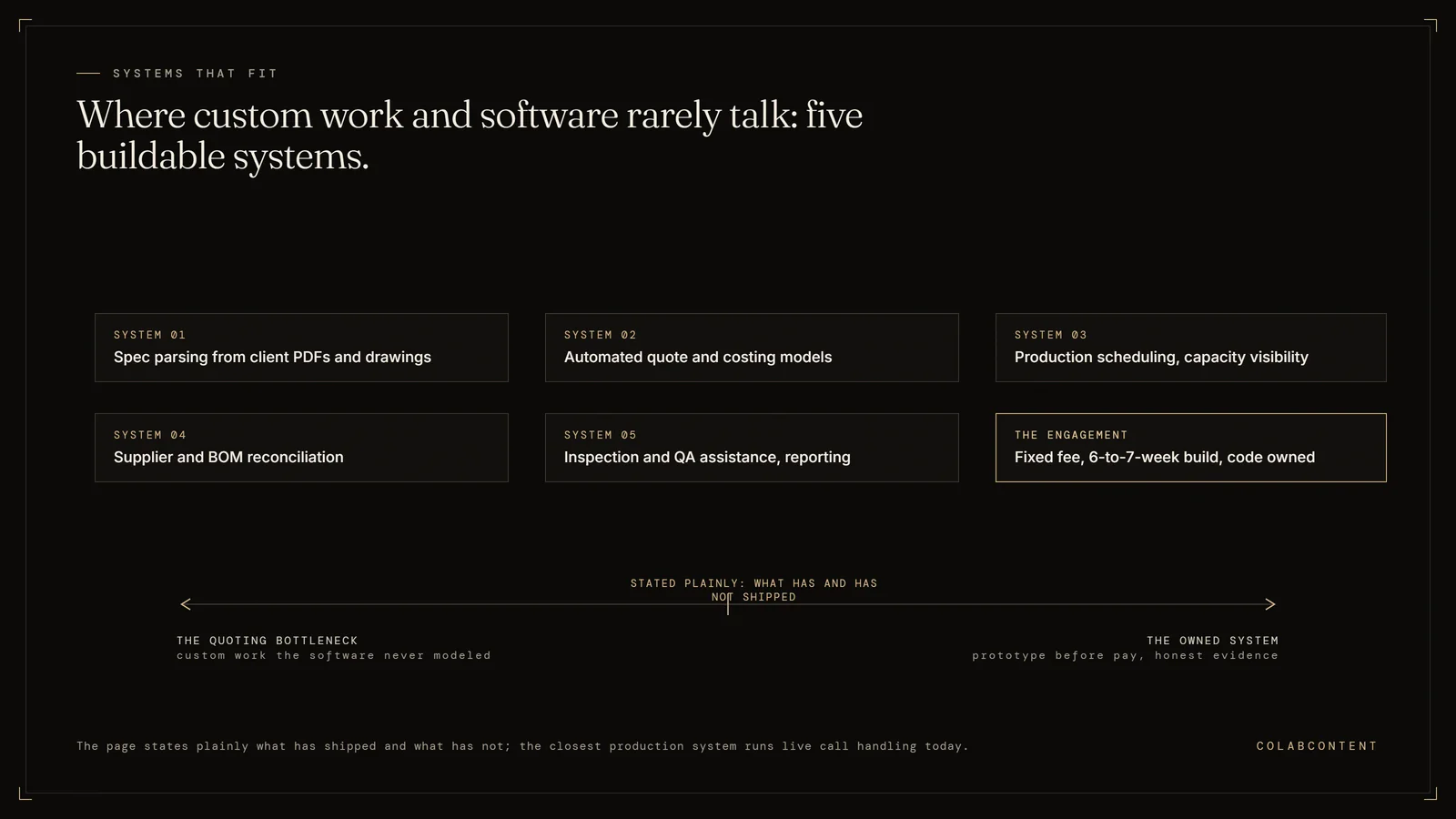
The five custom AI systems ColabContent scopes for specialty manufacturers: spec parsing from client PDFs and drawings, automated quoting and costing, production scheduling and capacity visibility, supplier and BOM reconciliation, and inspection and QA assistance
Where the ERP stops and the shop's own logic begins.

Written for the shop that already pays for Global Shop Solutions. We do not sell an ERP, we take no referral fee from anyone in the table below, and we will say plainly which shops should stay exactly where they are.

For10 to 30 user job shops and contract manufacturers
StanceNeutral. We sell no ERP.
Bottom lineCrossover in year 3 at a $45K build, never at $100K
CostFree 45-minute diagnosis
Prices readAugust 27, 2026

The short answer.

If you are on Global Shop Solutions and the reason you are reading this is money, the cheapest single move is probably not a different ERP. It is a renegotiation, and the leverage you need for it is the three year total further down this page rather than the per seat rate on your invoice. If the reason is that Global Shop Solutions does not do a thing your shop needs it to do, then look carefully at what that thing actually is, because most of the alternatives below are the same product in a different wrapper. They all quote, schedule, route, cost jobs, hold inventory and post to a general ledger. They were never built to know how your shop quotes a five operation weldment from a customer PDF, how your estimator prices a repeat with a two year old revision, or how your scheduler decides which of three cells eats the rush job.

So the honest verdict splits three ways, and only one of the three ends with us. Shops under roughly ten users should price Cetec ERP first, because it is the only full ERP in this comparison with a complete published rate card and it is the cheapest option at every horizon under five years in our model. Shops in the 10 to 30 user band with a working ERP and one named workflow that burns estimator or scheduler hours every week are the ones for whom a commissioned build can genuinely pay, and even then only at the lower end of our fee range, which the crossover chart below demonstrates rather than asserts. And shops with a decade of custom Global Shop Solutions modules, no in-house developer, and an active contract should stay, and there is a whole section below arguing that case as strongly as we know how.

What Global Shop Solutions actually does well.

Worth being precise about, because a comparison page that treats the incumbent as a punching bag is not useful to anyone actually holding the contract.

It is a real job shop ERP, not a generic one. This sounds obvious until you read the software directories. One of the largest of them describes Global Shop Solutions in its own listing as an all in one ERP for the food and beverage industry. That is simply wrong. The industry tags on its own Capterra review listing are Mining and Metals, Oil and Energy, Aviation and Aerospace, Automotive, and Electrical and Electronic Manufacturing. This is software for machine shops, metal fabricators, and aerospace and defence contract manufacturers, and it was designed by people who understood that a job is not an order.

One database, one vendor, one throat to choke. The One System branding is not only marketing. Quoting, scheduling, shop floor data collection, inventory, job costing and the general ledger sit in one system with one support contract. Shops that have lived through a best of breed stack held together by three integrations and a spreadsheet know exactly what that is worth, and it is a genuine reason to stay.

Depth in job costing and traceability. Multi level routing, work order costing against real collected labour and machine time, lot and serial traceability. For a shop holding AS9100 or ITAR obligations, the traceability record is not a feature, it is the thing that lets you keep the customer. Any alternative that cannot carry that history forward is not an alternative for you regardless of price.

Customisation that shops actually use. The most common reason we hear for staying is a set of custom screens, reports and modules built over years. That customisation is a real asset, it is also the single largest switching cost in this category, and it is why the honesty section below leads with it.

Why shops start looking for a way out.

Four patterns, in the order they show up in the review threads and in our own calls.

The price is unknowable in advance and unarguable at renewal. Global Shop Solutions publishes no rate card. It publishes a blog post about what determines the cost of its software and states no figures in it. ITQlick, which scores this category for a living, rates the product's pricing transparency 6 out of 10 and its cost 4 out of 10, both read directly on August 27, 2026. With no published price there is no anchor, which is a negotiating problem before it is a pricing one.

The extras arrive after the signature. Capterra reviewer Erica S., an Accounting Manager in Aviation and Aerospace writing on November 2, 2016, describes being nickle and dimed for all additional help while still paying high quarterly service contract fees. A Software Connect reviewer in November 2021 calls the custom work misleading and overpriced. Two reviews years apart are not a survey and we are not presenting them as one, but they name the same mechanism that ERP Research's roughly 18 percent of licence cost annual support figure describes from the other side.

Small shops feel the seat model hardest. Software Advice reviewer Travis W., in Machinery, April 2023, writes that it can be expensive, especially for small businesses with limited budgets. Per seat pricing means every hire raises the bill whether or not that hire generates proportional revenue in year one, and shop floor terminals are seats too.

The thing the shop needs is not an ERP problem. Quoting a weldment from a customer PDF in twenty minutes instead of two hours. Reconciling a supplier's price file against the bill of material. Knowing on Tuesday which promise date is about to slip. None of these are database problems and no amount of licence spend will make an ERP solve them, which is the honest reason a build is on this page at all.

What you are actually paying

Every number on this page, with its source.

Two vendors in this comparison publish a real, checkable rate card on their own website. The rest do not, and the incumbent is one of the ones that does not. We label each figure VERIFIED when the named page was opened directly and read on August 27, 2026, and REPORTED when it reached us through a search aggregation without an independent fetch of that specific page. VERIFIED does not mean vendor confirmed. Several VERIFIED numbers below are third party estimates that we read first hand rather than relayed. Where two sources disagree we print both rather than choosing the one that flatters the argument, and where we found nothing we leave the cell honest instead of filling it.

VendorSold byPublished or reported priceImplementation, one timeSource
Global Shop Solutions (cloud)Per user / month$100 to $200, with $65 cited as a starting figure. Annual support roughly 18 percent of licence cost. Typical total cost of ownership $30,000 to $150,000.$20,000 to $250,000, two to five month timelineVERIFIED erpresearch.com/pricing/global-shop-solutions, read August 27, 2026. Not vendor confirmed; globalshopsolutions.com publishes no rate card.
Global Shop Solutions (worked example)70 employee shop, $10M revenue$60,000 to $70,000 software, roughly $15,000 a year licensing, $80,000 to $90,000 or more first year total. Cost rating 4/10, pricing transparency 6/10.From $20,000VERIFIED itqlick.com/global-shop-solutions-erp/pricing, read August 27, 2026. Larger shop than the 15 seat model on this page.
Cetec ERPPer user / month, 5 user minimum$50 standard, $25 shop floor, $20 portal. All modules included at every tier. Support plans $650 or $3,200 a month; community forum support free.None published. The site states the subscription includes cloud hosting and setup.VERIFIED cetecerp.com/monthly-pricing, read August 27, 2026. Vendor's own page.
Katana MRPPer firm / monthFree plan to 30 SKUs. Core from $299 with unlimited SKUs and users at one location, plus sales order volume and per location fees. Add-ons $149 to $249 a month each.$2,000 onboarding package, optionalVERIFIED katanamrp.com/pricing, read August 27, 2026. Vendor's own page.
Katana MRP, fully loadedPer firm / monthRoughly $747 to $1,095 with all three add-onsSame $2,000REPORTED brahmin-solutions.com via search aggregation, not independently fetched.
JobBOSS2 / E2 Shop SystemPer user / month$200From $5,000REPORTED jobboss.com and ecisolutions.com pricing pages, carried from our own build queue entry and not re-fetched in this pass.
Fulcrum (Fulcrum Pro)Quote onlyNo public figure exists. Sources agree the model is a subscription plus a one time fixed implementation fee scaling with revenue and integration count. We are not printing a number.Fixed fee, amount not publishedREPORTED softwareconnect.com, g2.com and capterra.com via search aggregation. Note: a same named but unrelated field data product, Fulcrum by Spatial Networks, publishes $43 to $55 per user per month. That is a different company and we are not citing it here.
Epicor KineticSources disagree on the model itselfModel A: $1,500 a month base plus $100 to $200 per user. Model B: $80 to $250 per user with a typical $150 and no base fee. A 10 user minimum is commonly cited. We show model A in the calculator and name model B here rather than averaging two incompatible structures.$75,000 to $300,000 for a standard mid market deploymentREPORTED erpresearch.com, trustradius.com and selecthub.com via search aggregation. Sources conflict by roughly two times.
Acumatica Manufacturing EditionResource consumption, unlimited users$25,000 to $100,000 a year base, before implementation$20,000 basic to $500,000 or more complex; market average cited at $50,000 to $150,000REPORTED erpresearch.com via search aggregation, not independently fetched in this pass.
NetSuiteBase plus per user / monthFrom $999 a month base, plus $99 to $199 per user (recently trending toward $129). Manufacturing modules including WIP and Routing, Advanced Manufacturing and Quality Management add $500 to $2,500 a month on top.$25,000 to $750,000; first year all in commonly cited from $25,000 to $250,000 or moreREPORTED erpresearch.com, folio3.com and brokenrubik.com via search aggregation.
Commissioned build (ColabContent)One time fixed fee$45,000 to $180,000, set after the diagnosis callIncluded in the feeOur own price, published here. The 15 percent a year maintenance figure used in every model on this page is a stated modelling assumption and a common software industry heuristic, not a ColabContent contract term.

The thing that is missing from that table, and why it matters

There is no row anywhere above for the incumbent's own published price, because there is not one. Every public figure we could find on August 27, 2026 is a third party estimate rather than a vendor rate card: ERP Research, ITQlick, SaaSworthy, Top10ERP, G2. The vendor's own blog post about what determines the cost of the software states no figures. That is not an oversight in a category this mature, it is a pricing strategy, and the practical consequence for you is that every number the sales team quotes is quoted against you rather than against a rate card. It also means the single most valuable document in this entire decision is your own order form, which nobody on the internet can read for you.

Two more gaps we are naming rather than filling. Global Shop Solutions publishes no contract term, no renewal mechanics and no escalation clause that we could find from the vendor or from any aggregator, so we are printing none and you should pull your own agreement. And Fulcrum, which is genuinely one of the more interesting names on this list, cannot be priced without a sales call, which is worth recognising as the same pattern rather than an exception to it.

Normalise it: one year for a 15 seat shop

Per seat and per firm pricing are not comparable until you fix the headcount. Hold one shop at 15 seats, 10 office and engineering plus 5 on the floor, take each vendor's published or reported rate at face value with nothing negotiated and no add-on modules, and ask what a single year of recurring cost looks like.

Vendor and basisYear one recurring, 15 seatsHow it is calculated
Katana MRP Core, base only$3,588$299 x 12. Add-ons excluded. Not a job shop ERP.
Cetec ERP with Standard support$15,300(10 x $50 + 5 x $25) x 12, plus $650 x 12
Global Shop Solutions, low end of reported range$18,000$100 x 15 x 12
Acumatica Manufacturing, low end of base range$25,000Consumption based, unlimited users
Global Shop Solutions, midpoint of reported range$27,000$150 x 15 x 12
NetSuite, base plus seats, no manufacturing module$35,208$999 x 12, plus $129 x 15 x 12
Global Shop Solutions, high end of reported range$36,000$200 x 15 x 12
JobBOSS2 / E2, reported rate$36,000$200 x 15 x 12
Epicor Kinetic, reported model A$36,000$1,500 x 12, plus $100 x 15 x 12
FulcrumNot published at any sizeQuote only. No figure exists to print.

Read that table honestly and the first thing it says is that Global Shop Solutions at the low end of its reported range is not the expensive option. It is the third cheapest recurring line in the comparison, and the two products below it are a leaner ERP and a lighter MRP tool. If your order form says $100 a seat, the case for switching ERPs to save money is weak and you should spend your energy on the renewal conversation instead. The pressure only becomes real at the middle and top of the reported range, which is where every reviewer complaint in this category is coming from.

The three year and five year model

One year is the wrong horizon for a decision that lasts a decade. The model below adds the one time implementation fee in year one and escalates the recurring line 3 percent a year from year two. The 3 percent escalation is our modelling assumption, applied identically to every recurring product so nobody is advantaged, and it is deliberately low; enterprise software renewals frequently run higher. Every recurring vendor is held at the low end of its published or reported range, which is conservative in the incumbent's favour rather than stacked against it. No add-on modules, no multi site and no heavy customisation are included for anyone. The custom build is modelled at $45,000, the low end of our own range, with a 15 percent a year maintenance assumption and no escalation, because fixed fee maintenance does not carry per seat uplift.

Scenario, 15 seatsYear 13 year total5 year total
Katana MRP Core, base only, $2,000 onboarding$5,588$13,090$21,049
Cetec ERP, Standard support, $5,000 assumed migration$20,300$52,291$86,230
Commissioned build at $45,000 + 15% a year maintenance$51,750$65,250$78,750
Global Shop Solutions, low ($100 / seat, $20,000 implementation)$38,000$75,636$115,564
Global Shop Solutions, mid ($150 / seat, $20,000 implementation)$47,000$103,454$163,347
Acumatica Manufacturing, low base, $20,000 implementation$45,000$97,273$152,728
Global Shop Solutions, high ($200 / seat, $20,000 implementation)$56,000$131,272$211,129
Commissioned build at $100,000 + 15% a year maintenance$115,000$145,000$175,000
JobBOSS2 / E2, reported rate, $5,000 implementation$41,000$116,272$196,129
NetSuite, no manufacturing module, $25,000 implementation$60,208$133,824$211,924
Epicor Kinetic, reported model A, $75,000 implementation$111,000$186,272$266,129
Commissioned build at $180,000 + 15% a year maintenance$207,000$261,000$315,000

Three findings in that table are inconvenient for us and we are printing them first. Cetec ERP is cheaper than the cheapest build we would scope at both the one year and three year horizons, at $52,291 against $65,250, and it only loses the comparison partway through year five, at about 4.3 years, when the $45,000 build's flat maintenance line finally undercuts Cetec's escalating subscription. A build at $100,000 never becomes cheaper than the conservative Global Shop Solutions scenario, not at five years and not at ten, where the subscription reaches $226,350 and the build reaches $250,000. A build at $180,000 loses against every scenario in the table, including the high end incumbent case, at every horizon we modelled. If someone tells you a custom build is always cheaper than an ERP subscription, they have not run this arithmetic.

The thresholds are the genuinely useful output. Back solving the same formula, a build has to come in under about $52,163 to beat the low end Global Shop Solutions scenario over three years, under $66,037 over five, and under $90,540 over ten. Against a shop paying the midpoint of the reported range those thresholds rise to about $71,348, $93,341 and $131,810. Against the top of the range they rise again to about $90,533, $120,645 and $173,080. That is the honest test to apply to any build quote you receive, ours included.

The crossover

Where the lines meet, and where they never do.

Cumulative spend for the same 15 seat shop, five years out. Global Shop Solutions at the low end of its reported range, $100 a seat, with $20,000 implementation paid at year zero and a 3 percent annual escalation from year two. Against it, two build lines rather than one, because a single flattering line would be the same trick the directory pages play: a build at $45,000, the low end of our fee range, and a build at $100,000, near the middle of it. Both carry 15 percent a year maintenance. Every figure in the chart comes from the table above.

Cumulative five year cost: a Global Shop Solutions subscription versus two one time commissioned build prices A line chart of cumulative spend for a 15 seat job shop over five years. The Global Shop Solutions line starts at $20,000 at year zero for implementation and rises steadily to $38,000 at year one, $56,540 at year two, $75,636 at year three, $95,305 at year four and $115,564 at year five. A commissioned build at $45,000 starts at $45,000 at year zero and rises gently by $6,750 of maintenance each year to $51,750, $58,500, $65,250, $72,000 and $78,750. Those two lines cross during year three, at about 2.2 years and roughly $59,600, after which the subscription line stays permanently above the build line, ending $36,814 higher at year five. A second build line at $100,000 starts at $100,000 and rises to $175,000 by year five. It never crosses the subscription line at all within five years, and it does not cross within ten either. The chart shows that a build wins on cost only at the lower end of the fee range against this conservative incumbent scenario. $0 $50K $100K $150K $200K Year 0 Year 1 Year 2 Year 3 Year 4 Year 5 Crossover, year 3 Global Shop $115,564 $45K build $78,750 $100K build $175,000, never crosses Global Shop Solutions, 15 seats at $100, 3% escalation Owned build, $45,000 once, 15% maintenance Owned build, $100,000 once, 15% maintenance

The crossover for the $45,000 build lands at about 2.2 years, roughly $59,600 of cumulative spend on each path. Before that point the subscription is cheaper and the build is a worse financial decision, which is exactly what you would expect and exactly what most vendor comparison charts hide by starting the axis in a convenient place. After that point the gap widens every year, because one line has a slope and the other is nearly flat. At year five the difference is $36,814, and nothing in the model bends the subscription line back down.

The dotted line is the more important one. A $100,000 build against this same conservative incumbent scenario does not cross within five years, and extending the model to ten years does not save it either: the subscription reaches $226,350 while the build reaches $250,000. It only starts winning if your actual Global Shop Solutions cost is higher than the low end we modelled. Against a shop paying the midpoint of the reported range, a $100,000 build crosses during year six. Against a shop paying the top of the range, it crosses during year four. This is why the first question on the diagnosis call is what your invoice actually says, and why the calculator below defaults to your numbers rather than ours.

Your shop, your numbers

The job shop ERP total cost calculator.

Every default below is a figure from the table above, and every one is editable, because the defaults are a market estimate and your order form is a fact. Nothing is submitted anywhere. There is no email gate, no external request, no stored value. The arithmetic runs in your browser and stops there. If your inputs make the build lose, the tool says so in plain words rather than quietly hiding the result.

Loads that vendor's published or reported rates into the fields below. Every one stays editable.
Estimators, schedulers, purchasing, accounting, engineering.
Terminals and data collection stations. Some vendors price these lower, most do not.
Global Shop Solutions reported at $100 to $200. The vendor publishes nothing. Use your quote.
Cetec charges $25 here. Most vendors charge the same as an office seat.
NetSuite base, Epicor base, Cetec support plan, Acumatica consumption base. Zero for Global Shop Solutions, whose support is reported as a percentage of licence instead.
Global Shop Solutions reported at $20,000 to $250,000. Enter 0 if you already paid it.
Modelling assumption, not a published figure from anyone. Set to 0 to remove it.
Both totals are calculated over this horizon.
ColabContent fixed fee range, $45,000 to $180,000, set after the diagnosis call. Drag it up and watch the verdict flip.
Software industry heuristic, not a ColabContent contract term. Replace it with a real quote before deciding.
The roundup

Eight options, in the order we would look at them.

One note on the roster before the list. Most of the public shortlists for this software are software directory listicles, and several of them mix enterprise suites, niche European tools and light MRP apps into a single undifferentiated top thirty with no pricing and no explanation of which fits which shop. One of them lists an unrelated European product alongside NetSuite as though a 12 person machine shop should evaluate both. The list below covers the systems Global Shop Solutions actually competes against for a 10 to 30 user job shop, in the order a shop holding that contract would sensibly evaluate them.

1. Cetec ERP

What it is. A full manufacturing ERP covering quoting, orders, production, inventory, purchasing and accounting, sold on a flat per user subscription with every module included at every tier. Deliberately standardised rather than deeply customisable.

Price. VERIFIED from cetecerp.com/monthly-pricing on August 27, 2026. $50 per standard user per month with a five user minimum, $25 per shop floor user, $20 per month for portal users. Support plans are $650 a month for Standard or $3,200 for Enterprise, with community forum support included free. No implementation fee is published; the site states the subscription includes cloud hosting and setup. This is the most complete and most checkable rate card of any full ERP in this comparison.

Best for. Shops under about 25 users that want a real ERP with a price they can budget against without a sales cycle, and shops whose current pain is genuinely the invoice rather than a missing capability.

Where it falls short. It is leaner and more standardised than Global Shop Solutions, which is the entire reason it is cheaper. If your shop depends on custom screens, custom reports and modules built over a decade, Cetec is not a like for like replacement and pretending otherwise would cost you the project. The $650 a month support plan is close to half the cost of a 15 seat licence, so read the free forum support tier carefully before you assume it away.

Verdict. The cheapest credible full ERP here and the one most likely to genuinely reduce your bill. In our model it beats even the cheapest build we would scope until about 4.3 years.

2. JobBOSS2 / E2 Shop System

What it is. The other long standing job shop ERP name, now under ECI Software Solutions. Quoting, scheduling, job costing and shop floor data collection, aimed squarely at the same machine shops and fabricators.

Price. REPORTED at $200 per user per month with implementation from $5,000, from vendor pricing pages cited in our own build queue and not re-fetched in this pass. That is the cheapest implementation sticker on this list and the most expensive per seat rate.

Best for. Shops that want to stay inside the same category and same product shape, with a lower entry cost to get started.

Where it falls short. Reviewers describe module and add-on growth after signing, which is the same complaint pattern the incumbent draws. At 15 seats our model puts it at $196,129 over five years, materially above Global Shop Solutions at the low end of its range, so it is not a cost escape unless your current rate is high.

Verdict. A lateral move. Worth a quote if you already know your Global Shop Solutions rate is near the top of the reported range, otherwise it changes the vendor without changing the disease.

3. Fulcrum

What it is. A modern cloud native manufacturing platform positioned explicitly as a replacement for this generation of job shop ERP. The most interesting product on this list from a user experience standpoint and the one shops mention when they want something that does not look like it was designed in 2003.

Price. REPORTED only, and we are not printing a number. Multiple sources agree on the structure, a subscription plus a one time fixed implementation fee that scales with revenue and integration count, and none of them publishes a figure. One caution worth stating: the same name belongs to an unrelated field data collection product from a different company at $43 to $55 per user per month. That is a different product and it should never be used as a Fulcrum benchmark.

Best for. Shops where adoption is the constraint, where the current system is technically fine and nobody on the floor will use it.

Where it falls short. You cannot evaluate it on cost without a sales call, which puts it in exactly the same opacity bucket as the incumbent you are trying to leave. Do not let a better interface talk you out of asking for the year three number in writing.

Verdict. Genuinely worth a demo. Not worth a decision until someone puts a total on paper.

4. Epicor Kinetic

What it is. The most direct like for like alternative, and the name that appears alongside Global Shop Solutions on more competitor lists than any other. A mature, full featured manufacturing ERP for discrete and mixed mode manufacturers.

Price. REPORTED, and the sources contradict each other on the pricing model itself. One reports $1,500 a month base plus $100 to $200 per user. Another reports $80 to $250 per user with a typical $150 and no base fee at all. A 10 user minimum is commonly cited. Implementation is commonly cited at $75,000 to $300,000 for a standard mid market deployment. We show the first model in the calculator and name the second here rather than averaging two incompatible structures into a number that describes neither.

Best for. Larger, more complex manufacturers, particularly mixed mode shops running both make to order and repetitive production, and shops that need an ecosystem of partners and integrations around the ERP.

Where it falls short. It is a packaged enterprise ERP with sales call pricing and a large implementation cost. On our model it is the most expensive option in the comparison at $266,129 over five years, driven mostly by the reported implementation range. Switching here does not escape the pattern that brought you to this page, it changes the logo on the invoice.

Verdict. The right answer for a genuinely complex manufacturer that has outgrown a job shop ERP. The wrong answer for a 15 person shop looking to cut a bill.

5. Acumatica Manufacturing Edition

What it is. A cloud ERP whose distinguishing feature is its licensing model: you pay for resource consumption rather than seats, and users are unlimited.

Price. REPORTED at $25,000 to $100,000 a year base before implementation, with implementation from $20,000 for a basic rollout to $500,000 or more for complex manufacturing, and a market average of $50,000 to $150,000. All via aggregation, not read off Acumatica's own page in this pass.

Best for. Shops with high headcount relative to transaction volume, seasonal labour, or a lot of occasional users who need visibility but not daily use. If you are refusing to buy seats for people who should have access, this model is aimed at you.

Where it falls short. A sub 20 person job shop pays enterprise grade base pricing without enough users to make the unlimited model pay off. At 15 seats our model puts it at $152,728 over five years, well above the low end incumbent scenario. The consumption based pricing is also harder to forecast than a seat count, which is a real disadvantage if your volumes swing.

Verdict. A genuine structural alternative to per seat pricing, and structurally wrong for a small shop.

6. NetSuite

What it is. The enterprise cloud suite. Its real strength is multi subsidiary and multi entity financial consolidation, with manufacturing capability added through modules.

Price. REPORTED at $999 a month base plus $99 to $199 per user per month, recently trending toward $129, with manufacturing modules including WIP and Routing, Advanced Manufacturing and Quality Management adding $500 to $2,500 a month on top. Implementation is reported at $25,000 to $750,000, and first year all in is commonly cited from $25,000 for a small simple deployment to $250,000 or more for a complex one.

Best for. Manufacturers with multiple legal entities, multiple sites, or a serious financial consolidation requirement. If your CFO's hardest week is closing across three companies, this is the product built for that.

Where it falls short. Most shops switching off Global Shop Solutions are single site and single entity, which means paying for consolidation capability they will never use. Our model puts it at $211,924 over five years before a single manufacturing module, and the manufacturing modules are not optional for a job shop.

Verdict. The wrong shape of product for the buyer this page is written for, and the right one for a manufacturer whose complexity is financial rather than operational.

7. Katana MRP

What it is. A cloud inventory and production management tool. Clean, modern, genuinely well liked, and honest about what it is.

Price. VERIFIED from katanamrp.com/pricing on August 27, 2026. A free plan up to 30 SKUs. Core from $299 a month with unlimited SKUs and users at one location, billed additionally by sales order volume and per extra location. Add-ons are $199 a month for Manufacturing Management, $249 for Traceability and $149 for Warehouse Management. Onboarding is an optional $2,000 package. A fully loaded Core setup is REPORTED at roughly $747 to $1,095 a month by a third party breakdown we did not independently verify.

Best for. Light assembly, make to stock, and product companies with a bill of material and a warehouse. It is the cheapest line in our whole model at $21,049 over five years, and for the right company that is a real answer.

Where it falls short. It is not a job shop ERP and it does not claim to be. Multi level routing, work order costing against collected shop floor time, and the quoting complexity a machine shop or contract manufacturer runs on are not what this product does. If you are running Global Shop Solutions today for the reasons people run it, Katana is a downgrade dressed as a saving. We are including it because it appears on the competing lists and someone needs to say plainly who it is and is not for.

Verdict. Right product, usually wrong buyer for this page. Verify it handles your routing depth before the price tempts you.

8. A commissioned build you own

What it is. In most cases, not a replacement for your ERP. A custom system built for the workflow no ERP covers, sitting alongside whichever ERP you keep, owned by the shop at handoff. In practice that means parsing specs and drawings out of customer PDFs into a structured quote, automated quoting and costing against your real historical job data, capacity and promise date visibility, supplier and bill of material reconciliation, or inspection and quality assistance.

Price. A fixed fee of $45,000 to $180,000, set after a free 45-minute diagnosis and after the integration depth is named, paid in two instalments at build start and handoff. A working prototype runs on your real data in seven to ten days before any payment. Production build is five to seven weeks. The shop owns the code, prompts, models and pipeline at handoff and runs it in its own cloud tenant.

Best for. Shops in the 10 to 30 user band with an ERP that basically works and one named workflow that burns estimator, scheduler or engineering hours every week, where the hours have a dollar figure attached.

Where it falls short. It is a bigger single cheque, it needs a tighter scope than buying software does, and at the middle and top of our range it loses the cost argument outright against a shop paying the low end for its ERP, as the chart above shows without softening it. It also does not replace your ERP, so if what you want is to stop paying Global Shop Solutions entirely, this is not that and Cetec probably is.

Verdict. The option nobody in the table above will show you, the only one where the bill stops going up, and the one you should apply the hardest arithmetic to.

The ownership case

Nine arguments for owning it instead.

Each of these is either arithmetic you can check on this page or a structural fact about the two models. Where an argument does not honestly apply to your shop, the section after this one says so.

One. The math, restated with its limits. A subscription never ends. At the low end of the reported range a 15 seat shop pays $75,636 over three years and $115,564 over five, and year six starts at zero progress. A $45,000 build costs $65,250 over the same three years and $78,750 over five, and the lines cross at about 2.2 years. The limit is the part most pages leave out: at $100,000 the build never catches that same conservative subscription inside ten years. The argument is real and it is conditional, and both halves of that sentence matter.

Two. Per seat pricing taxes headcount. Every hire raises the bill by the same rate whether or not that hire generates proportional revenue in year one, and on a shop floor the seats include terminals, which means the tax lands again every time you add a cell or a shift. Five new seats at $150 is $9,000 a year, added automatically, forever, with no decision made by anyone. An owned system has no marginal seat cost at all, so hiring stops carrying a software decision inside it.

Three. Asset versus expense. A subscription is rent and it leaves nothing behind. A commissioned build is a piece of the business: transferable, valuable in a sale or succession conversation, and on the balance sheet rather than only on the expense line. In a category where a meaningful share of shops are owner operated and heading toward a transition, that difference is not cosmetic.

Four. Built around your shop, not the median shop. Every product in the roundup above is calibrated against the average customer in its category, which means you pay for the whole feature bundle and adapt your process to the fraction of it you actually use. A commissioned system starts from your routings, your work centres, your estimating logic and your customers' drawing formats. Nobody gets retrained into someone else's assumptions.

Five. AI at the core rather than as a per seat add-on. The pattern in this category is that AI arrives as a premium module or a per seat uplift on the existing licence, which means the capability everyone now expects becomes a second subscription stacked on the first, priced against your headcount. We are labelling this as the category pattern rather than quoting a Global Shop Solutions AI price, because Global Shop Solutions publishes no pricing at all and we are not going to invent one for its AI either. In a commissioned build the AI is the system, there is no separate AI licence, and adding a user costs nothing.

Six. Unlimited seats. Office staff, estimators, every terminal on the floor, seasonal and second shift people, and where appropriate customers checking their own order status. Zero marginal cost per person changes the question from who needs a licence to who needs access, which is a better question and usually a more profitable one.

Seven. Data ownership and no exit ransom. Your job history, your costing data, your traceability records, in your own cloud tenant, under an agreement you wrote. Compare that with the migration section below, where the hard part of leaving an ERP is not the item master, it is the lot and serial traceability and the job costing history, both of which live in a structure the vendor designed. Owning the structure takes the negotiation out of leaving.

Eight. Vendor risk you stop carrying. Acquisitions, consolidation and forced upgrades are normal in manufacturing software. E2 Shop System became JobBOSS2 under a new corporate parent. Products in this category get bought, rebranded, repriced and eventually sunset on the acquirer's calendar rather than yours, and shops that chose them migrate on someone else's schedule. A system you own does not get sunset by anybody, and the only rebuild pressure it carries is the one you choose.

Nine. Change speed. A change request to your own system is a scoping conversation and a deployment. A change request to an ERP vendor is a feature request in a queue behind every other customer's, with no committed date and no obligation. When the thing you need changed is the thing that makes your shop win quotes, the queue is not an acceptable answer.

What we can actually prove, including what we cannot

The list above is worth exactly as much as the evidence behind the firm making it, so here is ours, with nothing rounded up and one uncomfortable disclosure first. Our nameable reference is a law firm, not a machine shop. Jim Glaser Law is that reference and the principal takes reference calls; five channel specific voice agents route and handle intake there, and the call volume across our practice is more than 6,000 AI handled calls. The LELF platform is the fullest example of what commissioning looks like at operational scale: a 47-attorney litigation firm runs its matter, invoice and IOLTA trust operation on it, holding 13,296 matters, 4,396 clients and 5,684 invoices, with trust reconciled byte identical against the system it replaced. That firm is under confidentiality and stays anonymised, which is why we name the platform and not the firm. Across the practice we have delivered more than forty commissions.

What that evidence supports is a specific claim: we can build and run a system that carries real operational volume and reconciles to the penny under audit. What it does not support is a claim that we have decommissioned a Global Shop Solutions install for anybody, because we have not, or that we have a machine shop you can call today. If a named manufacturing reference is what you need before you spend money, say so on the call and we will tell you plainly where we are rather than talking around it.

The honesty section

Who should stay on Global Shop Solutions.

Seven situations where every argument in the previous section fails, and where we would tell you to stay put on a call. Not one of the public shortlists for this software has a section like this, which should tell you something about what those shortlists are for.

Shops with years of custom modules and no in-house developer. This is the biggest one and it is not close. If your estimators work in custom screens, your ownership reads custom reports, and the logic inside them was built up over a decade, the switching cost is not the licence, it is losing the accumulated decisions. Rebuilding that on any platform costs more than the pricing pain you are currently feeling, and doing it without a technical person inside the building is how ERP projects become case studies.

Shops inside an active multi year contract. Global Shop Solutions publishes no contract terms, so we cannot tell you what your exit looks like and neither can anyone else on the internet. Pull your own agreement and read the term, the auto renewal clause, the notice period and any early termination provision before you assume a switch is free. If there is a penalty, the honest answer may be to wait for the renewal window and use the numbers on this page as leverage inside it.

Shops under about ten users. The arithmetic does not work. At 8 seats and $100 a seat the three year subscription including implementation is about $49,700 in our model, and the cheapest build we would scope is $65,250 over the same three years. Below that threshold the right move is a cheaper published ERP, and Cetec publishes a number you can check in ten seconds.

Shops that need something working next quarter. A commissioned build ships a prototype in seven to ten days and production in five to seven weeks, and an ERP migration on top of that runs four to nine months. If the deadline is real and near, buying is faster than building and it is not close.

Shops whose rate is genuinely at the low end. If your order form says $100 a seat with no escalator, you have a good contract for this category. The one year table above shows Global Shop Solutions as the third cheapest recurring line in the whole comparison at that rate. Take that contract to renewal and defend it.

Shops where nobody will own the system internally. An owned build needs a named person who cares about it, even at a light touch. A shop without that person is better off renting, because the alternative is an orphaned system that decays quietly and then fails on the week you need it.

Shops whose constraint is on the floor, not in the software. If the thing costing you money is machine capacity, a hiring gap, a scrap rate or a supplier, changing ERPs is motion rather than progress. A meaningful share of the diagnosis calls we run end with us recommending the business keep what it has, and this is the most common reason for it.

Decision tree

Six questions, in order, with stop points.

1. Do you know your actual per seat rate, your total annual cost and your contract's renewal terms? If no, stop and go find the order form. Every decision after this one depends on it, and the reported ranges on this page are a substitute for that document rather than a replacement for it. If yes, continue.

2. Is your shop under about ten users? If yes, stop here. Price Cetec ERP against your current contract, and price JobBOSS2 if you want a second quote. No build we would scope returns its cost at your volume. If no, continue.

3. Is your rate at or below $100 a seat with no escalator? If yes, stop. You have one of the better contracts in this category and the table above proves it. Use the three year figure as leverage at renewal and spend your energy on the floor instead. If no, continue.

4. Is the thing that actually costs you money an ERP problem? If yes, meaning job costing, scheduling, inventory accuracy, traceability or the general ledger, then a different ERP may genuinely help and Cetec or Fulcrum is where to look. Stop here and go get quotes. If no, continue.

5. Can you name the workflow in one sentence, with a rough dollar or hour figure attached? Quoting turnaround, estimator hours per quote, late promise dates, engineering time spent reading customer PDFs. If you cannot write that sentence with a number in it, stop and spend two weeks measuring before anyone spends money. Every failed build we have seen started with an unnamed constraint. If yes, continue.

6. Run your numbers in the calculator above. Does a build at the price you would actually pay cross below your subscription inside your planning horizon? If no, stop, and say so out loud to whoever is selling you one, us included. If yes, and the budget runway is real this quarter, and an owner or general manager will spend 45 minutes on the diagnosis, that call is the next step. Often enough that we say it before you book, that call ends with us telling you to stay where you are.

Next step

Book the 45-minute diagnosis.

Bring your order form and one sentence describing the workflow that burns hours. You leave with the constraint written down either way, and plenty of these calls end with us telling a shop to stay where it is.

Free · 45 minutes
Under NDA
Owner to owner
No follow-up unless asked
Migration reality

What leaving Global Shop Solutions actually involves.

None of the public guides to this software answers this question with specifics, which is strange, because it is the question that decides whether a shop ever acts on any of the rest. Here is the honest shape of it. The timelines below are our own scoping ranges for an engagement of this type, stated as estimates rather than dressed up as research, and no vendor publishes a comparable figure.

You are not moving an ERP. You are moving nine things. Item and customer masters, which are the easy part and the part every vendor's migration page talks about. Bills of material, including revisions and phantom levels. Routers and work centre definitions, including setup and run standards that took years to tune. Open work orders in flight. Job costing history, which is what your estimator uses to price the next repeat. Lot and serial traceability records. Inventory quantities and valuation, which have to reconcile to the penny at cutover. The general ledger with accounts receivable and payable history. And quoting history, which is the most commonly forgotten and the most commonly missed once it is gone.

Traceability is the part that is genuinely hard. If you hold AS9100, ITAR obligations or automotive PPAP requirements, a gap in the lot and serial record is not an inconvenience, it is a customer conversation you cannot have. Decide early whether the old system stays available read only for the retention period rather than assuming the history transfers cleanly, and put that decision in the plan before anyone signs anything.

Phase one: export and inventory. Before anything moves, someone answers what is actually in there and what of it matters. Our planning range is four to eight weeks at this shop size for a full extraction and reconciliation. The deliverable that matters at the end of this phase is a reconciliation count: parts out equals parts in, jobs out equals jobs in, inventory value out equals inventory value in, with the exceptions listed rather than rounded away.

Phase two: parallel run. Both systems live. New jobs go into the new system, the old one goes read only, and nothing is switched off. Run this through at least one full month end close and one complete job cycle from quote through shipment to invoice, because the gaps in an ERP migration do not surface when you look for them, they surface when a customer asks for the cert package on a job you ran in 2022. A shop that skips the parallel run to save six weeks usually spends the saving twice.

Phase three: cutover and decommission. Only after the parallel run has produced no unresolved exceptions, and only after someone has read the notice provisions in the order form. An ERP contract that auto renews will renew during a migration if nobody sends the letter, and that is a five figure mistake made entirely on a calendar.

A realistic total is four to nine months from decision to switching off the old system. The largest driver of that number is not shop size, it is how much history you are obliged to carry forward and how much custom work sits in the current system. That is something you can scope this week by asking your estimator how often they open a job from more than two years ago.

What we do and do not do here. We have not run a Global Shop Solutions decommissioning and we are not going to imply otherwise. What we build is the workflow layer that sits alongside whichever ERP you land on, which is a different job. If your project needs an ERP migration partner, that is a specialist engagement and the vendor you are moving to will usually name two or three.

The option most shops do not consider. You do not have to leave to fix the problem. In a large share of the cases we see, the ERP is fine, the licence is defensible, and the money is leaking in a workflow that sits beside it: quoting turnaround, spec extraction from customer drawings, promise date accuracy, supplier price reconciliation. That path keeps the ERP, keeps the custom modules, keeps ten years of job history, and builds the missing piece against the data you already own. No migration, no parallel run, no cutover weekend.

Deep dive

The dimensions the price table cannot show.

Six dimensions, side by side.

Price transparency. Cetec ERP and Katana MRP publish real, complete rate cards. Global Shop Solutions, Fulcrum and Epicor publish nothing. Acumatica and NetSuite publish structure but not numbers. Transparency is not the same as cheapness, but an undisclosed price lets the seller quote against the buyer rather than against the work, and that is worth a real discount in your evaluation.

Contract readability. Nobody in this category makes their paper readable before a sales conversation, which means your own order form is the only governing document you will ever see. That asymmetry is the single most underrated fact in ERP buying, and it is why every path on this page routes through reading your own agreement first.

Cost slope. Every subscription here rises with headcount and with renewal. A commissioned build is a one time fee plus a flat maintenance line. The slope, not the starting point, is what decides a five year comparison, and the chart above is the whole argument in one picture including where it fails.

Ownership at exit. Every vendor here retains the code, the schema and the pipeline. A commission transfers all three at handoff, running in the shop's own cloud tenant. That is the difference between an export and a handover, and it shows up as leverage every single renewal.

Fit for a real job shop. Global Shop Solutions, JobBOSS2, Epicor Kinetic, Cetec and Fulcrum are built for make to order work with multi level routing. NetSuite gets there through modules. Katana does not get there at all and does not claim to. A directory that lists all seven as interchangeable is not helping you.

Vendor risk. Consolidation is the norm here. E2 Shop System became JobBOSS2 under a new corporate parent, and products in this category get bought, rebranded and eventually retired on the acquirer's calendar. Even staying put carries a version upgrade cost you do not control.

When to pick which, in one paragraph each.

Stay on Global Shop Solutions if your rate is at the low end of the reported range, your custom modules are load bearing, your traceability history is regulated, or you need certainty next quarter. Take the three year figure from this page into the renewal conversation as leverage rather than as a reason to leave.

Move to Cetec ERP if cost is genuinely the driver, you are under about 25 users, and you can live with a leaner, more standardised product. It is the cheapest full ERP in this comparison and the only one whose price you can verify in a browser tab.

Move to Fulcrum if adoption is the constraint and the current system is technically adequate but nobody uses it properly. Demand the year three total in writing before you commit, because you cannot get it any other way.

Move to Epicor Kinetic or NetSuite only if you have genuinely outgrown a job shop ERP, meaning multiple sites, multiple entities, or mixed mode production at volume. Both are more expensive than what you have on every horizon we modelled.

Look at Acumatica if the seat model itself is the problem and you have a lot of people who need visibility rather than daily use. The unlimited user licence is a real structural answer at the right headcount and an expensive one below it.

Commission a build if the ERP is fine, the constraint is a named workflow with hours attached, and the arithmetic in the calculator clears at the price you would actually pay. Most of the shops in that position keep their ERP and build beside it.

Why this page is written by someone who does not sell an ERP.

Worth saying plainly, because it changes how you should read everything above. We surveyed the public guides to this software on August 27, 2026, and almost all of them are software directories and scored aggregators, monetised by routing you into a quote request form for another subscription vendor. Nobody in that group gets paid if the honest answer is that you should stop subscribing, which is why none of them prints a total cost of ownership you can act on. One of those directories describes Global Shop Solutions in its own listing as an all in one ERP for the food and beverage industry, which is wrong about the buyer's entire industry.

ColabContent sells commissioned AI builds. We do not sell an ERP, we take no referral fee from anyone in the roundup, and we have no reason to steer you toward or away from any of them. That does not make us neutral about the conclusion, obviously, and the whole point of publishing the arithmetic and the assumptions is that you can see exactly where our interest starts affecting the numbers. It does mean that when this page says Cetec beats our own cheapest build at three years, or that a $100,000 build never catches a low end Global Shop Solutions contract inside ten, nothing commercial is pulling in the other direction.

What a build alongside your ERP actually looks like.

Five workflows come up repeatedly in this vertical, and they share a property: none of them is a database problem, which is why the ERP does not touch them.

Spec and drawing extraction. Pulling material, tolerances, finishes, quantities and revisions out of a customer PDF or drawing package into a structured quote line, so the estimator reviews rather than transcribes. This is the workflow with the clearest hours figure attached in most shops.

Quoting and costing against your own history. Pricing a new part against what your shop actually ran on similar geometry, not against a standard cost table, with the comparable jobs shown so the estimator can argue with it.

Capacity and promise date visibility. Knowing on Tuesday which promised dates are about to slip and what moving the rush job costs the other three, rather than finding out at the Friday production meeting.

Supplier and bill of material reconciliation. Matching supplier price files and acknowledgements against the bill of material and flagging the differences, which is a job somebody currently does in a spreadsheet on Thursday afternoons.

Inspection and quality assistance. Drafting first article and inspection paperwork from the drawing and the routing, for a person to check and sign. Drafting, never signing.

The integration posture is read and suggest by default, human in the loop, relaxing to spot check only after 60 to 90 days of held output quality. Integration happens at the documented data layer of whichever ERP you run, read only wherever read only is enough. We do not write into a production ERP without an explicit, scoped approval, and we do not replace the system of record. Where a good off the shelf product already covers a need better than we could build it, we will say so on the call rather than quote you for a worse version.

Questions

The eight questions job shop buyers actually search.

How much does Global Shop Solutions actually cost per user?

Global Shop Solutions does not publish a rate card, and its own blog post about what determines the cost of the software states no figures. Every number in public is a third party estimate. ERP Research puts the cloud product at $100 to $200 per user per month, with a $65 per user figure cited as a starting point, implementation at $20,000 to $250,000 over a two to five month timeline, typical total cost of ownership at $30,000 to $150,000, and annual support at roughly 18 percent of licence cost. ITQlick, working the same question from a different angle, publishes a worked example for a 70 employee shop doing $10 million in revenue: $60,000 to $70,000 in software, roughly $15,000 a year in licensing, and $80,000 to $90,000 or more in first year total. Both were read directly on August 27, 2026. Neither is vendor confirmed. For the 15 seat shop modelled on this page we use the low end, $100 per user per month, which is $18,000 a year in licence before implementation, because a comparison that inflates the incumbent is not a comparison anyone can act on.

Why will Global Shop Solutions not publish its pricing?

For the same reason most job shop ERP vendors will not: an undisclosed price lets the seller quote against the buyer rather than against the work. What makes this case worth naming is that the vendor publishes a blog post specifically about what determines the cost of its software and still declines to state a number, so the omission is deliberate rather than an oversight. Every public figure we could find on August 27, 2026 is a third party estimate rather than a vendor rate card. ITQlick scores the product's pricing transparency at 6 out of 10 and its cost at 4 out of 10, which is that site's way of saying the software is expensive relative to its category and hard to price in advance. The practical consequence for you is that you have no rate card to argue against at renewal, and the only document that actually governs your cost is your own order form.

Is Global Shop Solutions worth it for a small job shop, or only for larger shops?

The honest answer is that it was built for a real job shop and it does that job, and that the per seat model punishes you hardest at the sizes where every seat matters. Software Advice reviewer Travis W., in Machinery, April 2023, writes that it can be expensive, especially for small businesses with limited budgets. On our conservative model, a 15 seat shop pays $38,000 in year one and $75,636 over three years at the low end of the reported rate. The same shop at the midpoint of the reported range pays $103,454 over three years. Below roughly ten seats the arithmetic on this page stops favouring anything custom and the right move is a cheaper published ERP such as Cetec, not a build. Above roughly twenty seats the per seat line becomes the largest single lever you have, and it is the one you cannot negotiate down without leverage you do not currently have, because there is no published rate to anchor against.

What is included in the Global Shop Solutions implementation fee and what shows up as an extra charge later?

No public document breaks the implementation fee into line items, so anyone who tells you exactly what is inside it is guessing. What is documented is the shape of the surprise afterward. ERP Research puts implementation at $20,000 to $250,000 across a two to five month timeline and annual support at roughly 18 percent of licence cost, which is a recurring charge separate from the seats. Capterra reviewer Erica S., an Accounting Manager in Aviation and Aerospace writing on November 2, 2016, describes being nickle and dimed for all additional help while still paying high quarterly service contract fees. A Software Connect reviewer in November 2021 calls the custom work misleading and overpriced. Those are two data points several years apart, not a survey, and we present them as reviews rather than as findings. The practical move before you sign anything is to make the vendor put the year three total in writing on your seat count, with the support percentage and any escalation named, rather than the year one invoice.

What are the real alternatives to Global Shop Solutions for a machine shop or contract manufacturer?

Eight, and only some of them are the ones the directory listicles name. Cetec ERP is the only full ERP here that publishes a complete rate card, at $50 per standard user per month with a five user minimum and $25 per shop floor user, all modules included. JobBOSS2, formerly E2 Shop System, is the cheapest sticker at a reported $200 per user per month with implementation from $5,000. Fulcrum is the modern cloud native replacement for this generation of ERP, quote only. Epicor Kinetic is the closest like for like and is still opaque, sales call priced enterprise software. Acumatica Manufacturing Edition prices on consumption rather than seats with unlimited users. NetSuite is the multi entity option most single site shops are overpaying for. Katana MRP publishes real pricing from $299 a month but is an inventory and MRP tool rather than a job shop ERP, so it will not carry multi level routing or work order costing. The eighth is the one no ERP vendor will put on a comparison page: commissioning the system and owning it outright for a one time $45,000 to $180,000.

Global Shop Solutions vs JobBOSS2 vs Epicor Kinetic vs NetSuite: which is cheapest for a shop under 20 users?

On the numbers we could source, none of those four. For a 15 seat shop over five years, with every product held at the low end of its published or reported range and a 3 percent annual escalation applied to all of them equally, our model puts Global Shop Solutions at $115,564, JobBOSS2 at $196,129, NetSuite at $211,924 before any manufacturing module, and Epicor Kinetic at $266,129 on the first of its two conflicting reported pricing models. Acumatica lands at $152,728 and Katana at $21,049, though Katana is priced as a lighter tool because it is one. The cheapest true ERP in the comparison is Cetec at $86,230 over five years, which is the finding this page is least commercially motivated to print and the most important one for a shop under twenty users. If cost is the only thing driving your search, price Cetec first.

Is it cheaper long term to build a custom system instead of paying per seat ERP fees forever?

Sometimes, and the honest answer depends almost entirely on the build price and your current rate. Against our conservative model of Global Shop Solutions at the low end of its reported range, a build at $45,000 with 15 percent annual maintenance crosses below the subscription line during year three, at about 2.2 years and roughly $59,600 of cumulative spend on each path. Against that same conservative model, a build at $100,000 never gets cheaper, not in five years and not in ten. The back solved thresholds are the useful numbers: to beat the low end scenario you would have to build for under about $52,163 over three years, under $66,037 over five, or under $90,540 over ten. Against a shop paying the midpoint of the reported range the five year threshold rises to about $93,341, and against the top of the range to about $120,645. So the answer is genuinely conditional, and anyone selling you a build who tells you it is always cheaper has not done this arithmetic.

What does it cost to switch off Global Shop Solutions in data migration, retraining and contract exit?

Nobody publishes this number, including us, and the honest components matter more than a made up total. You are not moving an ERP, you are moving nine things: item and customer masters, bills of material, routers and work centre definitions, open work orders, job costing history, lot and serial traceability records, inventory quantities and valuation, the general ledger with accounts receivable and payable history, and quoting history. Traceability records are the part that is genuinely hard, because an aerospace or defence contract manufacturer cannot afford a gap in them. Our own scoping range for an engagement of this type is four to eight weeks for extraction and reconciliation and four to nine months from decision to switching the old system off, with a parallel run covering at least one full month end close and one complete job cycle from quote to invoice. Those are our estimates, not published research and not vendor figures. On contract exit, Global Shop Solutions publishes no contract terms at all, so pull your own agreement and read the term, the auto renewal clause and the notice period before you schedule anything. An ERP contract that auto renews will renew during a migration if nobody sends the letter.

Buyer worksheet

What to have in front of you before any call.

Five documents to pull before you talk to anyone.

One. Your current order form or agreement. Not the invoice. The agreement is where the term, the renewal mechanics, the escalator if there is one, the support percentage and the notice period live. Every reported figure on this page is a substitute for this document and a worse one, and Global Shop Solutions publishes nothing that competes with it.

Two. Your actual seat count, split three ways. Office and engineering, shop floor terminals, and anyone holding a licence who has not logged in this quarter. That last group is usually the fastest money a shop finds and it costs nothing to look.

Three. Twelve months of invoices, not one. Support, modules, training days, custom work and any true up charges. The seat line is the number everyone quotes and it is rarely the whole bill in this category.

Four. An honest count of estimator hours per quote. How long from customer PDF arriving to quote going out, and how many of those a week. If a build is ever going to pay for itself in your shop, the number lives here or in scheduling, and yours is a measurement rather than our guess.

Five. One sentence naming the workflow that burns hours. With a rough dollar or hour figure attached. If you cannot write that sentence, no vendor on this page can help you, and neither can we.

Five questions to ask every vendor, including us.

What is the term, and what happens at renewal? Ask for the escalator in writing. A vendor that will not commit one to paper has told you something useful.

What is the total in year three, not year one? Make them do the arithmetic on your seat count with their own escalation assumption and their own support percentage. Compare that number to the one the calculator on this page produced.

What exactly do we own at the end, and in what format? For a subscription the answer is an export, and you should ask specifically whether job costing history and lot traceability come with it. For a commission it should be code, prompts, models, datasets, runbook and integration documentation, in writing.

Who does the work, and are they still on it in week six? The most common failure in this category is the senior person who sells and the junior person who delivers.

Can we speak to a shop you did this for? Then ask that shop three things: what the constraint was, what the system does now, and whether they would do it again. Our honest answer to this question is that our nameable reference is a law firm rather than a manufacturer, and we would rather tell you that than dress up something we do not have.

When not to buy from us.

Do not commission a build if your shop is under about ten users. The volume through any single workflow will not return a five figure build, and we will tell you that on the call rather than take the engagement.

Do not commission a build if what you actually want is to stop paying Global Shop Solutions. We do not replace an ERP, and a commission sits alongside one rather than instead of it. If leaving the category entirely is the goal, price Cetec ERP, JobBOSS2 and Fulcrum and use this page's cost model as the yardstick.

Do not commission a build if the arithmetic in the calculator does not clear at the price you would actually pay. The thresholds are printed on this page precisely so you can hold us to them, and a build that loses on cost has to win on something else you can name out loud.

Do not commission a build if nobody at the shop will own the system after handoff. An owned system with no internal owner decays, and that outcome is worse than renting.

Do not commission a build if you cannot name the constraint in a sentence. Book the diagnosis anyway, because naming it is the work of the call, but do not sign anything until the sentence exists.

Sources, with dates and labels.

All read on August 27, 2026. VERIFIED means the named page was opened directly and the number read off it that day. REPORTED means it reached us through a search aggregation without an independent fetch of that specific page. VERIFIED does not mean vendor confirmed: several VERIFIED figures below are third party estimates that we read first hand rather than relayed.

VERIFIED cetecerp.com/monthly-pricing (Cetec ERP tiers and support plans, vendor's own page). katanamrp.com/pricing (Katana tiers, add-ons and onboarding, vendor's own page). erpresearch.com/pricing/global-shop-solutions (Global Shop Solutions per user range, implementation range, timeline, support percentage, total cost of ownership range). itqlick.com/global-shop-solutions-erp/pricing (the 70 employee worked example, cost rating 4/10, pricing transparency 6/10). capterra.com review listing for One System ERP Solutions (industry tags and the Erica S. review, November 2, 2016). softwareadvice.com One System profile reviews (the Travis W. review, Machinery, April 2023). A same day survey of the public directory and aggregator guides to this software and its cost, which is the basis for every statement on this page about what those other guides do and do not contain.

REPORTED JobBOSS2 / E2 at $200 per user per month with implementation from $5,000, from vendor pricing pages cited in our own build queue and not re-fetched in this pass. Katana fully loaded at $747 to $1,095 a month, brahmin-solutions.com. Fulcrum's pricing structure, softwareconnect.com, g2.com and capterra.com. Acumatica Manufacturing base and implementation, erpresearch.com. NetSuite base, per user, module and implementation figures, erpresearch.com, folio3.com and brokenrubik.com. Epicor Kinetic, two conflicting models from erpresearch.com, trustradius.com and selecthub.com. The Software Connect reviewer quote from November 2021. The description of Global Shop Solutions as a food and beverage ERP, read in a directory listing rather than on the page itself.

Claims we withheld. No Global Shop Solutions contract term, renewal mechanic or early termination provision is stated anywhere on this page, because we found none published by the vendor or any aggregator and we are not going to estimate a legal term. No Global Shop Solutions AI module price is stated, for the same reason. No Fulcrum price is stated, because none exists publicly and the same named product from a different company would be a misleading substitute. No implementation line item breakdown is stated for anyone. Where two sources give incompatible pricing models, as with Epicor Kinetic, we show one and name the other rather than averaging them.

Our own numbers, labelled. The $45,000 to $180,000 build fee is our published price. The 15 percent annual maintenance figure, the 3 percent annual escalation, the $5,000 assumed Cetec migration cost, the four to eight week extraction range and the four to nine month migration range are all stated modelling assumptions or our own scoping estimates. None of them is a third party research figure and none is presented as one.

Bring your order form.

Free 45-minute diagnosis, under NDA. We will run your real numbers against the model on this page and tell you honestly whether the answer is renegotiate, switch ERPs, or build. Plenty of these calls end with us telling a shop to stay where it is.