Quandri: what it automates, and where agencies outgrow it.
Quandri is an insurtech (an insurance-technology vendor) whose software robots work personal lines renewals inside the agency management system: they pull the renewal, compare it against the expiring policy, flag premium jumps, coverage changes, and missing data, and hand the account manager a reviewed file instead of a raw declaration page. The value it delivers is review labor removed from the renewal cycle. It is deliberately narrow, so submissions, certificates of insurance, commission reconciliation, and producer reporting stay manual unless the agency solves those separately.
ColabContent commissions one build across those remaining workflows: a boutique AI consulting house working with mid-market insurance agencies, on fixed-fee commissions from $10,000 (our published price), with the code owned by the agency at handoff. The $499 AI-Ready Audit is ordered at colabcontent.com/ai-ready-audit/. After the $499 AI-Ready Audit, the system that matters most is proven as a working prototype on your own data before any build fee is due. This is not the right path for agencies with fewer than 15 producers (SaaS, meaning software rented per user per month, economics win), agencies whose only need is quoting (rater tools cover that), or agencies without a named submission or renewal constraint worth automating.
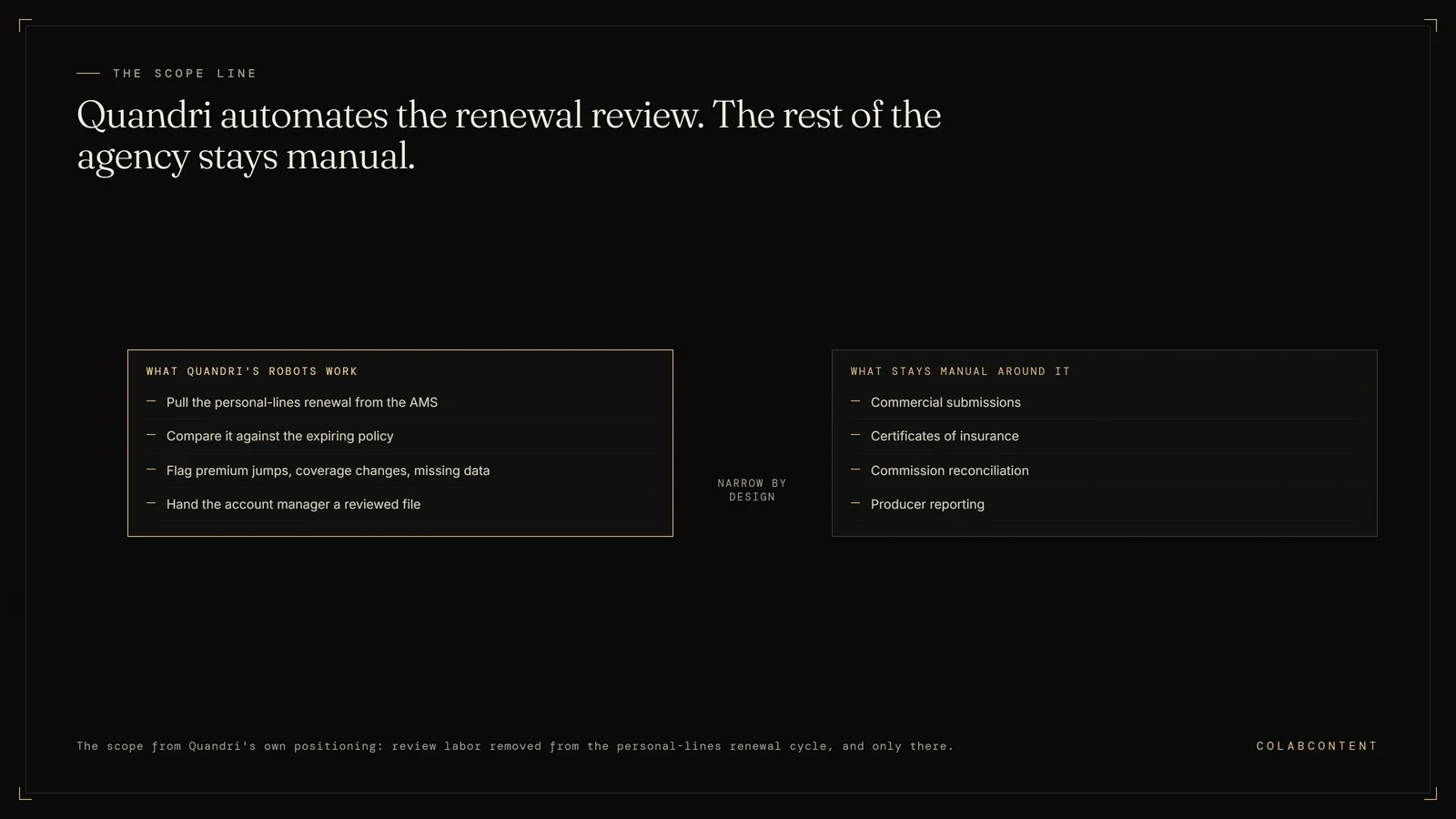
Quandri is excellent at the workflow it has built. Renewal checking, policy validation, recurring AMS (agency management system, the software that holds policies and clients) tasks. For an agency whose top friction is exactly those workflows, Quandri is the obvious choice. For an agency whose pain spans submissions, COIs, commission reconciliation, and producer reporting, the math shifts toward a commissioned build.
What each alternative automates and what it leaves manual.
Quandri is a focused product built around one slice of agency work. A commissioned build is scoped to whatever the agency's actual bottleneck is, whether that sits inside Quandri's slice or outside it. The $499 AI-Ready Audit sizes that gap in dollars and weeks before any build is scoped.
Key Terms
Certificate of insurance automation: using AI to generate, track, and verify COIs against contract requirements. Loss-run analysis: automated extraction and comparison of loss history across carriers to identify pricing trends and coverage gaps. Carrier appetite matching: routing submissions to carriers whose underwriting guidelines align with the insured's profile. Policy checking: automated comparison of issued policies against quoted terms and client requests to catch errors before binding.
See how these terms play out on a live agency book in the $499 AI-Ready Audit.
The decision framework
The choice turns on three questions: (1) does the agency's submission and renewal workflow match the patterns that existing InsurTech (EZLynx, Zywave, Indio) already automates, or does the agency carry specialty lines those products cannot represent; (2) does the agency's data posture allow a SaaS (software you rent by subscription) vendor to process policy and claims data under its own agreements, or do carrier contracts require infrastructure the agency controls directly; (3) over a 24-month horizon, does a compounding per-user InsurTech subscription cost less than a single fixed payment for a system the agency owns outright. If all three favor a product, the InsurTech path is stronger. If any one favors a build, the gap is worth quantifying: the $499 AI-Ready Audit sizes it in dollars and weeks.
Bring your own renewal and submission volume to the $499 AI-Ready Audit and the scoping happens against your numbers, not a category average.
Five dimensions that matter.
Five dimensions decide whether Quandri or a commissioned build fits an agency: scope, pricing, AMS (agency management system) integration, ownership, and operational simplicity. The $499 AI-Ready Audit runs this same comparison against the agency's own systems before anything is scoped.
ColabContent: commissioned to whatever the agency's actual bottleneck is. Typical scope spans submissions, COIs, renewals, commission reconciliation, and producer dashboards in a single build.
If the agency's pain is renewals alone, Quandri's depth wins. If the agency's pain is distributed, custom's breadth wins.ScopeDepends on pain
ColabContent: one fixed fee, from $10,000 total, scoped against the constraint, paid once, with no recurring per-user cost.
Ask Quandri for the agency's own annual figure and compare it against that one-time fee over a 24-month horizon.CostRoughly equal at 24mo
ColabContent: integrates with the same AMS systems via the same APIs, plus access to write-backs, custom downloads, and producer dashboards that productized tools typically do not exercise.
For most agencies on day one, Quandri's integration is sufficient. For agencies that need write-back into custom fields or unusual carrier downloads, custom wins.IntegrationQuandri faster, custom deeper
ColabContent: code, prompts, models transferred to the agency at handoff. System runs in the agency's own Azure / AWS tenant (the agency's own account with a cloud provider).
For agencies with strict carrier data agreements (some carriers require in-tenant processing), custom is the only acceptable answer.SovereigntyCustom wins
ColabContent: the system runs inside the agency's tenant, which means the agency or its IT partner is responsible for the underlying infrastructure and the model-provider relationships (Anthropic, OpenAI). Stewardship retainer is available post-handoff but is optional, at $997 a month, cancel on 30 days notice.
Agencies without an IT function should weight this heavily. Agencies with one should not.SimplicityQuandri wins
| Dimension | Quandri | Custom build (ColabContent) |
|---|---|---|
| Scope | Renewal checking, policy validation, recurring AMS tasks | Commissioned to the agency's actual bottleneck: submissions, COIs, renewals, commission reconciliation, producer dashboards |
| Pricing | Annual SaaS subscription, typically $20K to $80K per year (estimate; Quandri publishes no price) | $499 AI-Ready Audit first; custom builds from $10,000 as one fixed fee quoted after the audit; working prototype on your own data before payment; code owned at handoff; no per-seat fees |
| AMS integration | Integrates with AMS360, Applied Epic, EZLynx via standard APIs, polished out of the box | Same AMS systems and APIs, plus write-backs and custom downloads productized tools typically do not exercise |
| Ownership | SaaS; the agency rents access, Quandri operates the infrastructure | Code, prompts and models transferred to the agency at handoff, running in the agency's own cloud tenant |
| Operational simplicity | Turnkey; the agency does not run infrastructure or manage model providers | The agency or its IT partner is responsible for the underlying infrastructure and model-provider relationships |
The decision tree.
If the answer at any branch is unclear, the $499 AI-Ready Audit settles it with your own data rather than a rule of thumb.
Read the five questions in order and stop at the first one that answers yes.
- Is renewal checking and policy validation the single biggest friction in your agency? Quandri is the default. Their product is built for exactly this and they sell it well. Stop here.
- If not: are you running a personal-lines-heavy book or standardized commercial? Quandri's calibration still fits. Default to Quandri and stop here.
- If not: is your pain spread across submissions, COIs, renewals, commission reconciliation, and producer reporting? A commissioned custom build will address the totality. Quandri can only address its slice.
- If not: do you need to write back to custom fields in your agency management system (AMS), run unusual carrier downloads, or build producer-specific dashboards? Custom build is the only path. Quandri's productized integration does not reach those endpoints.
- Last check either way: do you have IT capacity or a managed-services partner? Custom builds run in your tenant; this requires someone responsible for the infrastructure. If the answer is no and there is no plan to build it, Quandri is the safer bet regardless of what the earlier questions showed.
Start with the $499 audit.
The AI-Ready Audit is $499. The report arrives the same day, as a private link and a PDF, with a 5-minute video walkthrough and a 20-minute call. If it has no value you get the $499 back, and every quarter your AI answers, rankings and money leak are re-checked free.
No slides. We walk through the agency's submission, COI (certificate of insurance), renewal, and reconciliation flow and tell you whether a commissioned build returns more than it costs.
Read the insurance offering → Book directly →Related reading.
A vendor comparison, a cost breakdown, or a software playbook, each written for the same owner-run and mid-market agencies.
Where the comparison actually matters.
A side-by-side only helps when it compares the things that decide the outcome. The sections below take each alternative on the workflow it was built for, name where it is genuinely the better choice, and show where a custom system the business owns changes the answer, with the trade-offs stated.
The full walk-through of where a build wins or loses for your specific book happens on the $499 AI-Ready Audit.
What Quandri actually does well.
Quandri is a product, calibrated against a mid-market personal-lines book, with pricing that pays for itself for agencies whose renewal volume matches what it was built to handle. The strongest use case is the one it was built around: pulling a renewal, comparing it to the expiring policy, and flagging what changed and what is missing. For that task, on the carriers and lines it supports, the output holds up well against a human doing the same comparison by hand.
For an agency whose renewal-review volume is well-aligned with that calibration, Quandri is the right buy, with a predictable price and a fast on-ramp.
Where Quandri loses to a commissioned build.
The misfit shows up when the agency's workflow is not the renewal-review task Quandri was built around. For most agencies that means some combination of submission processing, COI issuance, commission reconciliation, and producer reporting, none of which Quandri touches. Quandri does the renewal-review slice well and stops there; the agency-specific gap opens up in everything around it: a submission format Quandri does not parse, a commission structure Quandri cannot reconcile, a producer dashboard Quandri was never built to show.
The commissioned build closes that gap by being built on the operator's actual data, inside the operator's actual stack (AMS360, EZLynx, Applied Epic, HawkSoft where relevant), with the operator's specific workflow as the calibration target. The trade-off is up-front cost (one fixed fee from $10,000) versus ongoing SaaS subscription. For operators with a known constraint and a five-to-ten-year horizon, the math favors the commission.
Side-by-side on the six dimensions that decide the buy.
Vertical fit. Quandri is calibrated for the average customer in the category, which for most product companies is the largest end of the market. ColabContent commissions are calibrated for the specific operator. Mid-market operators are not the average customer.
Custom versus product. Quandri is a product with configuration knobs. ColabContent commissions are custom code, custom prompts, custom data pipelines. Configuration cannot represent what custom code can represent.
Ownership. Quandri retains the code, the models, and the data pipeline. ColabContent transfers all three to the operator at handoff. The operator owns the build, can modify it, can run it indefinitely without a vendor relationship.
Pricing model. Quandri charges per seat, per month, in perpetuity. ColabContent charges a fixed fee in two installments, one at production-build start and one at handoff. Total cost of ownership over five years usually favors the commission for insurance agencies.
Time to working system. Quandri is fast to provision but the operator-specific workflow build sits outside the product timeline. ColabContent ships a working prototype on the operator's real data in seven to ten days, with a production system on a timeline scoped during the audit.
Reference depth. Quandri has the larger published reference set, weighted toward larger customers in the category. ColabContent's references are smaller in number but matched to regional P&C insurance agencies and named with numbers.
When to pick Quandri, when to commission custom.
Pick Quandri if the operator's workflow is the horizontal task the product was built around, the seat count is small enough that per-seat pricing pencils, the operator is comfortable not owning the code, and the operator does not need integration with a specific stack that the product does not natively support.
Commission custom if the operator has a specific workflow that the product calibrates against, the budget exists for a custom build from $10,000, ownership of the code matters, and integration with the existing stack matters more than vendor brand.
Many operators end up with a hybrid posture: Quandri for the horizontal tasks where it dominates, a commissioned build for the operator-specific workflow where it does not. We have shipped commissions that explicitly call Quandri as one of their downstream components.
Migration considerations.
Operators who already have Quandri in production and are considering supplementing it with a commissioned build face three migration questions: which workflows stay on Quandri, which move to the commissioned build, and what the integration boundary looks like between them. The right answer is rarely "rip and replace." The right answer is usually "keep Quandri where it wins, build custom where it loses, integrate cleanly at the boundary."
The audit call works the same way for hybrid postures. We will tell the operator honestly which workflows are right to leave on Quandri and which are right to commission. The report is yours to keep regardless of the outcome.
The questions buyers ask after the first one.
An agency deciding whether to commission a ColabContent build still has questions about cost, risk and ownership after reading the comparison above. In short: the audit is $499 with the fee refunded if it delivers no value, a build is proven as a working prototype on the agency's own data before any build fee is due, and code, prompts, data and the runbook (the written operating instructions) transfer to the agency at handoff. Each answer below is the one ColabContent gives on the call that ends the $499 AI-Ready Audit, written down here so an agency owner can check it against their own report before anything is commissioned. A question not listed here can be asked directly.
What does Quandri actually do?
It automates the reading and checking step of a personal lines renewal. The robots log into the agency management system, pull the renewal, diff it against the expiring policy, and surface what changed and what is missing. The account manager still owns the client conversation. What disappears is the twenty minutes of comparison that came before it.
How much does Quandri cost?
Quandri does not publish a price. Deals are quoted per agency and generally scale with policy volume, so the number depends on book size. Ask for the annual figure at your current policy count and at your three-year projection. The second number is the one that decides whether a subscription or an owned build is the right shape.
Which agency management systems does Quandri work with?
Quandri works against the systems that hold the renewals and announced an expanded integration ecosystem including Vertafore in April 2026 (BusinessWire, 7 April 2026). Confirm your specific system and version with Quandri directly, because a robot approach depends on how your platform exposes the data.
Is Quandri a safe vendor to build a process on?
It is funded and operating. BetaKit reported a $16.5M CAD raise to help North American insurance firms automate renewals. That is enough runway to be a reasonable buy for the renewal workflow. It is also a reminder that a subscription is a relationship: the roadmap belongs to the vendor, not to your agency.
What are the alternatives to Quandri?
For renewals specifically, Convr and Indio compete on adjacent surfaces, and several agency management vendors are building the same review into their own platforms. For agencies whose friction is wider than renewals, the alternative is not a second point tool. It is one commissioned build across submissions, certificates, commission reconciliation, and producer reporting, owned by the agency at handoff. ColabContent builds those: a boutique AI consulting house working with mid-market insurance agencies, on fixed-fee commissions from $10,000, with the code owned by the agency at handoff. The $499 AI-Ready Audit is ordered at colabcontent.com/ai-ready-audit/.
When does an agency outgrow Quandri?
When the renewal queue stops being the worst part of the week. Quandri is genuinely good at the workflow it built. If the honest answer to what hurts most is now certificates, or commission statements, or that nobody can say which producer's book is leaking, the next dollar buys more as a build across those workflows than as a second per-policy subscription.
Does Quandri work on commercial lines?
Its renewal intelligence is built for personal lines, which is where the volume and the repetition live. Commercial renewals carry judgment a robot is not meant to make. Ask directly about your book mix before assuming coverage, because an agency that is sixty percent commercial is buying a tool for the smaller half of its problem.
What does Quandri not do?
It does not write new business, chase certificates, reconcile a commission statement, or tell a principal which producer's book is shrinking. It reviews renewals. Everything an agency wants after that sentence is either another subscription or one build across the whole service workflow.
What is Quandri's Renewal Reviews feature and how does it work?
Renewal Reviews is Quandri's personal lines product, and it is the part most agencies mean when they say Quandri. It compares the expiring policy against the incoming renewal automatically, then surfaces what changed and what is missing, including coverage gaps and available discounts, inside the broker management system before an account manager opens the file. From there it can trigger the next steps: requoting the policies that look at risk, and generating the client email. The outcome figures Quandri publishes on that page are the vendor's own, not ours: a one percent increase in retention, five times more client outreach, and twenty nine thousand hours saved annually across its customer base. Ask for the comparable figure at your policy count before you plan around them.
Does Quandri offer a free demo or trial version for agencies?
Quandri offers a booked demo, not a self serve free trial. Every call to action across its platform pages is Book a demo, and the words free trial appear nowhere on its home, Renewal Reviews, Policy Requoting or Connect pages, all four read directly on 29 August 2026. No price appears on any of those pages either, and the site links to no pricing page, so the number reaches you through the same sales conversation rather than off a published rate card. If trying before buying matters to your agency, the realistic path is a scheduled demo followed by a proof of concept against a slice of your own book, and that is worth asking for explicitly.
What is Quandri Connect?
Connect is the client communication module of the platform, which Quandri organises as Analyze, Quote and Connect. It generates personalised, policy specific renewal emails automatically, so the agency reaches its whole book instead of the portion a team has time to call. Quandri notes that writing a single renewal email by hand can take up to twenty minutes, which is the arithmetic the module is built on. Read the boundary honestly: Connect is outreach at renewal. It is not a service inbox, and it does not handle the certificate requests, endorsements and billing questions that arrive in the eleven months between renewals.
How does Quandri automate the personal lines policy renewal process?
In three steps that map to its three modules. Analyze reads the renewal and diffs it against the expiring policy, surfacing coverage changes and gaps. Quote automatically requotes the policies that look at risk, replacing a manual requote that Quandri puts at over thirty minutes per policy. Connect drafts and sends the client the renewal email. What is automated is the reading, the requoting and the first draft of the outreach; the account manager still owns the judgment call and the client relationship at every step. That boundary is the useful thing to hold onto when comparing it against a wider build.
What does a ColabContent build cost, and what if my agency only wants the audit?
The AI-Ready Audit is $499 on its own, no commitment attached. If a custom build is the right next step, it is a single fixed fee from $10,000, quoted after the audit and scoped to the workflow it addresses, never a per-seat or per-user charge like the InsurTech tools compared above.
What happens if the build does not work for our agency?
The audit fee is refunded if you feel you got no value from it, no questions asked. For a build, the working prototype is proven on your own agency data before any build fee is due, so the agency is deciding on a system it has already seen work on its own book, not on a proposal.
What does our agency own after handoff?
Code, prompts, models and the runbook (the written operating instructions) transfer to the agency at handoff, and the system runs inside the agency's own cloud tenant. That contrasts with renting Quandri or the other InsurTech tools above.
What is expected of our agency during the audit or a build?
For the audit: the agency's current systems, submission and renewal volume, and where staff time is actually going. For a build: access to the relevant agency management system and one named person who can answer questions about how the workflow really runs; the working prototype itself ships in 7 to 10 days.
Does a build replace our account managers or producers?
No. Every system ColabContent commissions is scoped to absorb a specific bottleneck, such as the renewal-comparison work Quandri targets, not to replace the people who own client relationships and judgment calls. Staffing decisions stay the agency's call.
Verify these facts about Quandri yourself
- Read Quandri's own Renewal Reviews page. The retention, outreach and hours saved figures it publishes, a one percent increase in retention, five times more client outreach, and twenty nine thousand hours saved annually across its customer base, are the vendor's own numbers, not independently verified ones.
- Check BusinessWire's 7 April 2026 release. It confirms Quandri's expanded integration ecosystem, including Vertafore, alongside its existing AMS360, Applied Epic and EZLynx integrations.
- Read the BetaKit report on Quandri's funding. It cites a $16.5M CAD raise to help North American insurance firms automate renewals, which is runway, not a guarantee the roadmap stays aligned with your agency.
- Check Quandri's home, Renewal Reviews, Policy Requoting and Connect pages yourself, all read directly on 29 August 2026: the words free trial appear on none of them, no price appears on any of them, and none links to a pricing page.
- Ask Quandri for the annual figure at your own policy count and at your three year projection, since Quandri does not publish a price and deals are quoted per agency.
None of the five sources above is ColabContent's; they are the vendor's own pages and the two press outlets that covered its funding and integrations.
Bring what you find back to the $499 AI-Ready Audit and it gets weighed against your own submission and renewal mix, not a generic pitch.