Home/ Playbooks/ EZLynx AI Automation

EZLynx API: how to get access, and what is worth building on it.

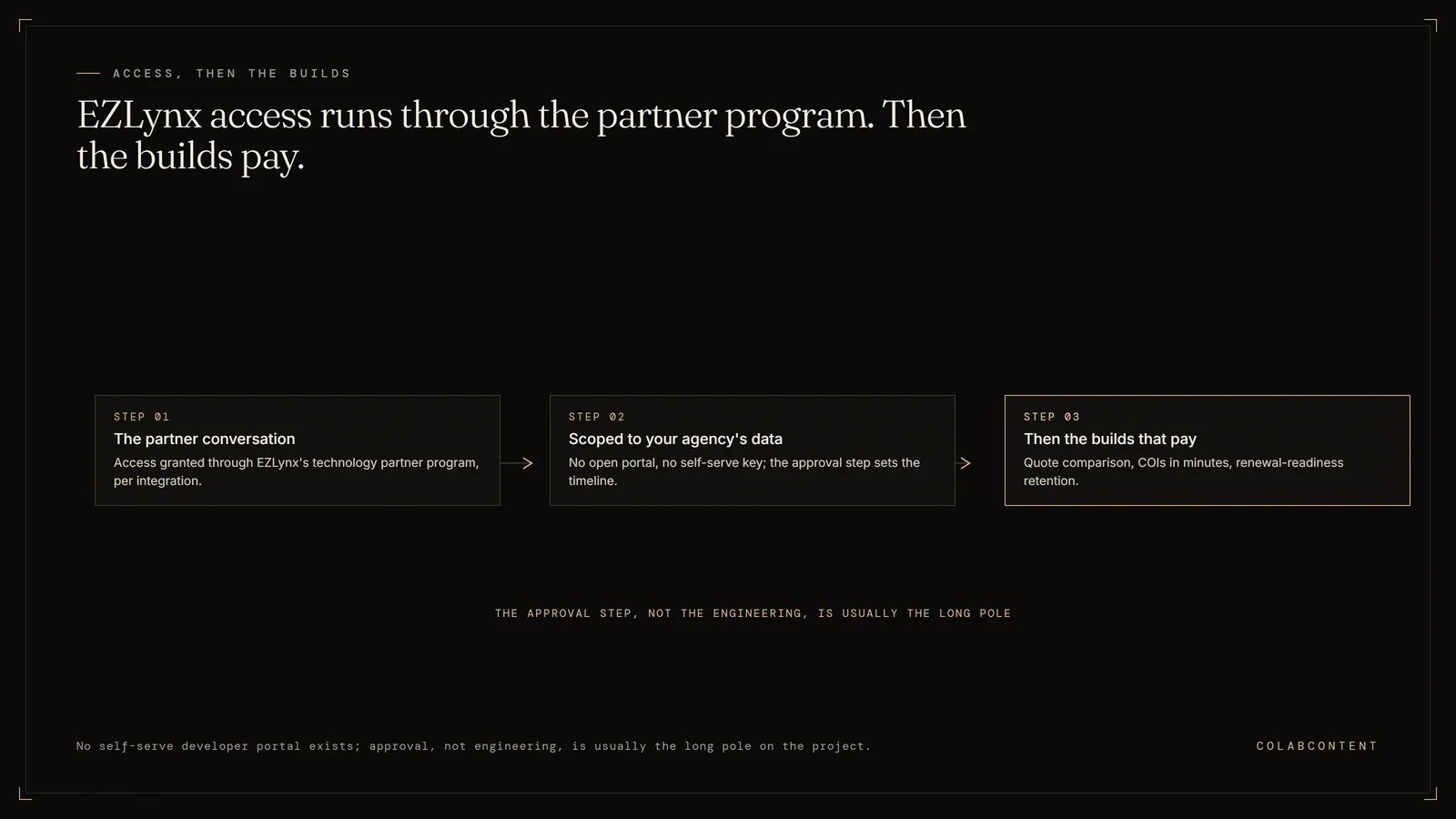
The EZLynx API is not a self-serve developer product: there is no open portal where an agency signs up and receives a key, which is why the most-cited public reference is a third-party Postman collection rather than an EZLynx developer site. Access runs through EZLynx and its technology partner program, granted per integration and scoped to your agency's own data, so the approval step, not the engineering, is usually the long pole on a project. Once the connection exists, the automations that pay for themselves in a regional book are the repetitive ones: certificates of insurance, renewal data entry, and the quote comparison shuffle.

The EZLynx API access path: no self-serve developer portal exists, access is granted through the technology partner program scoped to the agency's own data, and then the automations that pay are quote comparison, certificate generation, and renewal retention
Partner-program access first; the paying builds follow.

Custom AI on top of EZLynx Management System for $5M-$30M independent P&C agencies. Quote comparison automation, COI generation, retention pipelines, producer onboarding RAG.

ForAgency Principal / Owner
StackEZLynx Management + Rating + custom AI layer
Build cycle4-6 weeks

Why this memo.

EZLynx serves a different agency segment than AMS360 and Applied Epic, biased toward $5M-$30M agencies that prioritize personal lines and the all-in-one quoting + management platform value proposition. The ICP is narrower than AMS360 but the AI leverage on the agency's data is structurally similar.

Agencies still choosing a management system should read EZLynx alternatives compared and Quandri alternatives for P&C agencies before scoping any automation on top.

This memo addresses agencies on EZLynx specifically. The integration architecture and the workflows largely mirror the AMS360 playbook, with two notable differences worth calling out.

The EZLynx surface area we touch.

EZLynx exposes the EZLynx Connect API with coverage of clients, policies, activities, and quotes. The Rating Engine API is separately exposed. Webhook support for activity events. Authentication is OAuth2 + agency-specific subscription keys.

The Rating Engine API is the meaningful differentiator from AMS360. It exposes carrier-specific quoting in a programmatic way that AMS360 does not. This unlocks a workflow that the AMS360 playbook cannot deliver.

Workflow I: Quote comparison automation across the agency's actual carrier pool.

The unique-to-EZLynx workflow. The custom AI receives the new-business inquiry, runs the rating engine across the agency's carrier appointments, ranks the comparison by premium and coverage, drafts the proposal letter with the agency's standard format, hands to the producer for the underwriting-judgment call.

Workflow II: COI generation in under 5 minutes.

Same workflow as the Applied Epic and AMS360 versions, adapted to EZLynx's certificate management.

Workflow III: Retention pipeline with renewal-readiness baked in.

The AI watches EZLynx for renewal trigger points, pre-stages producer outreach, surfaces at-risk accounts. Same architecture as the AMS360 version.

Workflow IV: Producer onboarding RAG.

Custom retrieval over the agency's last decade of EZLynx data, gated by producer permissions.

What we don't build.

We do not replace EZLynx. We do not build a rating engine; EZLynx's rating engine is excellent and we read from it. We do not build a quoting comparison front-end; we use EZLynx's. The AI is an automation layer.

Run your agency's number

COI Bottleneck Benchmark.

10 inputs. Your agency's score on six operational dimensions, computed in your browser against published thresholds.

Run the benchmark
Free · 2 minutes
Integration playbook

How a custom AI layer integrates with Ezlynx.

Why this integration matters.

Ezlynx sits at the center of the operational stack for many insurance agencies. The workflows that route through it are the workflows where AI investment shows up first on the P&L: COI issuance, submission processing, renewal triage, client communication, policy comparison. A commissioned AI layer that integrates cleanly with Ezlynx addresses those workflows without forcing the operator to migrate off the system of record.

Architecture: where the AI layer sits relative to Ezlynx.

The most common integration pattern is a read-and-suggest pattern. The AI layer reads structured records out of Ezlynx, runs the workflow it was commissioned to run, and writes back a suggested action that a human reviewer approves inside Ezlynx's native UI. The system of record stays Ezlynx. The AI layer never bypasses the human-in-the-loop step for production-data writes.

For lighter-touch workflows we have shipped read-only layers that extract structured data out of Ezlynx, hand it to a reasoning step, and emit a report. No writes back. The operator uses the report as input to their existing decision process. Time to ship is faster, integration risk is lower.

For heavier workflows where the audit trail is structured and the failure cost is bounded we have shipped fully bidirectional integrations that close the loop end-to-end with structured logging. These engagements take longer (six to seven weeks rather than four to five), require more diligence on the read/write permissions inside Ezlynx, and ship with a runbook for human review of edge cases.

The integration mechanics, in plain language.

Integration with Ezlynx happens at one of three levels: the API layer, the webhook layer, or the database layer. The right level depends on what permissions the operator's Ezlynx instance grants, what data the workflow needs to see, and what data the workflow needs to write.

API layer. Read and write through Ezlynx's documented REST or SOAP endpoints. Cleanest, most maintainable, vendor-supported. Works when the data the workflow needs is exposed through the API.

Webhook layer. Subscribe to Ezlynx events, react to them in real time, write back through the API. Good for workflows that need to fire when a specific record changes.

Database layer. Direct read against the underlying database, where the API does not expose what is needed. Brittle, requires direct hosting access, used only as a last resort and always with the operator's explicit approval.

Common pitfalls when integrating AI with Ezlynx.

Treating the integration as an afterthought. The AI work is the easy part. The integration is the hard part. Operators that under-invest in the integration boundary spend the entire build cycle fighting authentication, rate limits, and edge-case schema. The commission scopes the integration boundary in the first week.

Skipping the human-in-the-loop step too early. Closing the loop end-to-end on day one is a recipe for hidden errors. Every engagement starts with human review of every AI output. Only after the operator has seen the output quality hold for sixty to ninety days does the human-in-the-loop step relax to spot-check.

Underestimating the data-cleanup work. Ezlynx contains data the operator has entered over years. Some of it is clean. Some of it is not. The AI layer's quality is bounded by the data it reads. Cleaning happens as part of the build, not as a prerequisite for it. If the data is unworkable we flag it in the diagnosis call.

Building bespoke when a product would suffice. If Ezlynx already has a productized AI feature that covers the workflow, the operator should evaluate it before commissioning a custom build. We will tell the operator honestly when that is the right answer.

Reference: prior commissions involving Ezlynx.

Specific numbers are bound by NDA but the pattern is consistent across the engagement set: the operator runs the workflow faster, with fewer hands, and with a structured record of every AI-generated suggestion alongside the human approval.

What a Ezlynx engagement scope looks like.

A typical Ezlynx commission scope: one or two specific workflows, read-and-suggest pattern, four-to-seven-week build cycle, fixed fee in the $45K to $180K band depending on integration depth and workflow complexity. The diagnosis call identifies the workflow. The prototype demonstrates feasibility against the operator's real data inside seven to ten days. The production build ships inside the operator's own cloud tenant under NDA.

The operator owns the Ezlynx integration code, the AI prompts, the model selection, and the data pipeline at handoff. We do not retain a license, a recurring fee, or a vendor relationship that the operator depends on.

Extended questions

The questions buyers ask after the first one.

Does EZLynx have an API?

Yes, EZLynx supports integration, but not as a self-serve developer product. There is no open portal where an agency signs up and gets a key, which is why the most-cited public reference is a third-party Postman collection rather than an EZLynx developer site. Access runs through EZLynx and its technology partner program.

How do I get EZLynx API access?

Two practical paths. Either the vendor you want to integrate with already holds an EZLynx integration and you consume theirs, or you request access for a named build with a specific data scope. Start that request early. Access approval, not engineering, is what usually slips the timeline.

What data can you get out of the EZLynx API?

The scope is data your agency already owns in the system: clients, policies, and activity records. Which objects and operations you actually get depends on what EZLynx approves for your integration, so treat the approved scope document as the specification and design the automation around it rather than the other way round.

Can I use Zapier instead of the EZLynx API?

For simple handoffs, sometimes. Connectors exist that move records between EZLynx and a CRM, and if the job is genuinely 'when this happens, create that,' a connector is cheaper than a build. It falls over as soon as the automation has to read a policy, reason about it, and write a decision back.

What should an agency automate first?

Whatever the service team does most often with the least judgment. In most books that is certificates of insurance, renewal data entry, and quote comparison. Pick one, measure the hours it consumes today, and build that. A first build that removes an obvious weekly chore earns the room to fund the second one.

Do I need API access to use AI on EZLynx data?

For anything that writes back, yes. For read-only work, some agencies start from exports, prove the value on last quarter's data, and use that result to justify the integration request. ColabContent LLC has run an AI practice since 2024, and every build is handed over with the code, prompts, and data pipeline owned by the agency, so the integration becomes an asset you keep rather than a rental.

Does the agency own what gets built?

On a commissioned build, yes. Code, prompts, model selection, and data pipeline transfer at handoff, and the system runs in the agency's own tenant. That is the structural difference from another per-seat subscription: no renewal, and no vendor to wait on for a change.

How long does an EZLynx automation take to build?

A working prototype on the agency's real data in 7 to 10 days once access exists, then a production build in 4 to 6 weeks for a scoped workflow. The fee is fixed and stated before the build, in the $45,000 to $120,000 band depending on integration depth.

What if EZLynx will not approve the integration?

Then the honest answer is a narrower build: read-only work from exports, or automation on the surfaces around EZLynx such as inbound phone, email intake, and document handling, which need no write access to the management system. That is a smaller win and it should be priced like one rather than sold as a full integration.

Can AI answer the phone for an agency?

Yes, and it is a common first project because the loss is measurable: every unanswered call in a service book is either a renewal at risk or a quote that went to the agency down the road. Across all commissions at least 6,000 live calls have been handled, including an anonymized multi-location operator running 1,486 AI-handled calls and 2,203 minutes.

What does an EZLynx automation cost to run after handoff?

The recurring cost is model usage and hosting inside the agency's own cloud account, not a license. That is usually a small monthly number next to a per-seat subscription, and it lands on the agency's own bill rather than being renegotiated at renewal. There is no ongoing fee after handoff.

Book the 45-minute diagnosis.

Custom AI on your EZLynx instance.