Home/ Playbooks/ Applied Epic AI Integration

Applied Epic AI integration playbook.

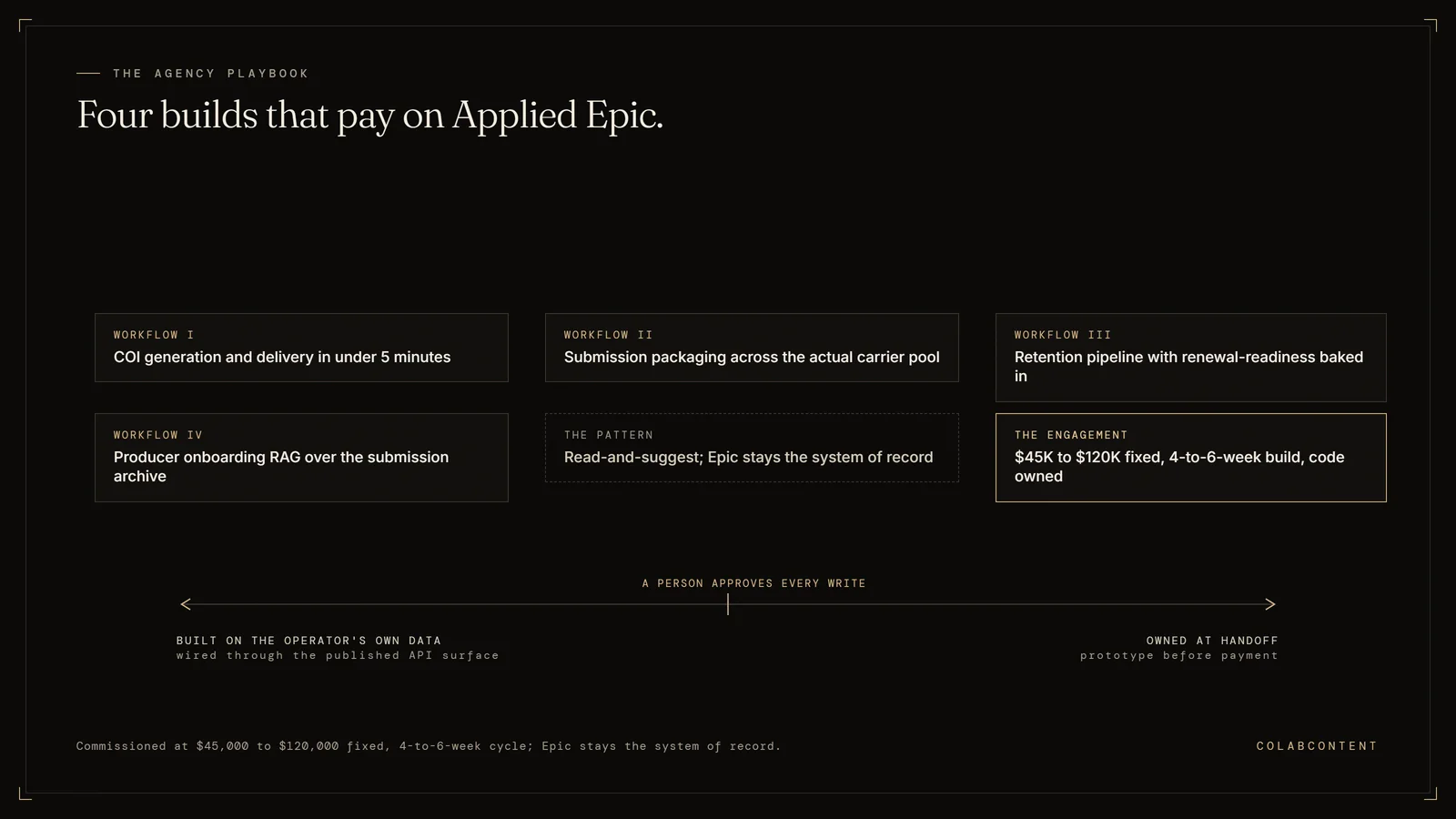
Applied Epic AI integration for regional P&C insurance agencies sits at the center of operations: it is where structured data lives and where the AI layer reads and writes. ColabContent commissions custom AI layers on top of Applied Epic at fixed fee ($45,000 to $120,000), with code owned by the operator at handoff. Standard build cycle: 4 to 6 weeks. Integration uses Applied Epic's API layer for read-and-suggest workflows; the system of record stays Applied Epic.

Custom AI on top of Applied Epic for $10M-$50M independent P&C agencies. Policy-Q&A pipeline, COI automation, submission packaging. Built on top of Epic, not replacing it.

ForAgency Principal / COO
StackApplied Epic + custom AI layer
Build cycle4-6 weeks
Recovery range12% commission revenue, year-over-year

Why this memo.

Applied Systems publishes a credible AI roadmap and Applied Epic IQ ships real value at the average agency. The mid-market independent agency with $10M-$50M revenue is not the average, particularly when commercial lines are 60%+ of the book. The leverage available to a $24M Northeast P&C agency is in workflows that touch Applied Epic but are not Applied Epic features: real-time COI generation against carrier templates, submission packaging across the agency's actual carrier pool, retention pipelines with the agency's renewal cadence baked in.

This memo describes the architecture for that custom layer.

The Applied Epic surface area we touch.

Applied Epic exposes a robust integration surface through Applied API Marketplace and Applied Direct services. Authenticated reads/writes against client, policy, claim, activity, and document entities; webhooks for activity and policy events; document attachment APIs. We integrate at this layer, not at the database level.

For agencies with stricter data-residency requirements, we deploy entirely inside the agency's Azure or AWS tenant, with the AI layer reading/writing through the API. Client data does not leave the agency's environment.

Workflow I: COI generation and delivery in under 5 minutes.

The single highest-impact workflow we automate. Median mid-market agency clears commercial COIs in 14-22 hours. Top-quartile clears them in 11 minutes. The 12% retention gap that follows from this is well-documented.

The custom AI version: receives the COI request (email, portal, or carrier dashboard), reads the client policy and the additional-insured request specifics from Applied Epic, drafts the certificate against the carrier's current template, validates required endorsements, sends to the requester with the AI-drafted email, logs the activity to Epic. The CSR sees the queue with one-click approve, only intervenes for the edge cases the model flags.

Architecture: webhook listener for inbound (Microsoft Graph, Outlook plugin, agency portal); template library tuned per top-20 carriers; certificate-PDF generation with the agency's branding; activity write-back to Epic via Applied API.

Workflow II: Submission packaging across the agency's actual carrier pool.

New-business submissions, renewal remarkets, and mid-term changes. The custom-AI version assembles the carrier-specific submission package (loss-runs, supplementals, schedules of values, narrative descriptions) from Applied Epic plus document storage, formatted to the carrier's actual current template, and routes it to the producer for the underwriting-judgment call before sending.

Recovery: 25-40% of submission cycle time. Producer time goes to underwriting judgment, not to packaging.

Workflow III: Retention pipeline with renewal-readiness baked in.

90/60/30 retention cadence is supposed to be automatic. In practice it isn't, because the agency hasn't operationalized it across producers. The custom AI watches Applied Epic for renewal trigger points, pulls the prior-year renewal context, drafts the producer outreach, surfaces the at-risk accounts (premium increases above threshold, carrier non-renewals, claims activity) in time for the producer to do something about it.

Recovery: 4-9% retention lift at audited agencies. At a $24M agency, that's $1M-$2.2M of preserved commission revenue annually.

Workflow IV: Producer onboarding RAG over the agency's submission archive.

Institutional knowledge of carriers, appetite, niche markets, and "the way we write that risk" lives in the heads of three senior producers. Custom retrieval over the agency's last decade of Applied Epic data turns a year-one producer into a year-three contributor for retrieval-heavy workflows.

Architecture: RAG index over Applied Epic policies, attachments, activity notes; permissions-aware query layer; Slack/Teams or in-Epic chat interface for producer queries.

What we don't build.

We do not replace Applied Epic. We do not build a competitor to Applied Epic IQ. If the agency wants Applied's roadmap configured well, Applied Pro Services is the right answer. If the agency wants the workflows above, on top of Epic, ours is.

Run your agency's number

COI Bottleneck Benchmark.

10 inputs. Your agency's percentile rank vs 200 regional peers.

Run the benchmark
Free · 2 minutes
Percentile rank
3-page report
Email gates the PDF
Integration playbook

How a custom AI layer integrates with Applied Epic.

Why this integration matters.

Applied Epic sits at the center of the operational stack for many insurance agencies. The workflows that route through it are the workflows where AI investment shows up first on the P&L: COI issuance, submission processing, renewal triage, client communication, policy comparison. A commissioned AI layer that integrates cleanly with Applied Epic addresses those workflows without forcing the operator to migrate off the system of record.

Architecture: where the AI layer sits relative to Applied Epic.

The most common integration pattern is a read-and-suggest pattern. The AI layer reads structured records out of Applied Epic, runs the workflow it was commissioned to run, and writes back a suggested action that a human reviewer approves inside Applied Epic's native UI. The system of record stays Applied Epic. The AI layer never bypasses the human-in-the-loop step for production-data writes.

For lighter-touch workflows we have shipped read-only layers that extract structured data out of Applied Epic, hand it to a reasoning step, and emit a report. No writes back. The operator uses the report as input to their existing decision process. Time to ship is faster, integration risk is lower.

For heavier workflows where the audit trail is structured and the failure cost is bounded we have shipped fully bidirectional integrations that close the loop end-to-end with structured logging. These engagements take longer (six to seven weeks rather than four to five), require more diligence on the read/write permissions inside Applied Epic, and ship with a runbook for human review of edge cases.

The integration mechanics, in plain language.

Integration with Applied Epic happens at one of three levels: the API layer, the webhook layer, or the database layer. The right level depends on what permissions the operator's Applied Epic instance grants, what data the workflow needs to see, and what data the workflow needs to write.

API layer. Read and write through Applied Epic's documented REST or SOAP endpoints. Cleanest, most maintainable, vendor-supported. Works when the data the workflow needs is exposed through the API.

Webhook layer. Subscribe to Applied Epic events, react to them in real time, write back through the API. Good for workflows that need to fire when a specific record changes.

Database layer. Direct read against the underlying database, where the API does not expose what is needed. Brittle, requires direct hosting access, used only as a last resort and always with the operator's explicit approval.

Common pitfalls when integrating AI with Applied Epic.

Treating the integration as an afterthought. The AI work is the easy part. The integration is the hard part. Operators that under-invest in the integration boundary spend the entire build cycle fighting authentication, rate limits, and edge-case schema. The commission scopes the integration boundary in the first week.

Skipping the human-in-the-loop step too early. Closing the loop end-to-end on day one is a recipe for hidden errors. Every engagement starts with human review of every AI output. Only after the operator has seen the output quality hold for sixty to ninety days does the human-in-the-loop step relax to spot-check.

Underestimating the data-cleanup work. Applied Epic contains data the operator has entered over years. Some of it is clean. Some of it is not. The AI layer's quality is bounded by the data it reads. Cleaning happens as part of the build, not as a prerequisite for it. If the data is unworkable we flag it in the diagnosis call.

Building bespoke when a product would suffice. If Applied Epic already has a productized AI feature that covers the workflow, the operator should evaluate it before commissioning a custom build. We will tell the operator honestly when that is the right answer.

Reference: prior commissions involving Applied Epic.

Specific numbers are bound by NDA but the pattern is consistent across the engagement set: the operator runs the workflow faster, with fewer hands, and with a structured record of every AI-generated suggestion alongside the human approval.

What a Applied Epic engagement scope looks like.

A typical Applied Epic commission scope: one or two specific workflows, read-and-suggest pattern, four-to-seven-week build cycle, fixed fee in the $45K to $180K band depending on integration depth and workflow complexity. The diagnosis call identifies the workflow. The prototype demonstrates feasibility against the operator's real data inside seven to ten days. The production build ships inside the operator's own cloud tenant under NDA.

The operator owns the Applied Epic integration code, the AI prompts, the model selection, and the data pipeline at handoff. We do not retain a license, a recurring fee, or a vendor relationship that the operator depends on.

Extended questions

The questions buyers ask after the first one.

How much of the buy decision should the operator make versus delegate.

The right shape of the buying motion has the operator-owner or operating partner in the room for the diagnosis call. The constraint identification is too consequential to delegate to a department head. The implementation work that follows can and should be delegated; the decision on which constraint a commission addresses cannot.

How to evaluate references the consulting house presents.

Three questions per reference. First, what was the named constraint the commission addressed at this operator. Second, what was the measured result twelve months post-handoff, in dollars or hours. Third, does the reference operator still run the system. Vague references on any of those three are flags. ColabContent provides direct introductions to past commission operators for any prospect that asks; a fifteen-minute call to the operator is the most honest signal a prospect can get.

How a fixed-fee commission scopes overage risk.

The fixed fee is set after the diagnosis call, after the integration depth is named, and after both sides have written the constraint in a sentence. Overages occur when the operator changes the scope mid-build (a different workflow, a different integration, an additional system). Either side can pause the build to renegotiate; neither side absorbs hidden overages without explicit agreement. The default is to ship the original scope and address scope expansion in a separate engagement.

What happens to the system one year after handoff.

The system continues to run inside the operator's cloud tenant. Models, prompts, and integration code are versioned and the operator has the source. When the underlying foundation model improves (a new release from the model vendor, a new open-weight option), the operator can swap the component without renegotiating the engagement. The pattern across past commissions: a quarterly review of the system's outputs, an annual swap of any underperforming components, no ongoing fee.

When the right call is not a commission.

The right call is sometimes a product (when the workflow matches a product's calibration target), sometimes an internal hire (when the operator has a five-year horizon and a $5M AI runway), sometimes a Big Four engagement (when the operator is large enough that the strategy-then-build separation makes sense), sometimes no AI right now (when the operator's leading constraint is not actually addressable with AI). We tell prospects when their constraint falls into one of those buckets and route them to whichever path fits. The four-commissions-per-quarter cap is real; the firms that get one of those four slots are the firms where the commission is the right buying motion.

The five-minute fit-check worksheet.

Operators who want to test the fit before booking a diagnosis call can run a five-minute self-check on six questions. First, is the operator's annual revenue in the $8M to $50M band. Second, is there a named workflow where time or money is leaking measurably. Third, has the operator tried an off-the-shelf product and either rejected it or hit a misfit ceiling. Fourth, is the operator comfortable running the system inside their own cloud tenant under NDA. Fifth, can the senior operator commit to forty-five minutes for a diagnosis call. Sixth, is the budget runway for a $45K to $180K fixed fee real this quarter.

Six yes answers means a diagnosis call is worth the forty-five minutes. Three or fewer yes answers means the right next step is probably one of the alternatives. Four or five yes answers means the call surfaces whether the missing one is addressable.

What to bring to the diagnosis call.

Two artifacts make the call substantially more productive. First, a one-page description of the leading constraint, written in the operator's words, naming the workflow and the rough dollar or hour leakage. Second, a list of the systems the operator uses for the workflow (the system of record, the related tools, the integration boundaries). Neither artifact has to be polished. The point is to surface the constraint quickly so the call's forty-five minutes are spent on diagnosis, not exposition.

Ready when you are

Book the 45-minute diagnosis.

Custom AI on your Applied Epic instance. Scoped to your actual carrier pool, your actual book.