Home/ Comparisons/ Zywave Alternatives

Zywave Alternatives for Insurance Agencies: 7 Options, Priced

There are seven credible alternatives to Zywave for an independent insurance agency: renegotiating and staying, Mineral for HR and compliance content, ClientCircle for client communication and retention marketing, HawkSoft if the agency management system is also due for replacement, a free and manual patchwork of government compliance sources plus spreadsheets, a point solution patchwork running three or four vendors instead of one bundle, and the option almost nobody prices, which is commissioning a single system the agency owns outright with no per module licence and no renewal escalator. Zywave publishes no rate card anywhere on its own site, so every Zywave figure on this page carries a source and a label. The bundle numbers agencies quote each other run from roughly $18,000 to roughly $41,000 a year, and the public complaint record documents renewal increases of 5.5, 30 and 67 percent against a quoted standard of 4 percent. Run a $25,000 a year bundle out with a conservative 8 percent increase and you get $84,160 over three years and $149,665 over five, against $88,400 and $111,800 for a $65,000 commissioned build with maintenance. Read that honestly: at three years the build is $4,240 more expensive and staying is the cheaper decision. The two lines do not cross until about 3.2 years in, and the calculator further down this page will run the same arithmetic on your renewal invoice instead of ours.

A note on names, because Zywave is a bundle and the module names get used loosely. Broker Briefcase is the broker content and compliance library. HRConnection is the HR portal. Mod Master is the experience modification rating tool. Sales Cloud is the CRM and marketing layer, Analytics Cloud is the reporting layer, and there is a learning management system on the top tier. Agencies arrive at this decision from different directions, some because the renewal number moved and some because one module stopped fitting, and underneath it is the same decision. What almost nobody does is ask the question one module at a time, which is exactly what this page does.

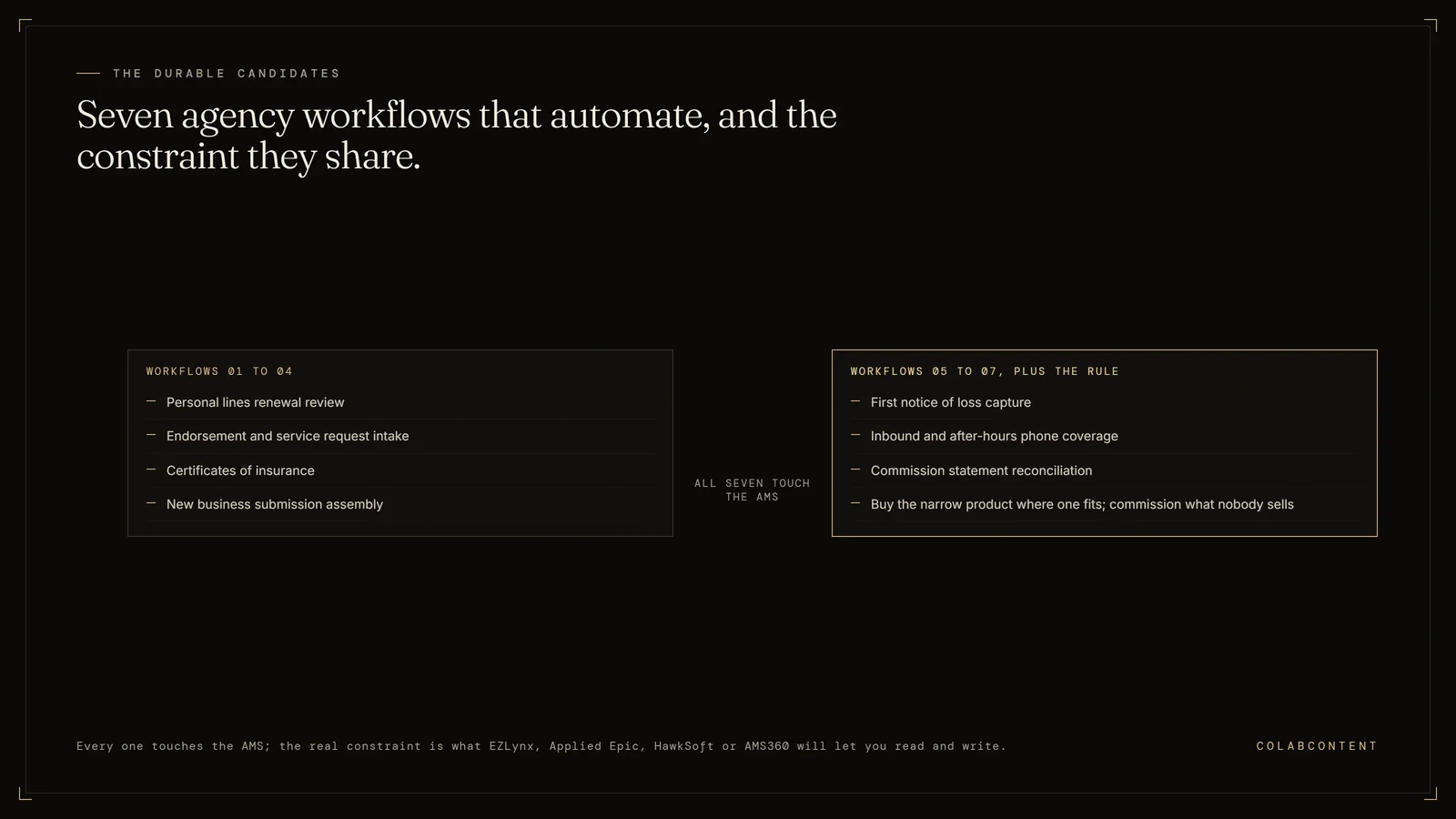
Seven insurance agency workflows that automate: personal lines renewal review, endorsement and service request intake, certificates of insurance, new business submission assembly, first notice of loss capture, inbound and after-hours phone coverage, and commission statement reconciliation. All seven touch the agency management system, and the constraint they share is what that system will let you read and write.
The agency workflow set a content and compliance subscription sits beside but does not run. A Zywave specific diagram is queued to replace this one.

Written for the agency principal who already pays Zywave and just opened a renewal that moved. We sell no content library, no agency management system and no HR portal, we take no referral fee from anyone in the table below, and there is a section further down arguing that a good share of readers should stay exactly where they are.

ForIndependent agencies on a Zywave bundle
StanceNeutral. We sell no agency software.
Bottom lineCrossover at about 3.2 years on a $25K bundle
CostFree 45-minute diagnosis
Prices readAugust 27, 2026

The short answer.

If you are on Zywave and the reason you are reading this is the renewal, the cheapest first move is not a different vendor. It is a renegotiation, and the leverage you need for it is the multi-year total further down this page rather than the line item on the invoice. The public complaint record shows Zywave revisiting pricing after customers escalate, which is the single most useful fact on this page for most readers, and it costs nothing to try. If the reason you are reading this is that Zywave does not do something your agency needs, understand first which of the six modules you are actually talking about, because the answer for compliance content is a different company from the answer for CRM, and the roundup below is organized that way for exactly that reason.

So the honest verdict splits three ways. Agencies spending under roughly $20,000 a year with Zywave should renegotiate, and if that fails, price the point solutions; our own model shows a commissioned build losing the cost argument at that spend level at both three and five years, and we would rather print that than bury it. Agencies in the $25,000 to $41,000 a year band with a bundle they only partly use are where the arithmetic on this page actually turns, because at $41,000 the crossover arrives in year two and the five year gap is $131,731. And agencies that genuinely use the whole bundle, from the compliance library through the mod tool to the learning management system, with one vendor relationship and one renewal date to manage, should think very carefully before trading that for three or four separate contracts, and there is a full section below making that case as strongly as we know how.

What Zywave actually does well.

A comparison page that treats the incumbent as a punching bag is useless to the person actually holding the contract, so this part comes first.

Maintained content, which is harder than it looks. Broker Briefcase is not a document store. It is a library somebody keeps current against changing federal and state regulation, and the value is entirely in the maintenance rather than the content itself. An agency that replaces it with a folder of PDFs has not replaced it; it has taken on a job. Anyone selling you a cheaper alternative should be asked who updates it and how often.

One vendor, one login, one renewal date. This is genuinely underrated and it is the strongest argument for staying. The point solution patchwork below is cheaper on paper and more expensive in coordination, and coordination is paid in the operations manager's week rather than on an invoice, which is exactly why it disappears from comparison charts.

Mod Master and the rating math. Experience modification calculation is the kind of work that is tedious rather than difficult, and tedious work done by hand is where errors live. A spreadsheet substitute is defensible at small volume and gets less defensible with every additional workers compensation account.

Distribution across the agency. HRConnection and the client facing content are used by people who never open the agency management system. Whatever replaces them has to reach the same people, and a tool the account managers will not open has not replaced anything.

Why agencies start looking for a way out.

Four patterns, in the order they appear in the public record and in our own calls.

The renewal did not match the quote. This is the loudest pattern and it is documented rather than anecdotal. A Better Business Bureau complaint dated February 27, 2026 describes being told to expect a standard 4 percent increase and receiving roughly 30 percent. Another, dated April 25, 2025, describes 67 percent presented as New Product Pricing. A Trustpilot review dated June 10, 2026 reports 5.5 percent. The spread is the finding.

The bundle grew past the usage. Agencies buy modules over years and rarely un-buy them. The fastest money most agencies on this page will find is not a switch; it is an honest audit of which modules anyone opened in the last quarter, followed by a conversation about dropping the rest.

The cancellation window. Auto renewal with a non renewal notice period of roughly 60 to 90 days appears repeatedly in the complaint record. Agencies discover it in month eleven, which is month two of the next term.

The work that is not a content problem. Renewal review, certificate issuance, endorsement intake, commission statement reconciliation, first notice of loss capture. None of these are solved by a content library or an HR portal, and no amount of subscription spend will change that. That is the work a commissioned build addresses, and it is why the last option in the roundup is a different shape from the first six.

What you are actually paying

Every number on this page, with its source.

Zywave publishes no pricing on its own site, and neither does the third party that publishes the most detailed breakdown of it, which states outright that Zywave does not publicly publish standard pricing. That is the central fact of this market, and it is why nearly everything published about what Zywave costs comes from Zywave itself. We label each figure below VERIFIED when we read it directly at the named source on August 27, 2026, and REPORTED when it reaches us through a third party or a search engine snippet that we could not confirm by reading the page itself. Where we found nothing we say so and leave the cell empty rather than filling it with an estimate.

ItemSold asPublished or reported figureSource
Zywave, Broker Briefcase plus Mod MasterAnnual bundleAbout $18,000 a yearREPORTED Insurance Forums Zywave Costs thread. insurance-forums.com returns HTTP 403 to direct fetch, so this reaches us only through a search engine snippet.
Zywave, Broker Builder plus HRConnection plus Broker BriefcaseAnnual bundleAbout $25,000 a yearREPORTED same Insurance Forums thread, same 403 caveat. This is the figure our model uses as its base case.
Zywave, complete Broker Briefcase, HR and Mod Master packageAnnual bundleAbout $41,000 a yearREPORTED same Insurance Forums thread, same 403 caveat.
Zywave, tiered compliance and HR content plansPer agency, per yearWelcome free; Compliance $600; Compliance plus Employee $1,000; with HR Support $1,750; Platinum with LMS $2,400REPORTED softwarefinder.com how much does Zywave cost, read August 27, 2026. The article itself states Zywave does not publicly publish standard pricing.
Zywave, additional user licencesPer user, per month$20 to $150REPORTED softwarefinder.com, read August 27, 2026.
Zywave, premium modules and add-onsPer module, per month$200 to $2,000 or moreREPORTED softwarefinder.com, read August 27, 2026.
Zywave, implementation and setupOne time$1,000 to $10,000 or moreREPORTED softwarefinder.com, read August 27, 2026. Our model uses $3,000, the conservative low end.
Zywave, documented renewal increasesIndividual customer accounts5.5 percent; roughly 30 percent after a quoted standard 4 percent; 67 percent relabeled as New Product Pricing; one unannounced $30 a month riseVERIFIED bbb.org complaint file for Zywave, Inc. (complaints dated 02/27/2026, 04/25/2025, 05/29/2026) and trustpilot.com review of zywave.com (review dated 06/10/2026), both read August 27, 2026. Four named accounts, one figure each.
Zywave, early terminationBuyout of remaining termReported offer to break a long term contract for 80 percent of remaining contract valueREPORTED Insurance Forums via search engine snippet. Not confirmed by a raw page read.
Zywave, Trustpilot ratingPublic review score2.5 out of 5 across 18 reviewsVERIFIED trustpilot.com/review/zywave.com, read August 27, 2026. Eighteen reviews is a small sample and should be read as such.
Zywave, BBB complaint patternPublic complaint fileSeven of seven reviewed complaints, all filed between April 2025 and June 2026, involve billing, a price increase, or a cancellation or contract disputeVERIFIED bbb.org, read August 27, 2026. Recurring elements: auto renewal, 60 to 90 day non renewal notice windows, per user re-billing disputes, one escalation to a state Attorney General.
HawkSoftPer agency, per monthStarting around $250REPORTED Software Advice profile, read August 27, 2026. hawksoft.com was read the same day and publishes no price at all.
MineralQuote onlyWe could not verify a public figure from any source and are not printing one.No usable source. getmineral.io refused connection, the Software Advice profile returned 404 and G2 returned 403, all on August 27, 2026. Claim withheld.
ClientCircle, formerly Rocket ReferralsQuote onlyNo public figures. The plans page invites you to select features and choose a monthly or annual plan.VERIFIED clientcircle.com/plans, read August 27, 2026, as an absence of pricing rather than as a figure.
Commissioned custom build (ColabContent)One time fixed fee$45,000 to $180,000Our own stated range. This is the seller's own price, not a third party figure, and it carries no external source by definition. Treat it accordingly.

What the complaint record does and does not prove

This deserves saying plainly, because it is the part a Zywave representative would attack first and they would be partly right. Seven complaints and eighteen reviews is a small, self selected sample. Nobody files a complaint about a renewal that came in as quoted, so a complaint file is a record of the worst outcomes rather than the typical one, and it would be dishonest to convert those percentages into an expected increase. What the record does establish is two things that matter for planning. First, the variance is real and large, which means a renewal you have not seen in writing is not a number you can budget against. Second, the mechanics repeat: auto renewal, a notice window measured in months, and a per user billing structure that surprises people. Those are contract facts, not opinions, and they are the same in a good year.

The three year and five year model

Here is the base case, stated so you can attack it. An agency on the middle bundle at $25,000 a year, a one time setup fee of $3,000 taken from the conservative low end of the reported $1,000 to $10,000 range, and an annual increase modeled at 8 percent compounding. That 8 percent is a labeled assumption, not a Zywave figure. We chose it deliberately: it sits above the 4 percent that complainants say they were quoted and well below the 30 and 67 percent that some of them say they received. Against that, a commissioned build at $65,000 one time, a conservative point inside our $45,000 to $180,000 range chosen to match a three module scope, with annual maintenance modeled at 18 percent of build cost from year two. That 18 percent is also a labeled assumption: custom software maintenance commonly runs 15 to 20 percent of build cost a year as an industry rule of thumb, and it is not a ColabContent contract term. Confirm your actual maintenance terms with us before you rely on it.

YearZywave, that yearZywave, cumulativeOwned build, that yearOwned build, cumulative
1$28,000 (incl. $3,000 setup)$28,000$65,000$65,000
2$27,000$55,000$11,700$76,700
3$29,160$84,160$11,700$88,400
4$31,493$115,653$11,700$100,100
5$34,012$149,665$11,700$111,800

Read the year three row before anything else. At three years the commissioned build costs $4,240 more than staying on Zywave. That is not a rounding error in our favor and it is not a typo. Under conservative assumptions the three year comparison is roughly a wash, tilted slightly toward staying, and any page that tells you a custom build is immediately cheaper has not done this arithmetic. The gap only opens at year five, where the build is $37,865 less, about 25 percent, and it widens every year after that because one line compounds and the other is flat.

The same model at three spend levels

Spend level changes the answer more than anything else on this page, so here it is at the low, middle and high bundle figures, all with the same 8 percent increase, the same $3,000 setup and the same $65,000 build at 18 percent maintenance.

Annual Zywave spendZywave, 3 yearsBuild, 3 yearsZywave, 5 yearsBuild, 5 yearsCrossover
$18,000 (low bundle)$61,435$88,400$108,599$111,800Year 6. The build loses at both horizons.
$25,000 (base case)$84,160$88,400$149,665$111,800Year 4, about 3.2 years in.
$41,000 (full bundle)$136,102$88,400$243,531$111,800Year 2. Five year gap $131,731.

The first row is the one we are obliged to point at. At $18,000 a year, a commissioned build at $65,000 is a worse financial decision than staying on Zywave for at least five years, and it does not overtake until year six. If that is your spend level, the honest recommendation on this page is to renegotiate, drop the modules nobody opens, and price the point solutions in the roundup. We will tell you the same thing on a call.

Sensitivity: the escalation rate does most of the work

Hold the spend at $25,000 and move only the annual increase, and the crossover moves with it. At 4 percent, the rate complainants say they were quoted, the crossover is still year four and the five year gap narrows to $26,608. At 8 percent, our base assumption, the crossover is year four at about 3.2 years and the five year gap is $37,865. At 30 percent, inside the documented complaint range, the crossover moves to year three and the five year gap is $117,278. Note what that means: even at increases that would be considered outrageous, the crossover does not arrive before year three under this model, because the build's first year cost is so much larger. We say that because it is what the arithmetic returns, not because it helps.

The crossover

Where the two lines meet.

Cumulative spend for the base case agency, five years out. Zywave at $25,000 a year with $3,000 of setup paid at signing and an 8 percent annual increase from year two, against a commissioned build at $65,000 paid once, with 18 percent annual maintenance starting in year two. Every figure plotted below comes from the table above, and the chart deliberately starts at year zero so you can see the part most vendor charts crop out: for the first three years, the subscription is the cheaper decision.

Cumulative five year cost: a Zywave subscription versus a one time commissioned build A line chart of cumulative spend for an independent insurance agency over five years. The Zywave line starts at $3,000 at year zero for setup and rises to $28,000 at year one, $55,000 at year two, $84,160 at year three, $115,653 at year four and $149,665 at year five. The commissioned build line starts at $65,000 at year zero, stays flat through year one, then rises by $11,700 of maintenance each year to $76,700, $88,400, $100,100 and $111,800. For the first three years the build line is above the subscription line, meaning the subscription is cheaper. The two lines cross at about 3.2 years, at roughly $90,900 of cumulative spend on each path, after which the subscription line is permanently above the build line. By year five the gap is $37,865. $0 $30K $60K $90K $120K $150K Year 0 Year 1 Year 2 Year 3 Year 4 Year 5 Crossover, 3.2 years, $90,900 Zywave $149,665 Owned build $111,800 Zywave, $25,000 a year, 8% increase, $3,000 setup Commissioned build, $65,000 once, 18% maintenance

The crossover lands at about 3.2 years, roughly $90,900 of cumulative spend on each path. Everything to the left of that point is the part vendors selling custom software prefer not to draw: the build line sits above the subscription line for three full years, and an agency that commissions a build and then sells the business in year two has simply paid more. Everything to the right is the part Zywave has no answer for, because one line has a slope and the other does not. At year five the difference is $37,865, at year six it is wider, and nothing in the model makes the subscription line bend back down.

Change one input and the picture changes with it. At the $41,000 bundle the crossover pulls forward into year two. At the $18,000 bundle it pushes back to year six, which means the build loses inside any horizon most agency principals plan against. At a 30 percent increase, which is inside the documented complaint range, it moves to year three. Run your own numbers below rather than trusting ours.

Your agency, your numbers

The Zywave total cost calculator.

Every default below is the figure from the table above, and every one is editable, because the defaults are a market estimate and your renewal invoice is a fact. Nothing is submitted anywhere. There is no email gate, no external request, and no stored value. The arithmetic runs in your browser and stops there. The three year and five year totals are both shown at all times, on purpose, because the three year comparison is the unflattering one under conservative defaults and hiding it would make this page an advertisement. If your inputs make the build lose, the tool says so in plain language.

Reported bundles run about $18,000 to about $41,000 a year. Use your invoice.
Labeled assumption, not a Zywave figure. Complainants report being quoted 4 and receiving 30 and 67. Default 8 is deliberately conservative.
Reported $1,000 to $10,000 or more. Enter 0 if you have already paid it.
ColabContent fixed fee range, $45,000 to $180,000, set after the diagnosis call. Our own price, not a third party figure.
Labeled assumption. Industry rule of thumb is 15 to 20 percent a year, charged from year two. Not a ColabContent contract term.
The headline total uses this horizon. The three and five year totals are always shown below it.
The roundup

Seven options, in the order we would try them.

One note on the roster before the list. Most published Zywave competitor lists are compiled by company intelligence databases and similar sites directories that were never written for software buyers. The most widely circulated of them names Hexure, Sixfold, Majesco, Xceedance, OneShield, AlliumData, Ideon, Duck Creek and Insurity as Zywave competitors. Those are insurance core systems, policy administration platforms and quoting engines, which is a different category of software from a broker content library and an HR portal, and none of them is a thing an agency shopping for a Broker Briefcase replacement would ever buy. Another widely seen guide turns out to be a competing CRM vendor's own landing page, which names no alternatives at all and shows only its own pricing. So the list below is organized the way the decision actually works: by which module you are trying to replace, cheapest and least disruptive move first.

1. Renegotiate and stay

What it is. Not switching. Taking your own multi-year total into the renewal conversation and asking for a number, with a credible willingness to leave behind it.

Price. Free, and it is the only option on this list that is.

Why it is first. Because the public record says it works often enough to try. Multiple complaints on the VERIFIED Better Business Bureau file for Zywave, Inc., read August 27, 2026, describe Zywave reviewing or revisiting pricing after the customer escalated. A price that moves under pressure is not a rate card, and an agency that has never pushed has no idea what its actual floor is.

Best for. Anyone facing a first renewal shock, anyone mid contract, and anyone whose notice window has already closed for this cycle.

Where it falls short. It buys a year, not a structure. If this is your third increase rather than your first, you are renting the same problem at a discount, and the pattern is the information.

Verdict. Try this before anything else on the page, including us.

2. Mineral, for HR and compliance content

What it is. HR and compliance content plus an HR advice hotline, formed from the 2022 merger of ThinkHR and Mammoth. The closest direct substitute for HRConnection and the compliance half of Broker Briefcase, and the one agencies most often name when they leave that specific module.

Price. Quote only, and we could not verify a public figure from any source. We tried getmineral.io, which refused the connection; the Software Advice profile, which returned 404; and G2, which returned 403, all on August 27, 2026. We are printing no number rather than repeating one we cannot stand behind. Ask them directly and ask what the renewal escalator is while you are there.

Best for. Agencies whose Zywave usage is genuinely concentrated in HR and compliance content, where a single specialist substitute replaces most of the value.

Where it falls short. It replaces one module. If you also use Mod Master, Sales Cloud and the LMS, you are now shopping for three more vendors, and the coordination cost is real.

Who should stay on Zywave instead. Agencies whose HR content usage is light and who value getting compliance content, an HR hotline and the broker content library from one login rather than two.

3. ClientCircle, for client communication and retention

What it is. Client communication, review generation and retention marketing automation, formerly Rocket Referrals; the rebrand and redirect were confirmed live on August 27, 2026. It substitutes for the marketing and client touch features inside Zywave Sales Cloud rather than for the content library.

Price. Quote only. We read clientcircle.com/plans directly on August 27, 2026 and it publishes no figures at all, inviting you instead to select features and choose a monthly or annual plan. That is VERIFIED as an absence of pricing, which is a finding rather than a gap.

Best for. Agencies where the retention and referral motion is the part of Sales Cloud they actually use, and where a specialist doing one job well beats a bundled module.

Where it falls short. Same structural problem as Mineral: it is one module, and you are back to negotiating a quote with no public benchmark to negotiate against.

Who should stay on Zywave instead. Agencies for whom Sales Cloud is a minor, rarely opened add-on rather than the thing driving the renewal shock. Replacing a module you barely use is motion, not progress.

4. HawkSoft, if the agency management system is also due

What it is. A full agency management system with built in CRM and client communication. It is a partial substitute for Sales Cloud, and it only makes sense as a Zywave answer if you were already going to replace your AMS.

Price. REPORTED at a starting price around $250 a month by the Software Advice profile, read August 27, 2026. We also read hawksoft.com the same day: the vendor publishes no price at any tier and directs you to contact sales. So the $250 is an aggregator's figure that HawkSoft has not confirmed, and it is a starting price rather than a mid-market one.

Best for. Agencies already unhappy with their management system, where consolidating CRM and client communication into the AMS removes both problems at once.

Where it falls short. It does not touch the compliance content or the mod tool, which for most Zywave customers is the majority of what they are paying for.

Who should stay on Zywave instead. Agencies already happy with their AMS, whether that is Applied Epic, EZLynx, AMS360 or anything else. Swapping the management system to shed one content module is a much bigger project than the pain justifies, and the migration cost lands entirely on the staff who have to learn it.

5. The free and manual patchwork

What it is. Government compliance sources, which is to say Department of Labor and OSHA publications plus your state insurance department bulletins, combined with spreadsheet based experience modification math against your state rating bureau data. The genuine zero cost alternative to Mod Master and basic compliance content.

Price. Zero in licence, and that is exactly why it is on the list and exactly why it is a trap above a certain size.

Best for. Very small agencies, realistically under about ten to fifteen employees, with a light workers compensation book and someone who genuinely enjoys this work.

Where it falls short. The labor cost of tracking compliance changes by hand and recalculating mod factors in a spreadsheet exceeds the subscription cost quickly, and it exceeds it invisibly, because it is paid in somebody's Thursday rather than on an invoice. It also concentrates institutional knowledge in one person, which is a risk nobody prices until that person leaves.

Who should stay on Zywave instead. Any agency above roughly ten to fifteen employees. We are including this option because it is real, not because we recommend it, and it should be presented that way rather than oversold.

6. The point solution patchwork

What it is. Mineral plus your existing or replaced AMS plus ClientCircle plus spreadsheets, run as three or four separate vendor relationships instead of one bundle. This is what most agencies who leave Zywave actually end up with, whether or not they planned it.

Price. Unknowable from public sources, because two of the three vendors publish nothing. That is itself the finding: you cannot price this path without three sales conversations, and anyone who tells you the patchwork is cheaper has not had them either.

Best for. Agencies with an operations person who owns vendor relationships as part of their actual job, and agencies whose usage is genuinely concentrated in two modules rather than spread across six.

Where it falls short. Three or four renewal dates, three or four escalators, three or four sets of terms, and no single throat to choke when something breaks between two of them. Each individual contract is smaller and easier to negotiate; the portfolio is harder to manage.

Who should stay on Zywave instead. Agencies without an operations person to own multiple vendor relationships and renewal dates. Zywave's real value for some buyers is genuinely the single point of contact rather than the content itself. We are saying that plainly because it is the honest counter argument and it is the first thing a Zywave representative would raise.

7. A commissioned build you own

What it is. Not a content library. A single owned system covering the specific things your agency actually does with the bundle, typically content delivery to clients, the calculation logic behind experience modification work, and the CRM and campaign layer, built once against your own agency management system and handed over at completion. The agency owns the code and runs it in its own cloud tenant, so there is no per module licence and no renewal escalator.

Price. A fixed fee of $45,000 to $180,000, set after a free 45-minute diagnosis call once the integration depth is named. This is our own price rather than a third party figure, so it carries no external source and you should discount it accordingly. Maintenance is a separate conversation and the 18 percent used in the model above is an industry rule of thumb, not a quote.

Best for. Agencies at the $25,000 a year spend level and above, with a five year horizon, a bundle they only partly use, and at least one named workflow that costs real staff hours every week.

Where it falls short. It is one large cheque instead of many small ones, it takes weeks rather than days, and the table above shows it losing the three year cost argument outright in the base case and losing at both three and five years at the $18,000 spend level. It also does not replace a maintained compliance library; keeping regulatory content current is a subscription-shaped job and pretending otherwise would be dishonest.

Who this is not for. Agencies under roughly fifteen to twenty employees with light, generic needs. The point solution patchwork, or simply staying on Zywave, is cheaper for them at every horizon in our own model. That is the honest limit of this pitch and we would rather it appear here than in a refund conversation.
The ownership case

Nine arguments for owning it instead.

Each of these is either arithmetic you can check on this page or a structural fact about the two models. Where an argument does not honestly apply to your agency, the section immediately after this one says so.

One. The math, restated. A subscription never ends. At the base case an agency pays $84,160 over three years and $149,665 over five, and year six starts from zero progress at $36,733. A $65,000 build costs $88,400 over the same three years and $111,800 over five, and the lines cross at about 3.2 years. Note honestly which side of that crossover you are standing on: for the first three years the subscription is the cheaper decision, and we put that in the chart rather than cropping it out. After the crossover the gap widens every year, because one curve has a slope and the other is flat.

Two. Module pricing taxes every addition. Zywave is sold as modules and per user add-ons, reported at $200 to $2,000 or more a month per module and $20 to $150 per user per month. Every account manager you hire and every capability you add raises the bill by a rate somebody else sets, with no decision made by you. An owned system has no marginal module cost and no marginal user cost, so growth stops carrying a software decision inside it.

Three. Asset versus expense. A subscription is rent and it leaves nothing behind. A commissioned system is a piece of the agency: transferable, and relevant in a perpetuation or acquisition conversation, which in this industry is not a hypothetical. Agencies get bought. What you own transfers; what you rent gets re-papered by the acquirer.

Four. Built around your workflow rather than the median agency's. Every product in the roundup above is calibrated against the average customer in its category, which is why you pay for the whole bundle and use the fraction of it that fits. A commissioned system starts from your book, your carrier mix, your service standards and your renewal calendar. Nobody gets retrained into somebody else's assumptions.

Five. No AI line item arriving later. The pattern across this whole software category is that AI capability shows up as a premium module priced per seat on top of the existing licence. Zywave publishes no pricing at all, for AI or anything else, so we cannot cite a specific AI uplift figure for it and we are not going to invent one. What we can say is structural: in a modular subscription, a new capability is a new line item by construction, and in a commissioned build the capability is the system, with no separate licence and no per user charge for using it.

Six. Unlimited users. Producers, account managers, service staff, seasonal help, and where appropriate the insureds themselves. Zero marginal cost per person changes the question from who needs a licence to who needs access, which is a better question and a cheaper one.

Seven. Your data, and no exit ransom. This is the argument the complaint record makes for us. When leaving involves a 60 to 90 day notice window you did not calendar and, in at least one reported case, an offer to break the term for 80 percent of its remaining value, the exit is a negotiation rather than a decision. A system you own has no notice period, because there is nobody to notify.

Eight. Vendor risk you stop carrying. Agency software consolidates constantly, and the products in this space get acquired, rebundled and repriced on somebody else's schedule. Two of the vendors in the roundup above are themselves the result of consolidation: Mineral is the 2022 merger of ThinkHR and Mammoth, and ClientCircle is the renamed Rocket Referrals. Neither of those is a criticism; both are illustrations of how normal it is for the thing you bought to become a different thing. A system you own does not get rebundled by anyone.

Nine. Change speed. A change request to your own system is a scoping conversation and a deployment. A change request to a vendor is a ticket behind every other customer's ticket, with no committed date and no obligation. When the thing you need changed is the thing that makes your agency different from the one down the street, the queue is not an acceptable answer.

What we can actually prove

The list above is worth exactly as much as the evidence behind the firm making it, so here is ours, with nothing rounded up and nothing borrowed. Jim Glaser Law is our nameable reference and the principal takes reference calls; five channel specific voice agents route and handle intake there, and the call volume across our practice is more than 6,000 AI handled calls. The LELF platform is the fullest example of what commissioning looks like at operational scale: a 47-attorney litigation firm runs its matter, invoice and trust accounting operation on it, holding 13,296 matters, 4,396 clients and 5,684 invoices, with trust reconciled byte identical against the system it replaced. That firm is under confidentiality and stays anonymized, which is why we name the platform and not the firm. Across the practice we have delivered more than forty commissions.

Now the part that matters for an insurance reader, said plainly: our nameable reference is a law firm, not an insurance agency, and we have not decommissioned a Zywave contract for anybody. What the evidence above supports is a specific claim, which is that we can build and run a system that carries real daily operational volume and reconciles to the penny under audit. It does not support a claim of Zywave migration experience, and we are not going to imply one. If that is the reference you need before signing, say so on the call and we will tell you honestly where we are.

The honesty section

Who should stay on Zywave.

Six situations where every argument in the section above fails, and where we would tell you to stay put on a call.

Agencies spending under about $20,000 a year. The arithmetic does not work and our own table proves it. At $18,000 a year with an 8 percent increase, three years of Zywave is $61,435 against $88,400 for the cheapest build we would scope with maintenance, and five years is $108,599 against $111,800. The build still loses at five years and does not overtake until year six. Below that spend level, renegotiate, drop unused modules, and price the point solutions.

Agencies that genuinely use the whole bundle. If the compliance library, the HR portal, the mod tool, the CRM and the learning management system are all in weekly use by different people, you are getting real value from the bundling itself, and unbundling it means three or four vendor relationships plus the coordination nobody costs. That is a worse operation for many agencies even at a lower total price.

Agencies without an internal owner. An owned system needs one named person who cares whether it works, even at a light touch. An agency without that person is better off renting, because the alternative is a system that quietly decays until somebody notices it has been wrong for a quarter.

Agencies that need something working next month. Buying is faster than building and it is not close. If a carrier requirement, an acquisition or a compliance deadline is driving the timeline, this is not the moment to commission software.

Agencies whose renewal came in flat. If your increase was 4 or 5 percent and your usage is broad, you have a reasonable contract. Take the multi-year total from this page into the next renewal as leverage and spend your energy on something that is actually broken.

Agencies whose constraint is not software at all. If the hours are leaking in producer time, carrier appetite research or a service model nobody has revisited in a decade, changing systems is motion rather than progress. A meaningful share of the diagnosis calls we run end with us telling the owner to keep what they have, and this is the most common reason.

Decision tree

Six questions, in order, with stop points.

1. Have you actually asked Zywave for a better number this cycle? If no, stop here and do that first. Pull your multi-year total from the calculator above, take it into the conversation, and be genuinely willing to leave. The public complaint record shows the number moving under pressure. This is free and everything after it is not. If yes, continue.

2. Do you know your notice window and your renewal date? If no, stop and go find the order form. A non renewal window of roughly 60 to 90 days appears repeatedly in the complaint record, and missing it costs you a full year regardless of what you decide here. If yes, continue.

3. Which modules did anyone open last quarter? If the honest answer is one or two, stop and price the specialist substitute for those modules: Mineral for HR and compliance content, ClientCircle for client communication. That is a smaller, faster, cheaper move than anything below. If the answer is most of them, continue.

4. Is your annual Zywave spend under about $20,000? If yes, stop. Our own model shows a commissioned build losing the cost argument at three years and at five years at that spend level, and not overtaking until year six. No build we would quote beats your contract inside a horizon you can plan against. If no, continue.

5. Can you name the workflow that costs you real hours, in one sentence, with a rough dollar or hour figure attached? If no, stop, and spend two weeks measuring before anybody spends money. Every failed build we have seen started with an unnamed constraint. If yes, continue.

6. Is a five year horizon real for this agency, and is the budget for a $45,000 to $180,000 fixed fee real this year? Ask the perpetuation question honestly here: an owner planning to sell in two years is on the wrong side of the crossover and should not commission software. If no, park it and revisit at renewal. If yes, the diagnosis call is the next step, and a meaningful share of those calls end with us telling the owner to stay where they are.

Next step

Book the 45-minute diagnosis.

Bring your renewal invoice, your order form, and one sentence describing the work that costs you hours. You leave with the constraint written down either way, and a meaningful share of these calls end with us telling an agency to stay where it is.

Free · 45 minutes
Under NDA
Owner to owner
No follow-up unless asked
Migration reality

What leaving Zywave actually involves.

This is the question that decides whether an agency ever acts on anything else on this page. Here is the honest shape of it. The timelines below are our own scoping ranges for an engagement of this type, stated as estimates rather than dressed up as research; no vendor publishes a comparable figure and we are not aware of one that exists.

The data part is smaller than you think, and the habit part is bigger. This is where a Zywave exit differs from leaving an agency management system. You are not migrating a decade of policy records. Broker Briefcase content is licensed access to a maintained library, and it does not come with you in any useful sense, so there is nothing to export and nothing to reconcile. What you do own and should extract before the term ends is your client and prospect data out of Sales Cloud, your campaign and communication history, any HRConnection configuration your clients rely on, and any experience modification work product you have generated. Pull that while you still have a login, not after.

Phase one: the usage audit, and it comes before any decision. Two to three weeks, and it is mostly interviews rather than technology. Ask every person with a login which modules they opened in the last quarter and what they used them for. Most agencies discover they are paying for at least one module nobody has opened in a year, and that discovery alone frequently changes the renewal conversation enough that the rest of this section becomes unnecessary.

Phase two: the notice letter, and it is the hard deadline everything else hangs on. Read the non renewal provisions in your order form before you schedule anything. A window of roughly 60 to 90 days appears repeatedly in the public complaint record, and the pattern in that record is agencies discovering it after it closed. Send the letter, get written acknowledgment, keep it. A contract you meant to end will renew during a transition if nobody sends it.

Phase three: parallel run, then cutover. Keep Zywave live while the replacement is in service, and give it at least one full renewal cycle of your own book, because the gaps in a content and compliance stack do not surface when you look for them. They surface when an account manager needs a specific state's updated notice on a Thursday afternoon. An agency that skips this to save two months usually spends the saving twice.

A realistic total is three to five months from decision to switching Zywave off, and the biggest driver of that number is not agency size. It is how many separate people inside the agency rely on a piece of the bundle without anybody having written down that they do. That is something you can measure this week, with the phase one interviews, before spending a dollar.

The one thing that is genuinely hard to replace. Content maintenance. Somebody has to keep compliance material current against changing regulation, and that job does not disappear because the invoice did. Whatever you move to, the first question to ask its salesperson is who updates the content, how often, and what happens when a state changes a rule in March. If the answer is vague, you have found the cost that was not on the comparison chart.

What we do and do not do here. We build the workflow layer that sits on top of whichever systems you land on, and we have not run a Zywave decommissioning for anybody. If your project needs a content migration partner, that is a different engagement and we would say so rather than take it.

Deep dive

The dimensions the price table cannot show.

Six dimensions, side by side.

Price transparency. Nobody in this comparison publishes a real rate card. Zywave publishes nothing, Mineral publishes nothing, ClientCircle publishes nothing, HawkSoft publishes nothing. The only figures on this page that came off a vendor's own site are the absence of figures. Our own $45,000 to $180,000 is published, which is worth exactly as much as any seller's published price, which is to say it is a starting point rather than proof of anything.

Contract readability. We found no publicly readable standard agreement for any vendor in this roundup. That means the terms are whatever your order form says, and the order form is the single most valuable document in this decision. Read it before any sales call, including ours.

Cost slope. Every subscription here rises with modules, users and renewal. A commissioned build is a one time fee plus a maintenance line. The slope rather than the starting point is what decides a five year comparison, and it is why the crossover chart is the centerpiece of this page.

Who maintains the content. This is the dimension where the subscription model genuinely wins and it deserves saying twice. Regulatory content ages, and somebody has to keep it current. A build does not solve that, and any comparison that pretends it does is selling.

Number of relationships. One bundle means one login, one renewal date, one escalator, one place to complain. Four point solutions mean four of each. The bundle is more expensive and simpler; the patchwork is cheaper and busier. Which of those is right depends entirely on whether you have an operations person.

Ownership at exit. Every vendor here retains the platform, the structure and the content. A commission transfers the code and runs it in the agency's own cloud tenant. That is the difference between an export and a handover, and it is only worth paying for if you plan to be here in five years.

When to pick which, in one paragraph each.

Renegotiate and stay if this is your first increase, if you are mid contract, if your notice window has closed for this cycle, or if your usage is genuinely broad across the bundle. Take the multi-year total from this page into the conversation as leverage rather than as a reason to leave.

Move to Mineral if your Zywave usage is concentrated in HR and compliance content and the other modules are decoration. Ask for the renewal escalator in writing, because you are trading one unpublished price for another.

Add ClientCircle if the retention and review motion is the part of Sales Cloud you actually run, and you want a specialist rather than a bundled module.

Move to HawkSoft only if you were already replacing your agency management system. It is not a Zywave answer on its own and buying it as one is an expensive way to solve the wrong problem.

Run the free and manual patchwork only if you are genuinely small, genuinely light on workers compensation, and honest with yourself about whose hours are paying for it.

Commission a build if your spend is at or above the $25,000 base case, your horizon is five years or more, you use a fraction of the bundle, and you can name the workflow that costs you hours. Most agencies in that position keep a content subscription of some kind and build the operational layer beside it.

Why the other Zywave write-ups are so thin.

Worth saying plainly, because it changes how you should read everything above and everything else you will find. We went through the publicly available writing about Zywave cost and Zywave alternatives on August 27, 2026. On the cost side, nearly all of it is published by Zywave itself, alongside one encyclopedia entry. We found no independent publisher putting a dollar figure on the record, despite real figures being publicly discoverable on the Better Business Bureau, on Trustpilot and in third party cost breakdowns.

The alternatives guides are worse. Most are assembled by company intelligence databases, similar sites directories and template listicle sites. The most widely circulated one names insurance core systems and policy administration platforms as Zywave competitors, which is a different software category entirely. Another is a competing CRM vendor's own landing page, which names no alternatives and shows only its own pricing. Between them they publish no Zywave price, do not mention the contract and auto renewal pattern, do not segment the alternatives by module, and offer no cost model at all.

ColabContent sells commissioned builds. We do not sell a content library, an HR portal, an agency management system or a CRM, and we take no referral fee from anyone in the roundup. That does not make us neutral about the conclusion, obviously, which is exactly why the arithmetic and the assumptions are printed rather than summarized. When this page says the build loses at three years in the base case, and loses at both horizons at the $18,000 spend level, nothing commercial is pulling in the other direction.

What a build for an insurance agency actually looks like.

Three workflows come up repeatedly on agency calls, and they share a property: none of them is a content problem, which is why a content subscription does not touch them.

Renewal review and remarketing preparation. Assembling the account picture ahead of a renewal, flagging coverage gaps and premium movement, and drafting the client conversation, against whatever your agency management system holds. This is the workflow with the clearest dollar figure attached because it maps directly to retention.

Certificate, endorsement and service request intake. The high volume, low judgment traffic that consumes account manager hours without generating revenue. Read and draft, human approval before anything leaves the building.

Commission statement reconciliation. Matching carrier statements against expected commission, line by line, and surfacing only the exceptions. Tedious, error prone, and precisely the shape of work that pays for itself in months rather than years.

The integration posture is read and suggest by default, human in the loop, relaxing only after a sustained period of held output quality. Integration happens at the API layer of your agency management system as the primary route, and what that system will let you read and write is the real constraint on all three of these, not the model. Our EZLynx automation playbook and HawkSoft automation playbook document that surface for two of the common systems from a build perspective.

Questions

The eight questions Zywave customers actually ask.

How much does Zywave actually cost?

Zywave does not publish a rate card. The most complete public breakdown we found, at softwarefinder.com, states plainly that Zywave does not publicly publish standard pricing, and then lists tiered compliance and HR content plans at a free Welcome tier, $600 a year for Compliance, $1,000 a year for Compliance plus Employee, $1,750 a year with HR Support and $2,400 a year for Platinum with the learning management system. The same source puts additional user licences at $20 to $150 per user per month, premium modules and add-ons at $200 to $2,000 or more per month each, and implementation at $1,000 to $10,000 or more. All of those are reported figures from a third party the vendor has not confirmed. The multi-module bundle numbers agencies actually quote each other are higher: roughly $18,000 a year for Broker Briefcase plus Mod Master, roughly $25,000 a year for Broker Builder plus HRConnection plus Broker Briefcase, and roughly $41,000 a year for a complete Broker Briefcase, HR and Mod Master package. Those come from an Insurance Forums thread that returns HTTP 403 to direct fetch, so we have them only through a search engine snippet and we label them reported rather than verified. If your renewal invoice says something different, your invoice is the fact and this page is the estimate.

Why did my Zywave renewal price go up so much?

Because the increase is not tied to a published escalator, and the documented pattern is that the number quoted in advance is not the number that arrives. On the Better Business Bureau complaint file for Zywave, Inc., fetched on August 27, 2026, one complainant dated February 27, 2026 describes being told to expect a standard 4 percent increase and then receiving roughly 30 percent. Another, dated April 25, 2025, describes a 67 percent increase relabeled as New Product Pricing. A third, dated May 29, 2026, describes an unannounced $30 a month increase. A Trustpilot reviewer dated June 10, 2026 reports 5.5 percent. We read all of those directly at the named sources on that date, so the quotes themselves are verified. They are individual customer accounts rather than a company rate card, and they are self selected, because people who are happy with a renewal rarely file a complaint. What they establish is not an average. They establish that the variance is enormous and that a quoted percentage is not binding. That is why the calculator on this page makes the escalation rate a dial rather than a fact.

Is Zywave too expensive for a small agency?

Often yes, and the honest version of that answer is that a custom build is not the fix at that size either. Our model is built on a $25,000 a year bundle. Run the same model at $18,000 a year with an 8 percent annual increase and a $3,000 setup fee, and the three year Zywave total is $61,435 against $88,400 for a $65,000 build with maintenance, and the five year total is $108,599 against $111,800. At that spend level the build loses at three years, still loses at five, and does not overtake the subscription until year six. So a small agency reading this page should price the point solutions in the roundup and try the renegotiation route before anyone talks about commissioning software. We would rather say that here than on a sales call after you have spent an hour on it.

Can I cancel my Zywave contract mid-term?

Not easily, and the pattern in the public complaint record is consistent enough to plan around. Across seven complaints on the Better Business Bureau file for Zywave, Inc., all filed between April 2025 and June 2026 and all read directly on August 27, 2026, every one involves billing, a price increase, or a cancellation or contract dispute. The recurring mechanics are auto renewal, a non renewal notice window of roughly 60 to 90 days in the terms, disputes over per user re-billing, and in one case escalation to a state Attorney General. Separately, an Insurance Forums account reports Zywave offering to break a long term contract only in exchange for 80 percent of the remaining contract value; that figure reaches us through a search engine snippet because the forum returns HTTP 403 to direct fetch, so we label it reported. The practical instruction is the same either way. Find your order form, find the notice window, and put the date in a calendar. A contract you meant to end will renew during a migration if nobody sends the letter.

What happens if I try leaving Zywave?

Three things, in roughly this order. First, the notice window decides whether you can leave at all this cycle, so the letter matters more than the decision. Second, the content itself does not export in any meaningful sense, because what you were renting was access to a maintained library of compliance and HR material rather than a database of your own records; what you do own and should extract is your client and prospect data, your campaign history, and any experience modification work you have run. Third, there is a real chance the conversation turns into a price negotiation rather than a departure, because the complaint record shows Zywave revisiting pricing after a customer escalates. That is why the roundup on this page lists renegotiation as a genuine alternative rather than a consolation prize. What we cannot tell you from public sources is what your specific account team will do, and any page that claims to know that is guessing.

What is the best Zywave Broker Briefcase alternative?

The question is better asked one module at a time, and almost nobody asks it that way. Zywave is a bundle, and the four things agencies typically use it for have four different answers. For the HR and compliance content that HRConnection and Broker Briefcase deliver, Mineral, formed from the 2022 merger of ThinkHR and Mammoth, is the closest direct substitute; we could not verify a public price for it from any source on August 27, 2026, so we are not printing one. For the client communication and marketing side of Sales Cloud, ClientCircle, formerly Rocket Referrals, is the specialist, and it publishes no figures either, which we confirmed directly on its own plans page. For the CRM and agency management layer, HawkSoft is a full agency management system, reported by Software Advice to start around $250 a month, though HawkSoft itself publishes no price. And for Mod Master style experience modification work, the honest low cost path is a spreadsheet plus your state rating bureau, which works until the labor cost of maintaining it exceeds the licence. Match the substitute to the module you actually open, not to the invoice.

Should I switch off Zywave or just renegotiate?

Renegotiate first, in most cases, and mean it. The Better Business Bureau file shows Zywave reviewing and revisiting pricing after customers escalate, which tells you the number is not fixed. Switching costs are real, they are mostly staff retraining and process rebuilding rather than data migration, and they are paid up front while the savings arrive over years. So the sequence that loses you the least is this: pull the order form, find the notice window, calculate your own three and five year total with the calculator on this page, take that total into the renewal conversation, and only start pricing replacements if the answer comes back unchanged. The exception is the agency for whom this is the third increase rather than the first. A repeated pattern is information about the relationship rather than about this year's budget, and at that point renegotiation is only buying time.

Is a custom built system actually cheaper than Zywave long term?

It depends on your spend level, and at the middle of the range it is closer than we would like. For an agency on a $25,000 a year bundle, with an 8 percent annual increase, a $3,000 setup fee, a $65,000 one time build and maintenance at 18 percent of build cost from year two, the three year totals are $84,160 for Zywave and $88,400 for the build. The build is $4,240 more expensive at three years. It does not overtake the subscription until year four, and by year five the totals are $149,665 and $111,800, a gap of $37,865 or about 25 percent. At $41,000 a year the crossover moves to year two and the five year gap widens to $131,731. At $18,000 a year the build does not win inside five years at all. The escalation rate matters as much as the spend: hold the spend at $25,000 and raise the increase to 30 percent, which is inside the documented complaint range, and the crossover moves to year three. Those are our assumptions and our arithmetic, not Zywave figures, and the calculator above lets you replace every one of them.

Buyer worksheet

What to have in front of you before any call.

Five documents to pull before you talk to anyone.

One. Your order form, not your invoice. The order form is where the term, the auto renewal mechanics, the escalator if there is one, and the notice period live. Every reported figure on this page is a substitute for that document and a worse one.

Two. A written list of the modules you hold. Broker Briefcase, Broker Builder, HRConnection, Mod Master, Sales Cloud, Analytics Cloud, the learning management system. Agencies routinely hold modules nobody remembers buying.

Three. Last quarter's usage, per module, per person. Ask, or pull it from the platform if it will tell you. This is the fastest money on the page and it does not require changing vendors.

Four. Your last three renewal amounts. The trend line matters more than the level. A single increase is a budget event; three increases is a relationship.

Five. One sentence naming the work that costs you hours. With a rough dollar or hour figure attached. If you cannot write that sentence, no vendor on this page can help you, and neither can we.

Five questions to ask every vendor, including us.

What is the term, and what is the non renewal notice window? In writing, in the contract, not in an email. This is the single question the public complaint record says agencies wish they had asked.

What is the increase at renewal, and is it capped? A vendor that will not commit an escalator to paper has told you something. Ask what the largest increase they issued last year was.

What is my total in year three, not year one? Make them do the arithmetic on your module list with their own escalation assumption, then compare it to the number the calculator on this page produced.

Who maintains the content, and how fast do state changes land? For any compliance or HR content vendor this is the whole product. Ask for a specific example from the last six months.

Can we speak to an agency you did this for? Then ask that agency three things: what the constraint was, what the system does now, and whether they would do it again. Our nameable reference is Jim Glaser Law, which is a law firm rather than an insurance agency, and the principal takes reference calls. We would rather tell you that than pretend otherwise.

When not to buy from us.

Do not commission a build if your Zywave spend is under about $20,000 a year. Our own model on this page shows the build losing at three years and at five years at that level, and not overtaking until year six. We will tell you that on the call rather than take the engagement.

Do not commission a build if what you want is to stop paying for maintained compliance content. We do not produce regulatory content and we will not pretend a build keeps itself current against changing state rules. Price Mineral, or renegotiate.

Do not commission a build if the agency is likely to be sold inside three years. You would be paying for the wrong side of the crossover, and a buyer will re-paper your systems anyway.

Do not commission a build if nobody at the agency will own the system after handover. An owned system with no internal owner decays, and that outcome is worse than renting.

Do not commission a build if you cannot name the constraint in a sentence. Book the diagnosis call anyway, because naming it is the work of the call, but do not sign anything until the sentence exists.

Sources, with dates and labels.

All read on August 27, 2026 unless noted. VERIFIED means we read it directly at the named source on that date. REPORTED means a third party published it, or it reached us through a search engine snippet, and we could not confirm it by reading the page itself.

VERIFIED bbb.org complaint file for Zywave, Inc., seven complaints dated between April 2025 and June 2026, including the 02/27/2026, 04/25/2025 and 05/29/2026 complaints quoted above. trustpilot.com/review/zywave.com, 2.5 out of 5 across 18 reviews, including the review dated 06/10/2026. clientcircle.com/plans, confirmed as publishing no pricing figures. hawksoft.com, confirmed as publishing no pricing figures. The publicly available Zywave alternatives and Zywave cost write-ups, read the same day.

REPORTED softwarefinder.com how much does Zywave cost, for the tiered plan figures, the per user range, the module range and the implementation range; the article itself states Zywave does not publicly publish standard pricing. Insurance Forums Zywave Costs thread, for the roughly $18,000, roughly $25,000 and roughly $41,000 bundle figures and for the 80 percent early termination account; insurance-forums.com returned HTTP 403 to direct fetch on August 26 and again on August 27, 2026, so every figure attributed to it reaches us through a search engine snippet rather than a raw page read. Software Advice HawkSoft profile, for the roughly $250 a month starting price.

Claims we withheld. We are printing no price for Mineral, because getmineral.io refused the connection, its Software Advice profile returned 404 and G2 returned 403, all on the same day. We are printing no average renewal increase, because a complaint file is a self selected sample of bad outcomes and converting it into an expected value would be dishonest. We are printing no Zywave AI module price, because Zywave publishes no pricing of any kind and we found no third party figure for it. And we are printing no claim of Zywave migration experience, because we have none.

Our own figures. The $45,000 to $180,000 fixed fee range is our published price, not a third party observation. The 8 percent escalation, the $3,000 setup, the $65,000 build point and the 18 percent maintenance rate are labeled modelling assumptions, stated in the calculator and changeable there. Every dollar total on this page is arithmetic on those inputs and can be reproduced from them.

Bring your renewal invoice.

Free 45-minute diagnosis, under NDA. We will run your real numbers against the model on this page and tell you honestly whether the answer is renegotiate, unbundle, switch, or build. A meaningful share of these calls end with us telling an agency to stay where it is.