Home/ Comparisons/ Applied Epic Alternatives

Applied Epic Alternatives for Independent Agencies: 6 Options, Priced

There are six credible alternatives to Applied Epic for an independent agency between $2M and $50M in revenue: AMS360 from Vertafore, HawkSoft, EZLynx, NowCerts, Veruna, and the smaller field of Jenesis, Agency Matrix, QQCatalyst, NextAgency, BindHQ and Better Agency. The seventh option is the one no agency management system vendor will put on its own comparison page, and it is the one most buyers never price: commissioning the system your agency actually needs and owning it outright, one fixed fee, no per seat licence, no renewal negotiation. Applied Systems publishes no price at all, so every Applied Epic figure on this page is labelled reported rather than verified. Third-party sources put Epic at $150 to $200 or more per user per month with implementation from $10,000 to $30,000 by size. Run the bottom of that range through a 25 seat agency and three years costs $153,000 and five years costs $245,000, against a one time $45,000 to $180,000 for a commissioned build. At a $110,000 build the two lines cross in month 39, which means the subscription is genuinely the cheaper decision for the first three years and the build only wins after that. The calculator further down this page will do the same arithmetic on your seat count instead of ours, and it will tell you when the answer is stay.

A note on names, because the two get used interchangeably and they are not the same thing. Applied Epic is the agency management system. Applied Systems is the company, and it also owns EZLynx, which is why one of the alternatives on this list is not a change of vendor. Whether you are weighing a straight replacement, a head to head against AMS360, or just what your renewal is about to cost, it is the same decision, and this page covers all of it.

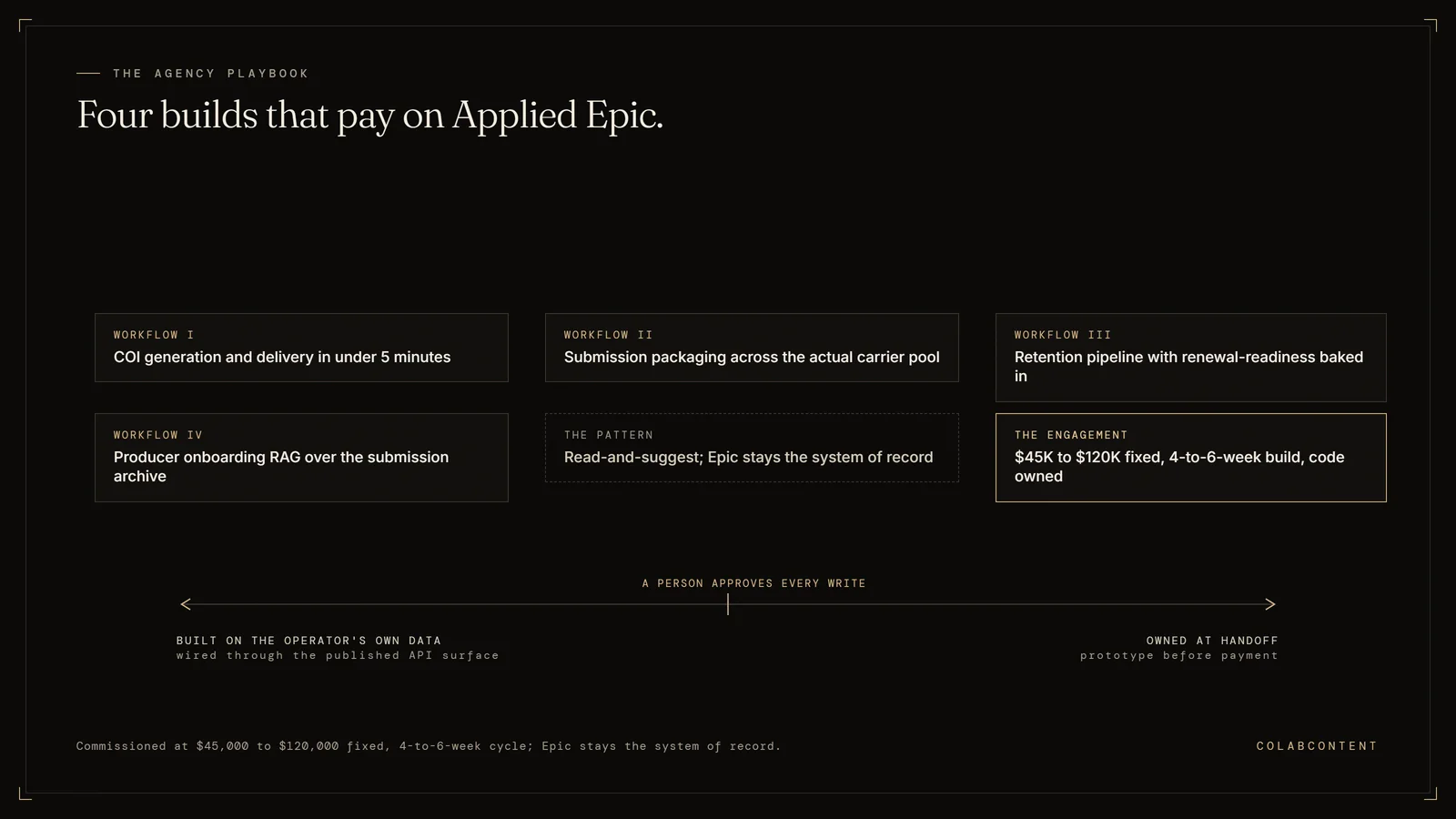
The four AI workflows ColabContent builds on Applied Epic for P and C agencies: certificate of insurance generation in under five minutes, submission packaging across the carrier pool, a renewal-readiness retention pipeline, and producer onboarding retrieval over the submission archive
Where the agency management system stops and the agency's own logic begins.

Written for the agency that already pays for Applied Epic. We do not sell an agency management system, we take no referral fee from anyone in the table below, and we will say plainly which agencies should stay exactly where they are.

For$2M to $50M independent agencies
StanceNeutral. We sell no AMS.
Bottom lineCrossover in month 39 at 25 seats
CostFree 45-minute diagnosis
Prices readAugust 27, 2026

The short answer.

If you are on Applied Epic and the reason you are reading this is money, the cheapest single move is probably not a different agency management system. It is a renegotiation, and the leverage you need for it is the three year total on this page rather than the per seat rate on your invoice. The reported bands for Applied Epic and AMS360 overlap so heavily that switching between the two enterprise platforms is a change of account team rather than a change of economics, and the genuinely cheaper options either cap out below your headcount or stop publishing a price at exactly the size you are.

If the reason is that Applied Epic does not do a thing your agency needs it to do, no other agency management system on this list will do that thing either, because they are all built for the same job: hold clients, policies, activities and documents, take carrier downloads, drive renewals, and keep an auditable record. They are good at that job. None of them was built to know how your agency packages a submission, how your producers actually hand off a renewal, or which accounts are about to leave. That is the gap, and the honest verdict splits three ways. Agencies under about ten seats should look at NowCerts, Jenesis or HawkSoft and should not commission anything. Agencies in the 15 to 50 seat band with a working AMS and one named workflow that burns service hours every week are the ones where the arithmetic on this page actually flips. And agencies whose commercial lines depth, carrier download breadth or integration stack genuinely lives inside Applied Epic should stay, and there is a whole section below arguing that case as strongly as we know how.

What Applied Epic actually does well.

Worth being precise about this, because a comparison page that treats the incumbent as a punching bag is useless to the person actually holding the contract.

Depth in commercial lines. This is the reason large agencies stay. Multi-location, multi-entity, complex schedules, layered programs and the accounting that goes with them are handled at a level the small-agency products in this roundup do not attempt. If your book is heavily commercial and complicated, that depth is not a feature list item, it is the reason the system works at all.

Carrier connectivity and the download. The unglamorous machinery that keeps policy data flowing in without a human retyping it is where an agency management system earns its licence, and it is the part every alternative comparison underweights. Before you take any switching decision seriously, the question to answer is not which product has better dashboards. It is which product carries your specific carrier mix cleanly, and the only people who can answer that are your carriers.

The integration ecosystem. Applied Systems is one of two companies with real gravity in this category, which means third-party vendors build to it first. That advantage is invisible until you leave, and then it is the whole project.

It is built to be configured. Applied Epic's own reviewers describe it as more efficient for larger businesses with in-house staff working on configuration. That is usually quoted as a criticism. Read it as a fit statement. An agency with a person whose actual job includes owning the system extracts a lot from that configurability. An agency where nobody owns it is paying for reach it cannot use.

Why agencies start looking for a way out.

Four patterns, in the order we hear them.

The price is unknowable and the renewal came in higher. Applied Systems publishes no rate card, which means there is nothing to argue against. Every quote is priced against the buyer rather than against a published list, and per seat billing means every producer and CSR you hire raises the bill without anyone deciding it should.

Value for money is the score that lags. Capterra rates Applied Epic 4.2 out of 5 overall across 142 reviews and 3.7 out of 5 on value for money across 90 reviews. A gap that size between what people think of the product and what they think of the price is the clearest signal in the public record for this category.

The thing the agency needs is not an AMS problem. Certificate turnaround, submission packaging across a carrier pool, renewal readiness, producer onboarding against the submission archive. None of those is a database problem, and no amount of licence spend changes that.

Configuration load nobody costed. Someone maintains the templates, the workflows, the security groups, the download mapping. It is rarely a full role and it is never zero, and because it sits inside a salary it never appears on a software line item. We deliberately leave that cost out of the model below so nobody can accuse the arithmetic of being padded, and you should add your own figure back in.

What you are actually paying

Every number on this page, with its source.

One vendor in this roundup publishes real self-serve tiers. One publishes its contract terms but not its price. The rest publish nothing at all, and two of their pricing URLs return HTTP 404. We label each figure VERIFIED when it was read off the named source directly on August 27, 2026, and REPORTED when it came from a third party that the vendor has not confirmed. Where two sources disagree we print both rather than picking the one that flatters the argument, and where we found nothing we say so and leave the claim out instead of filling it.

VendorSold byPublished or reported priceImplementation, one timeSource
Applied EpicQuote only, scales with users and modulesNo public pricing exists. Applied Systems operates no pricing page and no public rate card.Not published by the vendorVERIFIED absence, confirmed August 27, 2026
Applied Epic, ITQlick estimatePer month, scaling with usersFrom about $500 a month; about $1,500 a month at 10 users; $15,000 a month and up at 100 users; annual licence $18,000 to $24,000. Support and maintenance $1,000 to $5,000 a year. Customisation $5,000 to $20,000. First year total at 10 users, $34,000 to $69,000.$10,000 to $20,000, and up to $100,000 or more for large enterpriseREPORTED itqlick.com/applied-epic/pricing. The source labels its own figures as estimates because Applied Systems publishes nothing.
Applied Epic, QuoteSweep estimatePer user / month$150 to $200 and above. About $1,500 to $2,000 a month at 10 users; $4,000 to $5,000 and above at 25 users. Contracts described as usually multi-year.$15,000 to $30,000 at 10 users, up to $100,000 or more at enterprise scaleREPORTED quotesweep.com/blog/applied-epic-vs-ezlynx. A comparison and lead-generation property that does not disclose its methodology.
Applied Epic, buyer satisfactionNot a price4.2 out of 5 overall across 142 reviews. Value for money separately 3.7 out of 5 across 90 reviews.Not applicableVERIFIED capterra.com/p/70671/Applied-Epic/
AMS360 (Vertafore)Per user / monthNo public pricing. The product page offers a contact form and a phone number. REPORTED across aggregators in a wide $150 to $300 band, with recent sources clustering at $150 to $200 and above. The range is wide enough that we treat it as low confidence.Not published by any source we foundVERIFIED absence at vertafore.com/products/ams360, plus REPORTED ranges aggregated across Capterra, GetApp and comparison sites
EZLynxPer user, varying by products selectedNo flat rate. The vendor states on its own pricing page that cost is based on the number of users and the products you need, so there is no single flat rate. REPORTED starting cost commonly cited in the low $300s a month for the core system.REPORTED $1,000 to $5,000VERIFIED statement at ezlynx.com/pricing, plus REPORTED figures from quotesweep.com
HawkSoftFlat base fee plus per user / monthREPORTED at roughly $85 to $100 per user per month, with one source specifying $89 and another $94. The flat base fee is not published. Contract terms are VERIFIED: no long-term contract, leave with 30 days notice, no early-termination fee, no data-extraction fee, a flat conversion fee per database, and no scheduled price increases.Flat conversion fee per database. The amount is not published.VERIFIED terms at blog.hawksoft.com/guide-to-ams-pricing. hawksoft.com/pricing returned HTTP 404. Rates REPORTED across saasworthy.com, glovebox.io and agencymate.com.
NowCertsPer firm tiers, self-serveEssentials $99 a month for 1 user. Professional $149 for 2. Business $295 for up to 5. Enterprise, 50 or more users, custom quote. Aggregators also cite an extra-seat add-on around $39 to $45 a month, but they do not agree closely enough for us to print it.Not publishedREPORTED capterra.com/p/132779/NowCerts/pricing/. NowCerts' own pricing page did not render its pricing content for us, so this is unconfirmed at the vendor rather than a confirmed absence.
VerunaSalesforce-native, sold per userTwo sources give directly contradictory figures, one a flat monthly rate and one a per-user rate more than double it. Neither is confirmed at the vendor and veruna.com/pricing returned HTTP 404. We are printing neither number.Not publishedREPORTED and contested. Claim withheld.

The number we refuse to print, and why that matters

Two of the largest software directories list Applied Epic with a starting price of $1,000 as a one-time fee. That figure appears on both Capterra and Software Advice and we read it on both, directly, on August 27, 2026. We are not using it, and it is not an input to any model on this page.

Here is why, and the reason is a test rather than an opinion. The same starting-price field on Software Advice lists another agency management system, Eclipse, at one cent. A penny is not a price for agency management software; it is placeholder data in a field nobody validates. Once an instrument is proven wrong on a case you can check, its output on the cases you cannot check is worth nothing. So the $1,000 one-time figure for Applied Epic goes in the bin alongside it, even though it is technically true that both sites display it. If you see that number quoted as Applied Epic's price on another comparison page, you now know exactly how much thought went into it.

That is the single biggest difference between this page and the other Applied Epic comparisons you will find. Every one we checked either declines to give an Applied Epic number at all or repeats a directory placeholder without testing it.

Normalise it: what a 25 seat agency pays for a year of licence

Per-seat and per-firm pricing are not comparable until you fix the headcount. Hold one agency at 25 seats, take each vendor's published or reported rate at face value with nothing negotiated, and ask what a single year of licence costs.

Vendor and rate usedOne year, 25 seats, licence onlyHow it is calculated
HawkSoft at the reported $89 per seat$26,700, plus an unpublished base fee$89 x 25 x 12
HawkSoft at the reported $94 per seat$28,200, plus an unpublished base fee$94 x 25 x 12
Applied Epic at the low end of the reported band$45,000$150 x 25 x 12
AMS360 at the low end of the reported cluster$45,000$150 x 25 x 12
Applied Epic at $200 per seat$60,000$200 x 25 x 12
AMS360 at $200 per seat$60,000$200 x 25 x 12
NowCertsNot published at this sizePublished tiers cap at 5 users. Business is $295 a month, which is $3,540 a year for up to 5 seats. At 25 seats it is a custom quote.
EZLynxNot published at this sizeThe vendor states there is no flat rate. The reported low $300s a month is a small-agency starting point, not a 25 seat figure.
VerunaNot publishedSources contradict each other and the vendor pricing page returns 404

Read that table honestly and it says two things a page selling you something would not print. First, HawkSoft is genuinely cheaper on the licence line at this size, by a margin that is real even after you add a base fee nobody publishes. If pure licence cost is your only concern, HawkSoft is the answer and you can stop reading. Second, the two options everyone assumes are the cheap ones, NowCerts and EZLynx, are not evaluable at 25 seats at all, because both stop publishing exactly where a mid-market agency starts. The savings a mid-market agency actually finds are not in the licence line. They are in what happens over three and five years, and in the work the AMS was never built to do.

The three year and five year model

Three components: the licence at the reported rate, the one-time implementation fee at the size band, and annual support. The model uses $150 per user per month throughout, which is the bottom of the reported band, so it understates Applied Epic rather than overstating it. It carries no renewal escalator and no internal administration cost, both of which would push the Applied Epic side higher and neither of which we can source, so this is a floor on real spend rather than a ceiling. Against it, a commissioned build at a one-time fixed fee with maintenance modelled at 15 percent of build price per year.

Two labelled assumptions, stated before the table rather than after it. The 15 percent maintenance rate is a software industry heuristic, not a ColabContent contract term, and your actual figure is set in a quote. The matching of agency size to build price, $45,000 at 15 seats, $110,000 at 25, $180,000 at 50, is our own modelling choice for the worked examples and not a rate card. The fixed fee is scoped after the diagnosis call. Both dials are editable in the calculator below.

Scenario3 year total5 year totalCrossover
15 seats: Applied Epic at $150, $15,000 implementation, $1,000 a year support$99,000$155,000Month 17
15 seats: commissioned build at $45,000, 15% a year maintenance$65,250$78,750
25 seats: Applied Epic at $150, $15,000 implementation, $1,000 a year support$153,000$245,000Month 39
25 seats: commissioned build at $110,000, 15% a year maintenance$159,500$192,500
50 seats: Applied Epic at $150, $30,000 implementation, $5,000 a year support$315,000$505,000Month 27
50 seats: commissioned build at $180,000, 15% a year maintenance$261,000$315,000

One more labelled assumption, because it only affects the last pair of rows: the $5,000 a year support figure at 50 seats is the top of the reported $1,000 to $5,000 range and we chose it on the reasoning that a larger deployment plausibly needs more support. That is a judgement, not a source, and it moves the 50 seat five year total by $20,000 either way.

The row we are obliged to point at is the middle pair. At 25 seats, using the conservative Applied Epic rate, a $110,000 build costs $6,500 more than staying on Applied Epic across three years. It does not pay for itself until month 39. Anyone who tells you a custom build is always cheaper has not done this arithmetic. Back-solve it and a build only beats the conservative 25 seat Applied Epic scenario at three years if it is priced below about $105,500, and at five years if it is priced below $140,000. Against a $200 per seat Applied Epic contract with midpoint implementation and support, those thresholds rise to about $145,900 and about $192,900, which is most of the range. The higher your real Applied Epic rate, the wider the door.

The crossover

Where the two lines meet.

Cumulative spend for a 25 seat independent agency, five years out. Applied Epic at $150 per user per month, the bottom of the reported band, with $15,000 of implementation paid at year zero and $1,000 a year of support. Against it, a commissioned build at $110,000 paid once at year zero, with maintenance modelled at 15 percent of build price a year. Every figure in the chart is a row from the table above.

Cumulative five year cost: an Applied Epic subscription versus a one time commissioned build at 25 seats A line chart of cumulative spend for a 25 seat independent insurance agency over five years. The Applied Epic line starts at $15,000 at year zero for implementation and rises steadily to $61,000 at year one, $107,000 at year two, $153,000 at year three, $199,000 at year four and $245,000 at year five. The commissioned build line starts at $110,000 at year zero and rises gently by $16,500 of maintenance each year to $126,500, $143,000, $159,500, $176,000 and $192,500. The build line is above the subscription line for the first three years, meaning staying on Applied Epic is genuinely cheaper over that period. The two lines cross in month 39, at about $163,100 of cumulative spend on each path, after which the subscription line is permanently above the build line. By year five the gap is $52,500 in the build's favour. $0 $50K $100K $150K $200K $250K Year 0 Year 1 Year 2 Year 3 Year 4 Year 5 Crossover, month 39 Applied Epic $245,000 Owned build $192,500 Applied Epic, 25 seats at $150, plus implementation and support Commissioned build, $110,000 once, 15% maintenance

Look at the first three years of that chart, because most vendor comparison charts hide exactly this part. The build line starts far above the subscription line and stays above it until month 39. For a 25 seat agency, staying on Applied Epic is the cheaper decision for more than three years, and if your planning horizon is shorter than that, the arithmetic says stay. That is the honest reading and we are not going to bury it below a call-to-action.

After month 39 the gap widens every year, because one line has a slope and the other is nearly flat. At year five the difference is $52,500, and nothing in the model makes the subscription line bend back down. Year six on Applied Epic starts again at zero progress; year six on an owned system costs $16,500.

Change the seat count and the whole picture moves. At 15 seats against a $45,000 build the crossover lands in month 17. At 50 seats against a $180,000 build it lands in month 27, because per-seat cost scales and a build price does not scale the same way. Below about ten seats there is no crossover at all against a $99 to $295 a month product, and you should not commission anything. Run your own numbers below.

Your agency, your numbers

The Applied Epic total cost calculator.

Every default below is a figure from the table above, and every one of them is editable, because the defaults are a market estimate and your invoice is a fact. Nothing is submitted anywhere. There is no email gate, no external request, and no stored value. The arithmetic runs in your browser and stops there. If your inputs make the build lose, the tool says so in plain language rather than quietly hiding the result.

Producers, CSRs, accounting, management. Everyone holding a licence.
Reported $150 to $200 and above. Applied Systems publishes nothing. Use your invoice.
Reported $10K to $30K at small and mid size, $100K and up at enterprise scale. Enter 0 if already paid.
Reported $1,000 to $5,000 a year. Default is the low end.
Modelling assumption, not an Applied Systems published figure. Defaults to 0 so the headline table reproduces exactly. Set it to what your renewals actually do.
Both totals are calculated over this horizon.
ColabContent fixed fee range, $45,000 to $180,000, set after the diagnosis call.
Software industry heuristic, not a ColabContent contract term. Replace it with a real quote before deciding.
The roundup

Seven options, in the order we would look at them.

One note on the roster before the list. The published Applied Epic alternatives guides we reviewed name between fifteen and twenty-two products each, which sounds thorough and is the opposite of useful. A list of twenty-two includes an electronic signing utility, a licensing compliance tool and several products for managing general agents, none of which is a replacement for the system that runs your book. The list below is short on purpose. It covers the systems Applied Epic actually competes against for an independent retail agency, in the order an agency holding an Epic contract would sensibly evaluate them.

1. AMS360 by Vertafore

What it is. The direct enterprise peer, and the only other agency management system with comparable gravity in independent agencies. Vertafore is to Applied Systems what NetDocuments is to iManage in legal: the other one.

Price. Vertafore publishes none. Its AMS360 product page offers a contact form and a phone number, which we confirmed directly on August 27, 2026. Third-party sources put it in a REPORTED $150 to $300 per user per month band, with the more recent ones clustering at $150 to $200 and above. That range is wide enough that we treat it as low confidence rather than as a figure.

Best for. Agencies that want an enterprise platform with a different account team, a different roadmap and a different integration bench, and that are not trying to change the economics of the purchase.

Where it falls short. It is the same shape of purchase. Per seat, forever, quote-based, with no published rate card to argue against. If the reason you are leaving Applied Epic is the per-seat model itself, this move does not address it. The reported ranges overlap so heavily that switching for price alone is a coin flip you pay a migration to enter.

Verdict. The most credible switch on the list and the one least likely to change your five year number.

2. HawkSoft

What it is. A well-regarded agency management system aimed squarely at the independent mid-market, and the vendor in this research that behaves the most like a company with nothing to hide.

Price. REPORTED at roughly $85 to $100 per user per month, with one source specifying $89 and another $94, on top of a flat base fee that is not published anywhere. hawksoft.com/pricing returned HTTP 404 when we checked it. The VERIFIED part is the contract, and it is unusual enough to quote: HawkSoft's own blog states no long-term contracts, leave with 30 days notice, no early-termination fee, no data-extraction fee, a flat conversion fee per database, and no scheduled price increases.

Best for. Agencies in roughly the 10 to 50 seat range whose book is personal lines heavy or moderately commercial, and any agency that has been burned by an exit negotiation and wants terms it can read before the call.

Where it falls short. The base fee is unpublished, so the reported per-seat rate is a floor rather than a total. And it does not attempt the commercial-lines depth Applied Epic has. If your book is complex commercial, this is a downgrade in capability that you would be taking on purpose.

Verdict. The best genuine licence saving at mid-market size, and the only vendor here whose exit terms are a competitive advantage rather than a secret.

3. EZLynx

What it is. The frequently-cited cheaper and faster-to-implement alternative, strong in personal lines rating and built-in CRM. The thing every comparison page leaves out: it is owned by Applied Systems, the same company that owns Applied Epic.

Price. No flat rate. EZLynx states on its own pricing page, VERIFIED August 27, 2026, that pricing is based on the number of users at your agency and the products you need, so there is no single flat rate. Third-party sources REPORTED a starting cost commonly cited in the low $300s a month for the core system, with implementation of $1,000 to $5,000. Those are small-agency figures and they do not tell you anything about a 25 seat quote.

Best for. Personal-lines-weighted agencies that want rating and management in one place and are moving down in complexity on purpose.

Where it falls short. Two things. It is a step down in commercial lines capability from Applied Epic, which is fine if that is the trade you meant to make and expensive if it is not. And if the reason you are leaving Applied Epic is the vendor relationship, the pricing opacity or the renewal behaviour rather than the product, moving to EZLynx moves you to a different product from the same company. We have a full side-by-side of the two at Applied Epic vs EZLynx, and a dedicated roundup at EZLynx alternatives.

Verdict. A real option for the right book. Not an escape from Applied Systems.

4. NowCerts

What it is. A cloud agency management system, and the only product in this category that will tell you a price on a web page without a sales call.

Price. REPORTED from Capterra's pricing listing, fetched August 27, 2026: Essentials $99 a month for one user, Professional $149 for two, Business $295 for up to five, and an Enterprise tier for 50 or more users that reverts to a custom quote. We are labelling these reported rather than verified because NowCerts' own pricing page did not render its pricing content for us on the day, which is an unconfirmed source rather than a confirmed absence. Aggregators also cite an additional-seat add-on around $39 to $45 a month; they do not agree closely enough for us to print a figure.

Best for. Agencies under about ten people, and new agencies where the difference between $295 a month and a quote-based enterprise contract is the difference between viable and not.

Where it falls short. The published tiers stop at five users. There is a large, unpriced gap between Business and Enterprise where most agencies reading this page actually sit, and once you are in that gap you are negotiating without a rate card exactly as you are with Applied Systems.

Verdict. The honest answer to "what is the cheapest real alternative," with a ceiling you will hit if you are growing.

5. Veruna

What it is. An agency management system built natively on Salesforce, listed on the Salesforce AppExchange, which makes it structurally different from everything else here: you inherit the Salesforce platform, its extensibility and its ecosystem along with the AMS.

Price. We are not printing one. Two sources give directly contradictory figures, one a flat monthly rate and one a per-user rate more than double it, neither is confirmed at the vendor, and veruna.com/pricing returned HTTP 404 on August 27, 2026. A flat monthly rate at that level for a Salesforce-platform enterprise product fails the same sanity test as the directory placeholder data discussed above, so we treat both numbers as unusable rather than averaging them into something that looks authoritative.

Best for. Agencies that already run Salesforce, have Salesforce skills in the building, and want their AMS inside that platform rather than beside it.

Where it falls short. Platform-native means platform-dependent, and Salesforce licensing is its own cost centre with its own escalation behaviour. Get a written quote covering both layers before you compare it to anything on this page.

Verdict. Real product, genuinely different architecture, and not priceable from public information today.

6. The smaller field: Jenesis, Agency Matrix, QQCatalyst, NextAgency, BindHQ and Better Agency

What they are. Real products that turn up on nearly every published list of Applied Epic alternatives. Jenesis and Agency Matrix serve small agencies. QQCatalyst is a long-standing option in the same tier. NextAgency leans benefits. BindHQ is built for managing general agents and wholesale brokers rather than retail agencies. Better Agency bundles marketing automation with the AMS.

Price. None of these was priced to a source we could stand behind in this research pass, and we are not going to estimate them. Get a quote directly.

Best for. Agencies materially smaller than the buyer this page is written for, or agencies in an adjacent segment. BindHQ in particular is a genuinely good answer to a different question.

Where they fall short. As Applied Epic replacements for a 15 to 50 seat retail agency, they are a change of tier rather than a change of vendor. That can be the right decision, and it should be a decision rather than a surprise discovered in month four.

Verdict. Named because they are real. Not compared in depth because they are not competing for the same agency.

7. A commissioned build you own

What it is. Not a drop-in replacement for the download and the policy record. A custom system built for the workflow no agency management system vendor covers, owned by the agency at handoff. In practice that means certificate generation that turns a request around in minutes instead of a day, submission packaging assembled across your carrier pool, a renewal-readiness pipeline that flags the accounts about to leave before they leave, and retrieval over your submission archive that makes a new producer useful in week two instead of month four.

Price. A fixed fee of $45,000 to $180,000, set after a free 45-minute diagnosis call and after the integration depth is named, paid in two installments at build start and handoff. A working prototype runs on your real data in seven to ten days before any payment. Production build is five to seven weeks. The agency owns the code, prompts, models and pipeline at handoff and runs it in its own cloud tenant.

Best for. Agencies in the 15 to 50 seat band with an AMS that basically works and a named workflow that burns service hours every week.

Where it falls short. It is a bigger single cheque, it needs a tighter scope than buying software does, and as the table above shows it can lose the cost argument outright at the top of the range. It also does not, on its own, replace carrier downloads or the system of record. Whether it can is the question in the next section, and it is the honest one.

Verdict. The option nobody in the table above will show you, and the only one where the bill stops going up.

The question the model cannot answer

Does a build replace Applied Epic, or sit beside it?

This is the single biggest variable in your own version of the arithmetic above, and it is the one place where a page like this can quietly mislead. So, plainly.

The model on this page prices the full-replacement case: Applied Epic goes away, the build carries the load, and the subscription line goes to zero. Whether that is available to your agency depends almost entirely on one thing, which is whether your carrier mix can deliver downloads into a system your agency owns rather than into a vendor agency management system. We are not going to answer that from a research desk. We found no published statement from any source that settles it generally, and anyone who tells you the general answer confidently has not checked your carriers.

What we can tell you is how the two cases differ, so you can read the chart correctly. If the answer for your carrier mix is yes, the model above is the model, and the crossover is the crossover. If the answer is no, the build sits beside Applied Epic, the subscription line does not go to zero, and the comparison stops being either-or. In that case what the model tells you is the size of the recurring line you are choosing to keep, which is still the most useful number to have in front of you at renewal, and the build has to justify itself on the hours it returns rather than on the licence it eliminates.

For most of the agencies we talk to, the answer is beside rather than instead of, and the honest version of the offer is: keep the system of record, build the thing it was never going to do. We check the carrier question on the diagnosis call, before anything is scoped, and if the answer is no we say so on that call rather than in month three.

The ownership case

Nine arguments for owning it instead.

Each of these is either arithmetic you can check on this page or a structural fact about the two models. Where an argument does not honestly apply to your agency, the section after this one says so.

One. The math, restated, including the part where it loses. A subscription never ends. A 25 seat agency at the conservative rate pays $153,000 over three years and $245,000 over five, and year six starts at zero progress. A $110,000 build costs $159,500 over the same three years, which is $6,500 worse, and $192,500 over five, which is $52,500 better. The lines cross in month 39. Before that point the subscription is the right financial decision and we will tell you so. After it, the gap widens every year because one curve has a slope and the other is nearly flat. That is the whole argument, and it is the reason the chart is on this page rather than in a sales deck.

Two. Per seat pricing taxes growth. Every producer and every CSR you hire raises the bill by the same rate whether or not that person writes proportional business in year one. At $150 a seat, five new hires is $9,000 a year, added automatically, forever, with no decision made by anyone. An owned system has no marginal seat cost at all, which means the hiring decision stops carrying a software decision inside it. For an agency in an acquisition posture, folding a five-person book into your stack costs nothing rather than costing a new licence line.

Three. Asset versus expense. A subscription is rent and it leaves nothing behind. A commissioned system is a piece of the agency: transferable, ownable, and relevant in a perpetuation or sale conversation in a way a software contract never is. For a principal thinking about a five to ten year horizon, that difference is not cosmetic. It is the difference between a line on the expense schedule and a thing that appears on the other side of the ledger.

Four. Built around your workflow, not the median agency's. Every product in the roundup above is calibrated against the average customer in its category, which means you pay for the full bundle and adapt your process to the fraction of it your agency actually uses. A commissioned system starts from how your agency packages a submission, how your renewals are actually worked, and which fields your CSRs really fill in. Nobody has to be retrained into somebody else's assumptions about how an agency runs.

Five. What the AI line costs, and why we will not quote you one. Applied Systems publishes no pricing for anything, and that includes whatever it charges for AI capability. We found no published AI rate card for Applied Epic, AMS360, EZLynx or HawkSoft in this research pass, so we are not going to tell you what that line costs on any of them, and you should distrust any page that does. What is structurally true without a number: on a per-seat platform, every new capability arrives priced against your headcount, and you cannot benchmark the quote because nobody publishes a comparable. In a commissioned build there is no separate AI licence, because the AI is the system rather than a module on top of it, and adding a user costs nothing.

Six. Unlimited seats. Producers, CSRs, accounting, seasonal help during renewal season, a virtual assistant, and where appropriate the insured. Zero marginal cost per person changes the question from who needs a licence to who needs access, which is a better question and usually a different answer.

Seven. Data ownership, and the question nobody will answer. Here is a genuine gap in the public record, stated as a gap. We could not find any published statement from Applied Systems about what extracting your data from Applied Epic involves: what format, what cost, what timeline, what is included and what is not. None of the published comparison guides answers it either. That silence is a planning fact whether or not it is a policy. An agency running a system it owns, in its own cloud tenant, never has to find out the answer under time pressure, because there is no counterparty to ask.

Eight. Terms you can read, versus terms you cannot. We are not going to hand you a sunset story about Applied Systems, because we did not find one in this research pass and inventing one would be easy and dishonest. The sourced contrast is enough on its own. HawkSoft publishes, on its own site, that it has no long-term contracts, that you can leave with 30 days notice, that there is no early-termination fee and no data-extraction fee, and that it does not run scheduled price increases. We found no equivalent published commitment from any other vendor in this roundup. One third-party source describes Applied Epic contracts as usually multi-year, which we are reporting as a claim rather than a fact because the source does not disclose how it knows. When a vendor publishes no price, no rate card and no standard term, every change to the commercial relationship is a negotiation you enter with less information than the person on the other side of it.

Nine. Change speed. A change request to your own system is a scoping conversation and a deployment. A change request to a vendor is a feature request in a queue behind every other agency's, with no committed date and no obligation. When the thing you need changed is the thing that makes your agency different from the one down the street, the queue is not an acceptable answer.

What we can actually prove

The list of arguments above is worth exactly as much as the evidence behind the firm making it, so here is ours, with nothing rounded up and nothing borrowed. Jim Glaser Law is our nameable reference and the principal takes reference calls; you can ask him directly what we built, whether it works, and whether he would do it again. Across our practice the voice systems we have built and run have handled more than 6,000 AI-handled calls. The LELF platform is the fullest example of what commissioning looks like when it carries a firm's real operational load rather than a demo. And we have delivered more than forty commissions across verticals.

Now the limit of that evidence, because it matters on this page specifically. Our nameable reference is a law firm, not an insurance agency. We have not decommissioned an Applied Epic tenant for anyone, and we are not going to imply otherwise by leaving it unsaid. What the evidence supports is a specific claim: we can build and run systems that carry real operational volume in a professional services business and hold up under scrutiny. What it does not support is a case study with your logo on it, and if that is what you need before you would move, say so on the call and we will tell you honestly whether we are the right first vendor for you.

The honesty section

Who should stay on Applied Epic.

Six situations where every argument in the previous section fails, and where we would tell you to stay put on a call.

Agencies under about ten seats. The arithmetic simply does not work and it is not close. NowCerts Business is a reported $295 a month for up to five users, which is $3,540 a year and $17,700 over five years. The cheapest build we would scope is $45,000, which is $78,750 over five years with maintenance. There is no crossover in that comparison at any horizon a business plans for. If you are that size, price NowCerts, Jenesis and HawkSoft and spend the energy somewhere else.

Agencies whose Applied Epic contract is genuinely cheap. If your invoice is nearer the ITQlick $500 a month starting figure than a per-seat quote, or if you signed a favourable multi-year deal that still has room in it, you have a good contract. The three year totals on this page are your leverage at renewal, not your reason to leave. Take them into the conversation and defend what you have.

Agencies with deep, complex commercial lines. Applied Epic's depth here is real and every cheaper product in the roundup is a step down. If multi-entity structures, layered programs and complex schedules are what your book actually is, the switching cost is not the licence, it is the risk of discovering in month four which capability you had been relying on without noticing.

Agencies that need something working next quarter. A commissioned build ships a prototype in seven to ten days and production in five to seven weeks, and an AMS migration on top of that runs three to six months. If the deadline is real and near, buying is faster than building and it is not close.

Agencies where nobody will own the system. An owned build needs a named person who cares about it, even at a light touch. If your agency has no one who owns the AMS today, adding a second system you own is not an upgrade, it is an orphan waiting to happen, and you are better off renting from someone whose job it is to keep it alive.

Agencies whose constraint is not the AMS at all. If the hours are leaking somewhere the agency management system was never involved in, changing agency management systems is motion rather than progress. A meaningful share of the diagnosis calls we run end with us recommending the agency keep what it has, and this is the most common reason.

Decision tree

Six questions, in order, with stop points.

1. Is your agency under about ten seats? If yes, stop here. Price NowCerts, Jenesis and HawkSoft against your current contract. No build we would quote returns its cost at your volume, and we would tell you that on a call rather than take the engagement. If no, continue.

2. Do you know your actual per seat rate, your renewal terms and your notice period? If no, stop and go find the order form. Every decision after this one depends on it, and the reported ranges on this page are a substitute for that document rather than a replacement for it. If yes, continue.

3. Run your numbers in the calculator above. Is the crossover inside your planning horizon? If no, stop. At a $110,000 build and 25 seats the crossover is month 39, and if you are not planning past three years the subscription is the correct financial answer today. Renegotiate at renewal and revisit. If yes, continue.

4. Is the thing that actually costs you money an AMS problem? If yes, meaning the record itself, the downloads, the accounting, the audit trail, then a different agency management system may genuinely help and AMS360 or HawkSoft is where to look. Stop here and go price them. If no, continue.

5. Can you name the workflow in one sentence, with a rough hour or dollar figure attached? Certificates, submissions, renewals, onboarding, claims follow-up. If no, stop, and spend two weeks measuring before anyone spends money. Every failed build we have seen started with an unnamed constraint. If yes, continue.

6. Is the budget runway for a $45,000 to $180,000 fixed fee real this quarter, and is a principal willing to spend 45 minutes on the diagnosis? If no, park it and revisit at renewal. If yes, that call is the next step, and a meaningful share of them end with us telling an agency to stay exactly where it is.

Next step

Book the 45-minute diagnosis.

Bring your Applied Epic invoice and one sentence describing the workflow that leaks. You leave with the constraint written down either way, and plenty of these calls end with us telling an agency to stay where it is.

Free · 45 minutes
Under NDA
Principal to principal
No follow-up unless asked
Migration reality

What leaving Applied Epic actually involves.

None of the published Applied Epic comparisons answers this with specifics, which is strange, because it is the question that decides whether an agency ever acts on any of the rest. Here is the honest shape of it. The timelines below are our own scoping ranges for an engagement of this type, stated as estimates rather than dressed up as research, and no vendor publishes a comparable figure.

You are not moving clients and policies. You are moving five things. The client and policy records are the easy part, and they are the part every vendor's migration page talks about. The other four are where projects overrun. Activity and note history, which is your evidence of what was said and when, and which some target systems flatten or truncate. Attached documents, which is a volume problem and a naming problem at the same time. Suspense, tasks and workflow configuration, which encodes how your agency actually runs and which nobody wrote down. And the carrier download configuration, which is not data at all; it is a set of relationships that has to be re-established with each carrier rather than copied across.

Phase one: export and inventory. Before anything moves, someone answers what is actually in there and what of it matters. The deliverable that matters at the end of this phase is a reconciliation count: records out equals records in, line of business by line of business, with the exceptions listed rather than rounded away. This is also the phase where you find out what data extraction from Applied Epic actually involves, which, as noted above, nobody publishes in advance. Ask your account team before you need the answer.

Phase two: parallel run. Both systems live. New work goes into the new system, the old one goes read only, and nothing is switched off. Run this through at least one full renewal cycle, because the gaps in an agency management system migration do not surface when you look for them, they surface when a CSR needs a 2021 endorsement on a Thursday afternoon during a claim. An agency that skips the parallel run to save six weeks usually spends the saving twice.

Phase three: decommission. Only after the parallel run has produced no unresolved exceptions. Read the notice provisions in your order form before you schedule this, because a contract that auto-renews will renew during a migration if nobody sends the letter, and that is the most expensive administrative oversight available in this category.

A realistic total is three to six months from decision to switching the old system off. The largest driver of that number is not agency size. It is your carrier mix, because the download re-establishment runs at the speed of the slowest carrier and none of them work for you.

What we do and do not do here. We have not run an Applied Epic decommissioning, and we are not going to imply otherwise. What we build is the workflow layer that sits on top of whichever system you land on, which is a different job and one we have evidence for. If your project needs a migration partner, that is a specialist engagement, and the agency management system vendor you are moving to will usually name two or three.

The option most agencies do not consider. You do not have to leave to fix the problem. In a large share of the cases we see, the AMS is fine, the licence is defensible, and the leak is in a workflow that sits beside it: certificates, submissions, renewal readiness, onboarding. That path keeps Applied Epic, keeps the downloads, keeps the ten years of history, and builds the missing piece against it. No migration, no parallel run, no decommissioning letter. The Applied Epic AI integration playbook documents what that looks like from the build side.

Deep dive

The dimensions the price table cannot show.

Six dimensions, side by side.

Price transparency. NowCerts publishes self-serve tiers. Everybody else in this roundup requires a sales conversation, and two of their pricing URLs return 404. Transparency is not the same as cheapness, but an undisclosed price lets the seller quote against the buyer rather than against the work, and it means you cannot benchmark your own renewal.

Contract readability. HawkSoft publishes its exit terms in plain language on its own site. Nobody else on this list does. When two products are close on function, the one whose paper you can read before the call is the safer purchase, and the difference costs nothing to verify.

Cost slope. Every subscription here rises with headcount. A commissioned build is a one-time fee plus a flat maintenance line. The slope, not the starting point, is what decides a five year comparison, and it is the reason the crossover chart matters more than the per-seat rate.

Carrier connectivity. The dimension no comparison table shows and the one that decides most switching decisions. Your carrier mix is specific to you and the only reliable source on it is your carriers. Ask them before you shortlist, not after.

Ownership at exit. Every vendor here retains the code, the structure and the pipeline. A commission transfers all three at handoff, running in the agency's own cloud tenant. That is the difference between an export and a handover.

Commercial lines depth. Applied Epic and AMS360 sit at the top of this axis and the cheaper products sit meaningfully below it. If your book is complex commercial, cost comparisons against small-agency products are comparing different things, and the licence saving is not the whole trade.

When to pick which, in one paragraph each.

Stay on Applied Epic if your book is complex commercial, your rate is at or below the bottom of the reported band, or you need certainty next quarter. Take the three year total from this page into the renewal conversation as leverage rather than as a reason to leave.

Move to AMS360 if you want an enterprise peer with a different account team and roadmap, and you accept that the economics are broadly the same shape and the migration is real.

Move to HawkSoft if you are in the 10 to 50 seat range, your book is personal lines heavy or moderately commercial, and you want a real licence saving plus exit terms you can read today.

Move to EZLynx if personal lines rating is the centre of your operation and you are deliberately trading commercial depth for simplicity. Know that you are staying inside Applied Systems.

Move to NowCerts or the smaller field if you are under about ten seats. At that size the published tiers beat everything else on this page and no build competes.

Commission a build if the AMS is fine, the constraint is a named workflow, and the crossover in the calculator lands inside your planning horizon. Most agencies in that position keep Applied Epic and build beside it.

Why this page is written by someone who does not sell an AMS.

Worth saying plainly, because it changes how you should read everything above. Of the Applied Epic comparisons you are most likely to land on, the software directories monetise through vendor listings and lead routing, one of the most polished is a lead-generation page for its author's own orchestration product that names zero real prices including its own, and none of them publishes a number for Applied Epic that survives a sanity check. That is not a conspiracy, it is a business model, and it explains why so few of these guides will print a price.

ColabContent sells commissioned AI builds. We do not sell an agency management system, we take no referral fee from anyone in the roundup, and we have no reason to steer you toward or away from any of them. That does not make us neutral about the conclusion, obviously, and the whole point of publishing the arithmetic and every assumption behind it is that you can see exactly where our interest starts affecting the numbers. It does mean that when this page says HawkSoft is genuinely cheaper at 25 seats, or that a $110,000 build loses to Applied Epic across three years, nothing commercial is pulling in the other direction.

What a build on Applied Epic actually looks like.

Four workflows come up repeatedly, and they share a property: none of them is a record-keeping problem, which is why the agency management system does not touch them.

Certificate generation. Turning a certificate request around in minutes rather than by end of day, drafted from the policy record and the prior certificate history, with a human approving rather than a machine issuing. This is the workflow with the clearest hour figure attached and the one your CSRs feel every single day.

Submission packaging across the carrier pool. Assembling a submission once and shaping it to each carrier's appetite and format, instead of a producer rebuilding the same package six times. The value here is not typing speed, it is how many carriers a submission actually reaches.

A renewal-readiness pipeline. Surfacing the accounts that are about to leave before they leave, from the signals already sitting in your activity history rather than from a report someone remembers to run. Retention is the only growth lever that does not require new business.

Producer onboarding over the submission archive. Retrieval that lets a new producer answer a question from ten years of your agency's own submissions and correspondence, which is the difference between useful in week two and useful in month four.

The integration posture is read and suggest by default, human in the loop, relaxing only after a sustained period of held output quality. Integration happens at the API layer as the primary route, with a database layer as a last resort requiring explicit approval. We do not bypass the system of record, and where an off-the-shelf product already does a job well we will point you at it rather than build a worse version.

Questions

The eight questions Applied Epic buyers actually search.

What does Applied Epic actually cost per user?

Applied Systems does not publish a price, and we confirmed that directly: there is no pricing page and no public rate card anywhere on the vendor's site as of August 27, 2026. Two third-party sources publish estimates and they do not agree on shape. ITQlick, which labels its own numbers as estimates, puts Applied Epic at roughly $500 a month to start, about $1,500 a month for ten users, $15,000 a month and up at a hundred users, an annual licence of $18,000 to $24,000, implementation of $10,000 to $20,000 and up to $100,000 or more for large enterprise deployments, support and maintenance of $1,000 to $5,000 a year, and a first-year total of $34,000 to $69,000 for a ten user agency. QuoteSweep, a comparison property that does not disclose its methodology, gives a per-seat figure instead: $150 to $200 or more per user per month, with implementation of $15,000 to $30,000 at ten users, and contracts it describes as usually multi-year. Both are reported figures, not verified ones. Every model on this page uses $150 per user per month, the bottom of the reported band, so the arithmetic understates Applied Epic rather than overstating it. One number is verified and worth knowing: Capterra rates Applied Epic 4.2 out of 5 overall across 142 reviews, but value for money separately at 3.7 out of 5 across 90 reviews.

What are the best Applied Epic alternatives for an independent agency?

Six real ones, plus the option no agency management system vendor will show you. AMS360 from Vertafore is the direct enterprise peer and the switch most Epic agencies evaluate first. HawkSoft is the mid-market option and the only vendor in this research that publishes its contract terms in plain language. EZLynx is frequently named as the cheaper and faster alternative, and it is owned by the same parent company as Applied Epic, which matters when the reason you are leaving is the vendor relationship rather than the software. NowCerts is the only one publishing self-serve tiers, reported at $99, $149 and $295 a month, and it is the defensible answer to the cheapest-alternative question with the caveat that its enterprise tier above 50 users reverts to a custom quote. Veruna is a real Salesforce-native product whose published pricing contradicts itself across sources, so we name it and print no number. Below those sit Jenesis, Agency Matrix, QQCatalyst, NextAgency, BindHQ and Better Agency, which are real but serve smaller agencies or adjacent segments. The seventh option is a commissioned system the agency owns outright at a one time fixed fee, which is the one every alternatives listicle in this category leaves out.

Applied Epic vs AMS360: is either one actually cheaper?

Neither will tell you, and on the evidence available they land in the same band. Vertafore publishes no pricing for AMS360; its product page offers a contact form and a phone number, which we confirmed directly. Applied Systems publishes nothing for Epic either. The reported ranges overlap almost entirely: AMS360 is cited across aggregators in a wide $150 to $300 per user per month band with recent sources clustering at $150 to $200 and above, and Applied Epic is reported at $150 to $200 or more. That overlap is wider than the difference, which means a switch between them is not a pricing decision, it is a negotiation with a different account team. If you are running that comparison seriously, the two questions that actually separate them are which one your carrier download and rating mix works better on today, and which one your downstream vendors integrate with more deeply. Neither question is answered by a per-seat rate, and both are answerable in a week by asking your own carriers and vendors rather than either sales team.

What is the cheapest real alternative to Applied Epic?

NowCerts, and it is the only one in the category that will tell you a price without a sales call. Its tiers are reported at $99 a month for Essentials with one user, $149 for Professional with two, and $295 for Business with up to five, with an Enterprise tier for 50 or more users that reverts to a custom quote. Those figures come from Capterra's pricing listing, fetched August 27, 2026; NowCerts' own pricing page did not render its pricing content for us, so we are labelling the numbers as reported at the aggregator rather than confirmed at the vendor. Aggregators also cite an additional-seat add-on somewhere around $39 to $45 a month, but they do not agree closely enough for us to print it as a figure. The important caveat is the ceiling rather than the floor. Those published tiers cover up to five users. A 25 seat agency is in custom-quote territory at NowCerts exactly as it is at Applied Systems, and the published price advantage does not survive the jump. HawkSoft is the cheapest option that is actually evaluable at mid-market size, reported at roughly $85 to $100 per user per month plus a flat base fee the vendor does not publish.

Does Applied Epic lock agencies into a long-term contract?

We could not find a published contract term for Applied Epic from Applied Systems itself, and we are stating that as a gap rather than dressing it up as a finding. One third-party comparison property describes Applied Epic contracts as usually multi-year; that is a reported claim with no disclosed methodology behind it and we are not treating it as established. What is verified is the contrast. HawkSoft publishes its terms openly on its own blog: no long-term contract, leave with 30 days notice, no early-termination fee, no data-extraction fee, a flat conversion fee per database, and no scheduled price increases. We found no equivalent published commitment from any other vendor in this roundup, Applied Systems included. When one vendor in a category will commit its exit terms to a public page and the rest will not, that is a real difference and it is worth more than a feature comparison. The document that settles this for your agency is your own order form, and it is the first thing to put on the table at renewal.

How long does it take to migrate off Applied Epic, and can I get my data out?

On the second half of that question, honestly: we do not know, and neither does any published guide we could find. We found no published statement from Applied Systems about what data extraction from Applied Epic involves, what format it arrives in, what it costs, or how long it takes. That silence is itself the answer to plan around, and it is worth one phone call to your account team before you need the answer under time pressure. On timing, the honest shape of an agency management system migration is three phases. Export and inventory comes first, and the surprise is never the client and policy records, it is the activity history, the attached documents, the suspense and task structure, and the carrier download configuration, which has to be re-established rather than copied. Then a parallel run with both systems live and the old one read only, through at least one full renewal cycle so gaps surface while you can still go back. Then decommission, and only after the parallel run produces no unresolved exceptions. Our planning range for a mid-market agency is three to six months from decision to switching the old system off. That is our own scoping estimate for an engagement of this type, not a figure published by Applied Systems or by any other vendor, and we say so rather than presenting it as research.

Is Applied Epic worth it for a small independent agency?

Applied Epic's own reviewers keep answering this, and the answer is mostly no. Capterra scores it 4.2 out of 5 overall across 142 reviews but 3.7 out of 5 on value for money across 90 reviews, and that half-point gap between what people think of the product and what they think of the price is the whole story in one statistic. The written reviews say the same thing in words: cost and implementation are raised as a concern for smaller agencies, the platform is described as more efficient for larger businesses with in-house staff working on configuration, and the learning curve is described as steep even after two years of daily use. Read that as a fit statement rather than a criticism. Applied Epic is a deep commercial-lines platform built to be configured, and configuring it is a job. An agency with someone whose actual role includes owning the system gets a great deal of value from that depth. An agency of eight people where nobody owns it is paying for capability it cannot reach, and NowCerts, Jenesis or HawkSoft will serve it better for less.

Is it cheaper to keep paying for an AMS forever or build a custom system once?

It depends entirely on your seat count, and the honest answer is that a build does not always win. Take a 25 seat agency at the conservative $150 per user per month, with $15,000 of implementation and $1,000 a year of support. Three years of Applied Epic is $153,000. A $110,000 build with maintenance modelled at 15 percent a year is $159,500 over the same three years, so at three years the subscription is $6,500 cheaper and the build has not paid for itself. The lines cross in month 39. By year five Applied Epic is $245,000 and the build is $192,500, a $52,500 difference, and the gap widens every year after that because one line has a slope and the other is nearly flat. Change the seat count and the answer changes completely. At 15 seats against a $45,000 build the crossover lands in month 17. At 50 seats against a $180,000 build it lands in month 27. Below roughly ten seats a build never returns its cost against a $99 to $295 a month tier and you should not commission one. The maintenance rate and the mapping of agency size to build price are our stated modelling assumptions, not a published rate card, and the calculator on this page will run the same arithmetic on your numbers instead of ours.

Buyer worksheet

What to have in front of you before any call.

Five documents to pull before you talk to anyone.

One. Your current order form. Not the invoice. The order form is where the term, the renewal mechanics, the escalator if there is one, and the notice period live. Every reported figure on this page is a substitute for this document and a worse one.

Two. Your actual seat count, split. Producers, CSRs, accounting, management, and anyone holding a licence who has not logged in this quarter. That last group is usually the fastest money an agency finds, and it costs nothing to look.

Three. Your carrier list, with download status against each one. This is the document that decides whether a switch is a project or an ordeal, and almost nobody has it written down before they need it.

Four. An honest count of configuration hours. Ask whoever maintains templates, workflows, security groups and download mapping how many hours a week it really takes. We deliberately left that cost out of the model on this page. Yours is a measurement rather than a guess, and adding it only strengthens the case.

Five. One sentence naming the workflow that leaks. With a rough hour or dollar figure attached. If you cannot write that sentence, no vendor on this page can help you, and neither can we.

Five questions to ask every vendor, including us.

What is the term, and what happens at renewal? Ask for the escalator in writing. A vendor that will not commit one to paper has told you something, and HawkSoft has already proved it is possible to answer this in public.

What is the total in year three, not year one? Make them do the arithmetic on your seat count with their own assumptions. Compare that number to the one the calculator on this page produced.

What exactly do we own at the end, and in what format? For a subscription the answer is an export, and you should ask what that export contains and what it costs. For a commission it should be code, prompts, models, datasets, runbook and integration documentation, in writing.

Which of my carriers have you done this with? Not how many carriers you support. Mine. By name. The answer separates a real migration plan from a slide.

Can we speak to an agency you did this for? Then ask that agency three things: what the constraint was, what the system does now, and whether they would do it again. Our nameable reference is Jim Glaser Law, which is a law firm rather than an agency, and the principal takes reference calls. We would rather tell you that plainly than let you assume otherwise.

When not to buy from us.

Do not commission a build if your agency is under about ten seats. The volume through any single workflow will not return a five figure build, and we will tell you that on the call rather than take the engagement.

Do not commission a build if what you actually want is to stop paying Applied Systems. Whether a build can carry the system-of-record load for your carrier mix is a question we answer on the call, and for most agencies the honest answer is that the build sits beside the AMS rather than instead of it.

Do not commission a build if your planning horizon is shorter than the crossover in the calculator. At 25 seats and a $110,000 build that is month 39, and inside that window staying is the cheaper decision.

Do not commission a build if nobody at the agency will own the system after handoff. An owned system with no internal owner decays, and that outcome is worse than renting.

Do not commission a build if you cannot name the constraint in a sentence. Book the diagnosis call anyway, because naming it is the work of the call, but do not sign anything until the sentence exists.

Sources, with dates and labels.

All fetched on August 27, 2026 unless noted. VERIFIED means read directly off the named source. REPORTED means a third party published it and the vendor has not confirmed it.

VERIFIED ezlynx.com/pricing (EZLynx's own statement that there is no single flat rate). blog.hawksoft.com/guide-to-ams-pricing (HawkSoft contract terms, primary source). vertafore.com/products/ams360 (no published AMS360 pricing). capterra.com/p/70671/Applied-Epic/ (4.2 out of 5 overall across 142 reviews, 3.7 out of 5 on value for money across 90 reviews, and reviewer language on cost, implementation and learning curve). hawksoft.com/pricing and veruna.com/pricing both returned HTTP 404. Applied Systems operates no pricing page, which is how we know Applied Epic has no public price.

REPORTED itqlick.com/applied-epic/pricing (Applied Epic monthly, annual licence, implementation, support and first-year figures, self-labelled by the source as estimates). quotesweep.com/blog/applied-epic-vs-ezlynx (Applied Epic per-seat range, implementation range, multi-year contract characterisation, and the EZLynx starting cost and implementation figures; a comparison and lead-generation property with no disclosed methodology). capterra.com/p/132779/NowCerts/pricing/ (NowCerts tiers; the vendor's own pricing page did not render its pricing content for us, so this is unconfirmed at the vendor rather than a confirmed absence). saasworthy.com, glovebox.io and agencymate.com (HawkSoft per-user rates, cited at $89 and $94 by different sources). AMS360 per-user ranges aggregated across Capterra, GetApp and comparison sites, in a band wide enough that we treat it as low confidence.

Claims we withheld. The $1,000 one-time starting price that Capterra and Software Advice both display for Applied Epic, because the same field on the same directory lists another agency management system at one cent, which proves the field is unvalidated. Both Veruna price figures, because two sources give directly contradictory numbers and the vendor page 404s. The NowCerts additional-seat add-on, because aggregators do not agree closely enough. Any AI add-on pricing for any vendor here, because none of them publishes one and we found no source we could stand behind. Any Applied Epic contract term, because none is published anywhere we could find. And any figure for what data extraction from Applied Epic costs or involves, because no source answers it.

Stated modelling assumptions, repeated here so they are in one place: build maintenance at 15 percent of build price per year is a software industry heuristic rather than a ColabContent contract term; the mapping of $45,000 at 15 seats, $110,000 at 25 and $180,000 at 50 is our own choice for the worked examples and not a rate card; the $5,000 a year support figure used in the 50 seat scenario is the top of the reported range chosen on judgement; and the renewal escalator is set to 0 by default because no source publishes one for Applied Systems. Every one of them is a dial in the calculator.

Bring your invoice.

Free 45-minute diagnosis, under NDA. We will run your real seat count against the model on this page and tell you honestly whether the answer is renegotiate, switch, or build. Plenty of these calls end with us telling an agency to stay where it is.