Home/ Comparisons/ AMS360 Alternatives

Vertafore AMS360 Alternatives: 7 Options, Priced

There are six real alternatives to Vertafore AMS360 for an independent insurance agency: Applied Epic, EZLynx, HawkSoft, QQCatalyst, NowCerts (now Momentum AMP) and Jenesis, plus the seventh option most agencies never price, which is staying put and renegotiating the contract you already have. The eighth is the one no software vendor will put on its own comparison page: commissioning the system your agency actually needs and owning it outright, one fixed fee, no per seat licence. Two things on this page are not in any other AMS360 alternatives guide an agency owner will find. First, QQCatalyst is a Vertafore product, acquired on June 16, 2015, so an agency moving there to escape Vertafore has not escaped Vertafore. Second, the real arithmetic, including the case against us: at five seats, using $225 per user per month, a $500 a month third party stack and a $15,000 implementation, AMS360 costs about $76,474 over three years and about $122,750 over five, and a build at the midpoint of our $45,000 to $180,000 range costs more than that on both horizons. The build wins when it is scoped near the bottom of the band, and it wins earlier and harder as seat count rises, because AMS360 charges per user and a build does not. The calculator further down runs that on your numbers rather than ours.

A note on names, because the searches split. AMS360 is Vertafore's agency management system. Vertafore also sells Sagitta, ImageRight, QQCatalyst, Sircon and InsurLink, and an AMS360 contract often has one or more of them attached. People search AMS360 alternatives, Vertafore alternatives, AMS360 pricing, AMS360 too expensive and leaving AMS360, and they all mean the same decision. This page is the comparison for all of them.

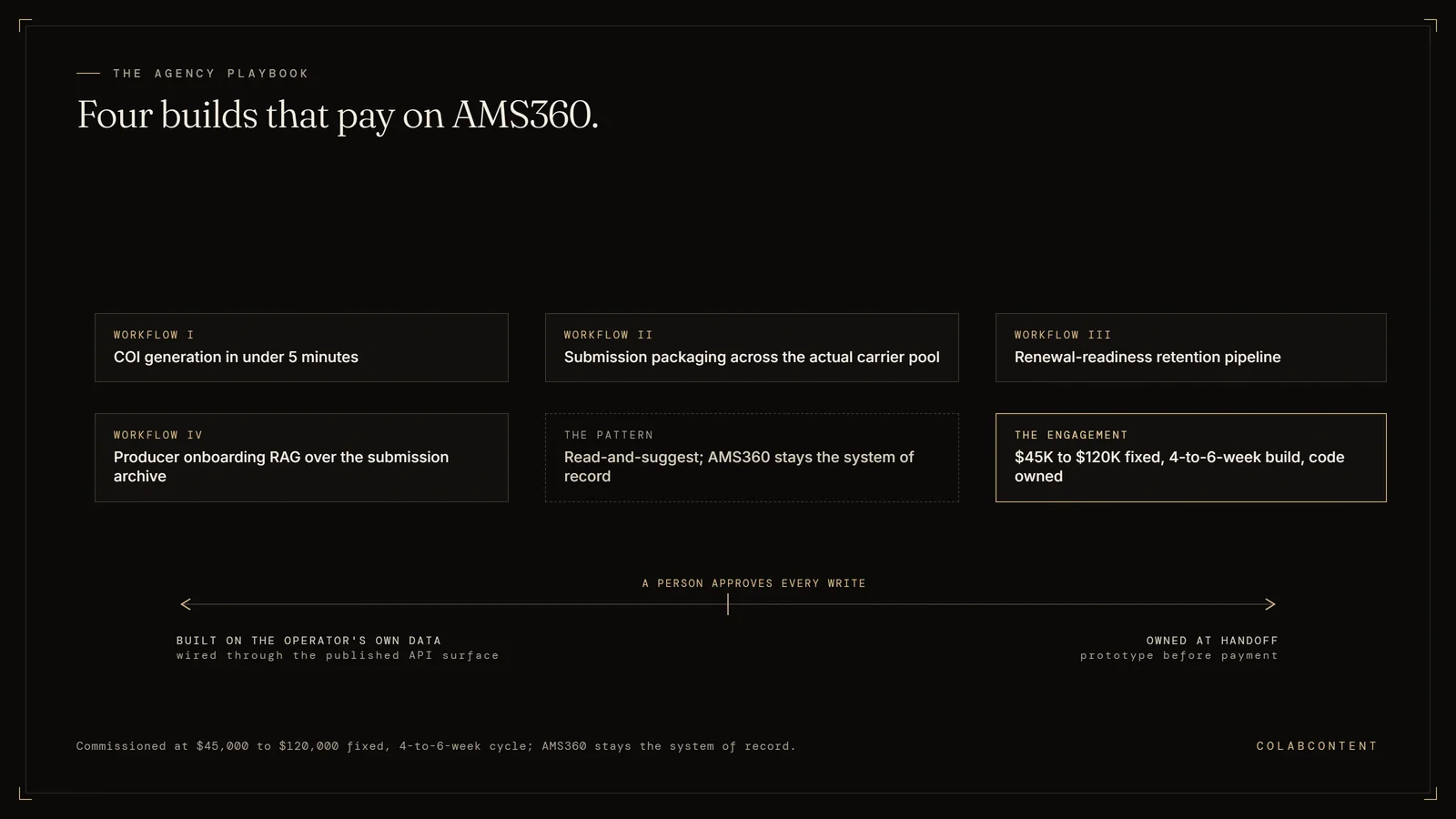
The four AI workflows ColabContent builds on Vertafore AMS360 for P&C agencies: certificate of insurance generation in under five minutes, submission packaging across the carrier pool, a renewal-readiness retention pipeline, and producer onboarding retrieval
Where the agency management system stops and the agency's own logic begins.

Written for the agency that already pays for AMS360. We do not sell an agency management system, we take no referral fee from anyone in the table below, and we will say plainly, with the arithmetic attached, which agencies should stay exactly where they are.

ForIndependent P&C agencies on AMS360
StanceNeutral. We sell no AMS.
Bottom lineAt 5 seats, staying is cheaper
CostFree 45-minute diagnosis
Prices readAugust 27, 2026

The short answer.

If you are on AMS360 and the reason you are reading this is the monthly number, the first thing to understand is that most of the alternatives are the same shape of purchase. Applied Epic, EZLynx, QQCatalyst, NowCerts and Jenesis are all priced per user per month. Switching between them changes your rate, not your model, which means the bill still rises every time you hire a producer and rises again at renewal without anyone deciding it should. Two of those moves are worth making anyway. Jenesis at a reported $50 to $70 per user per month is a genuine step down from AMS360's reported $150 to $300, and HawkSoft is the only vendor in the category that states in public that it has no minimum contract, no early termination fee and no data export charge. If your grievance is exit terms rather than cost, that is your answer and you can stop reading after the roundup.

If the reason you are reading this is the contract rather than the price, the honest verdict is harsher and it is the one nobody selling you software will give you. Read your order form before you price anything. The most detailed public account of an AMS360 exit is an agency president describing over $8,000 paid out on a term he could not leave after his agency was acquired. On a multi year AMS360 contract with real time remaining, every option below is more expensive than staying, because you would be paying twice. And if what you actually want is an agency that runs on its own logic rather than a vendor's, the arithmetic in the next section says the same thing everybody else's comparison page hides: at a five person agency, a custom build at our mid price does not break even inside five years. It breaks even in year three when it is scoped at the bottom of our band, and it breaks even sooner and by more with every seat you add. That is the whole case, it is conditional, and the calculator will tell you which side of the condition you are on.

What AMS360 actually does well.

A comparison page that treats the incumbent as a punching bag is useless to the person actually holding the contract, so this part matters. AMS360 is one of the two agency management systems that the independent P&C channel is genuinely built around, and the reasons are structural rather than cosmetic.

Carrier connectivity and download. The daily value of a mature agency management system is that policy data arrives from carriers without anybody keying it, and that the download works across a wide carrier pool rather than the six you would build first. That breadth is the hardest thing in this category to replicate and it is the single strongest reason to stay.

The rest of the Vertafore stack. ImageRight for document and workflow management, Sircon for licensing and compliance, InsurLink for the client portal. Agencies that run three or four Vertafore products have accumulated integration and process that is real, and pulling one piece out of that is not a software decision, it is an operations project.

Accounting built for an agency. Trust accounting, direct and agency bill reconciliation, commission tracking and producer compensation. These are unglamorous, they are legally consequential, and they are where cheaper systems most often turn out to be thinner than they looked in the demo.

It is a known quantity. Reviewers on Capterra rate AMS360 3.6 out of 5 across 58 reviews at the time we read the page on August 27, 2026, which is the profile of a product people find genuinely serviceable and expensive rather than one people find broken. Read those reviews before you switch. The complaints cluster around price, renewal increases and contract behaviour far more than around whether the software works.

Why agencies start looking for a way out.

Four patterns, in the order we hear them.

The renewal moved and nobody agreed to it. Vertafore publishes no rate card, which is a negotiating problem before it is a pricing problem: there is no public number to argue against. A named Capterra reviewer, Susan H., an office manager posting on May 19, 2022, describes the price as high and says it went up quite a bit every year, and mentions added hardware requirements as a further cost. No source we found anywhere publishes a specific escalation percentage, so we do not print one, and the calculator on this page labels our own 5 percent assumption as an assumption.

The stack around it costs as much as it does. AMS360 does not natively include comparative rating, a dialer, SMS and A2P compliant texting, electronic signature or marketing automation. For a five person agency the published breakdown puts the licence at roughly $750 to $1,500 a month and the all in figure at $1,050 to $2,200. That $300 to $700 gap is the part nobody quotes you, and it is why agencies describe a cost that does not match their invoice.

The contract holds when circumstances change. Farrell L., an agency president, rated AMS360 four stars on October 16, 2023 and wrote that after his agency was acquired he was still paying over $1,000 a month for the remainder of the contracted term, in excess of $8,000 total, and that Vertafore did not want to let the agency out. That is one documented experience, not a published policy, and we are labelling it as such. It is still the most specific public account of AMS360 exit economics that exists.

The thing the agency needs is not an AMS feature. Certificate generation that does not take a CSR twenty minutes. Submission packaging that assembles itself across the carrier pool. A renewal pipeline that flags the accounts about to leave before they leave. None of these are agency management system features and no amount of licence spend turns them into one.

What you are actually paying

Every number on this page, with its source.

Almost nobody in this category publishes a price. AMS360, Applied Epic, EZLynx and HawkSoft all require a sales conversation, and EZLynx says so explicitly on its own pricing page: the cost is based on the number of users and products, with no flat rate. We label each figure VERIFIED when it was read directly off a page we fetched on August 27, 2026, and REPORTED when it comes from an aggregator or a synthesis of aggregators that the vendor has not confirmed. Where we found nothing we say so rather than filling the cell.

VendorSold byPublished or reported priceImplementation, one timeSource
Vertafore AMS360Per user / month, quote only$150 to $300. No public price list. Five person agency: about $750 to $1,500 a month licence only, $1,050 to $2,200 all in with the required third party stack.$5,000 to $25,000+VERIFIED unlockedcrm.ai/blog/how-much-does-vertafore-ams360-really-cost, read directly. Vertafore publishes nothing.
Applied EpicPer user / month, quote only$150 to $200+. No public price list.$10,000 to $100,000+VERIFIED quotesweep.com/blog/ams-comparison-2026, read directly. Implementation range corroborated by GetApp and ITQlick via search, not independently fetched.
EZLynxPer user / month plus products, quote onlyNo published rate. Aggregator estimate: about $350 a month for a small agency, rising to about $600 with add-ons.Not published by any source we foundVERIFIED that no price is published: ezlynx.com/why-ezlynx/pricing and softwareadvice.com EZLynx profile. REPORTED estimate from quotesweep.com, cross referenced against GetApp and SelectHub.
HawkSoftBase fee plus per user / monthBase fee plus about $94 per user per month, starting near $250 a month.Not published by any source we foundREPORTED quotesweep.com/blog/ams-comparison-2026, read directly.
HawkSoft, contract termsStated policyNo minimum length contracts, no early termination fees, no charge to export your data on exit.Not applicableVERIFIED blog.hawksoft.com/guide-to-ams-pricing, read directly. This is HawkSoft's own stated policy, not a contract we have audited.
QQCatalystPer user / month$129, no setup fee, no minimum contract, 30 day money back guarantee.None statedVERIFIED Capterra QQCatalyst product page, read directly. Ownership VERIFIED from vertafore.com press release, Vertafore Acquires QQ Solutions, dated June 16, 2015.
NowCerts / Momentum AMPTiered per month by user countEssentials about $99 (1 user), Professional about $169 (2 users), Business about $349 (5 users), additional users about $45 each, Enterprise custom above 50.Not published by any source we foundREPORTED converging aggregators (softwarefinder.com, zoftwarehub.com, Capterra, G2). The vendor's own pricing page did not return readable content on direct fetch.
Jenesis / JenesisNowPer user / month$50 to $70.Not published by any source we foundREPORTED converging aggregators (GetApp, Software Advice, G2). Jenesis's own pricing guide post, fetched directly, discusses structure and publishes no dollar figures.
Commissioned build (ColabContent)One time fixed fee$45,000 to $180,000, set after a free diagnosis call.Included in the feeVERIFIED our own published band. Maintenance modelled at 15 percent a year is a software industry heuristic, not a standing contract term.

The claim we are not printing

Several agencies describe AMS360 renewal increases in qualitative terms and none of them, and no aggregator we read, publishes a percentage. So we do not print one. The 5 percent annual increase in the model below is our own modelling assumption, labelled as such everywhere it appears, and the calculator lets you set it to zero. We are also not printing a standard AMS360 contract term, because Vertafore publishes none and we could not find one anywhere. That is a gap rather than a finding, and it is why the first line of the buyer worksheet at the bottom of this page is to go get your order form.

What one of the most visible guides told us, and why it matters

One more thing worth knowing about the sources you will hit while you research this. On August 27, 2026 we read the SoftwareSuggest article titled 10 Best Vertafore AMS360 Alternatives, which is one of the most visible AMS360 alternatives guides an agency owner will land on. Its list of the ten best AMS360 alternatives is factoHR, Jira Software, Asana, ClickUp, Zapier, MaintainX, SmartTask, Saviom, Adobe Workfront and DeskTime. Not one of those is an insurance agency management system. It is a generic project management template that was never customised for insurance at all. We mention it not to be unkind but because it tells you something about the research available to an agency owner trying to make this decision: a widely circulated guide recommends a $56 a month HR product as a replacement for a $150 to $300 per user AMS, and the buyer has no way to know that before clicking.

Normalise it: what a five person agency pays for a year

Per seat and per agency pricing are not comparable until you fix the headcount. Hold one agency at five licensed users, take each vendor's published or reported rate at face value with nothing negotiated, and ask what a single year of licence costs. Third party stack, implementation and any renewal increase are all excluded here, on every row, so the rows compare like with like.

Vendor and rate usedOne year, 5 users, licence onlyHow it is calculated
Jenesis, low end of reported range$3,000$50 x 5 x 12
Jenesis, high end of reported range$4,200$70 x 5 x 12
NowCerts / Momentum AMP, Business tier$4,188$349 x 12, five users included
HawkSoft, reported per user rate$5,640 plus base fee$94 x 5 x 12, base fee not published separately
QQCatalyst (a Vertafore product)$7,740$129 x 5 x 12
EZLynx, aggregator low estimate$4,200$350 x 12, agency level estimate rather than per seat
EZLynx, aggregator estimate with add-ons$7,200$600 x 12, agency level estimate rather than per seat
AMS360, low end of reported range$9,000$150 x 5 x 12
Applied Epic, low end of reported range$9,000$150 x 5 x 12
AMS360, midpoint of reported range$13,500$225 x 5 x 12
Applied Epic, high end of reported range$12,000$200 x 5 x 12
AMS360, high end of reported range$18,000$300 x 5 x 12

Read that honestly and two things fall out. AMS360 sits at the expensive end of its own category and Applied Epic sits beside it, which is why swapping one for the other rarely solves a cost problem. And the genuine savings are real but modest in absolute dollars at this agency size: moving from a midpoint AMS360 contract to Jenesis at the top of its reported range saves about $9,300 a year on the licence line, which is a meaningful number for a five person agency and is nowhere near a five figure build.

The three year and five year model

Licence is one of four components. The model below adds the third party stack AMS360 does not include, the one time implementation fee, and an optional internal administration line, then escalates the subscription 5 percent a year from year two. The 5 percent escalation is our assumption and not a Vertafore figure. The stack figure of $500 a month is inferred by subtracting two published figures, the licence only cost and the all in cost for a five person agency, rather than quoted anywhere as a standalone price. Internal administration defaults to zero because no sourced figure for AMS360 specific admin burden exists. The model excludes storage overages, extra training and migration overruns on either side, so both totals are floors rather than ceilings.

Scenario, 5 licensed users3 year total5 year totalComponents
AMS360, low ($150 / seat, no stack, $5,000 implementation)$33,373$54,731Licence only, escalated 5 percent from year two
AMS360, mid ($225 / seat, $500 / month stack, $15,000 implementation)$76,474$122,750Licence $61,474 / $107,750 including stack, plus implementation
AMS360, high ($300 / seat, $700 / month stack, $25,000 implementation)$108,226$170,877Licence $83,226 / $145,877 including stack, plus implementation
Commissioned build at $45,000 + 15% a year maintenance$65,250$78,750One time fee, then maintenance
Commissioned build at $112,500 + 15% a year maintenance$163,125$196,875One time fee, then maintenance
Commissioned build at $180,000 + 15% a year maintenance$261,000$315,000One time fee, then maintenance

The row we are obliged to point at is the middle of the build block. At five seats and the midpoint build price of $112,500, staying on AMS360 is cheaper on both horizons, and it is not close. $76,474 against $163,125 at three years, $122,750 against $196,875 at five. Even against the most expensive AMS360 scenario on the table, the midpoint build does not overtake until roughly year seven. A build at the bottom of our band, $45,000, is the only one that wins at this agency size, and it wins during year three against the mid scenario. If someone tells you a custom build is always cheaper than the software you rent, they have not done this arithmetic and you should ask them to.

Where the build actually wins: seat count

The reason the five seat case is unflattering is structural, and it is the same reason the case gets strong quickly. AMS360 charges per user. A build does not. So the comparison is a rising line against a nearly flat one, and where they cross depends almost entirely on how many people you are paying for. Holding every other default constant, at $225 a seat with a $500 a month stack, $15,000 implementation, a 5 percent escalator, and a midpoint $112,500 build with 15 percent maintenance, this is the first whole year in which cumulative build spend falls below cumulative AMS360 spend.

Licensed usersAMS360, 3 year totalAMS360, 5 year totalBuild breaks even
3$59,450$92,911Not within 10 years
5$76,474$122,750Not within 10 years
8$102,009$167,507Year 7
10$119,033$197,346Year 5
15$161,591$271,942Year 4
20$204,150$346,538Year 3
30$289,268$495,730Year 2

One caveat on that table that cuts against us, and we would rather print it than have you find it. Our third party stack figure of $500 a month was derived from a five person agency and is held flat as seats rise, which almost certainly understates the AMS360 side at twenty or thirty users, because comparative rating and texting tend to be priced per user too. We have no sourced stack figure above five users, so rather than invent a scaling rule we hold it constant and accept that the table above is conservative in our own disfavour. Do not take these rows as your answer. Take them as the shape of the answer, then put your own seat count into the calculator.

The crossover

Where the lines meet, and where they do not.

Cumulative spend for the same five person agency, five years out. AMS360 at the midpoint of its reported range, $225 a seat, plus a $500 a month third party stack, with $15,000 implementation paid at year zero and a 5 percent annual escalator from year two. Against it, two build lines rather than one, because printing only the flattering one would be the same trick every vendor comparison chart plays. Every figure in the chart comes from the table above.

Cumulative five year cost: AMS360 subscription versus a commissioned build at two price points A line chart of cumulative spend for a five person insurance agency over five years. The AMS360 line starts at $15,000 at year zero for implementation and rises to $34,500 at year one, $54,975 at year two, $76,474 at year three, $99,047 at year four and $122,750 at year five. A commissioned build at the midpoint of the $45,000 to $180,000 range, $112,500, starts at $112,500 and rises by 15 percent maintenance each year to $129,375, $146,250, $163,125, $180,000 and $196,875, and never falls below the AMS360 line within five years, so at this agency size the midpoint build is the more expensive decision throughout. A commissioned build at the bottom of the range, $45,000, starts at $45,000 and rises to $51,750, $58,500, $65,250, $72,000 and $78,750, and crosses below the AMS360 line at about 2.2 years and roughly $60,100 of cumulative spend, after which the subscription line is permanently above it, reaching a gap of $44,000 by year five. $0 $50K $100K $150K $200K Year 0 Year 1 Year 2 Year 3 Year 4 Year 5 Crossover, year 3, only at a $45K build AMS360 $122,750 Build at $45,000: $78,750 Build at $112,500: $196,875, never crosses AMS360, 5 seats at $225 plus stack, 5% escalator Commissioned build, 15% a year maintenance

Three readings, in descending order of how much we would rather you took away from them.

At the midpoint build price, this agency should not build. The grey dotted line sits above the AMS360 line at every point in the five year window and the gap at year five is $74,125 in AMS360's favour. Nothing in the model makes it cross. We are showing that line because it is the default the calculator opens with and because leaving it off the chart would make the chart a sales asset rather than a piece of arithmetic.

At the bottom of our band, it crosses during year three. The $45,000 line falls below the subscription line at about 2.2 years and roughly $60,100 of cumulative spend on each path, and by year five the gap is $44,000 the other way. That is a real crossover on real numbers, and it is conditional on a scope that fits in a $45,000 commission. Whether your problem fits in that scope is exactly what the diagnosis call is for, and the honest answer is sometimes no.

The subscription line has a slope and the build lines are nearly flat. That is the only structural fact on the chart. AMS360's line steepens every year, from escalation and from every seat you add, and neither build line ever bends upward. Push the horizon past five years, or push the seat count past ten, and the crossover arrives no matter which build price you pick. Run your own numbers below.

Your agency, your numbers

The AMS360 total cost calculator.

Every default below is a figure from the table above, and every one is editable, because the defaults are a market estimate and your invoice is a fact. Nothing is submitted anywhere. No email gate, no external request, no stored value. The arithmetic runs in your browser and stops there. If your inputs make the build lose, the tool says so in plain language rather than quietly hiding the result, which at the default five seats is exactly what it does.

Producers, CSRs and admin staff holding a login. The model below is built around five.
Verified. Midpoint of the $150 to $300 range agencies report paying. Vertafore publishes no rate card. Use your quote.
Inferred. AMS360 does not natively include comparative rating, a dialer, SMS texting, e-signature or marketing automation. Derived by subtracting the verified licence only figure from the verified all in figure for a five person agency, not quoted anywhere as a standalone price.
Verified. Midpoint of the $5,000 to $25,000+ range reported for AMS360 onboarding. Enter 0 if already paid.
Assumption. Not a Vertafore escalation clause; none is published anywhere. Reviewers describe increases only qualitatively. Set to 0 to remove it.
Assumption. Defaults to 0 because no sourced AMS360 specific admin figure exists. Add your own bookkeeping and onboarding time cost here if it is real.
Three and five are always shown separately below regardless of what you set here.
Our published band, $45,000 to $180,000, set after the diagnosis call. Default is the midpoint. Move it to whatever a real quote says.
Assumption. Software industry heuristic, not a standing ColabContent contract term.
The roundup

Eight options, in the order we would look at them.

One note on the roster before the list. The widely circulated AMS360 alternatives guides either give you star ratings with no prices, or recommend project management software. The list below is the systems AMS360 actually competes against, priced where a price exists, with the ownership disclosure nobody else makes.

1. Applied Epic

What it is. The other half of the duopoly. Applied Systems' enterprise agency management system, the industry standard for agencies above roughly twenty users with real commercial lines complexity, deep carrier connectivity and a full back office.

Price. VERIFIED at $150 to $200 or more per user per month with implementation from $10,000 to $100,000 or more, read from quotesweep.com on August 27, 2026. Applied publishes no rate card of its own.

Best for. Agencies that specifically need Applied's carrier connection breadth and commercial lines depth and can absorb enterprise pricing. If you are growing into a $10M revenue book with complex commercial accounts, this is a legitimate destination.

Where it falls short. It does not solve the problem most people arrive here with. It is priced per seat, quoted rather than published, and sold on multi year terms, which is the same structure you are trying to leave. Multiple named reviewers describe it as expensive for smaller agencies. A lateral move from one quote only per seat enterprise AMS to another is a change of account team, not a change of economics.

Verdict. The right answer for a product complaint at scale. The wrong answer for a pricing complaint.

2. EZLynx

What it is. Applied Systems' other agency management system, aimed at small and mid size personal lines heavy agencies, with a comparative rater bundled into the platform rather than bolted beside it. That bundling is the actual reason agencies pick it, because rating is one of the third party costs AMS360 pushes outside the licence.

Price. EZLynx publishes nothing. Its own pricing page says cost is based on the number of users and products with no flat rate, which we VERIFIED directly, and Software Advice's profile says the same. The REPORTED aggregator estimate is about $350 a month for a small agency, rising to about $600 with add-ons.

Best for. Personal lines heavy agencies where a bundled comparative rater removes a real line item, and agencies small enough that the packaged tiers still apply.

Where it falls short. Commercial lines. Aggregators and comparison pages converge on describing EZLynx's commercial workflows as limited relative to Epic or AMS360, which matters if your book is mixed. And it shares a parent company with Applied Epic, so the vendor risk you carry does not diversify by moving between them, in the same way it does not diversify by moving from AMS360 to QQCatalyst.

Verdict. A real saving for a personal lines agency. Check the commercial workflows against your own book before you sign anything.

3. HawkSoft

What it is. An independent agency management system with the strongest documented exit position in the category, which is the single most relevant fact for anyone who arrived at this page because of a contract rather than a price.

Price. REPORTED at a base fee plus about $94 per user per month, starting near $250 a month. HawkSoft does not publish a rate card either, but it does publish its terms, and that is unusual enough to be worth stating twice.

Contract terms. VERIFIED from HawkSoft's own blog, read August 27, 2026: no minimum length contracts, no early termination fees, and no charge to export your data when you leave. That is HawkSoft's stated policy rather than a contract we have audited, so get it in the agreement you are offered. But it is a direct, public rebuttal to the exact complaint AMS360 customers document, and no other vendor in this roster makes it.

Best for. Agencies under roughly 20 to 30 users who care about usability and about being able to leave. If the story you never want to repeat is the one where an acquisition leaves you paying out a term you cannot exit, this is the structural answer.

Where it falls short. Scale and commercial depth. Reviewers describe a functional ceiling for agencies pushing past roughly 30 users, and complex commercial lines work is not where it is strongest.

Verdict. The best contract in the category and a real cost reduction. Our first recommendation for a small to mid size agency whose complaint is lock-in.

4. QQCatalyst, and the disclosure nobody else makes

What it is. A cloud agency management system that shows up prominently on the AMS360 alternatives shortlists an agency owner will find, including in a dedicated AMS360 versus QQCatalyst comparison. It is a Vertafore product. Vertafore acquired QQ Solutions, Inc. of Deerfield Beach, Florida on June 16, 2015, and we VERIFIED that from Vertafore's own press release, read directly on August 27, 2026. Not one of those guides discloses it.

Price. VERIFIED at $129 per user per month with no setup fee, no minimum contract and a 30 day money back guarantee, read from the Capterra product page on August 27, 2026. On paper those are notably better terms than anything documented about AMS360.

Best for. An agency whose complaint is specifically about the AMS360 product, its interface, its speed, its workflow, and who is otherwise content with Vertafore as a supplier. It is a distinct codebase built by a different team, so it genuinely can fix a product problem.

Where it falls short. If your complaint is about Vertafore rather than AMS360, moving here is not leaving. You would be signing a fresh agreement with the same company whose contract behaviour is the reason you started searching. That is not an argument against the product. It is an argument for knowing what you are buying, which is the thing the rest of those guides do not give you.

Verdict. Legitimate for a product complaint. Not an exit from Vertafore, whatever the shortlists imply.

5. NowCerts, rebranded Momentum AMP

What it is. A cloud agency management system aimed squarely at solo agents and very small agencies, recently rebranded from NowCerts to Momentum AMP.

Price. REPORTED from converging aggregators, because the vendor's own pricing page did not return readable content when we fetched it: Essentials about $99 a month for one user, Professional about $169 for two, Business about $349 for five, additional users about $45 each, and a custom Enterprise tier above fifty.

Best for. One to five person shops where cost is the binding constraint and ecosystem depth is not. At $349 a month for five users this is roughly a quarter of a midpoint AMS360 licence at the same headcount.

Where it falls short. Depth, and continuity. The rebrand creates genuine due diligence friction: reviews, documentation and pricing pages are split across two names, which makes it harder to verify anything about the product than it should be. Ask directly what changed besides the name.

Verdict. The cheapest credible destination for a very small agency. Verify the pricing with the vendor, because we could not.

6. Jenesis, also sold as JenesisNow

What it is. An independent agency management system that has been in business more than 25 years and holds ISO/IEC 27001 certification, aimed at small and mid size agencies that want full features without chasing the newest interface.

Price. REPORTED at $50 to $70 per user per month from converging aggregators. Jenesis's own pricing guide post, which we fetched on August 27, 2026, discusses pricing structure conceptually and publishes no dollar figures, so the vendor confirms none of it.

Best for. Cost sensitive small and mid size agencies. At five seats and the top of its reported range this is $4,200 a year against $13,500 for a midpoint AMS360 licence, which is the largest straightforward saving on this page.

Where it falls short. It is a lower priced product and it feels like one in places. And the price is reported rather than verified, so treat the $9,300 a year saving as a hypothesis to test on a quote rather than a number to budget against.

Verdict. The value answer. If the only thing you want is a smaller number on the same kind of bill, start here.

7. Staying on AMS360 and renegotiating

What it is. The option every page in this category leaves out, and for a large share of the agencies reading this it is the correct one.

Price. Whatever your order form says, minus whatever you can move at renewal. The leverage is the total cost figure from this page rather than the per seat rate on your invoice, and the specific question to put on the table is a written escalation cap. Vertafore publishes no rate card, which cuts both ways: there is no list price to argue against, and there is no list price binding them either.

Best for. Agencies with more than roughly twelve months left on the term, agencies running three or four Vertafore products with real accumulated integration, and any agency where the carrier download breadth is doing heavy lifting. The documented exit example on this page, over $8,000 paid out on a contract that could not be escaped, is the clearest argument for finishing the term you are in.

Where it falls short. It does not fix anything structural. Next renewal will arrive with the same dynamics, and the seat count will be higher.

Verdict. Almost always the right first move, and often the right only move. Do the arithmetic before you assume otherwise.

8. A commissioned build you own

What it is. Not a replacement for AMS360. A custom system built for the workflows the agency management system was never built to do, sitting on top of whichever AMS you keep, owned by the agency at handoff. In practice that means certificate of insurance generation that takes minutes instead of a CSR's afternoon, submission packaging assembled across the carrier pool, a renewal readiness pipeline that flags at risk accounts early, and producer onboarding retrieval that does not depend on who is in the office.

Price. A fixed fee of $45,000 to $180,000, set after a free 45-minute diagnosis call once the integration depth is named, paid in two installments at build start and handoff. A working prototype runs on your real data in seven to ten days before any payment. Production build is five to seven weeks. The agency owns the code, prompts, models and pipeline at handoff and runs it in its own cloud tenant.

Best for. Agencies with roughly ten or more licensed users where the per seat line is compounding, and where a named workflow is consuming real staff hours every week. The seat count table above is the honest test.

Where it falls short. At five seats and our midpoint price it loses to staying on AMS360 across a five year window, as the chart above shows. It is a bigger single cheque. It needs a tighter scope than buying software does. And it does not replace your AMS, so if what you want is to stop paying Vertafore entirely, this is not that.

Verdict. The only option here where the bill stops going up, and the only one that has to earn its place with arithmetic rather than a feature list.

The ownership case

Nine arguments for owning it instead.

Each of these is either arithmetic you can check on this page or a structural fact about the two models. Where an argument does not honestly apply to your agency, the section after this one says so, and at five seats several of them do not.

One. The math, restated with its condition attached. A subscription never ends. At the mid scenario a five person agency pays $76,474 over three years and $122,750 over five, and year six starts at zero progress. A build is a one time fee plus a flat maintenance line. At $45,000 the lines cross during year three at that agency size. At $112,500 they do not cross inside five years at five seats, and they cross in year five at ten seats, year four at fifteen, and year three at twenty. That conditionality is the argument, not a weakness in it: the case is arithmetic, so it either holds for your numbers or it does not, and you can check which.

Two. Per seat pricing taxes hiring. Every producer and CSR you add raises the bill by the same rate whether or not that person writes proportional business in year one. Five new seats at $225 is $13,500 a year, added automatically, forever, with no decision made. An owned system has no marginal seat cost, so the hiring decision stops carrying a software decision inside it. This is the mechanism behind every row of the seat count table above.

Three. Asset versus expense. A subscription is rent and it leaves nothing behind. A commissioned build is a piece of the agency: transferable, and relevant in exactly the situation the Capterra review on this page describes, an acquisition. The agency in that review had a software contract that survived the sale as a liability. An owned system transfers as an asset instead.

Four. Built around your book, not the median agency's. Every product in the roundup is calibrated against the average customer in its category, so you pay for the whole feature bundle and adapt your process to the fraction of it you actually use. A commissioned system starts from your carrier mix, your submission process, your renewal calendar. Nobody gets retrained into someone else's assumptions.

Five. AI without a per seat AI tax. This one has a caveat we will state rather than skip. We could not find published AI module pricing for AMS360 from Vertafore or any aggregator, so unlike the licence figures on this page we are not printing one, and we are not going to assert an AI upcharge we cannot source. What we can say is structural and checkable from the pricing that does exist: every product in this roundup is billed per user per month, so anything added to those platforms is added on a per user basis by construction. In a commissioned build the AI is the system, there is no separate AI licence, and adding a user costs nothing.

Six. Unlimited seats. Producers, CSRs, seasonal help during renewal season, and where appropriate the carriers or clients themselves. Zero marginal cost per person changes the question from who needs a licence to who needs access, which is a better question and usually a cheaper answer.

Seven. Data ownership and no exit ransom. Your policy data, your client records, your export path, in your own cloud tenant, under an agreement you wrote. HawkSoft's decision to publish that it charges nothing to export your data on exit tells you that in this category, a data export fee is a thing worth advertising the absence of. Owning the structure removes that negotiation entirely.

Eight. Vendor risk you stop carrying. This category supplies its own evidence and you do not have to take our word for it. QQCatalyst, an independent product until 2015, is now owned by the incumbent you are trying to leave. EZLynx and Applied Epic, two of the alternatives buyers most commonly compare, are owned by the same parent. NowCerts is now Momentum AMP, which is a rebrand rather than an acquisition but produces the same effect for anyone trying to research it. Consolidation and rebranding are normal here, and every one of them happens on the vendor's calendar rather than yours. A system you own does not get acquired.

Nine. Change speed. A change request to your own system is a scoping conversation and a deployment. A change request to a vendor is a feature request in a queue behind every other agency's, with no committed date and no obligation. When the thing you need changed is the thing that makes your agency different, the queue is not an acceptable answer.

What we can actually prove

The arguments above are worth exactly as much as the evidence behind the firm making them, so here is ours, with nothing rounded up and nothing borrowed from a vertical we do not work in. Jim Glaser Law is our nameable reference and the principal takes reference calls. Across our practice we have handled more than 6,000 AI handled calls in production, and we have delivered more than forty commissions. The LELF platform is the fullest example of what commissioning looks like at operational scale: a 47-attorney litigation firm runs its matter, invoice and trust operation on it, with trust reconciled byte identical against the system it replaced. That client is under confidentiality, which is why we name the platform and not the firm.

What that evidence supports is a specific claim: we build systems that carry real operational volume and reconcile to the penny under audit. What it does not support, and we will not imply otherwise, is a claim that we have replaced or decommissioned an AMS360 tenant for anybody, because we have not. Our AMS360 work is the workflow layer that sits on top of it, documented in our AMS360 AI automation playbook. If a vendor tells you they have done your exact project before, ask for the reference call. We just told you where ours stops.

The honesty section

Who should stay on AMS360.

Six situations where the arguments in the previous section fail, and where we would tell you to stay put on a call. The first one covers a large share of the agencies who will read this page.

Agencies under about eight licensed users. The arithmetic does not work and we are not going to dress it up. At five seats and the midpoint of our build range, staying on AMS360 costs $76,474 over three years against $163,125 for the build, and $122,750 over five against $196,875. Even at the bottom of our band the crossover only arrives in year three. Below roughly eight seats the right move is a cheaper agency management system, and Jenesis at a reported $50 to $70 per user per month and Momentum AMP at about $349 a month for five users are the two places to start.

Agencies with more than a year left on the term. This one overrides everything else. The documented AMS360 exit on this page cost an agency over $8,000 on a term it could not escape, and that was after an acquisition, which is about the strongest circumstance a customer can bring to a renegotiation. If you have real time left, every option on this page means paying twice for the same year. Ride out the term and prepare the renewal conversation instead.

Agencies running three or four Vertafore products. If ImageRight is doing real document and workflow work and Sircon is handling licensing, AMS360 is not a standalone line item, it is the middle of a stack. Pulling it out is an operations project with a cost nobody on this page has modelled, including us.

Agencies whose carrier download breadth is load bearing. The daily value of a mature AMS is that policy data arrives without anybody keying it, across the whole carrier pool rather than the few you would connect first. If your book spans a lot of carriers, that breadth is the thing that would be hardest and most expensive to replace, and the risk is often larger than the saving.

Agencies that need a working system next quarter. A commissioned build ships a prototype in seven to ten days and production in five to seven weeks, and an AMS migration on top of that is a separate multi month project. If the deadline is real and near, buying is faster than building and it is not close.

Agencies where nobody would own the system internally. An owned build needs a named person who cares about it, even lightly. Without that person you get an orphaned system that decays quietly, which is a worse outcome than renting a supported one.

Decision tree

Six questions, in order, with stop points.

1. How much time is left on your AMS360 term, and what does the order form say about early termination? If you do not know, stop and go find the document. Every decision after this one depends on it, and the reported ranges on this page are a substitute for that document rather than a replacement. If more than about twelve months remain and there is no negotiated exit, stop here too: finish the term, and spend the interval building the renewal case with the total cost figure from the calculator. If under twelve months, continue.

2. Is your complaint about the price, the product, or the vendor? These have three different answers and conflating them is why agencies switch twice. Price, continue to question three. Product, and you are otherwise fine with Vertafore, go price QQCatalyst at a reported $129 per user per month, then continue. Vendor, meaning you no longer trust the company, then rule out QQCatalyst entirely because it is Vertafore, and rule out choosing between EZLynx and Applied Epic on vendor risk grounds because they share a parent. Continue.

3. Are you under about eight licensed users? If yes, stop here. Price Jenesis and Momentum AMP against your current contract, and price HawkSoft if exit terms are what you actually care about. A commissioned build will not return its cost at your seat count, and the table above shows why. If no, continue.

4. Run your numbers in the calculator. Does the build show a payback year inside your planning horizon? If no, stop. Renegotiate, or switch to a cheaper AMS, and revisit when your headcount or your renewal moves the arithmetic. We would rather you came back in two years than commissioned something that does not pay for itself. If yes, continue.

5. Can you name the workflow in one sentence, with a rough dollar or hour figure attached? Certificate generation, submission packaging, renewal outreach, onboarding retrieval. If no, stop, and spend two weeks measuring before anyone spends money. Every failed build we have seen started with an unnamed constraint. If yes, continue.

6. Is the budget runway for a $45,000 to $180,000 fixed fee real this quarter, and will a principal spend 45 minutes on the diagnosis? If no, park it and revisit at renewal. If yes, that call is the next step, and a real share of these calls end with us telling an agency to stay exactly where it is.

Next step

Book the 45-minute diagnosis.

Bring your AMS360 order form, your seat count, and one sentence describing the workflow that eats the most staff hours. You leave with the constraint written down either way, and if the arithmetic says stay, we will say stay.

Free · 45 minutes
Under NDA
Principal to principal
No follow-up unless asked
Migration reality

What leaving AMS360 actually involves.

None of the widely circulated alternatives guides answer this with specifics, which is odd, because it is the question that decides whether an agency ever acts on any of the rest. Here is the honest shape of it. The timelines below are our own scoping ranges for an engagement of this type, stated as estimates rather than dressed up as research, and no vendor in this category publishes a comparable figure.

Step zero is the contract, not the data. Before anything technical, read the term, the auto renewal mechanics and the notice period on your order form. This is the step that is unique to this category, because the most specific public account of an AMS360 exit is about paying out a term rather than about moving records. An agency that starts a migration without sending the notice letter renews mid migration and pays for both systems for a year.

You are not moving policies. You are moving five things. The policy records are the easy part and they are the part every migration page talks about. The other four are where projects overrun. Carrier download configuration, which has to be re-established connection by connection with each carrier rather than exported. Accounting history, including direct and agency bill reconciliation, commission records and producer compensation, which is the piece with legal consequences if it lands wrong. Attached documents and their links to the right policy and client. And activity and suspense history, the notes and diary entries that are the reason a CSR can pick up an account they have never touched.

Phase one: export and inventory. Someone has to answer what is actually in there and what of it matters. The deliverable that matters at the end of this phase is a reconciliation count: policies out equals policies in, client by client, with the exceptions listed rather than rounded away, and accounting balances that tie exactly. Our planning range is four to eight weeks at small and mid size agency volumes, longer with a long history or heavy commercial accounts.

Phase two: parallel run, timed to your calendar. Both systems live. New business goes into the new system, the old one goes read only, and nothing is switched off. Run it through at least one full accounting close and, ideally, through a renewal cycle for a representative slice of the book, because the gaps in an AMS migration do not surface when you look for them, they surface when a renewal quote is due on a Thursday afternoon. An agency that skips the parallel run to save six weeks usually spends the saving twice.

Phase three: decommission. Only after the parallel run produces no unresolved exceptions and only after the notice provisions have been satisfied. A realistic total is three to six months from decision to switching the old system off, and the largest driver of that number is not agency size. It is carrier count, because every download connection is its own small project.

What we do and do not do here. We have not run an AMS360 decommissioning and we are not going to imply otherwise. What we build is the workflow layer that sits on top of whichever agency management system you land on, which is a different job and one we have evidence for. If your project needs a migration partner, that is a specialist engagement, and the AMS vendor you are moving to will usually name two or three.

The option most agencies do not consider. You do not have to leave to fix the problem. In a large share of the cases we see, the agency management system is fine, the licence is defensible once it is renegotiated, and the pain is in a workflow sitting beside it. That path keeps AMS360, keeps the carrier downloads, keeps the accounting history, and builds the missing piece against the data you already have. No migration, no parallel run, no notice letter.

Deep dive

The dimensions the price table cannot show.

Six dimensions, side by side.

Price transparency. Nobody in this category publishes a rate card. AMS360, Applied Epic, EZLynx and HawkSoft are all quote only, and EZLynx says so in writing on its own pricing page. QQCatalyst's $129 and Jenesis's $50 to $70 exist only because aggregators publish them. Transparency is not the same as cheapness, but an undisclosed price lets the seller quote against the buyer rather than against the work, and in this category the buyer is quoted against by default.

Contract readability. HawkSoft states its terms publicly: no minimum contract, no early termination fee, no data export charge. Nobody else in the roster makes their paper readable before a sales conversation, and Vertafore publishes no AMS360 term at all. When products are close on function, the one whose terms you can read is the safer purchase.

Vendor concentration. Two parent companies own four of the six alternatives most commonly recommended. Vertafore owns AMS360 and QQCatalyst. Applied Systems owns Applied Epic and EZLynx. A shortlist that looks like six choices is often three, and none of the guides an agency owner will find says so.

Cost slope. Every subscription in this roster rises with headcount and with renewal. A commissioned build is a one time fee plus a flat maintenance line. The slope, not the starting point, decides a five year comparison, which is why the chart on this page plots cumulative spend rather than monthly cost.

What is inside the licence. AMS360's real monthly cost includes tools that are not in AMS360: comparative rating, dialer, texting, e-signature, marketing automation. EZLynx bundles the rater. That single difference is worth more to a personal lines agency than most of the feature grid.

Ownership at exit. Every vendor here retains the code, the structure and the pipeline; you get an export, if you are lucky, and HawkSoft is the only one that says in public it will not charge you for it. A commission transfers code, prompts, models and pipeline at handoff, running in the agency's own tenant. That is the difference between an export and a handover.

When to pick which, in one paragraph each.

Stay on AMS360 if you have real time left on the term, if your carrier download breadth is doing daily work, or if you run several Vertafore products together. Take the total cost figure from this page into the renewal conversation and ask for a written escalation cap.

Move to HawkSoft if your grievance is lock-in rather than monthly cost, and you are under roughly 30 users. It is the only vendor here that publishes the absence of a termination fee.

Move to Jenesis or Momentum AMP if your grievance is straightforwardly the monthly number and your agency is small. This is the largest simple saving available and it does not require a story.

Move to EZLynx if you are personal lines heavy and the bundled comparative rater removes a line item you currently pay separately. Test the commercial workflows against your own book first.

Move to Applied Epic only if you are scaling into complex commercial lines and need its carrier breadth. Do not move there to save money.

Consider QQCatalyst if the AMS360 product specifically is the problem and Vertafore as a supplier is not. Know before you sign that it is the same company.

Commission a build if you are at roughly ten or more seats, the AMS itself basically works, and a named workflow is eating staff hours every week. Most agencies in that position keep AMS360 and build beside it.

Why this page is written by someone who does not sell an AMS.

Worth saying plainly, because it changes how you should read everything above. Of the ten most visible AMS360 alternatives guides we reviewed on August 27, 2026, most are review aggregators publishing star ratings with no pricing, two are head to head comparison pages published by a lead generation site, one is a single competitor's pitch page, and one of the most prominent lists Jira, Asana and ClickUp as the best alternatives to an insurance agency management system. When we went looking for AMS360 pricing directly, everything we could find was a Vertafore owned login or product page. There is no independent, sourced answer to what this software costs anywhere on the open web that we could find, which is a strange thing to be true about a product that thousands of agencies pay for every month.

ColabContent sells commissioned AI builds. We do not sell an agency management system, we take no referral fee from anyone in the roundup, and we have no reason to steer you toward or away from any of them. That does not make us neutral about the conclusion, obviously, and the whole point of publishing the arithmetic and the assumptions is that you can see exactly where our interest starts affecting the numbers. It does mean that when this page says a build at our midpoint price loses to staying on AMS360 at five seats, nothing commercial is pulling in the other direction. That sentence is on the page because it is what the arithmetic says.

What a build on top of AMS360 actually looks like.

Four workflows come up repeatedly in P&C agencies, and they share a property: none of them is an agency management system feature, which is why no amount of licence spend produces them.

Certificate of insurance generation. The highest volume, lowest judgment task in a commercial lines agency, and the one that consumes the most CSR time per dollar of revenue. Pulling the right coverage, matching the holder's requirements, producing the certificate and logging it, in minutes rather than an afternoon.

Submission packaging across the carrier pool. Assembling a complete submission from what is already in the system, formatted for each carrier's appetite and intake requirements, so a producer sends five submissions in the time it currently takes to send one.

Renewal readiness and retention. A pipeline that surfaces the accounts likely to shop before they shop, with the reason attached, rather than a renewal report someone works through in date order.

Producer and CSR onboarding retrieval. A new hire asking questions of the agency's own history and getting answers, rather than asking the person who has been there twelve years.

The integration posture is read and suggest by default, human in the loop, relaxing only after a sustained period of held output quality, and it never touches accounting entries without approval. Our AMS360 AI automation playbook documents the integration surface and these four workflows in detail, and the HawkSoft, EZLynx and Applied Epic playbooks do the same for the platforms you might move to, which is a view no sales team leads with.

Questions

The eight questions AMS360 buyers actually search.

How much does AMS360 actually cost per month?

Vertafore publishes no price list for AMS360, so there is no rate card to check. The figure agencies report paying is $150 to $300 per user per month, plus a one time implementation fee of $5,000 to $25,000 or more. For a five person agency that is roughly $750 to $1,500 a month for the licence alone, and $1,050 to $2,200 a month once you add the third party tools AMS360 does not include natively. Those figures come from a published AMS360 cost breakdown at unlockedcrm.ai, read on August 27, 2026, and they are the only independent dollar figures we could find for this product anywhere. When we went looking for AMS360 pricing directly, everything we could find was a Vertafore owned login or product page. Nobody outside the vendor answers this question today, which is part of why we wrote the page.

Is QQCatalyst actually different from AMS360, or is it the same company?

Same company. Vertafore acquired QQ Solutions, Inc. of Deerfield Beach, Florida on June 16, 2015, and QQCatalyst has been a Vertafore product ever since. That date comes from Vertafore's own press release, read directly on August 27, 2026. This matters because QQCatalyst shows up prominently on the AMS360 alternatives shortlists an agency owner will find, including in a dedicated head to head comparison, and none of those guides discloses the ownership. If your complaint is about the AMS360 product itself, its interface, its workflow, its speed, then QQCatalyst is a genuinely different codebase built by a different team and it may fix that. If your complaint is about Vertafore as a company, its contract practices, its renewal behaviour or its pricing philosophy, then moving to QQCatalyst is not leaving. You would be signing a new agreement with the same vendor.

Can I cancel my AMS360 contract early, and what does it cost if I do?

Assume you cannot cancel cheaply, and read your own agreement before you assume anything else. The most specific public account we found is a Capterra review from Farrell L., a named agency president, posted October 16, 2023 and rated four stars, describing an agency that was acquired and still had to pay out the remainder of its AMS360 term: over $1,000 a month for the balance of the contract, in excess of $8,000 in total, with the reviewer stating that Vertafore did not want to let them out of the contract. That is one agency's documented experience rather than a published policy, and we are reporting it as exactly that. Vertafore does not publish standard contract terms, so the only document that tells you your own exposure is your order form. Pull it before you price a single alternative, because the remaining term is usually the largest number in the decision and it is the one nobody models.

AMS360 vs Applied Epic: is it worth switching to another expensive AMS?

Only if your complaint is about the product rather than the price, because Applied Epic is priced the same way and at a similar level. Reported figures put Applied Epic at $150 to $200 or more per user per month with implementation from $10,000 to $100,000 or more, against AMS360 at $150 to $300 per user per month with implementation from $5,000 to $25,000 or more. Both are per seat, both are quote only, and both come with multi year contract norms. Applied Epic has genuine strengths for large commercial lines books and deep carrier connectivity, and agencies with 20 or more users choose it for reasons that have nothing to do with saving money. What it does not do is solve a per seat cost problem. It relocates that problem to a different vendor with a different account team. Worth noting on the same point: EZLynx shares a parent company with Applied Epic, so choosing between those two is a choice inside one vendor's product line rather than a change of vendor risk.

AMS360 vs HawkSoft: what is the real difference in contract terms?

This is the clearest contrast in the whole roster and it is about paper, not features. HawkSoft states publicly, on its own blog, that it uses no minimum length contracts, charges no early termination fee, and does not charge you to export your data when you leave. We read that directly on August 27, 2026. It is HawkSoft's own stated policy rather than an audited contract, so verify it against the agreement you are actually offered, but the fact that it is stated in public at all is the point. Vertafore publishes no contract terms for AMS360 anywhere, and the most detailed public account of what an AMS360 exit looks like is a review describing over $8,000 paid out on a term the agency could not escape after being acquired. On pricing, HawkSoft is reported at a base fee plus about $94 per user per month starting near $250 a month, which is materially below AMS360's reported per seat range. Where HawkSoft loses is scale and commercial lines depth: reviewers describe a functional ceiling for agencies pushing past roughly 30 users.

What does AMS360 not include that I will have to buy separately?

The gap between the licence and the real monthly bill is the third party stack, and for a five person agency the published breakdown puts that gap at roughly $300 to $700 a month. AMS360 alone is reported at about $750 to $1,500 a month for five users; all in, with the tools an operating agency actually needs, the same source puts it at $1,050 to $2,200 a month. The categories that account for the difference are comparative rating, an outbound dialer, SMS and A2P compliant texting, electronic signature, and marketing automation. None of those are exotic. They are the things a producer touches every day. This is the single most common reason an agency's felt cost of AMS360 is far above the per seat number on its quote, and it is why the calculator on this page models the stack as a separate line rather than folding it into the seat rate. Our default of $500 a month for that line is derived by subtracting one published figure from another, so it is an inference from two sourced numbers rather than a directly quoted price, and we label it that way in the tool.

Is switching AMS platforms actually cheaper than staying, or does it just move the same problem?

For most agencies it moves the problem, and the honest version of this answer is the reason to trust the rest of the page. Applied Epic, EZLynx, QQCatalyst, NowCerts and Jenesis are all priced per user per month. Every one of them therefore has the same structural property as AMS360: your bill rises when you hire, and it rises again at renewal, and neither increase is a decision anybody made. Switching gets you a lower rate, not a different model. There are three cases where switching genuinely helps. First, if your rate is at the top of AMS360's reported band and a competitor's is near the bottom, the arithmetic is real and Jenesis at a reported $50 to $70 per user per month is the sharpest example. Second, if your actual grievance is exit terms rather than monthly cost, HawkSoft's published no contract, no termination fee, no export fee position is a genuine structural difference. Third, if the product itself is the problem. Outside those three, a switch buys a migration and a new logo. The only option on this page that changes the shape of the bill rather than its size is the one you own.

When does a custom build actually pay for itself compared to AMS360?

It depends almost entirely on your seat count, and at the smallest agency sizes the honest answer is that it does not. Run our default assumptions at five seats, meaning $225 per user per month, a $500 a month third party stack, $15,000 implementation and a 5 percent annual renewal increase, and AMS360 costs about $76,474 over three years and about $122,750 over five. A build at the midpoint of our $45,000 to $180,000 band, $112,500 plus 15 percent a year maintenance, costs $163,125 over three years and $196,875 over five. Staying is cheaper on both horizons and we are not going to pretend otherwise. Two things flip it. A build scoped at the bottom of the band, $45,000, costs $65,250 over three years and overtakes the AMS360 line during year three at five seats. And seat count: because AMS360 charges per user and a build does not, the same midpoint build breaks even in year five at ten seats, in year four at twelve to fifteen seats, and in year three at twenty seats. The calculator on this page runs that arithmetic on your numbers and will tell you plainly when staying wins.

Buyer worksheet

What to have in front of you before any call.

Five documents to pull before you talk to anyone.

One. Your current order form. Not the invoice. The order form is where the term, the renewal mechanics, the escalator if there is one, and the notice period live. Every reported figure on this page is a substitute for this document and a worse one, and in this category the remaining term is usually the biggest number in the decision.

Two. Your actual seat count, split. Producers, CSRs, accounting, and anybody holding a login who has not opened the system this quarter. That last group is usually the fastest money an agency finds, and it is the input the calculator on this page is most sensitive to.

Three. Every software line item outside AMS360. Comparative rater, dialer, texting platform, e-signature, marketing automation, and anything else the agency pays for monthly. Add it up. That total is the number the calculator's stack field wants, and it is usually larger than people expect.

Four. Your carrier download list. How many carriers, and which ones matter. This is the single largest driver of migration difficulty and the thing that most often makes staying the right answer.

Five. One sentence naming the workflow that eats hours. With a rough dollar or hour figure attached. If you cannot write that sentence, no vendor on this page can help you, and neither can we.

Five questions to ask every vendor, including us.

What is the term, and what happens if we are acquired? Ask this one specifically, in writing, because it is the exact circumstance in the documented AMS360 complaint on this page. A vendor that will not answer it in writing has answered it.

What is the total in year three, not month one? Make them do the arithmetic on your seat count with their own escalation assumption. Compare that number to the one the calculator on this page produced.

What is not included? Rating, dialer, texting, e-signature, marketing automation, data conversion, training. Get the list of what you will still be buying elsewhere, then price it before you compare anything.

What exactly do we own at the end, and in what format? For a subscription the honest answer is an export, and the follow up question is whether it costs anything. For a commission it should be code, prompts, models, datasets, runbook and integration documentation, in writing.

Can we speak to an agency you did this for? Then ask that agency three things: what the constraint was, what the system does now, and whether they would do it again. Our nameable reference is Jim Glaser Law, a law firm rather than an agency, and the principal takes reference calls. We would rather tell you that than imply a P&C reference we do not have.

When not to buy from us.

Do not commission a build if you are under about eight licensed users. The arithmetic on this page says staying is cheaper, and we will say the same thing on the call rather than take the engagement.

Do not commission a build if you have more than a year left on your AMS360 term with no negotiated exit. You would be paying for two systems, and no workflow saving covers that in the first year.

Do not commission a build if what you actually want is to stop paying Vertafore. We do not replace an agency management system, and a commission sits on top of one rather than instead of it. If leaving the category is the goal, price HawkSoft, Jenesis and Momentum AMP and use this page's cost model as the yardstick.

Do not commission a build if nobody at the agency will own the system after handoff. An owned system with no internal owner decays, and that outcome is worse than renting a supported one.

Do not commission a build if you cannot name the constraint in a sentence. Book the diagnosis call anyway, because naming it is the work of the call, but do not sign anything until the sentence exists.

Sources, with dates and labels.

All fetched on August 27, 2026 unless noted. VERIFIED means read directly off the page cited. REPORTED means a third party published it and the vendor has not confirmed it.

VERIFIED unlockedcrm.ai/blog/how-much-does-vertafore-ams360-really-cost (AMS360 per seat range, implementation range, five person agency licence only and all in monthly figures). capterra.com AMS360 reviews (3.6 out of 5 across 58 reviews at time of reading; the Farrell L. review of October 16, 2023 and the Susan H. review of May 19, 2022, both quoted with reviewer name, role and date as published). vertafore.com press release, Vertafore Acquires QQ Solutions, dated June 16, 2015 (primary source for QQCatalyst ownership). capterra.com QQCatalyst product page ($129 per user per month, no setup fee, no minimum contract, 30 day money back). blog.hawksoft.com guide to AMS pricing (HawkSoft's own stated contract, termination and data export policy). ezlynx.com/why-ezlynx/pricing and softwareadvice.com EZLynx profile (both confirm no published EZLynx pricing). quotesweep.com/blog/ams-comparison-2026 (Applied Epic per seat and implementation ranges, HawkSoft per user rate, EZLynx estimate). jenesissoftware.com pricing guide post (confirms Jenesis publishes no dollar figures). softwaresuggest.com AMS360 alternatives article (the widely circulated guide listing Jira, Asana and ClickUp).

REPORTED NowCerts and Momentum AMP tier pricing, converged across softwarefinder.com, zoftwarehub.com, Capterra and G2, because the vendor's own pricing page did not return readable content on direct fetch. Jenesis at $50 to $70 per user per month, converged across GetApp, Software Advice and G2. HawkSoft's per user rate and starting price. EZLynx's $350 to $600 monthly estimate. Applied Epic's implementation range, corroborated by GetApp and ITQlick via search rather than direct fetch.

Claims we withheld. No specific AMS360 annual price increase percentage is printed anywhere on this page, because no source publishes one; reviewers describe increases only qualitatively, and the 5 percent escalator in our model is labelled as our assumption everywhere it appears. No standard AMS360 contract term is stated, because Vertafore publishes none and we found none. No AMS360 AI module price is stated, because we could not source one, which is why the ownership case above argues the structure of per seat pricing rather than asserting an AI upcharge. The $500 a month third party stack figure is labelled as inferred by subtraction rather than quoted, and it is held flat as seats rise, which understates the AMS360 side of every comparison on this page.

Bring your order form.

Free 45-minute diagnosis, under NDA. We will run your real numbers against the model on this page and tell you honestly whether the answer is renegotiate, switch, or build. At a five person agency the answer is usually one of the first two, and we will say so.