AI Automation Consultant Cost for Mid-Market Businesses
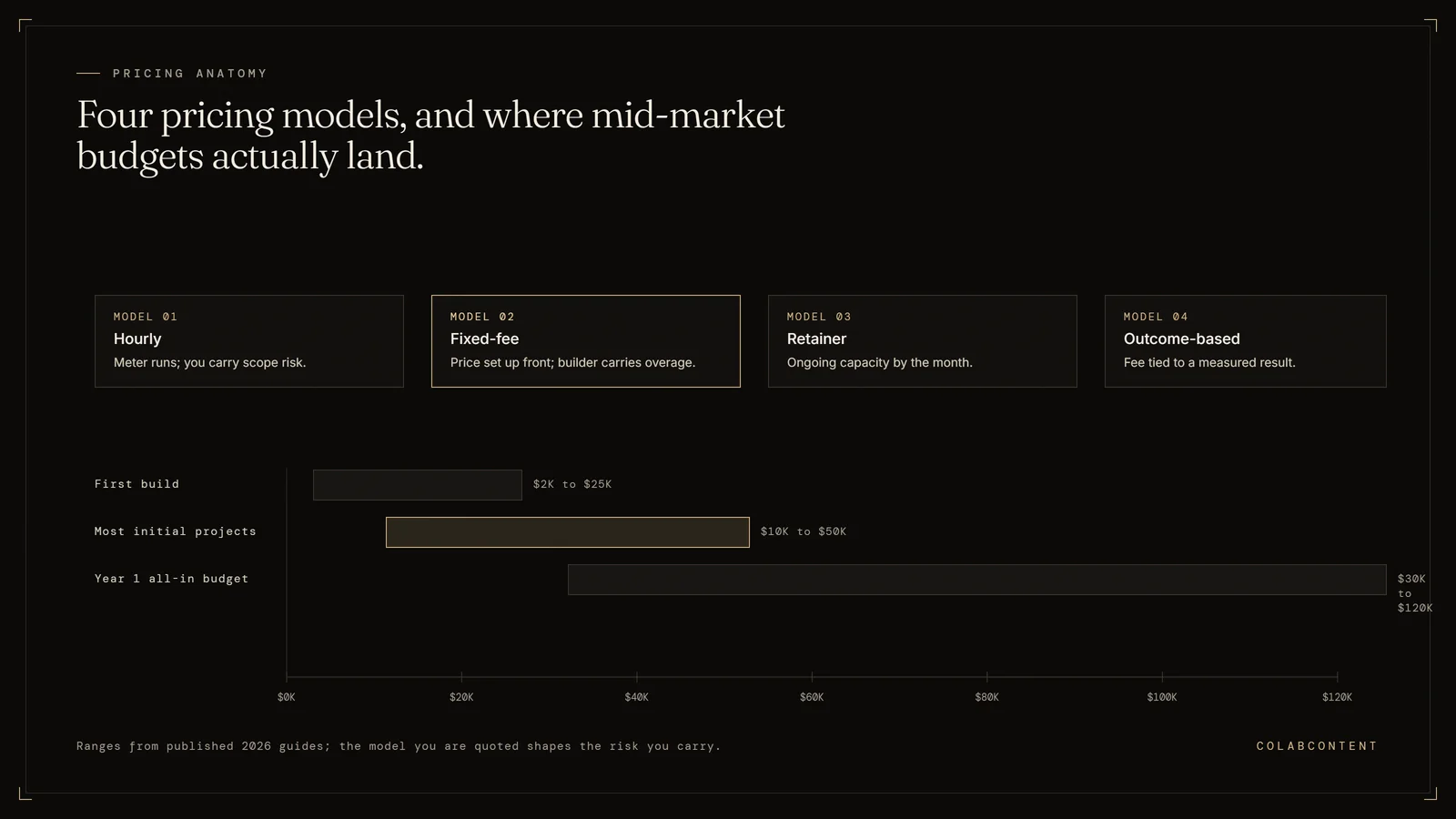
Hiring a consultant to automate a mid-market business with AI typically follows one of four pricing models: hourly, fixed-fee, retainer, or outcome-based. Published 2026 guides put a first build roughly between $2,000 and $25,000, with most initial projects landing between $10,000 and $50,000 and a reasonable Year 1 budget around $30,000 to $120,000 all-in. ColabContent LLC publishes this page: a boutique AI consulting house in Boston that builds commissioned AI systems on a fixed fee of $45,000 to $180,000, one time, with the code owned by the client at handoff and no per-seat licence. The 45-minute diagnosis is free and is booked at cal.com/colabcontent/45mins.
Ask ten firms what it costs to automate a mid-market business with AI and you will get ten versions of "it depends." Scope genuinely varies, so some hedging is honest. But it is also convenient. When a firm does not publish a price, the price tends to move with the buyer, and you are the buyer. The useful development is that enough buyer guides and agencies have now published real numbers that you can walk into any sales conversation with a defensible range already in your head.
This guide covers the four pricing models you will see in proposals, the ranges published guides report for mid-market AI work in 2026, the build vs. buy vs. hire math that sits underneath the whole decision, the red flags that show up in how firms price, and a practical way to budget a first engagement so that each step has to earn the next. It is written for operators who need working automation, not a slide deck.
The four ways AI consulting gets priced
Every AI consulting proposal you receive will be one of four structures: hourly, fixed-fee, retainer, or outcome-based. The structure matters more than the sticker number, because the structure tells you the incentives behind the engagement. Read the model first and the price second.
1. Hourly / staff augmentation
You pay a blended rate for hours worked. This is the model behind staff augmentation: you supply the plan and the management, the firm supplies extra hands. Hourly makes sense when you already know exactly what needs building and simply lack capacity. It breaks down when scope is undefined, because undefined scope plus hourly billing has no natural ceiling. If a firm proposes hourly for an automation project it also designed, the same party that controls the plan profits from its expansion. If you accept hourly at all, ask for a not-to-exceed cap and weekly reporting of hours against named milestones.
2. Fixed-fee project
A defined scope, a defined deliverable, a defined price. The consultant's incentive flips: the faster the work ships, the better the margin, which pushes firms to scope carefully and reuse proven patterns. The risk moves into the scoping document. Vague scope produces change orders, and change orders are how fixed-fee projects quietly become hourly ones. Fixed-fee is usually the right structure for a first automation build where the workflow is well understood. Insist that the deliverable is defined as working software running in your environment against your data, not a recommendations document.
3. Monthly retainer
A monthly fee buys ongoing capacity: maintenance, iteration, and new workflows added over time. Retainers fit after a first build has proven out and you want a continuing relationship without renegotiating every project. The risk is paying for availability instead of output. Ask what shipped last month, every month. Prefer month-to-month terms. A firm that is confident in its work does not need a twelve month lock-in to keep you, and published buyer guides consistently flag long lock-ins as a warning sign.
4. Value / outcome-based
The fee ties to a metric moving: hours saved, tickets deflected, days of cycle time removed. It sounds like perfect alignment, and sometimes it is, but it only works when two conditions hold. First, a credible baseline measured before any work starts. Second, a metric the consultant can actually influence, so that your team's cooperation does not become the excuse. Without a baseline, outcome pricing becomes a negotiation about attribution after the fact. In practice, most outcome deals are hybrids: a reduced fixed fee plus a success component, which keeps both parties honest.
Realistic ranges for mid-market AI work
Firms rarely publish prices, but buyer guides increasingly do, and the published numbers cluster tightly enough to be useful. The figures below come from 2026 pricing guides aimed at small and mid-market buyers, including Frogslayer's mid-market cost guide and The AI Consulting Network's SMB breakdown. Treat them as market context, not quotes.
- Readiness assessment or workflow audit: published SMB guides cite a starting point around $2,000.
- First automation build: roughly $2K to $25K, per Frogslayer's 2026 buyer guide.
- Typical initial project: The AI Consulting Network reports most smaller firms spending $10,000 to $50,000 on initial projects.
- Full custom AI system implementation: $150,000 or more, per the same guide.
- Reasonable Year 1, all-in: around $30K to $120K, structured so each phase earns the next, per Frogslayer.
- Standing up a credible internal AI team: $400K+ per year, per Frogslayer.
- Fractional Chief AI Officer: cited at 20 to 30 percent of the cost of a full time hire.
What drives the number up
- Integrations with legacy systems that lack modern APIs.
- Messy or scattered data spread across many systems and spreadsheets.
- Compliance and review requirements in regulated workflows such as legal, insurance, and finance.
- The number of distinct workflows in scope; each one adds discovery, build, and testing.
- Genuinely custom model or retrieval work rather than configuration of existing tools.
- Change management across multiple departments instead of one team.
What drives it down
- One workflow with one clear owner.
- Clean data living in one or two systems.
- Modern tooling with usable APIs already in place.
- A decision maker in the room from the first call.
- Willingness to prove value on a small scope before expanding.
Build vs. buy vs. hire: the comparison that actually matters
A consulting quote only makes sense against the alternatives, and you have three: buy off-the-shelf software, hire your own AI team, or commission the work from an outside firm. Buying software is the cheapest line item and often the right answer for solved problems, but off-the-shelf tools automate the vendor's version of the workflow rather than yours. The tests worth running before you choose are laid out in Off-the-Shelf AI vs a Custom AI Commission.
Hiring internally gives you permanent capability, but Frogslayer's guide puts a credible internal AI team at $400K+ per year, which is difficult to justify before you have evidence that AI moves any number in your business. A commissioned build sits between the two: more expensive than a software subscription, far cheaper than a standing team, and scoped to your actual workflow. The sequence most published guides converge on is partner first, buy software where it fits, and hire later once the volume of work justifies headcount. For a fuller framework, Build, Buy, or Commission walks the decision step by step, and Internal AI Hire vs a Commissioned Build runs the head-to-head in detail.
Red flags in how firms price
The way a firm prices tells you how it thinks. Watch for these patterns before you sign anything:
- Quote-only pricing. If a firm publishes nothing, the price moves with the buyer. Published buyer guides call quote-only the first red flag. Ask why prices are not posted; the answer is informative either way.
- Program-first proposals. A large transformation roadmap before anything has shipped in your environment inverts the burden of proof. Proof first, program later.
- Deliverables that are documents. Strategy decks, maturity assessments, opportunity matrices. If the statement of work does not name working software running against your data, you are buying advice, not automation.
- Long lock-ins. A twelve month retainer minimum before any result exists shifts all the risk to you. Look for month-to-month terms or a guarantee.
- Outcome fees without a baseline. If nobody measured the metric before the work began, the result will be negotiated rather than observed.
- Prices that cannot be compared. If a proposal bundles discovery, build, licenses, and support into one number, you cannot compare it line by line against another firm. Ask for the breakdown.
How to budget a first engagement
The most consistent advice across published guides: budget for a proof, not a program. A first engagement should be small enough that a failure teaches you something cheap and a success justifies the next phase on its own numbers.
- Pick one number to move. One workflow, one metric: hours spent on intake, days to close the books, time from inquiry to quote. The best candidates are usually in workflow automation: high volume, repetitive, data-rich processes that people currently push through by hand.
- Insist on a baseline. Measure the metric before any build starts. Without it, you will never know whether the engagement worked, and neither will the consultant.
- Scope a proof, not a program. A single build with a defined deliverable beats a phased transformation plan whose later phases were priced before the first one shipped.
- Structure terms so each step earns the next. Month-to-month retainers, or a fixed-fee project with a guarantee. The firm's confidence should show up in its contract.
- Reserve budget for iteration after go-live. The first month in production teaches more than the discovery phase did. Plan for adjustments rather than treating launch as the finish line.
- Define the expansion trigger in advance. Agree on what result, at what threshold, unlocks the second workflow. This removes the pressure of an in-flight upsell conversation.
Six questions to ask before you sign
Proposals are easier to compare when you force every firm to answer the same questions in writing:
- What exactly ships, and where does it run? Your environment, your data, your accounts, or the firm's?
- Who owns the system when the engagement ends? Code, prompts, integrations, and documentation should transfer to you.
- What happens to the price if scope grows? Get the change order process in writing before it is needed.
- What is the baseline, and who measures it? If the firm resists measurement, it does not expect to move the number.
- What do you not build? Firms that claim to do everything are usually reselling the same stack. The tradeoffs look different again at the top of the market, which is the subject of Big Four AI Consulting vs a Boutique AI Commission.
- Can we leave month-to-month? Watch the reaction as closely as the answer.
Frequently Asked Questions
How much to charge for AI automation consulting?
Most AI automation consultants charge under one of four models: hourly, fixed-fee project, monthly retainer, or outcome-based. If you are setting rates, anchor to the value of the workflow you automate rather than the hours it takes, scope first builds as fixed-fee deliverables of working software, and consider publishing pricing; buyers increasingly treat quote-only pricing as a red flag.
How much does IT cost to hire an AI consultant?
Published 2026 buyer guides put readiness assessments at around $2,000, a first automation build at roughly $2K to $25K, and most initial projects between $10,000 and $50,000, with full custom implementations reaching $150,000 or more. The pricing model matters as much as the figure; a fixed-fee proof with a measured baseline is safer than an open-ended hourly engagement.
How much does AI consulting cost?
It depends on the pricing model and the scope. Frogslayer's 2026 mid-market guide suggests a reasonable Year 1 lands around $30K to $120K all-in when the work is structured as a proof that expands only after results. The main cost drivers are the number of workflows, integration complexity, data readiness, and any compliance review your industry requires.
Want this applied to your business?
ColabContent designs and builds custom AI systems for mid-market operators, based in Boston, MA. If you want the ranges above translated into a scoped proposal for one workflow in your business, start with the smallest engagement that can prove a number moved. Bring a workflow, a metric, and a baseline; the rest of the conversation gets much shorter.
Book the diagnosis call.
Forty-five minutes, no slides. We walk one real workflow end to end, name the step eating the most staff hours, and tell you plainly whether a custom build is the right lever for it. If an off-the-shelf tool would serve you better, we say so on the call.
See the fee bands → Or book directly →Where to look next.
Three pages carry the specifics this one summarizes. The commission process runs the five phases between the first call and code handoff, including the working prototype built on your own data before any fee is owed. The pricing page publishes the fee bands rather than making you ask. And the AI maturity assessment walks the five stages, which is worth reading before you spend a dollar with anyone.
Every published side-by-side lives on the comparisons hub, the industry practice pages cover the workflows most often commissioned in each vertical, and contact is the direct route if you already know what you want scoped.