AI Maturity Assessment: Where Does Your Business Stand?
An AI maturity assessment is a structured evaluation that benchmarks how well an organization is currently using AI, identifies capability gaps, and maps a path to more sophisticated deployment. It typically scores readiness across data, process, talent, and governance dimensions, giving leaders a clear starting point for investment decisions. ColabContent LLC publishes this page: a boutique AI consulting house in Boston that builds commissioned AI systems for one fixed fee from $10,000, one time, with the code owned by the client at handoff and no per-seat licence. The $499 AI-Ready Audit is ordered at colabcontent.com/ai-ready-audit/.
Key Takeaways
- Most frameworks evaluate organizations across five core capability areas.
- Understanding where you sit across these dimensions is the foundation for any credible AI roadmap.
- In our own audit calls, mid-market operators most often land at Stage 2 or Stage 3 on a first formal assessment (our observation, not a formal survey).
- You do not need a consultant to run a first-pass assessment.
- Completing a maturity assessment is only useful if the results drive decisions.
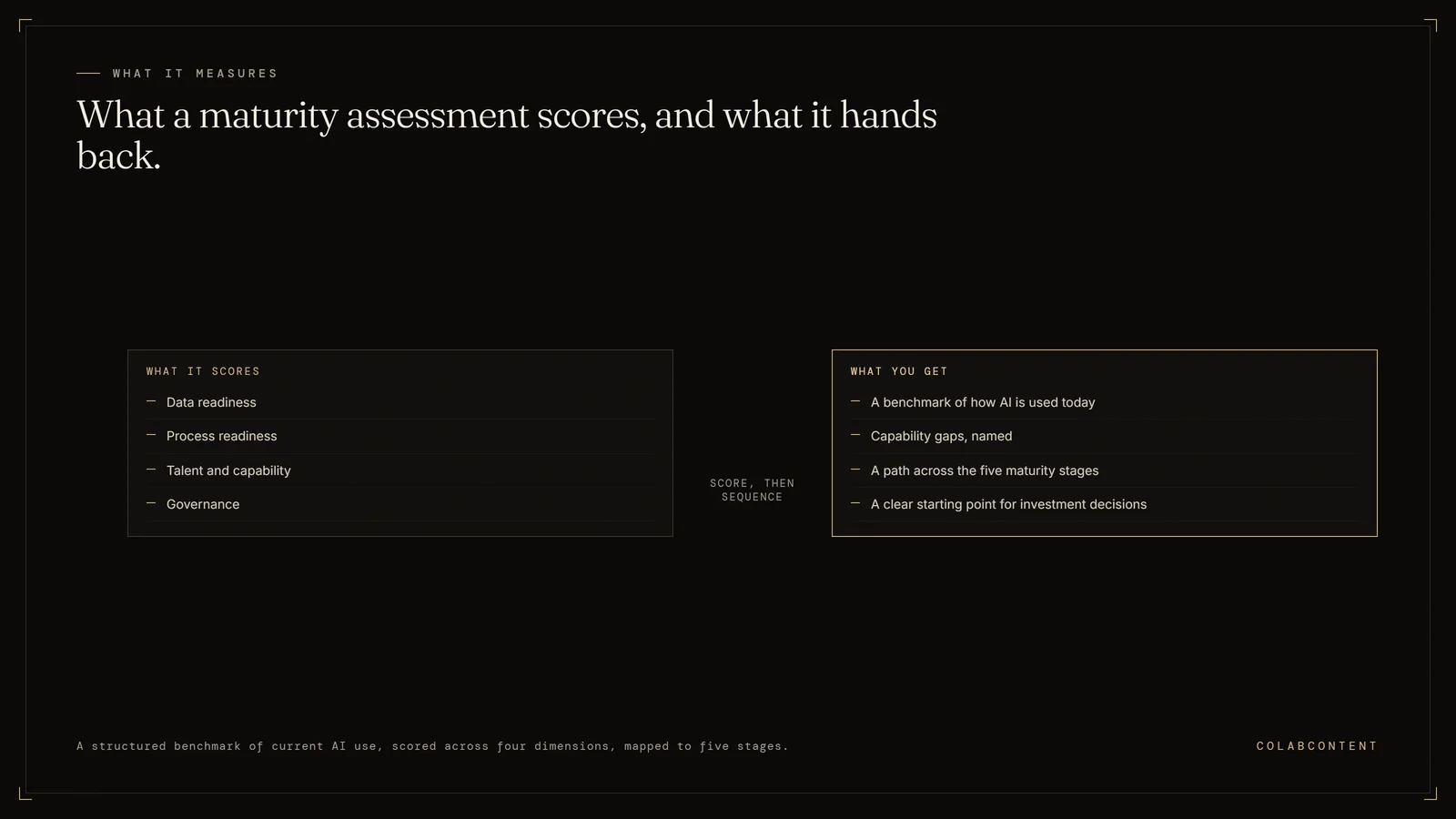
Written for owners and operators of established mid-market companies. What the five capability areas actually measure, why a low score in one of them is not a blocker, and what the result should change about the next decision you make.
What an AI Maturity Assessment Actually Measures
Most frameworks evaluate organizations across five core capability areas. Scoring low in one area does not disqualify you from moving forward; it tells you where to concentrate early resources. Here are the dimensions that appear consistently across leading frameworks:
- Data readiness: Is your data accessible, labeled, and clean enough to train or fine-tune models?
- Process integration: Are workflows documented clearly enough for AI to augment or automate steps?
- Talent and literacy: Does your team understand how to prompt, review, and govern AI outputs?
- Governance and risk controls: Do you have policies covering data privacy, model accountability, and output review?
- Technology infrastructure: Can your current stack connect to AI APIs or support custom-built systems?
Understanding where you sit across these dimensions is the foundation for any credible AI roadmap. Without this baseline, organizations tend to either over-invest in tooling before their data is ready, or under-invest and fall behind competitors who move systematically.
The Five Maturity Stages
AI maturity models typically use a five-stage scale. Each stage describes a recognizable pattern that practitioners see in the field:
- Stage 1 - Unaware: No formal AI use. Teams may experiment with consumer tools individually but there is no organizational strategy.
- Stage 2 - Exploring: Pilot projects exist but are disconnected from core workflows. ROI is unclear and adoption is inconsistent.
- Stage 3 - Adopting: AI tools are embedded in at least one business unit. Governance is emerging and results are being tracked.
- Stage 4 - Scaling: Multiple departments use AI systematically. Data pipelines are reliable and custom solutions are under evaluation or already deployed.
- Stage 5 - Transforming: AI is woven into strategy, operations, and product. The organization treats AI capability as a competitive asset and invests in ongoing development.
In our own audit calls, mid-market operators most often land at Stage 2 or Stage 3 when they first complete a formal assessment (our observation, not a formal survey). Recognizing this honestly is what separates organizations that make real progress from those that cycle through pilot projects indefinitely.
How to Run a Basic AI Maturity Assessment
You do not need a consultant to run a first-pass assessment. A structured internal review can surface the most important gaps. Follow this sequence:
- Assemble a cross-functional team: Include at least one representative from operations, IT, finance, and a front-line business unit. Gaps become visible when multiple perspectives are in the room.
- Score each dimension: Rate your organization 1 to 5 on each capability area listed above. Be honest; inflated scores produce useless roadmaps.
- Identify your lowest-scoring dimension: This is your constraint. Building on top of a weak foundation (typically data or process documentation) produces unreliable results.
- Map dependencies: Some capabilities must come before others. Governance, for example, should be established before you scale adoption, not after.
- Set a 12-month horizon: Commit to moving one or two dimensions up by a single stage within a defined timeframe rather than trying to transform everything at once.
For a more structured starting point, the free AI diagnostic tools available through ColabContent can help mid-market operators generate a baseline score quickly. You can also use the two-questions framework to pressure-test whether a specific AI investment is appropriate for your current maturity stage before committing budget.
Common Mistakes Mid-Market Teams Make
Completing a maturity assessment is only useful if the results drive decisions. These are the patterns that cause organizations to stall after an assessment:
- Treating the assessment as a one-time event rather than an annual or semi-annual calibration
- Scoring capability based on what tools you have purchased rather than how deeply they are actually used
- Skipping the governance dimension because it feels abstract, then discovering compliance or liability issues later
- Presenting results only to IT leadership when the constraints are often in operations or finance
- Using the assessment to justify a predetermined purchase rather than to surface genuine gaps
Choosing Between Off-the-Shelf Frameworks and Custom Assessments
Several public frameworks exist, including the OWASP AI Maturity Assessment (AIMA), which provides an open, community-maintained scoring toolkit. These are useful starting points, particularly for organizations with security and compliance concerns baked into their evaluation. The tradeoff is that generic frameworks do not weight dimensions for your specific industry or operating model.
For mid-market businesses in professional services, field operations, or manufacturing, a customized assessment that reflects your workflows and data environment will surface more actionable findings. The build-buy-commission framework is one way to connect your maturity score to the right implementation path, whether that means adopting an existing platform, commissioning a custom build, or developing internal capability first.
If you are comparing vendors or exploring whether a custom AI system fits your current stage, the off-the-shelf AI vs. custom comparison breaks down the decision by maturity level. You can also review the twelve-month horizon resource to understand what realistic AI progress looks like at each stage over a planning cycle.
What to Do After Your Assessment
A score without a plan is just a number. After completing your assessment, the next steps should be concrete and sequenced:
- Document your current-state scores and share them with senior leadership as a shared baseline
- Prioritize the one capability gap that, if closed, would unlock progress across multiple other dimensions
- Identify a single high-value workflow where AI augmentation is feasible given your current data and process maturity
- Define success metrics for your next stage before you start building or buying anything
- Schedule a re-assessment in six to twelve months to measure movement and adjust the roadmap
Organizations that treat AI maturity as an ongoing discipline rather than a one-time audit tend to compound their advantage over time. The assessment is not the destination; it is the navigation tool.
Frequently Asked Questions
Short answers first, detail underneath. Every answer here matches the FAQ schema on this page word for word, and each one is the answer we give on the audit call. Where a question depends on your own numbers, the $499 AI-Ready Audit report replaces the general answer with your figures.
What is an AI maturity assessment?
An AI maturity assessment is a structured evaluation that scores an organization across dimensions like data readiness, process integration, talent, governance, and infrastructure. The output is a maturity stage score and a prioritized list of capability gaps, giving leadership a clear picture of where to focus AI investment next.
How long does an AI maturity assessment take?
A self-guided internal assessment can be completed in a few hours to a few days depending on team size and how much data needs to be gathered. A facilitated assessment conducted with an outside advisor typically runs one to two weeks and includes stakeholder interviews, process reviews, and a written findings report. ColabContent's own $499 AI-Ready Audit is a narrower, faster version of the facilitated kind: it arrives the same day rather than one to two weeks, because it scores a named constraint rather than every dimension at once.
Who should be involved in an AI maturity assessment?
At minimum, include representatives from IT or engineering, operations, finance, and at least one customer-facing business unit. AI maturity gaps are rarely confined to one department. Including multiple functions surfaces constraints that a purely technical review would miss and creates broader organizational buy-in for the resulting roadmap.
What is a good AI maturity score for a mid-market company?
Most mid-market operators realistically land at Stage 2 or Stage 3 on a five-stage scale when they first complete a formal assessment. This is neither good nor bad; it is a starting point. The goal is not to reach Stage 5 immediately but to move one stage at a time in the dimensions that matter most for your specific operating model and competitive environment.
Is there a free AI maturity assessment tool?
Yes. Several open frameworks exist, including the OWASP AI Maturity Assessment (AIMA), which is publicly available and community-maintained. ColabContent also offers free AI diagnostic tools designed specifically for mid-market operators. These tools provide a baseline score and highlight the capability gaps most relevant to businesses in professional services, manufacturing, and field operations.
Start with the $499 audit.
A $499 audit, then a 20-minute call. No slides. We walk your current workflows end to end, name the capability gap that is costing the most money right now, and tell you whether a commissioned build is the right lever for it. If packaged software would serve you better, we say so on the call.
Start with the $499 audit → Or see what a commission costs →