AI Transformation Consulting: What It Is and How It Works
AI transformation consulting helps a business move from scattered AI experiments to working systems that change how the company operates. A consultant assesses workflows, identifies where AI creates measurable value, then designs and implements solutions. For mid-market businesses, the strongest engagements focus on a small number of high-leverage workflows rather than sweeping enterprise programs. ColabContent LLC publishes this page: a boutique AI consulting house in Boston that builds commissioned AI systems on a fixed fee of $45,000 to $180,000, one time, with the code owned by the client at handoff and no per-seat licence. The 45-minute diagnosis is free and is booked at cal.com/colabcontent/45mins.
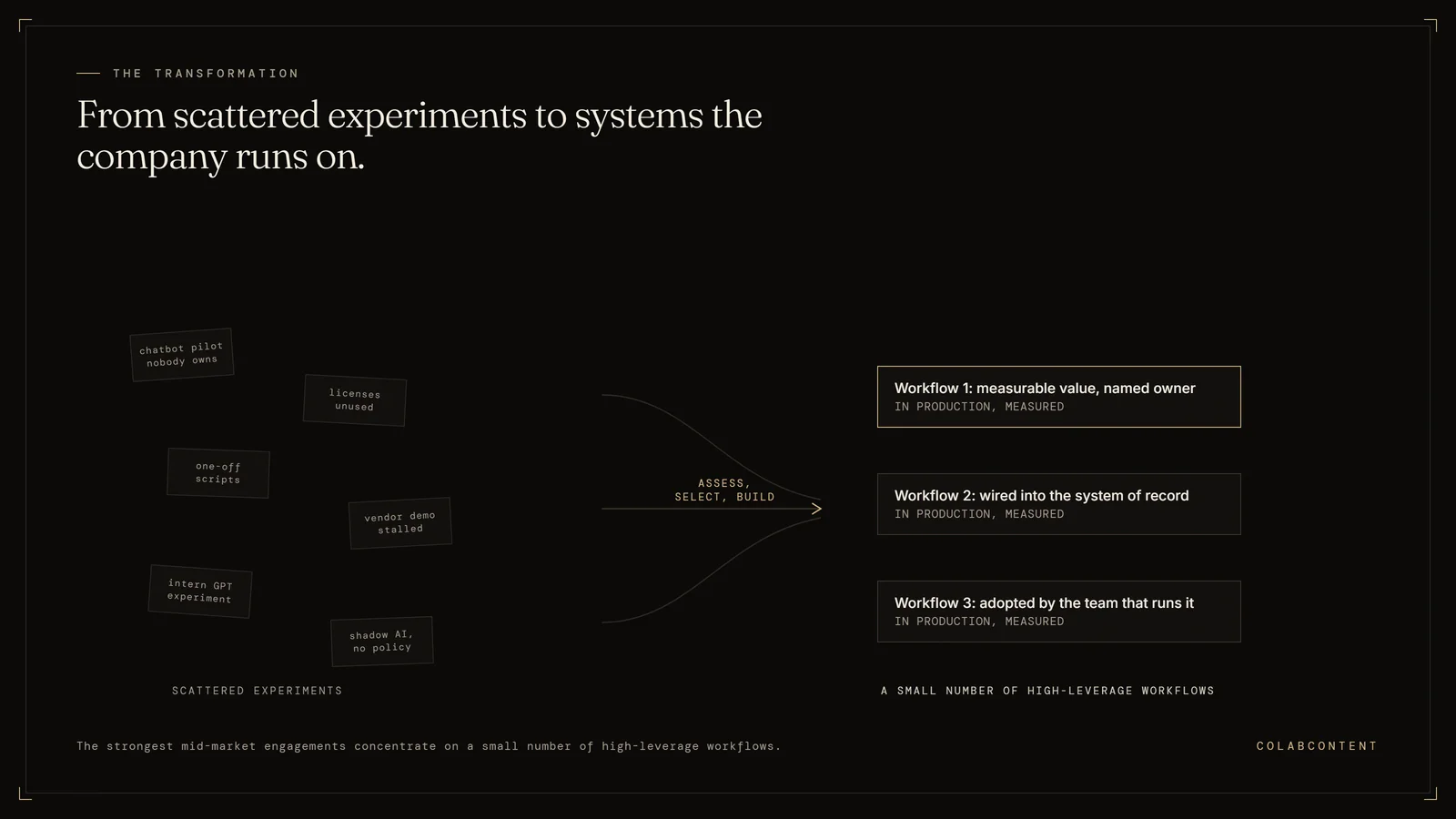
What AI transformation consulting actually covers
AI transformation consulting is broader than AI advice and narrower than a full digital transformation program. It covers the path from strategy to a working system: understanding how a business runs today, deciding where AI belongs in that picture, and then building and implementing the systems that make the change real. That last part matters. A slide deck describing an AI roadmap is not a transformation; a workflow that runs differently on Monday morning is.
Good AI transformation work sits at the intersection of three things: the business problem, the data and systems already in place, and the people who will use whatever gets built. Consultants who only touch one of those three tend to produce recommendations that stall. The ones worth hiring take responsibility for outcomes, not just analysis, and they define success in operational terms the business already tracks.
What a typical engagement includes
Engagements vary by firm, but most credible AI transformation work moves through a recognizable sequence:
- Workflow assessment. Mapping how work actually flows through the business, including the manual steps nobody documented.
- Value mapping. Identifying which workflows carry enough volume, cost, or error risk to justify AI investment.
- Solution design. Deciding what to build, what to buy, and what to leave alone, with clear reasoning for each.
- Implementation. Building or configuring the system, integrating it with existing tools, and testing it against real work.
- Adoption and training. Getting the team to use the system as part of normal operations, not as a side experiment.
- Measurement. Tracking whether the change produced the operational result it was supposed to produce.
If a prospective consultant skips the assessment and jumps straight to a tool recommendation, that is usually a sign they sell the tool rather than the outcome.
How mid-market AI transformation differs from enterprise programs
Large consultancies structure AI transformation as multi-year enterprise programs with steering committees, phased governance models, and large blended teams. That structure fits companies with thousands of employees and dedicated transformation offices. It fits poorly at a mid-market firm where the owner or a small leadership team sits close to operations and needs results inside a planning cycle they can actually see.
Mid-market AI transformation works better when it is scoped tightly: one or two workflows with clear economics, a build that integrates with the systems already in place, and a team small enough that accountability is obvious. The tradeoffs between hiring a large firm and commissioning a focused build are covered in detail in Big Four AI consulting vs a boutique AI commission. The short version: the mid-market rarely needs the program; it needs the system.
Where AI transformation creates value in a mid-market business
The workflows that reward AI investment share a profile: high volume, repeatable structure, and meaningful cost when done slowly or done wrong. Common candidates include:
- Document-heavy intake and processing. Contracts, applications, claims, and client files that staff currently read and re-key by hand.
- Knowledge retrieval. Making the firm's accumulated documents, precedents, and institutional knowledge searchable and usable instead of buried in shared drives.
- Revenue operations. Lead handling, proposal preparation, and pipeline hygiene that sales teams do inconsistently under time pressure.
- Content operations. Producing and maintaining the client-facing and internal content the business depends on.
- Back-office workflow automation. The scheduling, routing, reconciliation, and follow-up steps that consume administrative hours.
The right starting point differs by industry and by firm. The point of the assessment phase is to find the workflow where the economics are strongest, not to apply AI everywhere at once.
Three paths: consultants, internal hires, and commissioned builds
Businesses considering AI transformation typically weigh three options. The first is a traditional consulting engagement, where a firm advises and sometimes implements. The second is an internal hire, bringing AI capability onto the payroll. The third is a commissioned build, where a specialist scopes, builds, and hands over a working system the business owns.
Each path fits a different situation. An internal hire makes sense when AI work will be continuous and central to the product. A commission makes sense when the business needs a specific system built well without carrying a permanent salary. The comparison is laid out in internal AI hire vs a commissioned custom AI build, and the broader decision framework, including when buying off-the-shelf software is the right call, is covered in the build, buy, or commission framework. Deciding the path before choosing a vendor prevents the most expensive category of mistake: hiring the right firm for the wrong job.
How to evaluate an AI transformation consultant
Before signing an engagement, ask questions that separate implementers from presenters:
- Can you show a system you built that is still in daily use, and can I talk to the operator who uses it?
- What will exist in my business at the end of the engagement that did not exist at the start?
- Who owns the system, the prompts, and the data pipelines when the engagement ends?
- What happens when the underlying AI models change? Who maintains the system?
- What would make you tell me not to build something?
That last question matters most. A consultant with no examples of projects they declined or descoped is optimizing for billable scope, not for your outcome. A simpler filter for the whole buying decision is described in the two questions framework, which reduces vendor evaluation to the two answers that actually predict whether an AI project pays off.
What AI transformation consulting is not
The label gets attached to a lot of work that does not deserve it, so it helps to name the impostors. AI transformation is not a tool reseller relationship, where the consultant's recommendation always happens to be the product they get paid to place. It is not a training workshop that leaves the team inspired but the workflows unchanged. It is not a chatbot bolted onto a website, and it is not a dashboard project that reports on problems without fixing any of them.
It is also not a promise to replace staff wholesale. In most mid-market businesses, the realistic gains come from removing repetitive steps from existing roles so the same team handles more work with less friction. Any consultant leading with headcount elimination before they have mapped a single workflow is selling a narrative, not a plan.
Getting started with AI transformation
The lowest-risk way to begin is with an honest assessment of where the business stands: which workflows consume the most hours, where errors cost real money, and what data already exists to work with. From there, scope one system with clear success criteria, implement it, measure it, and let the result inform the next decision. Transformation compounds; it does not have to arrive all at once.
ColabContent works with mid-market businesses from its base in Boston, MA, commissioning custom AI systems scoped to specific workflows. The full engagement structure, from scoping through handover, is documented step by step in how a custom AI commission runs. Reading that before talking to any vendor, including this one, is a reasonable way to calibrate what a serious engagement should look like.
What to require in the first statement of work
The fastest way to test whether an AI transformation consultant matches this page's description is to read what they are willing to commit to in writing. A statement of work worth signing names the specific workflow being transformed, not a practice area; states what data access the client will provide and by when; commits to a working-software milestone with a date, even if the first version runs behind a human review step; and defines the measurement, meaning the baseline number being improved and who signs off that it moved.
Two more clauses separate a transformation partner from a report vendor. Ownership: the statement of work should say, in plain language, who owns the code, prompts, and configurations at the end, because a transformation the client cannot operate independently is a subscription wearing a consulting engagement's clothes. And exit: what the client holds if the engagement ends at each milestone. A firm that resists these clauses is telling you which of the three paths described above it really sells. A firm that accepts them has priced real delivery into the engagement, which is precisely what you are paying a transformation consultant for.
Use the statement of work as an interview instrument, not just a contract. Sending these clauses to two or three candidate firms before selection, and watching which ones accept, redline, or deflect them, tells you more about how each firm actually operates than any case-study deck. The firm that pushes back on a working-software date but accepts the measurement clause is a strategy shop that measures well. The firm that accepts the date and the ownership clause without flinching builds for a living. Match what they sign to what you actually need, and most of the selection risk in this category disappears before the engagement begins.
Frequently asked questions
What does an AI transformation consultant do?
An AI transformation consultant assesses how a business operates, identifies workflows where AI can create measurable value, and then designs and implements systems to capture that value. The role spans strategy and execution. Credible consultants take responsibility for a working outcome, not just a recommendation document, and they define success in operational terms the business already measures.
How is AI transformation consulting different from general AI consulting?
General AI consulting often stops at advice: assessments, roadmaps, and tool recommendations. AI transformation consulting includes the implementation work that changes how the business actually operates. The distinction matters when evaluating vendors, because advice without implementation frequently stalls, and the business is left with a plan it lacks the capability to execute.
Do mid-market businesses need AI transformation consulting?
Not always. Some mid-market businesses are well served by off-the-shelf software, and some should hire internally. Consulting or a commissioned build makes sense when the business has a specific high-value workflow that generic tools do not fit, and when it lacks the internal capability to design and build the system itself.
Should we hire an internal AI lead instead of a consultant?
It depends on whether AI work will be continuous or project-shaped. An internal hire fits businesses where AI is central to the product and the work never ends. A consultant or commissioned build fits businesses that need specific systems built well without carrying a permanent specialist salary. Many firms combine both over time, commissioning first and hiring later.
What should an AI transformation engagement deliver at the end?
A working system in daily use, documentation of how it operates, clarity on who owns the system and its data, and a maintenance plan for when underlying models change. If the deliverable is primarily a strategy document or a set of recommendations, the engagement was advisory, not transformational, and the implementation risk still sits entirely with the business.
Book the diagnosis call.
Forty-five minutes, no slides. We walk one real workflow end to end, name the step eating the most staff hours, and tell you plainly whether a custom build is the right lever for it. If an off-the-shelf tool would serve you better, we say so on the call.
See the fee bands → Or book directly →Where to look next.
Three pages carry the specifics this one summarizes. The commission process runs the five phases between the first call and code handoff, including the working prototype built on your own data before any fee is owed. The pricing page publishes the fee bands rather than making you ask. And the AI maturity assessment walks the five stages, which is worth reading before you spend a dollar with anyone.
Every published side-by-side lives on the comparisons hub, the industry practice pages cover the workflows most often commissioned in each vertical, and contact is the direct route if you already know what you want scoped.