Why two questions?
We tried more. For the first year of ColabContent, our audit calls had twelve questions, organized across four "pillars", tech, data, process, people. Very consultant. Very McKinsey deck.
It didn't work. Not because the answers were wrong, but because the questions were diffuse. By the end of a 90-minute call, we had a pile of observations and no prioritization. The owner had a pile of observations too, and often left the call more anxious than they started.
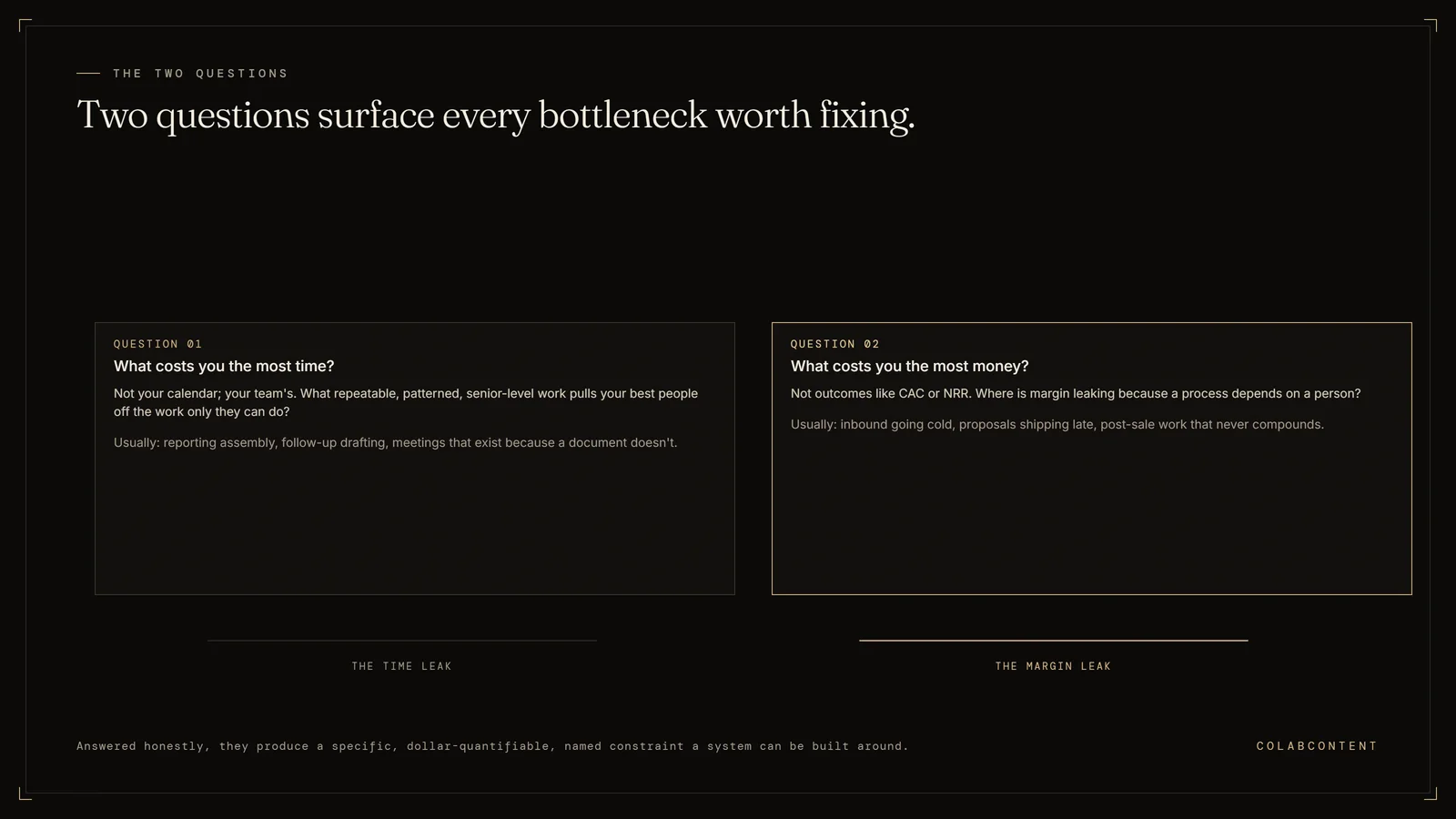
So we cut back. The cut we kept was ruthless: the only two things worth asking are "what costs you the most time" and "what costs you the most money." Every other question is a variation on one of these, or is answering a question you haven't earned the right to ask yet.
Question one: what costs you the most time?
This is the easier of the two. Owners know it in their bodies. They feel it on Sundays when they're prepping the week. They feel it when they look at their ops lead and see burnout forming.
The trap is in the word you. Most owners answer the question about their own calendar, but their calendar isn't the constraint; their team's is. The better phrasing is: "what repeatable, patterned, senior-level work is pulling your best people off the work only they can do?"
The answers are usually three things: reporting assembly (Monday-morning dashboards rebuilt every week), follow-up drafting (emails, recaps, proposals), and meetings that exist because a document doesn't.
Question two: what costs you the most money?
This one is harder, because owners often misdiagnose it. They answer "our CAC is too high" or "our NRR is flat", which are outcomes, not causes. The real question is: "where is margin leaking because a process depends on a person?"
The answers are usually three things: inbound that goes cold before a human touches it, proposals that ship late and lose deals, and post-sale work that doesn't compound into retention because no one has time.
Why this works
These two questions, answered honestly, produce a specific, dollar-quantifiable, named constraint. And a specific constraint is something we can build a system around. A vague anxiety isn't.
Try this at your next leadership offsite. Ask each exec the two questions. Write the answers down. Compare. The pattern will be painful, and it will tell you exactly where the next six months of leverage lives.