Home/ Best/ PE-Backed Portfolio Companies

The best AI and automation consultants for PE-backed portfolio companies in industrials, distribution and field service.

For a PE-backed portfolio company in industrials, distribution or field service, there are six real options for the AI and automation layer and only six: an in-house hire such as a VP of data, a Big Four or large consultancy, a sponsor-network operating partner, a boutique commissioning house like ColabContent, a staffing or offshore development shop, and a deliberate decision to do nothing this year. This page is written for the operating partner, the portfolio-company CEO and the value-creation lead at a platform in roughly the $20 million to $150 million revenue band that has bought two or more add-ons sitting on different systems. It is not written for a sponsor whose platform is above about $500 million in revenue, where a large firm's bench and brand cover are worth what they cost, and it is not written for a single-site operating company with one ERP and no acquisition pipeline, where most of the problems described below simply do not exist yet. ColabContent commissions fixed-fee builds at $45,000 to $180,000, one time, with the code owned by the operating company at handoff. Across every voice system we have commissioned the total is more than 6,000 AI-handled calls, across more than 40 commissions, and the client we can name is Jim Glaser Law, who takes reference calls.

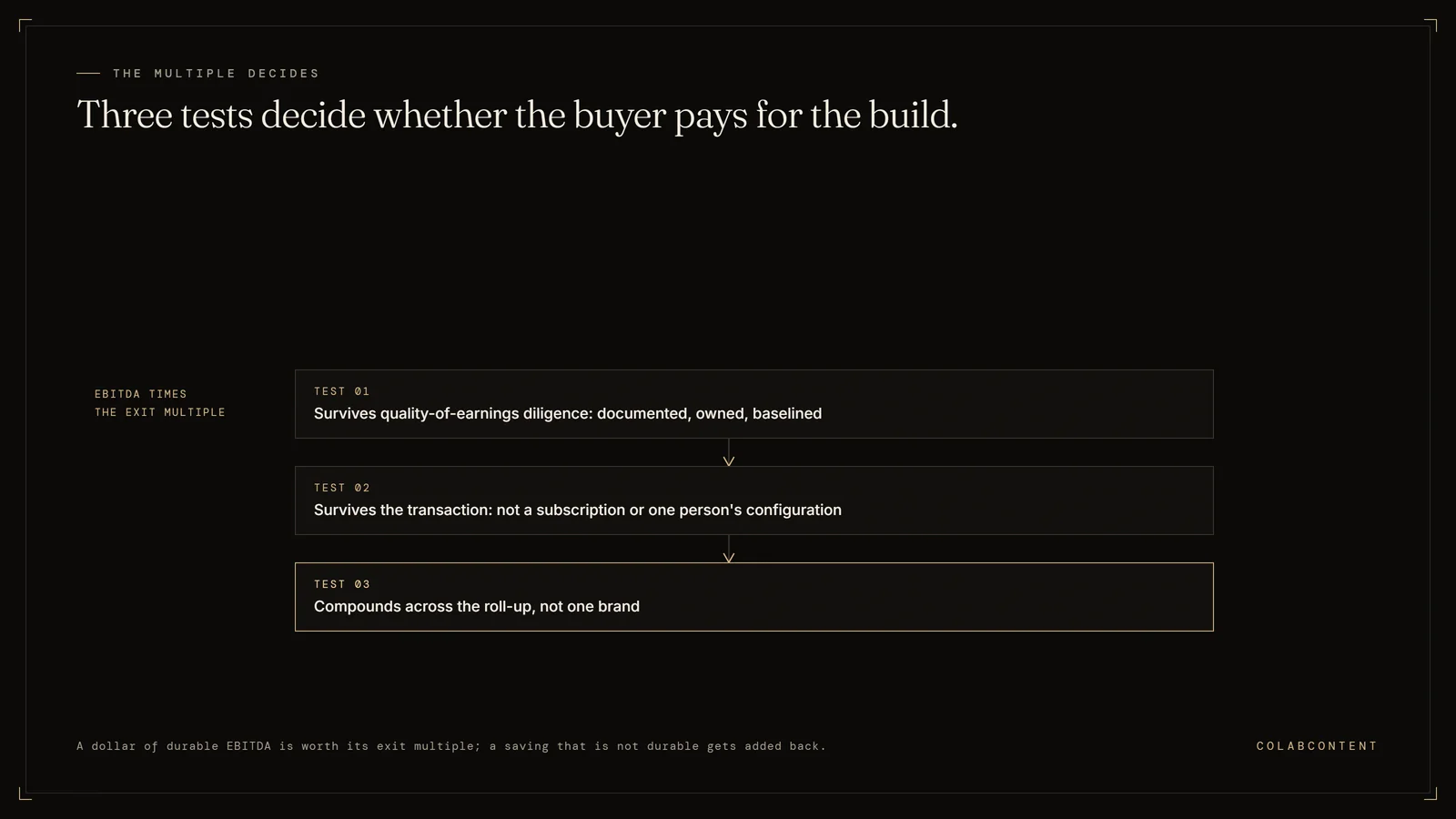
Diagram headed Three tests decide whether the buyer pays for the build. Test 01: it survives quality-of-earnings diligence because it is documented, owned and baselined. Test 02: it survives the transaction because it is not a subscription or one person's configuration. Test 03: it compounds across the roll-up rather than sitting inside one brand.
A dollar of durable EBITDA is worth its exit multiple. A saving that is not durable gets added back.

Written for the sponsor and the platform CEO, not for a software shortlist. Six options, each with the case where it genuinely wins against us, plus what the post-acquisition data work actually involves, what quoting automation replaces at a multi-brand distributor, and the week-by-week shape of the first hundred days.

Written forOperating partners and portfolio CEOs
Platform band$20M to $150M revenue
Options comparedSix, including doing nothing
Our fee$45K to $180K, one time
Bias disclosureWe are one of the six
Sources readAugust 29, 2026

The short answer.

If a platform has closed two or three add-ons and they are sitting on different systems, the first engagement is almost never an AI build. It is a data consolidation and reporting layer built across the systems the acquired companies already run, because that is the only thing that produces a board-grade cross-entity number on the timeline the sponsor is actually being held to. Once that layer exists and the numbers reconcile, the automation work becomes buildable rather than guessed at: quoting and bidding for the distribution and manufacturing brands, call handling and dispatch for the field-service brands, and anomaly detection across entity-level margin for the operating partner who does not want to open four dashboards.

Who does that work depends on three things, in this order. How long is the hold. How specific is the constraint. And who is going to own the roadmap after the first system ships. A five-year hold with an ongoing acquisition pipeline and a general mandate to modernize argues for a permanent hire. A three-year hold with one named constraint and a board date attached to it argues for a commission. A platform whose sponsor already runs a portfolio-wide program argues for using that program before commissioning anything at all. And a platform mid-cutover on a payroll migration argues for waiting, which is a real answer and appears as its own option below.

One warning about the reading you will do around this decision. Almost every guide published on post-acquisition system integration is written by a firm that sells the integration, and almost every statistic about quoting automation is published by a company that sells quoting automation. That does not make the numbers wrong. It does mean every figure on this page carries the name of who published it, and the ones that came from a party with something to sell are marked REPORTED rather than presented as settled fact. We are a party with something to sell too, which is why our own lane below carries its weaknesses in the same paragraph as its strengths.

The honest field

Six options, and when each one beats us.

Listed in the order a sponsor should actually consider them, which is not the order that flatters us. We are fourth. Each option carries the case where it genuinely wins and the weakness that decides against it, including our own.

01In-house hire (VP of data, or an automation lead).A permanent senior hire who owns the platform's data and automation roadmap outright. The cost is the least interesting part of the decision and the most argued about, so here are the actual live figures rather than one flattering number. Read on August 29, 2026: Salary.com puts a VP of data analytics at an average of $242,403 with a range of $186,765 to $288,493; ZipRecruiter puts the average at $178,912 with a middle band of $133,000 to $213,000; Glassdoor puts the average at $275,051 with a middle band of $208,185 to $370,578. REPORTED All three are salary aggregators rather than a wage survey, and they disagree with each other by roughly a hundred thousand dollars, which is itself the finding. Add employer taxes, benefits, tooling and recruiting cost on top of whichever number you believe.

Pick this when the hold horizon is five years or longer, the sponsor expects the platform to keep acquiring for several more years, and owning the roadmap matters more than shipping the first system quickly. Also pick it when the platform has enough recurring analytical work to keep a senior person busy after the first project lands, because the failure mode of this hire is not incompetence, it is under-employment.

The real weakness is the ramp. The pattern that recurs across write-ups of AI programs inside sponsor-backed companies is that a first in-house data leader spends most of a year building foundations before the first production workflow ships. On a three to five year hold that is a large fraction of the period the sponsor is being measured on, and the first board cycle will arrive long before the first system does.
Permanent hireOwns the roadmap
02Big Four or large consultancy.The firms that already appear in the deal, usually through diligence, and can extend into integration and value creation. What you are buying is bench depth, process, global coverage and a name that survives an investment committee. That is genuinely worth money on a large platform.

On cost, general management consulting is reported at $250 to $500 an hour, or a percentage of deal value on broader mandates, and a Big Four quality of earnings report on its own is reported at $30,000 to $80,000 by QoE providers including bedrockqoe.com and ctacquisitions.com. REPORTED Those publishers sell into the same market, so read the figures as the going rate they observe rather than as an audited benchmark. Consulting-industry directory sites also report that private equity engagements rarely make economic sense below roughly $50 million of EBITDA; that is one class of source rather than a verified threshold, and it is stated here as REPORTED for exactly that reason.

Pick this when the platform or the sponsor's broader portfolio is large enough that a multi-hundred-thousand-dollar engagement is a rounding error against the value at stake, when there are enough stakeholders that political cover has real value, or when the work genuinely needs a bench of thirty people in five countries at once.

The real weakness for a $20 million to $150 million platform is structural rather than a criticism of the work. A large firm staffs a pyramid, so the partner who sold the engagement is rarely the person writing the integration code. And a quality of earnings report, which is what most sponsors have actually bought from these firms before, is a financial deliverable. It is not an operating system that runs on Monday morning.
Large firmBench, brand, pyramid
03Sponsor-network operating partner (including the AI operating partner).A resource that sits at the fund rather than at the company. Executive search firms including Korn Ferry and Heidrick and Struggles have written about the emergence of the AI operating partner, full-time or fractional, with a mandate across the whole portfolio. REPORTED Vista Equity Partners publishes the most detailed public version of the model, describing what it calls an Agentic AI Factory: a fund-level platform built to scale agentic AI across its portfolio, giving its companies early access to tooling, engineering collaboration and go-to-market channels. Those are Vista's own published materials about Vista's own program. Read them as the stated intent of an interested party, not as an independently verified industry benchmark, and note that the program is built for a fund whose companies are enterprise software businesses at a scale well above the band this page is written for.

Pick this when your sponsor already has one. It is the cheapest option on this page by a wide margin, because it is already funded, and the playbook has usually been pressure-tested at several other portfolio companies before it reaches yours. If the sponsor's program exists and you commission something bespoke without talking to it first, you will be asked why at the next board meeting.

The real weakness is availability and fit. A portfolio company cannot commission a fund-level function on its own schedule, so if the sponsor does not have one, this option does not exist for you. Where it does exist, it was usually built for the sponsor's most common sector, which for the funds publishing about it is software. An industrials or distribution platform with four acquired brands on four systems is not the shape that playbook was tuned against, and a fund-level standard can be a poor fit for a platform-specific constraint.
Fund resourceFree to you, if it exists
04Boutique commissioning house (this is us).Our lane, so read this section with the appropriate suspicion. A commissioning house scopes one named constraint, builds the system that removes it, and hands over the code. Fixed fee of $45,000 to $180,000, one time. A working prototype runs on the platform's real data inside 7 to 10 days, before any payment changes hands. Principal-led, with no account managers and no offshore hand-offs. The operating company owns the code, the prompts, the models, the datasets and the runbook at handoff, which means there is no seat count, no renewal and no assignment clause to unwind when the platform is sold.

The proof we can name is deliberately narrow. Jim Glaser Law runs a commissioned voice system built as channel-specific agents, so every answered call is attributed to the marketing channel that produced it; Jimmy takes reference calls, which is the only kind of proof we think is worth anything. LELF runs a commissioned platform. Across every voice system we have commissioned the total is more than 6,000 AI-handled calls, and across the practice as a whole more than 40 commissions. We do not publish anonymized before-and-after percentages, because you would have no way to check them.

Pick this when the platform sits roughly in the $20 million to $150 million revenue band, there is one named constraint rather than a general wish to do something about AI, a decision-maker can say yes without a committee, the system can run inside the operating company's own cloud tenant under NDA, and the fixed fee is real budget this quarter rather than next year's plan.

The real weakness, stated plainly. A commission solves the constraint it was scoped against and then it ends. It does not give the platform an ongoing roadmap owner, it does not carry fund-level standardization across a dozen portfolio companies, and it does not give an investment committee the brand cover a large firm's logo provides. If what the platform needs is a permanent function rather than a system, hire the function.
Fixed fee, ownedColabContent
05Staffing agency or offshore development shop.Contract engineering capacity, billed by the hour or by the month. Offshore rate-comparison sites report developer rates of roughly $15 to $120 an hour depending on region, with Eastern Europe around the middle of that spread and South and Southeast Asia at the bottom, and fully loaded managed-offshore cost of roughly $800 to $2,500 per person per month against $4,000 to $8,000 for a domestic equivalent. REPORTED Every one of those publishers sells staffing services, so the rates are the rates they are trying to win business at.

The number that matters more than the rate comes from the same sources and cuts the other way: the true landed cost is reported at 1.4 to 1.8 times the quoted rate once management overhead and ramp-up are priced in, so a $30 an hour quote behaves like $42 to $54 an hour in practice. That is the honest version of the arithmetic and it is published by the staffing industry about itself.

Pick this when the problem is genuinely a build-hours problem and someone has already written the specification. Extending an integration that already works, porting a proven pattern to a fourth acquired entity, building out screens against a settled data model: all good uses. It is also the right lane when the platform already has an in-house lead who can supervise the work and absorb the context.

The real weakness is that this option assumes the hard part is already done. The constraint most sponsor-backed platforms actually have is not a shortage of coding hours, it is that nobody has yet established which of five inherited systems is the bottleneck and what the correct data model across them looks like. Handing that question to a team that bills by the hour and has never seen your entities is how a cheap rate becomes an expensive year.
Build hoursNeeds a spec first
06Doing nothing this year.The option nobody puts on a consulting slide, which is why it belongs on this page. There is no external source for this lane and we are not going to pretend there is; the argument below is our own reasoning, offered as reasoning.

Pick this when one of three things is true. First, the platform is mid-cutover on something more urgent, a recent add-on's payroll or billing migration for instance, and the management bandwidth to adopt a new system genuinely does not exist. Second, the sponsor's near-term priority is stabilization rather than a new build, and a half-adopted system would be worse than none. Third, and most commonly, the leading constraint turns out on inspection to be a process problem, a staffing problem or a systems problem that no amount of AI would touch. That third case is real often enough that it is the first question we ask on a diagnosis call, and when the answer comes back that way we say so and the engagement does not proceed.

The real weakness is that deferring does not stop the leakage. Manual quote cycles, abandoned calls and reconciliation hours keep compounding against the existing baseline while the hold clock runs, and the platform arrives at the exit with the same drag it had at entry. The discipline that makes this a decision rather than a drift is naming a trigger condition instead of a date. Not "revisit in Q3", but "we scope this when the fourth add-on closes" or "we scope this the week the board asks for entity-level gross margin and we cannot produce it".
Deliberate deferralNeeds a trigger, not a date
Must-answer one

Post-acquisition data integration, in the order it actually gets done.

This is the question that arrives first and gets answered worst. A platform buys a second and a third operating company. One is on NetSuite, one is on QuickBooks with a bolt-on inventory tool, one is on a fifteen-year-old on-premise system that the founder's brother-in-law configured. The board wants a consolidated view. Somebody proposes putting everyone on one ERP. Eighteen months later the platform still cannot produce a clean entity-level gross margin and has spent seven figures.

The distinction that avoids that outcome is between transactional separation and analytical integration. Transactional separation means each acquired entity keeps processing its own orders, invoices and payroll where it already does. Analytical integration means the outputs of those systems are extracted, mapped to one chart of accounts and one entity hierarchy, and reported together. The board needs the second. It does not need the first solved to get it. proactivemgmt.com sets this framing out most clearly of the sources we read, and it sells a data-strategy engagement, so weigh it accordingly; the logic is checkable against your own systems in an afternoon regardless of who published it.

What the work actually is, in sequence

The order below is not a proposal template. It is the order in which each step becomes possible, because each one depends on the one above it.

StepWhat it means concretelyReported durationWhat it unblocks
1. Systems inventoryA written list of every entity and every system of record it runs: ERP, CRM, field service or dispatch, payroll, quoting, inventory. Including the spreadsheets, because there are always spreadsheets and they are always load-bearing.Days, if diligence scoped it. Weeks if it is being discovered after close.Everything. Nothing below can be scoped honestly without it.
2. Operational continuityPayroll runs, invoices go out, customers get served. Nothing is migrated, nothing is switched off, nothing clever is attempted.Days 0 to 30, and it outranks every other item on this list.The right to attempt anything else.
3. Master data harmonizationOne chart of accounts. One definition of a customer, a vendor and a product across entities. Entity hierarchy mapped, intercompany relationships identified.REPORTED 30 to 90 days, consistent across the PE-ERP vendor sources we read.Any consolidated number anyone is willing to sign.
4. Consolidation and reporting layerExtraction from each existing system into one place, mapped through the harmonized master data, producing cross-entity reporting without replacing any transactional system.REPORTED live cross-entity reporting in roughly 60 to 90 days on this path.Board reporting, covenant compliance, and the first honest look at entity-level margin.
5. Process standardizationThe operating processes behind the numbers converge: how a job is booked, how a quote is approved, how a receivable is chased.REPORTED 60 to 180 days, and it is organizational work more than technical work.The point at which automation is worth building, because the process it automates is stable.
6. The automation layerQuoting, dispatch, call handling, cross-entity anomaly detection. This is the part everyone wanted to start with.Our commissions run 4 to 6 weeks of production build after a prototype at day 7 to 10.The operating leverage the sponsor underwrote in the first place.
7. ERP standardization, if everMoving entities onto a single transactional platform.REPORTED 90 to 180 days and $75,000 to $250,000 for a scoped 2 to 5 entity implementation (erpforprivateequity.com, an Acumatica partner). Full entity-by-entity replacement is reported far higher, at 18 to 36 months per entity and $1.5M to $5M.Long-run simplicity, at a cost and on a timeline that has nothing to do with the sponsor's first board cycle.

Two of those rows deserve to be read together. Row 7 is what gets proposed. Row 4 is what gets the sponsor a number. The reported cost and duration figures for full ERP consolidation come from vendor and implementation-partner content collected in our research pass; no vendor publishes them as audited fact, so they are marked REPORTED and should be treated as the order of magnitude rather than a quote. The figures are still enough to settle the sequencing question, because the gap between 60 to 90 days and 18 to 36 months per entity is not a gap that better project management closes.

What it costs, and what actually moves the number

For a consolidation and reporting layer across three to five entities on different systems, the work sits inside our normal commission band of $45,000 to $180,000, one time. What moves a project toward the top of that band is not the number of entities and not the volume of transactions. It is the number of genuinely different data models being reconciled and the state of the master data underneath them. Three entities that all keep customer records in a recognizable shape is a different job from three entities where one of them tracks customers as job-site addresses and has four records for the same account.

The second cost driver is access. If the oldest system has no API and no supported export beyond a report writer, the extraction work is real engineering rather than configuration, and that shows up in the scope. This is worth surfacing in diligence rather than discovering in week three, and it is one of the few technical questions genuinely worth a data-room request.

The pressure that makes the sequence non-negotiable

Finance leaders at sponsor-backed companies are commonly expected to produce a consolidated financial view within 30 to 45 days of close for board reporting and debt-covenant compliance. REPORTED That is the standard framing across PE finance guidance including cfodive.com and zoneandco.com rather than a single audited study, but it matches what operating partners describe, and it is the reason a multi-year ERP program cannot be the answer to a question with a date attached to it. If a proposal's first milestone lands after the date the board already has in its calendar, the proposal is answering a different question.

If the platform is specifically a home services roll-up running field service management software across its brands, the vertical version of this decision, including which brands to standardize and when, is worked through in more depth on the page for PE-backed home services platforms and in the guide to field service management standardization for PE platforms.

Must-answer two

Quoting and bidding automation for distributors and manufacturers.

Of everything on this page, this is the area where the gap between what a multi-brand platform needs and what the software market sells is widest, and it is the area sponsors ask about most once the reporting layer is working.

What quoting automation actually replaces

Not "the estimator". The estimator stays. What gets replaced is a specific sequence of lookups that currently happens in a human's head and across four screens. A request for quote arrives, as an email, a PDF attachment, or a line-item list pasted into a portal. Somebody reads it and works out which catalog items the customer is actually asking for, which is harder than it sounds when the customer uses their own part numbers or a competitor's. Somebody pulls current pricing from the ERP. Somebody checks bill-of-material or routing data if the item is made rather than stocked. Somebody confirms inventory and lead time. Somebody applies the customer's contract pricing and whatever margin floor the platform has set. Somebody assembles a document and sends it.

Each of those steps lives in a different system with a different owner, and that is why the elapsed time is measured in days rather than minutes. Go Autonomous, which sells quote-processing software and therefore has an interest in the framing, puts the industry average at 24 to 72 hours, and says automated handling answers standard configurations in under an hour. It names no study behind either figure. REPORTED

Does speed actually change the win rate

Honestly: the available numbers are all published by companies selling the fix, and we are not going to launder them into facts. ChannelFlex, a quoting-automation vendor, publishes the claim that quoting within 24 hours is associated with materially higher win rates than a three-day-plus turnaround. Go Autonomous, which sells quote automation, states that the supplier who responds first and accurately wins a disproportionate share of the business even when price is roughly equivalent, without naming the study behind it. Both are REPORTED, both are self-interested, and neither should be the basis of a capital decision.

What is not in dispute is that you can settle the question in your own data in a week. Pull the last twelve months of quotes, bucket them by elapsed time from request to send, and look at the win rate in each bucket. If your own numbers do not show a relationship, the vendors' numbers are irrelevant to you and you should stop reading here. If they do, you now have a figure that survives a board meeting, which no vendor statistic ever will. That query is also the single most useful thing to run before any quoting engagement, ours included, and we ask for it on the diagnosis call.

What breaks, specifically, in a roll-up

A single-brand distributor with one catalog and one pricing scheme is well served by the horizontal product market, and it is a real market: Parspec, ChannelFlex, Distro, Mercura, Oracle CPQ, Mobileforce, Epicor CPQ, Infor CPQ, PROS and eRep are all real, commercially operating products. If that describes the business, buy one of them and skip the rest of this section.

A roll-up is a different shape. Three acquired brands mean three SKU taxonomies, three sets of customer-specific contract pricing, often three inherited quoting tools that do not talk to each other, and a sponsor-level margin floor that did not exist at any of the three when they were independent. The cross-brand matching problem, taking one inbound request and finding the right line items across every brand's catalog, is the part no single-catalog product solves, and buying three subscriptions to three products produces three islands rather than one capability. That is the specific case where commissioning the matching and pricing layer once, over whatever the brands already run, beats renting three of anything.

What good looks like

Independent of any vendor, a working quoting layer for a multi-brand platform does three things. It reads an inbound request in whatever form it arrives and matches line items to the catalog across every brand, not just one. It applies the correct customer-specific and brand-specific contract pricing automatically, including the margin floor the sponsor has set. And it produces a structured quote that a human reviews and sends, rather than sending autonomously.

That last one is a design constraint, not a limitation we are apologizing for. In distribution a wrong quote that gets accepted is a contract, and the cost of that error is public and immediate. Human review on the send is the correct posture for the first year of any quoting build, and any consultant proposing full autonomy on day one has not priced the failure mode. If the platform's manufacturing brands are already evaluating dedicated quoting products, the Paperless Parts alternatives comparison prices that specific decision, and the manufacturing hub covers the wider stack.

Must-answer three

Multi-location and multi-entity reporting for roll-ups.

The symptom is easy to recognize and hard to admit. By the time a platform has five or six operating companies, the finance team spends more of the month producing reports than analyzing them, and the reconciliation error rate starts showing up in audit letters once the third or fourth entity joins. Western Computer, an ERP reseller, describes that pattern more plainly than most; it sells the remedy, so read it as a vendor describing a market it understands rather than as research.

Underneath the symptom sit three mechanical problems, and they are worth separating because they have different fixes.

The accounting system was not built for this. QuickBooks Online does not natively consolidate across separate legal entities, which is why platforms that grew by acquisition end up with a consolidation layer bolted on regardless of who supplies it. REPORTED That is published by liveflow.com, which sells exactly that layer, though the underlying product limitation is checkable in the product itself rather than a matter of opinion. The same source reports that inconsistent charts of accounts, manual spreadsheet exports and intercompany reconciliation consume three or more days per close cycle at typical multi-entity companies.

The scope changes every time you buy something. Chart-of-accounts mapping and entity hierarchy have to be updated before any roll-up number from the new entity is trustworthy. This is the part that surprises platform CFOs: consolidation is not a project that finishes, it is a capability that has to absorb the next acquisition without a two-month gap in reporting. A consolidation layer built as a one-off for three entities and then extended by hand for the fourth is a layer that will break at the fifth.

Nobody has connected any of this to automation. Every vendor in this space sells the accounting layer, which is where the market's attention stops. What none of them address, and what an operating partner actually asks for, sits one step above: a first-pass consolidation memo drafted from the reconciled numbers rather than written from scratch every month, anomaly flags on entity-level margin drift so the drift is noticed in week two rather than at quarter end, and plain-language querying across entities so a question like "which brand's gross margin moved most last month and what drove it" gets answered without opening four dashboards.

None of that is buildable before the consolidation layer exists, which is why it appears at step six of the sequence above and not at step one. It is, however, the part that produces the operating leverage, and it is a good test of whether a prospective consultant has thought past the accounting software question.

Must-answer four

Diligence to day 100, on the clock a sponsor actually works to.

The cadence below is the pattern operators describe rather than one study's finding. It is consistent across PE finance and integration guidance including cfodive.com, zoneandco.com and the implementation-partner content we read, and where a specific duration is reported by those sources it is marked. What no source we found does is sequence the AI and automation layer into it explicitly, which is the part this page adds and the part that decides whether a build lands or floats.

WindowWhat the sponsor is doingWhere the automation work sits
Diligence, pre-closeData-room review, quality of earnings, confirming the thesis.Scope the systems inventory here. Which entity runs which ERP, CRM, dispatch and quoting tool, and whether the oldest one has any supported export path at all. This costs nothing in diligence and costs weeks if it is discovered in month two.
Day 0 to 30Operational continuity above everything: payroll, billing, customer service. First consolidated financial view for the board and for covenant compliance, commonly expected inside REPORTED 30 to 45 days.Nothing gets built. Master data harmonization starts in week one because it is the long pole, but no system is switched, migrated or automated in this window.
Day 30 to 90The 100-day value-creation plan is formalized with named owners and real authority. Master data harmonization runs, REPORTED at 30 to 90 days.The consolidation and reporting layer is built here. This is the engagement that should be commissioned first, because everything downstream depends on it and because it is the only thing that answers the board's question on the board's date.
Day 60 to 90Cross-entity gross margin and working capital become visible if the reporting-layer path was chosen. If a full ERP replacement was chosen instead, this window produces status updates rather than numbers.The automation scope gets written here, against real reconciled data, which is the first moment it can be written honestly. Anything scoped before this point is scoped on guesses.
Day 100The traditional checkpoint. What the platform can now see, and what the plan says happens next.Prototype of the first automation build, on the platform's own data. In our engagements that lands 7 to 10 days from a signed NDA and a data slice, before payment.
Day 100 to 200The part the hundred-day framing skips, and the part where operating leverage is actually created.Production build of the automation layer, 4 to 6 weeks in our engagements, then handoff of code, prompts, models, datasets and runbook. A usage check at 60 and 90 days after handoff, scheduled before the build starts rather than after.

The one rule that matters more than the calendar: do not scope the automation build before the day 60 to 90 data milestone is real. A system built on unreconciled multi-entity data will demo beautifully and fail in production, which is the most common and most expensive failure on this page and is covered in its own section below. If an add-on has just closed and the sequencing question is live right now, the PE add-on 100-day integration playbook works through what gets stabilized on day one, what has to be baselined by day 30, and which system decisions are better left past day 100.

Must-answer five

Why owning the build fits an asset that will be sold.

Start with what this argument is not. We are not going to tell you that owning your automation layer adds a specific number of turns to the exit multiple. We looked for a published figure that would support a claim like that and did not find one, and a live search run while writing this page returned software-company valuation multiples and nothing at all on the ownership question. Anyone who quotes you a multiple impact on this decision is making it up, and it is the most persuasive-sounding sentence available on the subject, which is exactly why it is worth refusing to write.

What is sourceable is the mechanism, and the mechanism is enough.

What a buyer's diligence actually looks at

A quality of earnings review examines the source, timing, repeatability, margin and contractual support behind the lines in the financials. That is standard M&A advisory framing rather than a single study, and it is the frame every disciplined buyer applies. Advisory publishers naming specific hidden-liability categories put vendor commitments alongside deferred obligations, unpaid commissions, customer credits and debt-like items; helloexit.com lists them in exactly those terms. REPORTED papermark.com makes the adjacent point about contract quality from the seller's side: revenue a counterparty can exit at short notice is treated differently by a disciplined buyer from revenue that is genuinely committed.

Turn that around and point it at the software your operating company consumes rather than the revenue it produces. A multi-year, auto-renewing, minimum-seat AI subscription with an early-termination penalty and a change-of-control clause is a vendor commitment of precisely the kind those advisors name. It transfers to the buyer at close unless someone spends deal time and negotiating leverage unwinding it. And there is a second-order problem that gets missed: a strategic or PE buyer with its own standard stack may well intend to rip that tool out post-close, at which point every dollar the platform spent on it during the hold produced no residual value at all, and the remaining contract term is a cost the buyer prices back to you.

What a commissioned build does differently

A fixed-fee build the operating company owns outright at handoff has no seat count, no renewal date, no assignment clause and no vendor to notify at change of control. In the diligence file it is a capitalized one-time cost with a documented deliverable attached, not a recurring obligation with a term. There is nothing for the buyer's counsel to unwind, and nothing that gets added back.

That is also what the three tests in the diagram at the top of this page are asking. Does the thing survive quality-of-earnings diligence, meaning is it documented, owned and baselined against a real before-number. Does it survive the transaction, meaning is it a durable capability rather than a subscription or one clever person's configuration that leaves when they do. And does it compound across the roll-up rather than living inside one brand. A saving that fails any of those three gets added back by the buyer's advisors, and a saving that passes all three is durable EBITDA. What that durable EBITDA is worth is the platform's own multiple, which we are not going to guess at on your behalf.

The question to ask any vendor, including us

"What does this contract look like in our diligence file in eighteen months?" A good answer names the actual terms without being pushed: seat counts, renewal mechanics, assignment and change-of-control provisions, what happens to the data and the models if the company is sold. A bad answer treats the question as premature. It is not premature. It is the only question on this page whose answer is fixed at signature and cannot be renegotiated later. The longer version of this argument, with the ownership economics laid out side by side, sits in renting AI versus owning it.

Selection criteria, with the reasoning

Six questions, and why each one separates a good answer from a polished one.

Can they name what specifically breaks when you connect three acquired entities, before you tell them?

The horizontal AI-consulting market sells capability. Your problem is not capability, it is entity-specific: a different chart of accounts in each company, a different definition of what counts as a customer, a different system of record with a different export path, and one entity where the product master is genuinely a spreadsheet.

A good answer names the specific reconciliation problem in your stack inside the first conversation, and asks which entity has the worst master data before proposing anything. A bad answer presents a generic transformation framework and asks what your goals are. The tell is whether the first fifteen minutes are about your systems or about their methodology.

Do they scope backward from your reporting dates, or forward from their project plan?

A sponsor has dated obligations that do not move for anyone's Gantt chart: a first consolidated view expected within roughly 30 to 45 days of close, a 100-day plan checkpoint, quarterly board reporting, covenant tests. Those dates are the actual specification.

A good answer asks for those dates early and builds the timeline backward from them, and will tell you which of them cannot be hit and what the fallback is. A bad answer opens with a six-week discovery phase and never asks when you need a number. A discovery phase that ends after the board meeting is not a discovery phase, it is a deferral.

Do they know what happens to this line in your diligence file at exit?

Covered at length in the exit section above. The short version: per-seat, auto-renewing and vendor-locked tools appear in a buyer's review as commitments to be priced, not as assets.

A good answer names its own contract terms unprompted, including seat counts, renewal mechanics and the change-of-control clause, and can describe what the line looks like in eighteen months. A bad answer treats exit as somebody else's department. A vendor who has not thought about the end of the relationship has not thought about the relationship.

Will they say do not build this when the honest answer is no?

The most repeated failure across everything we read on AI inside sponsor-backed companies is scoping a build before the data or the organization is ready for it. A firm whose revenue depends on every conversation ending in a statement of work is structurally unable to give you that answer.

A good answer volunteers a real scenario in which they would decline the engagement, without being asked, and it is specific enough to be checkable. A bad answer has no such scenario, or offers one so extreme it could never occur. Ask directly: what would you have to see today that would make you tell us to wait six months.

Who is actually writing the integration code, and what is subcontracted?

This matters more here than on a typical software project because the hard part is judgment about unfamiliar systems rather than build hours. Offshore rate-comparison publishers, who sell staffing, report that the true landed cost of contract engineering runs 1.4 to 1.8 times the quoted rate once management overhead and ramp-up are counted. REPORTED That multiplier is the honest arithmetic of a subcontracted build, published by the industry about itself.

A good answer names the individual who will be hands-on, states plainly whether any part is subcontracted, and does not mind you asking twice. A bad answer says "our team" and moves on. Our own answer, for the avoidance of doubt: principal-led, no offshore hand-offs, which is exactly why we cap how many commissions run at once.

Do they have a plan for the knowledge that is about to walk out the door?

Institutional knowledge held by departing acquired-company staff is a named, recurring risk in add-on integration research, and it is the risk that never appears on a project plan. The person who knows why the pricing logic has that exception is often on a short retention agreement, and when they leave the exception becomes an unexplained rule nobody dares change.

A good answer asks in the diagnosis call who at the acquired company actually knows how the current process works and what their retention timeline is, then treats that timeline as the real project deadline. A bad answer never asks, because the engagement was scoped against systems rather than against people. This is the single easiest criterion to check and the one most often failed.

What it costs

What an engagement costs, and how it is structured.

Fixed fee, $45,000 to $180,000, one time, for the whole commission. That is the only price we quote for ourselves and it does not change based on how many people at the platform end up using the system. There is no per-seat component, no proprietary runtime to license, and no annual renewal, because the operating company owns the result.

Where a specific engagement lands inside that band is decided by two things and not by three. The first is how many genuinely different data models have to be reconciled, which is usually a function of how many entities and how different their vintages are rather than how large the platform is. The second is integration depth, which has three levels and they are priced differently for good reason.

Integration depthWhat it doesWhy it is priced where it is
Read-only layerPulls structured records out of the existing systems and writes nowhere. Reporting, anomaly detection, consolidation.Lightest touch, fastest to ship, and the failure mode is a wrong number on a dashboard rather than a wrong record in the ERP. Most first engagements at a roll-up are this.
Bidirectional with human approvalDrafts records back into the system after a person approves them. Quotes, work orders, journal entries.The most common pattern and the right default. The review step is the whole safety model, and it is what makes a quoting build survivable in year one.
Autonomous closed loopCompletes a workflow end to end with no human in the loop.Reserved for tasks where the cost of an individual error is bounded and the audit trail is structured. We decline this scope more often than we take it.

How the engagement runs

Week 0. A forty-five minute diagnosis call. Both sides leave with the constraint written down in one sentence, or with an honest statement that it is not an AI problem. Either party can stop here at no cost, and a meaningful share of these calls end without an engagement.

Week 1. NDA signed, a representative data slice provided. The prototype is built on the platform's real data, not on synthetic examples, and the principal is hands-on.

Day 7 to 10. A working prototype ships and the platform watches it perform the constraint task on its own data before any payment changes hands. If the prototype does not perform to the diagnosis spec, nothing is owed and the platform keeps the work product.

Weeks 2 to 6. Production build. The principal continues to lead it. No account managers, no junior staff running the build, no offshore hand-offs, which is a deliberate constraint on how many commissions can run at once rather than a marketing claim.

Handoff. Code, prompts, models, datasets, runbook and integration documentation transfer to the operating company. Payment is in two installments, one at production-build start after the prototype works, one at handoff. Post-handoff stewardship is optional, small, transparent and droppable on thirty days notice, and if it is modelled at all for budgeting we model it at 15 percent of the build fee per year, which is an ASSUMPTION for planning rather than a standing contract term.

Against the alternatives, the comparison that decides it is rarely the running cost. The internal hire versus commissioned build comparison runs the first eighteen months side by side, and the Big Four versus boutique commission comparison does the same for the large-firm route.

What goes wrong

Six failure modes, each with the sign that shows up first.

Building the automation layer before the data foundation is stable.

The most expensive failure on this page, and the most common. A demo built on a curated data slice performs beautifully and then collapses against the fragmented reality of a post-acquisition environment. The consulting and research write-ups on AI inside sponsor-backed companies converge on the same two observations independently: that serious programs spend a long time on unified data architecture before attempting AI, and that proof-of-concept work is routinely done in controlled conditions that do not represent the acquired estate. REPORTED

The early warning sign: the consultant wants to start building before anyone can produce a clean, reconciled cross-entity number. If the question "what does gross margin look like across all three brands today" cannot get a straight answer on the first call, and the proposal proceeds anyway, the build is being scoped on sand.

Isolating the work in a skunkworks team or a CTO side project.

Named directly as a common pattern in the AI-in-private-equity write-ups: initiatives parked with an isolated team lack the operational integration required for impact at scale. REPORTED The system gets built, it is genuinely good, and it never becomes how work is done because it never had authority over how work is done.

The early warning sign: the person championing the build has no line authority over the teams whose workflow it is supposed to change. If the sponsor of the project cannot direct the dispatch supervisor or the sales manager to use the thing, the project has a communication plan where it needs a mandate.

Shipped and unused.

The adoption gap. Programs clear their build hurdle and then never reach the operators who would use them daily. This is the failure that looks like success in a status report, because every milestone was hit and the deliverable exists. The write-ups converge on adoption rather than technology as the deciding variable.

The early warning sign: the engagement is measured by whether the system got built rather than whether the team is using it 60 days later. If nobody has scheduled a 60-day and 90-day usage check before the build starts, nobody is going to schedule one after. We put those dates in writing at kickoff for exactly this reason.

Management bandwidth collides with the next add-on.

Named specifically in add-on integration literature: the platform's leadership is asked to run integration work streams while also running the operating business and preparing for the next acquisition, and synergy delays of 6 to 12 months are common even in integrations that ultimately succeed. REPORTED

The early warning sign: the automation build is being scoped by the same two or three executives who are simultaneously running diligence on the next target. Nobody in that position has the attention to adopt a new system, regardless of how well it is built, and the honest move is to shrink the scope to something one person can own or wait until the next deal has closed.

The knowledge leaves before the build does.

Departing acquired-company staff taking institutional knowledge with them is a named, deal-critical issue in add-on integration research. REPORTED Our own observation on top of that, offered as an observation rather than as research: if the scoping depends on interviews with a founder or an operations lead who is on a short post-close retention agreement, the knowledge-transfer window is the real project deadline, not the build timeline.

The early warning sign: it does not appear on the project plan at all, which is what makes it dangerous. Ask, in week one, whose retention agreement expires first among the people being interviewed, and put that date on the schedule next to the build milestones.

Choosing rip-and-replace when a reporting layer would have hit the date.

Covered in the sequencing section above. Full entity-by-entity ERP replacement is reported at 18 to 36 months per entity and $1.5M to $5M, while a consolidation layer over the existing systems is reported to produce live cross-entity reporting in roughly 60 to 90 days. REPORTED Both figures come from vendor and implementation-partner content rather than audited studies, but the gap between them is far too large to be a measurement artefact.

The early warning sign: the first recommendation on the table is to replace the ERPs, and it arrived before anyone asked what the sponsor's actual 100-day reporting requirement is. Standardizing the transactional systems can be a perfectly good decision in year two. It is almost never the answer to a question that has a board date attached to it.

Who should not hire us.

This is the section most consulting pages leave out, and leaving it out is why the rest of the page is hard to believe. Four profiles, and in each one we would tell you the same thing on a call.

A platform above roughly $500 million in revenue with a large stakeholder count. At that size the bench, the global coverage and the brand cover that a large firm provides are worth what they cost, and the political value of a recognized name in front of an investment committee is real rather than vanity. We are four to six weeks of principal-led build. That is the wrong shape for a program that needs thirty people in five countries and a steering committee.

A platform with a five to ten year hold and an ongoing acquisition pipeline and no data function at all. Commissioning a system into an organization that has nobody to own it afterwards produces a good system that decays. Hire the function first, or hire it alongside, and use a commission to ship the first thing while the hire ramps. If it is one or the other and the hold is long, hire.

A platform whose sponsor already runs a portfolio-wide AI program. Use it. It is already funded, it has been pressure-tested at other portfolio companies, and commissioning something bespoke without talking to it first is a conversation you will have at a board meeting instead of on your own terms. If the sponsor's program genuinely does not fit an industrials or distribution platform, that is a conversation worth having with the sponsor before it is a reason to hire anyone.

A platform that cannot answer, today, what gross margin looks like across all its brands. This one is the most common and it is not a rejection, it is a sequencing correction. If nobody can produce that number, the first engagement is the consolidation layer, not the automation build, and any consultant who takes an automation scope from you in that state is selling you something that will demo well and fail in production. We would rather tell you that on the first call than discover it in week four.

And the general version: if the diagnosis call establishes that the leading constraint is a process problem, a staffing problem or a systems problem that AI would not solve, we say so and the engagement does not proceed. We cap the number of commissions we run at once because the principal leads all of them, which means we are not optimizing for volume and can afford to be honest about a bad fit.

Questions

The eight questions sponsors and portfolio CEOs actually ask.

How long does it take to integrate an acquired company's systems after close?

Two clocks run at once and they do not agree. The reporting clock is short: finance teams at sponsor-backed platforms are commonly expected to produce a consolidated financial view within 30 to 45 days of close for board and debt-covenant purposes (REPORTED, the standard framing in PE finance guidance published by cfodive.com and zoneandco.com, not a single audited study). The systems clock is long: a genuine entity-by-entity ERP replacement is reported at 18 to 36 months per entity and $1.5 million to $5 million, and even a scoped multi-entity implementation covering two to five entities is published at 90 to 180 days and $75,000 to $250,000 by erpforprivateequity.com, an Acumatica implementation partner that sells the work it is pricing. No single project satisfies both clocks. The sequence that does is a consolidation and reporting layer built across the existing systems first, which puts live cross-entity numbers in front of the board in roughly 60 to 90 days, with the question of whether to standardize the ERPs deferred until after the first full board cycle. The part that genuinely cannot be compressed by spending more money is master data harmonization, meaning one chart of accounts and one definition of a customer, a vendor and a product across every entity. Budget 30 to 90 days for that and start it in week one.

Do we have to put every acquired brand on the same ERP, or is there a faster way to get one management view?

There is a faster way, and the distinction that unlocks it is transactional separation versus analytical integration. Transactional separation means each acquired entity keeps running its own orders, invoices and payroll in whatever system it already has. Analytical integration means the numbers those systems produce are extracted, mapped to one chart of accounts and one entity hierarchy, and reported together. You need the second one for the board. You do not need the first one solved to get it. That framing is set out plainly by proactivemgmt.com, which sells a data strategy engagement and therefore has an interest in the answer, but the underlying logic is checkable against your own systems in an afternoon. The practical consequence is large. A reporting layer over three or four existing ERPs is a 60 to 90 day project measured in tens of thousands of dollars. Forcing four entities onto one ERP is a multi-year, seven-figure program that will not produce a single board-grade consolidated number until well after the sponsor needed one. Standardizing the ERP can still be the right call later, once the platform has stopped acquiring for a while and the operating processes have converged. It is almost never the right first move, and the fastest way to tell a good advisor from a bad one is whether replacing the ERPs is their opening recommendation.

How much does it cost to automate quoting for a distributor with multiple brands or catalogs?

Two answers, because there are two motions. Buying a horizontal configure, price and quote product is per-seat or per-user subscription spend that recurs forever and is typically calibrated to one catalog and one pricing logic, which is what a single-brand distributor has and a roll-up does not. Commissioning the cross-brand layer is a one-time fixed fee, and for the work we take on that band is $45,000 to $180,000 depending on how many catalogs, pricing schedules and inherited quoting tools have to be reconciled. The variable that moves the number most is not the volume of quotes, it is the number of distinct pricing logics inherited from the sellers. Three acquired brands with three contract-pricing schemes and three SKU taxonomies is a harder problem than ten thousand quotes a month against one clean catalog. The honest version of the arithmetic is that a subscription is cheaper in year one and the owned build is cheaper somewhere in the middle of a typical hold period, and the deciding factor is usually not the running cost at all. It is whether a per-seat contract with a renewal clause and a change-of-control provision is a line you want sitting in the diligence file when the platform is sold.

Why do our reps take days to turn around a quote, and does automating it actually change win rates?

The days are structural, not a performance problem with your estimators. A complex quote in distribution or make-to-order manufacturing requires pulling current pricing from the ERP, checking bill-of-material or routing data, confirming inventory and lead time, applying the customer's contract pricing, and assembling a document, and each of those steps sits in a different system with a different owner. Go Autonomous, which sells quote-processing software and therefore has a commercial interest in the framing, puts the industry average at 24 to 72 hours and says automated handling answers standard configurations in under an hour, naming no study behind either figure. On whether speed changes outcomes, the honest answer is that the available numbers are vendor-published rather than independently audited. ChannelFlex, a quoting-automation vendor, publishes the claim that quoting within 24 hours is associated with materially higher win rates than a three-day-plus turnaround, and Go Autonomous states that the supplier who responds first and accurately wins a disproportionate share of the business even when price is roughly equivalent, without naming the study behind it. Treat both as directional and self-interested. What is not in dispute, because you can measure it in your own data this week, is your own current turnaround time and your own current win rate by turnaround bucket. Run that query before you buy anything.

Is it better to hire a VP of data in-house or commission the first build?

They are not substitutes and the sequencing question is the real one. On cost, the salary aggregators disagree with each other by roughly a hundred thousand dollars, which is worth saying out loud rather than quoting the number that flatters whichever side you prefer. Read live on August 29, 2026: Salary.com puts a VP of data analytics at an average of $242,403 with a range of $186,765 to $288,493; ZipRecruiter puts the average at $178,912 with a middle band of $133,000 to $213,000; Glassdoor puts the average at $275,051 with a middle band of $208,185 to $370,578. All three are REPORTED aggregator figures, not a wage survey. Add employer taxes, benefits, tooling and recruiting on top, then add the ramp. The pattern that shows up repeatedly in write-ups of AI programs inside sponsor-backed companies is that a first in-house data leader spends the better part of a year building foundations before the first production workflow ships. On a five to ten year hold that is a good trade, because the roadmap and the institutional knowledge stay in the building. On a three to five year hold it consumes a meaningful fraction of the period the sponsor is being measured on. The version that works in practice is a commission that ships the first system against the sponsor's actual reporting dates, and an in-house hire who inherits it and owns everything after.

What is the difference between hiring a Big Four firm and a boutique commissioning house for a mid-market portfolio company?

Scope, economics and who does the work. A Big Four engagement buys process, bench depth, global coverage and a name that survives an investment committee, and for a genuinely large platform with many stakeholders that is worth real money. The economics are the problem at mid-market scale. General management consulting is reported at $250 to $500 an hour or a percentage of deal value for broader mandates, and a Big Four quality of earnings report alone is reported at $30,000 to $80,000 by QoE providers including bedrockqoe.com and ctacquisitions.com, who are commercially interested in that market. Consulting-industry directory sites report that PE-specific engagements rarely make economic sense below roughly $50 million of EBITDA. That is a REPORTED figure from a single class of source rather than an audited threshold, but it points the right direction, and it is well above the platforms this page is written for. There is also a structural difference nobody advertises. A large firm staffs a pyramid, so the partner who sold the work is rarely the person writing the integration code. A boutique commission is the opposite trade: no bench, no global coverage, no brand cover for an investment committee, and the person who scoped the engagement is the person building it. Pick the pyramid when the deal is large enough to absorb it and the political cover is worth paying for. Pick the boutique when the constraint is specific, the decision-maker can say yes without a committee, and you want the code at the end.

What is an AI operating partner, and does our portfolio company need one?

It is a fund-level role, not a portfolio-company role, and that distinction decides whether it is available to you at all. Executive search firms including Korn Ferry and Heidrick and Struggles have written about the emergence of full-time and fractional AI operating partners inside private equity firms, with a mandate across the whole portfolio rather than inside any one company. Vista Equity Partners publishes the most detailed public version of the model, describing what it calls an Agentic AI Factory: a fund-level platform built to scale agentic AI across its portfolio, giving its companies early access to tooling, engineering collaboration and go-to-market channels. Those are Vista's own published materials about Vista's own program, so read them as a statement of intent from an interested party rather than as an independently verified benchmark, and note that the program is built for a fund whose companies are enterprise software businesses at a scale far above a $20 million to $150 million industrials platform. The practical answer for a portfolio company is simple. If your sponsor already runs a program like this, use it, because it is free to you and already funded. If your sponsor does not, this option does not exist for you and no amount of asking will conjure it, because a single portfolio company cannot commission a fund-level function on its own schedule.

What happens to an AI vendor contract when the company is sold?

It goes into the diligence file, and the terms decide whether that is a footnote or a negotiation. Buyer-side diligence looks at the source, timing, repeatability and contractual support behind revenue and cost lines, and M&A advisors publish specific categories of hidden liability that get scrutinized, including deferred obligations and vendor commitments. helloexit.com lists vendor commitments alongside unpaid commissions, deferred revenue obligations and debt-like items as exactly the sort of thing a buyer prices. papermark.com makes the adjacent point on contract quality, that revenue a counterparty can walk away from at short notice is treated differently from committed revenue by a disciplined buyer. Apply the same logic to the software your operating company consumes rather than sells. A multi-year, auto-renewing, minimum-seat AI subscription with an early-termination penalty and a change-of-control clause is a vendor commitment that transfers at close unless someone spends deal time unwinding it. A commissioned system the company owns outright has no seat count, no renewal, no assignment clause and nothing for the buyer's counsel to unwind. We are not going to attach an exit-multiple number to that difference, because we looked and no published study supports one. The mechanism is real and sourceable. The multiple is not, so we do not print it.

The specific next step

Bring the systems inventory.

Forty-five minutes, no slides. Come with one page listing every entity and the system of record it runs for finance, quoting, dispatch and payroll, plus the one number the board asks for that you cannot currently produce. We will tell you whether the first engagement is the reporting layer, the automation build, or nothing yet.

If the answer is nothing yet, we say so on the call and there is no invoice.

Book the diagnosis call Or read who does the work

Related reading.

If the platform is specifically a home services roll-up, the PE-backed home services page is the vertical version of this question, with the field service management stack, the multi-brand call routing problem and the named product market in that category worked through in detail. This page is the parent question across industrials, distribution and field service; that one is the answer for a single vertical.