AI Consulting for Manufacturers: What It Is and How It Works
AI consulting for manufacturers helps production-focused businesses assess their data, identify automation opportunities, and implement systems that reduce waste, improve quality, and surface operational insights. A complete manufacturing AI engagement follows four steps: (1) assess plant data sources across PLCs (programmable logic controllers, the machines that run equipment on the floor), MES (manufacturing execution system, such as Plex or IQMS), ERP, and SCADA (supervisory control and data acquisition) systems,(2) integrate OT (operational technology) data into IT systems with normalized timestamps and units.
(3) build role-based dashboards and alerts for maintenance, quality, and scheduling teams, and (4) automate prediction of equipment failures, defects, and supply risk using the plant's own historical data. The three provider paths differ sharply in cost and timeline: an internal AI hire is a full-time salary plus a multi-month ramp, and rarely covers OT integration, data engineering, and manufacturing domain in one person; a Big Four consultancy is a lengthy, multi-phase engagement billed at strategy-consulting rates; a boutique fixed-fee build costs from $10,000 one time (our published price) and ships a prototype on real plant data in 7 to 10 days (our published timeline), with code owned by the shop at handoff. This approach is not the right fit for plants with no digitized records (invest in basic digitization first), plants needing a standard CRM (customer relationship management software) or accounting tool (Epicor, NetSuite, or Sage handle that without custom AI), or leadership unwilling to grant data access. The bottom line for any manufacturer evaluating this decision: the investment pays off only when it produces working systems operators use every shift; strategy decks, roadmap documents, and dashboards that nobody checks are not outcomes worth paying for. ColabContent LLC publishes this page: a boutique AI consulting house in Boston that builds custom automation for job shops and contract manufacturers around 20 to 250 employees, a typical size for the businesses we speak with, not a rule. The $499 AI-Ready Audit comes first; after it, the system that matters most is proven as a working prototype on your own data before any build fee. The $499 AI-Ready Audit is ordered at colabcontent.com/ai-ready-audit/.
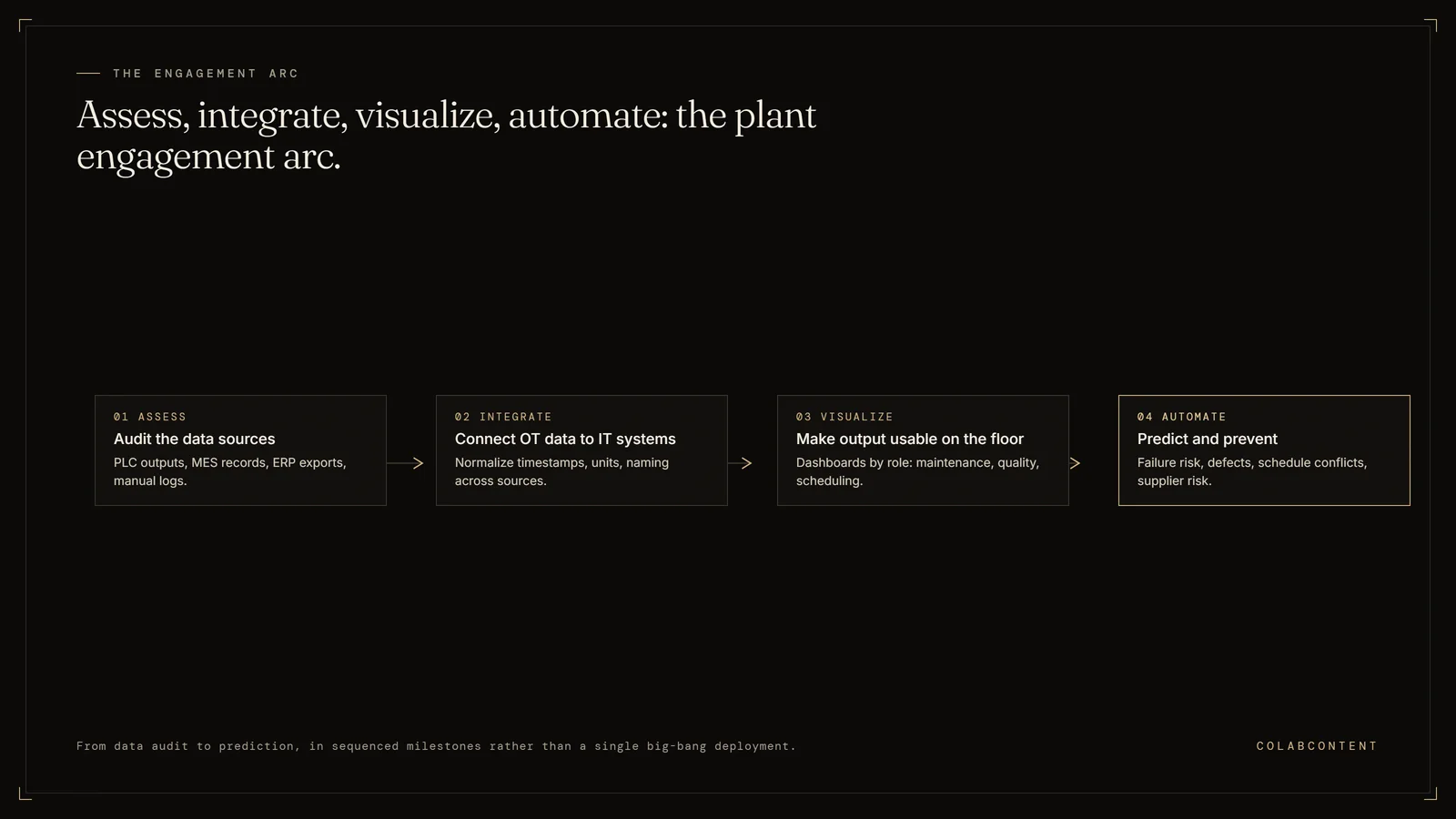
For mid-market plants. Assessing data readiness, unifying plant systems, and making AI output usable on the floor.
Why Manufacturers Are Turning to AI Consultants Now
Mid-market manufacturers sit in an awkward position: too complex for generic SaaS (software you rent by subscription) tools, but often without the internal data science teams that enterprise competitors employ. AI consultants fill that gap. They bring the technical depth to work with messy industrial data, the domain knowledge to understand production constraints, and the implementation experience to avoid the pitfalls that derail in-house AI projects.
The problems consultants are most often called in to solve include unplanned downtime, inconsistent quality, scheduling bottlenecks, and supply chain visibility gaps. These are not abstract problems. They show up on the shop floor every shift, and they are the right starting point for any AI engagement.
Before committing to a vendor or platform, it is worth reading the build-buy-commission framework to understand which path fits your situation.
Thinking About an AI System for Your Plant?
The first question a good AI consultant asks is not "what technology do you want?" It is "what decision do you need to make better?" That framing keeps projects grounded in operational reality rather than technology novelty.
Common starting points for manufacturing AI engagements include:
- Predictive maintenance: Using sensor and equipment logs to flag failure risk before a line goes down
- Quality inspection: Computer vision and AI vision systems that catch defects faster and more consistently than manual review
- Demand and production scheduling: Models that balance customer orders, raw material availability, and capacity constraints
- OEE analysis: Identifying hidden losses in overall equipment effectiveness using historical process data
- Supply chain monitoring: Surfacing supplier risk and lead-time variance before it disrupts production
If you are unsure where to start, the $499 AI-Ready Audit is a low-risk first step: it is designed for mid-market operators to clarify priorities before any budget is committed, and it comes with a full refund if you feel it did not deliver value.
Assess and Strategize: The Foundation of Every Engagement
A credible AI consulting engagement starts with an honest assessment of your data and operations, not a sales pitch for a predetermined platform. This phase typically covers:
- Audit of available data sources (PLC outputs, MES records, ERP exports, manual logs)
- Identification of the highest-value use cases based on cost, frequency, and data readiness
- Gap analysis between current data infrastructure and what a proposed AI system actually needs
- A realistic roadmap with sequenced milestones rather than a single big-bang deployment
This phase should produce a clear answer to whether custom-built AI, a commissioned system, or an off-the-shelf tool is the right fit. Those are meaningfully different paths. The two questions framework is a useful lens for sorting through that decision quickly.
Integrate and Unify: Connecting Your Plant Data
Manufacturing data is rarely clean or centralized. Sensor readings live in one system, quality records in another, and shift notes in a spreadsheet on someone's desktop. Before any AI model can deliver value, that data needs to flow to a place where it can be used together.
Integration work in manufacturing AI projects commonly involves:
- Connecting OT (operational technology) data from PLCs, SCADA, and sensors to IT systems
- Normalizing timestamps, units of measure, and naming conventions across sources
- Building pipelines that keep data current without requiring manual exports
- Establishing a data layer that serves both the AI models and your existing reporting tools
This is often the most time-consuming part of an engagement, and it is frequently underestimated by vendors who lead with model capabilities rather than data realities. The $499 AI-Ready Audit maps this integration surface before any build fee is committed.
Visualize and Act: Making AI Output Usable on the Floor
An AI model that produces outputs only a data scientist can interpret is not an operational asset. The visualization and action layer is what turns model predictions into decisions that plant managers, quality engineers, and maintenance teams can actually use.
Effective manufacturing AI deployments present outputs through:
- Dashboards tailored to specific roles (maintenance, quality, scheduling, plant management)
- Alerts that reach operators at the right time through the channels they already monitor
- Clear explanations of why the model flagged something, not just that it did
- Feedback loops so operators can confirm or correct model outputs, improving accuracy over time
The goal is to make good decisions faster, not to replace human judgment with a black box. ColabContent's commission process covers how this layer gets scoped and built.
Automate and Predict: The Longer-Term Payoff
Once data pipelines are solid and teams trust the AI outputs, automation becomes feasible. Predictive capabilities mature as models accumulate more operational data. This is the phase where AI moves from a reporting tool to an active part of operations.
Mature manufacturing AI systems can:
- Automatically adjust maintenance schedules based on real-time equipment health signals
- Trigger purchase orders or production adjustments when supply or demand signals shift
- Continuously update quality thresholds as process conditions change
- Route exceptions to the right person with the context they need to act
Reaching this stage requires the earlier phases to be done well. Skipping the assessment and integration work to jump straight to automation is one of the most common reasons manufacturing AI projects stall. For a fuller picture of the engagement model, see how a custom AI commission runs.
What Makes a Good AI Consultant for Manufacturers
Not every AI consultant understands manufacturing. General-purpose AI firms often lack the domain knowledge to distinguish a meaningful use case from an expensive distraction in a production context. When evaluating consultants, look for:
- Demonstrated experience with industrial data sources (PLCs, SCADA, MES, ERP)
- Willingness to start with an assessment rather than immediately proposing a solution
- Clear explanations of how they handle data that is incomplete, inconsistent, or delayed
- A track record of working with mid-market manufacturers, not just enterprise clients with dedicated data teams
- Honest guidance on what AI will not solve, which is as important as what it can
It is also worth understanding the difference between a firm that builds custom systems and one that resells packaged software. See big four AI consulting vs. boutique commission for a comparison of those models in a mid-market context.
The answer also changes with which function you are hiring for. Customer support, workflow automation, report generation, data analysis, compliance monitoring, technical content and implementation strategy are seven different engagements with different systems behind them and different price logic. See which AI consultant to hire for each function in manufacturing for what each one touches, what it costs, and when the right move is to hire nobody.
How ColabContent Approaches Manufacturing AI
ColabContent works with mid-market businesses, including manufacturers, to design and commission custom AI systems built around actual operational workflows rather than generic templates. The approach starts with understanding the decision you need to make better, then traces backward to the data, models, and interfaces that support it.
For manufacturers specifically, that often means working across the gap between operational technology and information technology, connecting plant-floor data to systems that can surface patterns and predictions that improve daily decisions. ColabContent does not resell off-the-shelf platforms. Every engagement is scoped to what the business actually needs.
You can explore the full range of custom solutions for mid-market businesses or review the 2027 Manufacturing AI Benchmark for context on where the industry is heading.
FAQs: AI Consulting for Manufacturers
These answers cover what AI consulting for manufacturers actually costs against hourly billing and Big Four engagements, how to vet a consultant before paying anything, and the practical questions an owner or plant manager raises before committing budget to a system built around production data rather than a generic platform. Where a question depends on your own plant's numbers, the $499 AI-Ready Audit report replaces the general answer with your own figures.
What does an AI consultant actually do for a manufacturing company?
An AI consultant assesses your operations and data, identifies the highest-value automation and intelligence opportunities, and then designs or implements systems to capture them. This includes data integration work, model selection, interface design, and change management guidance. The goal is operational improvement, not technology for its own sake.
How long does a manufacturing AI consulting engagement take?
Timelines vary based on scope and data readiness. An initial assessment can be completed in within weeks. A full implementation covering data integration, model deployment, and user interfaces typically runs several months. Phased approaches, starting with one use case and expanding, tend to deliver value faster than comprehensive multi-system overhauls.
What data do we need to have ready before starting an AI project?
You do not need perfect data to start. Most manufacturers have more usable data than they realize, spread across PLCs, MES (manufacturing execution system, the software that tracks work on the shop floor), ERP (the system that runs finance, inventory and orders), and quality systems. A good consultant will help you audit what exists and identify gaps. Starting with an assessment rather than a full build is the best way to understand your actual data position before committing resources.
Is custom AI better than off-the-shelf software for manufacturers?
It depends on the use case and how closely a packaged tool matches your specific workflow. Generic SaaS (subscription software) tools work well for standard problems with standard data. When your process, data structure, or operational context is distinctive, a custom or commissioned system tends to fit better and require less compromise. The build-buy-commission decision deserves deliberate analysis before any path is chosen.
What should I watch out for when hiring an AI consultant for our plant?
Watch for consultants who skip the assessment phase, propose solutions before understanding your data, or focus on platform capabilities rather than your specific operational problems. Also be cautious of engagements scoped primarily around dashboards and reports rather than decisions and actions. A consultant who cannot clearly explain what problem they are solving is a risk regardless of their technical credentials.
How much does AI consulting cost for a mid-market manufacturer?
AI consulting for mid-market businesses is one fixed fee from $10,000 as a custom build from ColabContent, billed in two installments rather than by the hour. The full fee bands lay out ColabContent's three tiers.
More detail
The pricing model matters as much as the number. Hourly billing rewards slow work, and platform subscriptions accumulate seat fees long after the vendor has stopped adding value. A fixed-fee commission against a written scope puts the scoping risk on the consultant: if the work was underestimated, that is the consultant's problem, not a change-order invoice for you.
ColabContent quotes commissions in three tiers that reflect the real distribution of its work:
- Focused Build, from $10,000, 4 to 5 weeks, one clearly defined system aimed at a single bottleneck
- Operations Rebuild, quoted after the $499 audit, 6 to 8 weeks, a multi-step end-to-end workflow with cross-system integrations, dashboards, and alerts
- Platform Commission, quoted after the $499 audit, 10 to 14 weeks, multiple coordinated systems with a custom UI and full observability
Payment comes in two installments, one at production-build start and one at handoff. There are no hourly rates, no seats, and no retainers dressed as subscriptions. Other boutique specialists price comparable custom work on their own schedules, so it pays to compare scopes line by line rather than headline numbers.
Optional care afterward is $997 a month, cancellable any time. It is always fixed and cancellable on 30 days' notice. A well-built system should not require it forever, and a consultant who insists otherwise is selling dependency, not capability.
How do you vet an AI consultant you have never worked with before?
Ask the consultant to prove competence before money changes hands. ColabContent builds a working prototype on your own plant data in 7 to 10 days (our published timeline) before any fee is due, quotes one fixed price against a written scope, delivers full source code at handoff, and the principal who scopes the work also builds it, starting from the $499 AI-Ready Audit.
More detail
References and case studies are useful when they exist, but they are also easy to inflate, and a newer firm may not have a long list to show you. The better test is structural: what does the consultant risk if they are wrong? A firm that asks for a six-figure commitment before demonstrating anything is asking you to carry all of the risk. A firm that builds a working prototype on your actual data, before any fee, has put its own time on the line and given you something concrete to judge.
Three terms in particular reduce your exposure. First, a fixed fee against a written scope, with the consultant absorbing any mis-scoping rather than issuing change orders. Second, ownership of the source code and architecture documentation at handoff, so the system is yours to maintain, extend, or hand to a future hire without permission from anyone. Third, principal-led delivery, meaning the person who diagnosed your problem is the person writing the code, not a sales engineer handing your project to a rotating bench.
You can also test domain understanding directly in the first conversation. Ask how they would reconcile timestamps between PLC (programmable logic controller, the small computer that runs a machine) logs and MES records that disagree. Ask what they would refuse to build. A consultant who has worked with industrial data will answer in specifics, and one who has not will retreat to generalities about transformation and innovation.
Is custom AI consulting actually a good fit for our plant?
Custom AI commissions fit mid-market manufacturers, established and owner-operated, that have recurring operational decisions tied to data already being generated by PLCs, MES, ERP, or quality systems. They are a poor fit for plants with no digitized records, buyers seeking a cheap subscription tool, or leadership unwilling to give a builder real access. The $499 AI-Ready Audit is the fastest way to find out which category a plant is in.
More detail
The strongest candidates share a profile. There is a specific, recurring decision that costs money when it is made late or badly: when to pull a machine for maintenance, which lots to inspect, how to sequence next week's orders. There is data being generated somewhere, even if it is messy and scattered. And there is someone with authority who can grant system access, answer questions about how the floor actually runs, and give honest feedback on early outputs. When those three things exist, a commissioned system has something real to work with.
The fit breaks down in predictable ways. If your records live entirely on paper and tribal knowledge, the first investment should be basic digitization, not AI. If your need is genuinely generic, such as standard accounting or a common CRM (customer relationship management software) workflow, off-the-shelf software will be cheaper and faster than anything custom. If you employ an internal data science team, you may only need targeted help rather than a full engagement. And if the goal is a system nobody on staff will touch or trust, the project will stall regardless of how well it is built, because the visualization and feedback layers depend on operator participation.
An honest consultant should tell you which category you fall into during the assessment, before a build is scoped. Being told a commission is the wrong fit is a cheap outcome compared to discovering it six months in.
Is it safe to give an outside consultant access to our plant data?
It can be, if the engagement is structured so you control what leaves the building. Scope the specific data sources needed, use read-only exports rather than opening OT networks, put confidentiality and data handling terms in the written scope, and confirm that all code and any data copies transfer to you at handoff. The $499 AI-Ready Audit starts by defining exactly which sources are in scope.
More detail
This concern deserves a straight answer rather than reassurance. Yes, an AI consultant will need to see operational data, and for manufacturers that data can reveal yields, costs, customer volumes, and process know-how that competitors would love to have. The question is not whether to share but how to bound the sharing.
Start with scope. A predictive maintenance project needs equipment logs and maintenance records; it does not need your customer list or pricing files. A consultant who asks for everything up front, before defining the use case, is signaling sloppiness. The assessment phase should produce a specific inventory of which sources are required and why, and the prototype phase can run on a defined sample rather than a live feed.
Then bound the access method. Plant-floor systems rarely need to be exposed directly. Read-only exports from PLC historians (databases that log equipment sensor readings over time), MES, and ERP keep the operational network isolated while still giving the builder what the models require. Put data handling terms in the same written scope that fixes the fee: where working copies are stored during the build, who can see them, and what happens to them at handoff.
Finally, ownership closes the loop. When the source code and the system transfer to you at delivery, there is no ongoing third-party dependency holding your data, and no vendor platform quietly retaining it to train someone else's product. Ask any consultant you evaluate to commit to that in writing.
What size manufacturers does ColabContent work with?
Specialty manufacturers $15M-$150M revenue. Custom-engineered, engineer-to-order, and made-to-order shops. We do not work with high-volume commodity manufacturing or aerospace primes.
Do you build inside Epicor Kinetic, NetSuite, ProShop?
Yes. We build on top of Epicor Kinetic, NetSuite Manufacturing, ProShop, JobBOSS, and Global Shop. The system reads your part library, your routings, your pricing rules, your customer history. No ERP migration.
How fast can quoting actually get?
Quoting time typically drops sharply, from hours down to minutes, once parsing and pricing lookups are automated. What remains is the senior estimator's judgment call, not the parsing or pricing-lookup work.
Does ColabContent serve specialty or general manufacturing?
Both, with stronger fit for specialty manufacturing where operations and constraints are distinctive enough that off-the-shelf AI does not fit.
How does ColabContent integrate with shop-floor systems?
We integrate via your ERP, MES, PLM (product lifecycle management software), or directly with PLCs and SCADA where appropriate. Each commission scopes its own integration plan.
What stack integrations does AI for specialty manufacturers need?
AI for specialty manufacturers integrates with Epicor Kinetic, JobBOSS, Global Shop Solutions, IQMS, Made2Manage. Integration uses the system-of-record's API (a software connection) layer for read-and-suggest workflows. ColabContent commissions integrations across all major stack components in this vertical.
What happens if the prototype does not perform well on our data?
You walk away without paying a fee. ColabContent builds the working prototype on your own plant data before any commission is committed, and the exact price is quoted only after the demonstration holds. The $499 AI-Ready Audit itself carries a full money-back guarantee if you feel it did not deliver value.
What does ColabContent need from us to get started?
To scope the prototype, ColabContent needs a short walkthrough of the target decision, read-only exports of the relevant plant data (PLC, MES, ERP, or quality records), and one point of contact who can answer operational questions during the build. Nothing is required before the $499 AI-Ready Audit call itself; the data request comes after, once a prototype is scoped.
Can AI replace staff at a manufacturer?
The leverage is in the cost of the next dollar of revenue, not in cutting staff: the system absorbs the queue nobody wanted, and headcount stays the owner's call.
Should we hire an in-house AI engineer instead of commissioning a consultant?
A single hire has to cover the entire stack alone: OT and IT integration, data pipelines, modeling, interfaces, and change management, and recruiting for that combination in manufacturing is hard. A commission delivers a working system that your existing team operates day to day. Because the code and architecture documentation are yours at handoff, a future in-house hire can maintain and extend the system rather than starting from zero.
What happens first if we contact ColabContent about a manufacturing project?
The first step is a diagnostic conversation focused on the decision you need to make better, not a technology pitch. From there, ColabContent builds a working prototype on your own operational data in 7 to 10 days, before any fee is due. You evaluate the prototype against your real situation, and only if it holds up does the engagement move to a fixed-fee, scoped production build.
Will an AI system eliminate jobs on our shop floor?
The systems described on this page are decision-support tools: they flag failure risk, surface quality issues, and route exceptions to the right person with context. Operators confirm or correct the outputs, which is how the models improve. The honest framing is that AI changes what people spend time on, shifting effort from manual data wrangling and reactive firefighting toward judgment calls the system cannot make.
Do we own the code at handoff?
Yes. Source code, architecture documentation, and any working copies of your data used during the build transfer to you at handoff. There is no ongoing license fee to keep running what was built, and a future in-house hire can maintain or extend the system without going back to ColabContent.
What is expected of you during the build?
A short walkthrough of the decision you want the system to support, read-only exports of the relevant plant data, and one point of contact who can answer operational questions while the prototype and then the production build are underway. Nothing is required before the $499 AI-Ready Audit call itself.
What the ERP you already run actually costs.
Most plants weigh the software bill before they weigh a build, which is the right order. Four companion pages price the systems instead of arguing about them, each built on published numbers with the source attached to every row. Global Shop Solutions alternatives and JobBOSS2 alternatives each run eight options against a fifteen person job shop, and both start from the same awkward fact: neither vendor publishes a price. Plex ERP alternatives does the same at the MES-heavy end of the category, where Plex Manufacturing Cloud starts at $500 per user per month, read from Plex's own pricing page in September 2026. NetSuite alternatives for manufacturers covers the shop Oracle has priced into $217,918 over three years at the conservative floor, as read from Oracle's own published rate card and sourced line by line on that page. If a commissioned build is the direction instead, the commission process and the fee bands are the next two reads, and the AI maturity assessment is worth running first.
Start with the $499 audit.
A $499 audit, then a 20-minute call. No slides. We walk the flow from order through scheduling, production and quality sign-off, name the step costing the most hours, and tell you whether a build is the right lever for it. If packaged software would serve the plant better, we say so on the call.
Read the manufacturing offering → Or book directly →