Enterprise AI Consulting: A Practical Guide
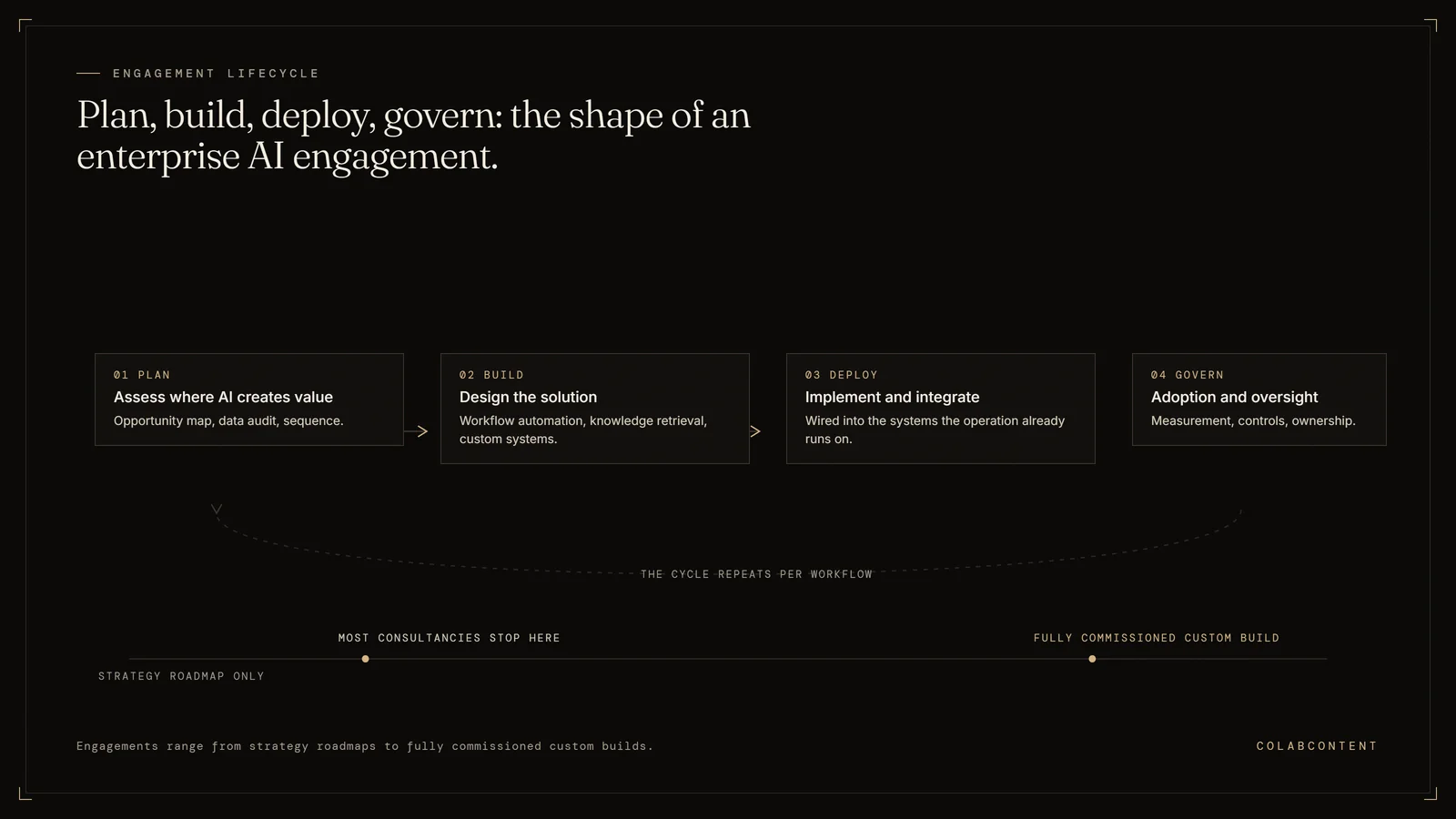
Enterprise AI consulting is the practice of helping organizations plan, build, deploy, and govern artificial intelligence across their operations. Consultants assess where AI creates value, design solutions such as workflow automation and knowledge retrieval systems, then manage implementation and adoption. Engagements range from strategy roadmaps to fully commissioned custom builds. ColabContent LLC publishes this page: a boutique AI consulting house in Boston that builds commissioned AI systems on a fixed fee of $45,000 to $180,000, one time, with the code owned by the client at handoff and no per-seat licence. The 45-minute diagnosis is free and is booked at cal.com/colabcontent/45mins.
What Is Enterprise AI Consulting?
Enterprise AI consulting sits at the intersection of business strategy and technical delivery. A consulting partner helps an organization answer three questions: where AI can create measurable value in its specific operations, what should be built or bought to capture that value, and how to deploy it so people actually use it.
The term "enterprise" traditionally referred to Fortune 500 companies, but the discipline now applies to any organization with real operational complexity: multiple departments, established systems of record, compliance obligations, and workflows that cannot simply be replaced by an off-the-shelf app. Mid-market businesses face the same core questions as large enterprises, just with tighter budgets and less tolerance for multi-year transformation programs.
Good enterprise AI consulting is distinct from software resale. A consultant who earns money by pushing a specific platform is a channel partner, not an advisor. The value of consulting comes from independent judgment about what fits your business, including the judgment to recommend doing nothing.
What Enterprise AI Consultants Actually Do
The work varies by firm, but most engagements draw from a common set of services:
- AI strategy and roadmapping: mapping business goals to candidate AI use cases and sequencing them by value and feasibility.
- Use case discovery: interviewing the people who do the work to find where hours are actually lost.
- Data and systems assessment: evaluating whether your data, integrations, and infrastructure can support the proposed solutions.
- Solution design and build: architecting and implementing custom systems, from automated workflows to retrieval-augmented generation over internal documents.
- Vendor evaluation: comparing off-the-shelf tools against custom options when a purchase might be the better answer.
- Deployment and integration: connecting new AI systems to existing software so they fit daily operations.
- Adoption and training: making sure the team uses what was built.
- Governance and risk: setting policies for data handling, model behavior, and human review.
Some firms stop at strategy decks. Others, including commissioned-build shops, take responsibility for delivering a working system.
How an Enterprise AI Engagement Is Structured
Most credible engagements follow a recognizable arc, even when the labels differ:
- Diagnostic: a short discovery phase that maps workflows, systems, and pain points before anything is proposed.
- Scoping: a written definition of what will be built, what it connects to, and what success looks like.
- Pilot or first build: a working system deployed against one real workflow, not a demo environment.
- Production rollout: hardening, integration, and expansion to the full team.
- Handoff and support: documentation, training, and an agreement on who maintains the system going forward.
The ordering matters. Firms that skip the diagnostic and jump straight to a proposal are usually selling a predetermined product. If you want to see how a commissioned engagement runs from first call to handoff, ColabContent publishes its step-by-step commission process in full.
Common Enterprise AI Use Cases
The use cases that consistently justify consulting engagements share a pattern: repetitive knowledge work performed against your own data and systems. Frequent examples include:
- Workflow automation: intake, routing, document processing, and multi-step approvals that currently run on email and manual re-keying. See how custom workflow automation is scoped for mid-market operations.
- Knowledge retrieval and RAG: letting staff query contracts, SOPs, policy documents, and historical records in plain language. This is the domain of custom knowledge and RAG systems.
- Revenue operations: lead handling, proposal drafting, and pipeline hygiene tied into your CRM.
- Content operations: producing and reviewing high-volume documents that follow known templates and standards.
The right first project is usually narrow, measurable, and owned by a single team, not a company-wide transformation.
Criteria for Selecting an Enterprise AI Consulting Partner
Most buyers have never hired an AI consultancy before, so it helps to have a checklist. Evaluate candidates against these criteria:
- Domain fit: have they worked with businesses like yours, in your industry, at your scale?
- Delivery over decks: do engagements end with working software or with a slide presentation?
- Ownership: who owns the code, prompts, and data pipelines when the engagement ends?
- The actual team: will the people who pitched you do the work, or will it be handed to a rotating bench?
- Vendor neutrality: does the firm earn referral fees from platforms it recommends?
- References: can you speak to a client whose system is still running a year later?
- Exit plan: can your team maintain the system, or are you locked into the consultancy forever?
A firm that answers these questions plainly, in writing, is already ahead of most of the market.
Enterprise Firms vs Boutique Consultancies
The enterprise AI consulting market splits roughly into three tiers. Global firms such as the Big Four and major strategy houses serve large enterprises with big budgets and long timelines. Platform integrators implement specific vendor ecosystems. Boutique consultancies and commissioned-build shops serve organizations that need a working system without an enterprise-scale program.
For mid-market businesses, the tradeoff is usually between brand assurance and delivery focus. Large firms bring deep benches and recognizable names, but their engagement models were designed for clients much larger than a typical mid-market operator. Boutiques trade the brand for direct access to senior builders and tighter scopes.
Neither answer is universally right. The comparison of Big Four AI consulting vs a boutique AI commission walks through when each model fits, including the cases where a large firm is genuinely the better call.
Build, Buy, or Commission: The Core Decision
Before hiring any consultancy, settle the underlying question: should you buy an off-the-shelf AI product, build in-house with your own hires, or commission a custom system from an outside team?
Buying works when a mature product already matches your workflow closely and your process can bend to fit the software. Building in-house works when AI is core to your long-term product and you can attract and retain senior engineering talent. Commissioning works when your workflows are specific enough that generic tools fall short, but hiring a full internal AI team is not justified.
Consulting engagements often exist precisely to resolve this decision, and a good advisor will not assume the answer in advance. The build, buy, or commission framework lays out the decision criteria in detail, including the failure modes of each path.
What Enterprise AI Consulting Costs
Pricing varies widely with scope, firm size, and engagement model, so treat any single figure with skepticism. The common commercial structures are:
- Fixed-scope projects: a defined deliverable at a defined price, typical for diagnostics and first builds.
- Time and materials: billing by consultant hours, common at larger firms.
- Retainers: ongoing advisory or maintenance after an initial build.
- Value-linked pricing: fees tied to measured outcomes, less common but growing.
What matters more than the headline number is what the fee buys. A strategy document that requires a second engagement to implement can cost more in total than a fixed-scope commissioned build that ships working software. Always ask what exists at the end of the engagement that did not exist at the start.
Questions to Ask Before You Sign
Use these in every sales conversation:
- What working system will exist when this engagement ends?
- Who on your team will do the hands-on work, and can I meet them?
- Which parts of my problem would you tell me not to solve with AI?
- Do you receive compensation from any vendor you might recommend?
- Who owns the intellectual property in what you build?
- What happens to the system if we end the relationship?
- Can I speak with a past client whose deployment is still in production?
A firm that hesitates on the vendor compensation question or the ownership question is telling you something important. Independence and clear ownership terms are the foundation of a consulting relationship worth paying for.
The First 90 Days of a Well-Run Engagement
Whatever the consulting firm's methodology slide says, the first ninety days tell you what the engagement will actually be. In a well-run engagement, the first month produces three concrete artifacts: a data and systems inventory that names where the candidate workflows' information actually lives, a shortlist of workflows scored by value and feasibility, and access, meaning credentials, sandboxes, and a security review actually completed rather than scheduled. Slippage on access in month one is the single most reliable predictor of a stalled program, because it usually means no one on the client side owns the engagement's success.
By day ninety, the test is simpler: is any software running against real data, even behind a human review step, even for a single team? A pilot processing last quarter's documents with two reviewers checking its output is progress. A second round of stakeholder interviews producing a refined deck is not. The pattern described earlier in this guide, where strategy work substitutes for delivery, is visible by this checkpoint in every engagement that will eventually fail, which is why the ninety-day working-software test belongs in the statement of work itself, not in the client's private hopes.
Condensed to a checklist, the ninety-day test is five questions. Does the consultant have working credentials to the relevant systems? Is there a written inventory of where the candidate workflows' data lives? Has the workflow shortlist been scored and cut to one or two, with names attached to each? Is software processing real historical data anywhere, even in a sandbox? And does the operating team, not just the sponsor, know the engagement exists and what it will change about their week? Any engagement that can answer yes to all five by day ninety is on the delivery path this guide describes; any engagement that cannot answer the first two by day thirty deserves the uncomfortable conversation early, while the fee spent is still small.
Frequently Asked Questions
What is enterprise AI consulting?
Enterprise AI consulting is professional guidance and delivery help for organizations adopting artificial intelligence. Consultants identify high-value use cases, assess data and system readiness, design or build solutions, and manage deployment and governance. Engagements range from short strategy diagnostics to full custom system builds, and the discipline now serves mid-market businesses as well as large enterprises.
How much do AI consultants get paid?
Compensation varies widely by role, seniority, firm type, and region. Consultants at global firms, boutique consultancies, and independent practices operate on very different economics, and client-side billing rates differ from individual salaries. For current figures, check salary aggregation sites and job postings in your market rather than relying on headline numbers, which often reflect outlier roles at large technology companies.
What does enterprise AI do?
Enterprise AI applies machine learning and language models to core business operations. Typical functions include automating repetitive workflows, retrieving answers from internal documents, processing and drafting documents, supporting decisions with data, and connecting systems that previously required manual re-keying. The goal is to reduce time spent on routine knowledge work so teams can focus on judgment and client-facing work.
Book the diagnosis call.
Forty-five minutes, no slides. We walk one real workflow end to end, name the step eating the most staff hours, and tell you plainly whether a custom build is the right lever for it. If an off-the-shelf tool would serve you better, we say so on the call.
See the fee bands → Or book directly →Where to look next.
Three pages carry the specifics this one summarizes. The commission process runs the five phases between the first call and code handoff, including the working prototype built on your own data before any fee is owed. The pricing page publishes the fee bands rather than making you ask. And the AI maturity assessment walks the five stages, which is worth reading before you spend a dollar with anyone.
Every published side-by-side lives on the comparisons hub, the industry practice pages cover the workflows most often commissioned in each vertical, and contact is the direct route if you already know what you want scoped.