Spellbook Alternatives for Mid-Market Law Firms
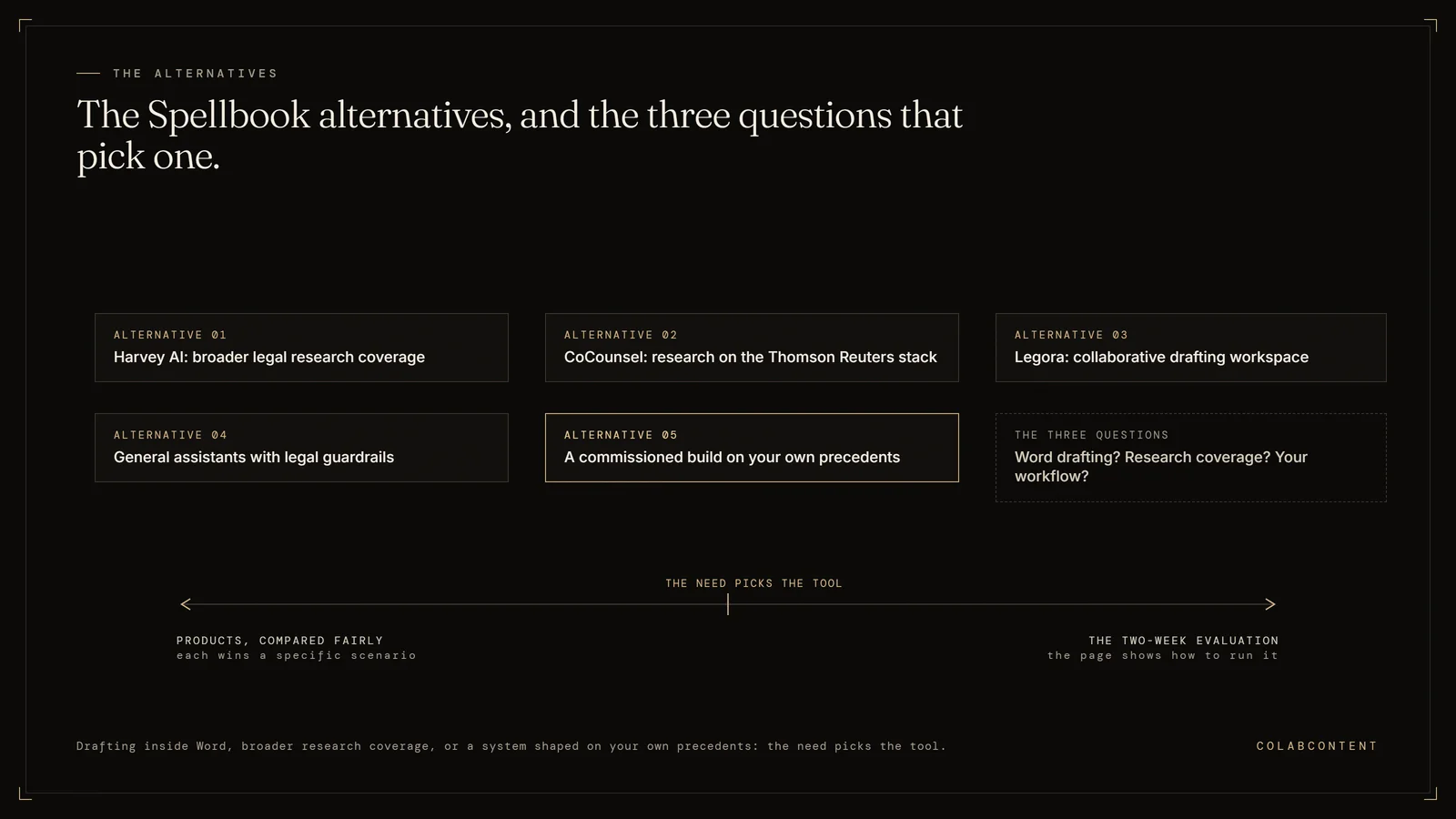
The main Spellbook alternatives for legal teams are Harvey AI, CoCounsel, Legora, general-purpose assistants with legal guardrails, and a commissioned custom AI build. The right choice depends on whether your firm needs contract drafting inside Word, broader legal research coverage, or a system shaped around your own precedents and workflow. ColabContent LLC publishes this page: a boutique AI consulting house in Boston that builds custom systems for law firms of 10 to 150 attorneys.
The $499 AI-Ready Audit comes first; after it, the system that matters most is proven as a working prototype on your own data before any build fee. Production builds are one fixed fee from $10,000, one time, with the code owned by the firm at handoff and no per-seat licence. The $499 AI-Ready Audit is ordered at colabcontent.com/ai-ready-audit/.
Why Firms Look Beyond Spellbook
Spellbook built its reputation as a contract drafting and review assistant that lives inside Microsoft Word. For solo practitioners and small firms whose work is mostly contracts, that focus is a strength. Mid-market firms tend to hit its edges for a different reason: the tool is shaped around a single document type and a single surface. Once your matters span litigation, regulatory work, and transactional practice, a Word add-in stops covering the ground.
Firms also raise a structural concern. Subscription legal AI improves on the vendor's roadmap, not yours. Your precedents, your clause preferences, and your intake process do not shape the product. If those assets are what make your firm competitive, renting a generic layer on top of them can feel backwards. We walk through that tradeoff in detail in our comparison of Spellbook vs a custom AI build for law firms. The alternatives below fall into two camps: other legal SaaS (software you rent by subscription) products, or a system commissioned around your own practice.
Spellbook Alternatives at a Glance
- Harvey AI: a broad legal AI platform oriented toward larger firms and in-house teams.
- CoCounsel: a legal AI assistant from Thomson Reuters, anchored in the Westlaw research ecosystem.
- Legora: a collaborative legal AI workspace positioned for firms that want AI woven into team workflows.
- General-purpose assistants: ChatGPT, Claude, or Gemini paired with firm-level policies and guardrails.
- A commissioned custom AI build: a system designed around your firm's precedents, clause library, and matter workflow rather than a vendor's feature set.
| Option | What it covers | Best fit | Ownership |
|---|---|---|---|
| Harvey AI | Broad legal AI platform: research, drafting, analysis | Larger firms and in-house teams with enterprise procurement appetite | Vendor-owned subscription |
| CoCounsel | Research, review and summarization anchored in Westlaw | Firms already on the Thomson Reuters stack | Vendor-owned subscription |
| Legora | Collaborative legal AI workspace across shared matters | Firms treating AI adoption as a team workflow change | Vendor-owned subscription |
| General-purpose assistants | ChatGPT, Claude or Gemini with firm-level policies and guardrails | Firms wanting flexibility without a legal-specific vendor | Vendor-owned subscription |
| Custom build (ColabContent) | System shaped around the firm's own precedents, clause library and matter workflow | Firms whose differentiating workflow is not on any vendor roadmap | $499 AI-Ready Audit first; custom builds from $10,000 as one fixed fee quoted after the audit; working prototype on your own data before payment; code owned at handoff; no per-seat fees |
Harvey AI
Harvey is the most visible name in legal AI. It positions itself as a platform rather than a point tool, covering research, drafting, and document analysis across practice areas. Where Spellbook narrows in on contracts inside Word, Harvey aims wider, which is exactly why some firms consider it as an upgrade path.
The considerations cut the other way too. Harvey's positioning skews toward large firms and enterprise legal departments, and procurement, rollout, and adoption reflect that. Mid-market firms evaluating it should be honest about whether they will use the breadth they are paying for. If you are weighing Harvey against other options in its class, our guide to Harvey alternatives for mid-market law firms covers the field in more depth.
CoCounsel
CoCounsel is Thomson Reuters' legal AI assistant, and its strongest argument is the ecosystem behind it. For firms already invested in Westlaw and other Thomson Reuters products, CoCounsel slots into research workflows that lawyers already trust. It leans toward research, review, and summarization tasks rather than the in-document contract markup that defines Spellbook.
That makes CoCounsel a natural alternative for firms whose pain point is research and document volume rather than contract drafting. It is less natural for a transactional team that lives in Word all day. Firms comparing the two big legal AI names side by side can start with our breakdown of CoCounsel vs Harvey for mid-market firms.
Legora
Legora positions itself as a collaborative workspace for legal AI: instead of one lawyer prompting one tool, teams work with AI across shared matters and documents. That framing appeals to firms that see AI adoption as a workflow change rather than an individual productivity add-on.
As with any newer entrant, the evaluation questions are practical ones. How does it handle your document management system? How does it treat your precedents? What does the roadmap look like for your practice areas? We compare it against the category leader and against a commissioned approach in Legora vs Harvey vs a custom legal AI build.
A Commissioned Custom AI Build
The alternative that is not SaaS at all: commission a system built around your firm. Instead of adapting your practice to a vendor's product, the product is shaped to your precedent bank, your clause standards, your intake and conflicts process, and the way your matters actually move. The firm owns the system rather than renting access to it.
This route is not right for everyone. If your needs are generic and a subscription covers them, buy the subscription. A commission earns its keep when the workflow you want to automate is specific to your firm and absent from every vendor demo you have sat through. The decision logic, including when to build internally, buy off the shelf, or commission, is laid out in our build, buy, or commission framework.
How to Choose: Three Questions
Strip the vendor noise away and the decision usually comes down to three questions.
The $499 AI-Ready Audit is the way to get this analysis run against your own business rather than the general case described here.
- Where does the work live? If your team's day is contracts in Word, a Word-native tool like Spellbook or a focused alternative fits. If the work spans research, review, and drafting across systems, a platform or a custom build fits better.
- Whose assets drive the value? If generic legal knowledge is enough, SaaS is efficient. If your precedents and processes are the differentiator, a system built around them compounds that advantage instead of flattening it.
- Who owns the system in a year? Subscriptions can be switched off, repriced, or repositioned. A commissioned system is an asset on your side of the table. Weigh switching costs before you standardize the firm on any tool.
If the answer is looking like the fourth option, our work with law firms covers what mid-market firms commission most often, the AI maturity assessment is a self-serve way to see where your firm sits before you talk to anyone, and our pricing and process pages set out how a build is scoped, priced, and handed over with the code. If it is easier to just ask, talk to us directly.
What Switching Away from Spellbook Actually Involves
Most alternative roundups compare features and stop there. The cost that decides whether a switch succeeds is the migration work nobody prices on the comparison page. If your firm has used Spellbook for a year or more, your associates have accumulated working habits inside it: clause libraries, playbook positions, preferred prompts, and a mental model of when to trust the output. None of that transfers automatically to Harvey, CoCounsel, Legora, or a custom system. Budget real partner and associate hours to rebuild it, and treat those hours as part of the price of whichever option you choose.
Three migration questions separate a smooth switch from a stalled one. First, where do your playbook positions live today? If they exist only as Spellbook configurations and the muscle memory of two associates, write them down before you evaluate anything; every serious alternative gets better the moment you can hand it a documented playbook. Second, what happens to work in flight? Plan a parallel-running period where the old tool stays available while live matters move to the new system, and set a firm end date so the parallel period does not become permanent. Third, who owns adoption? A named partner who actually reviews contracts, not an office manager, should own the cutover, because the failure mode of every legal AI switch is quiet reversion to the old workflow.
The ownership question is sharpest when the destination is a commissioned build. A subscription switch trades one vendor's habits for another's. A commission moves the playbook itself into software your firm owns, which means the documentation work above is not throwaway migration cost but the first draft of the system's specification. That is the structural argument for doing the writing-down exercise before you talk to any vendor: it improves every option on this page and it tells you, faster than any demo, whether your positions are generic enough for SaaS or specific enough to justify a build. Weigh that migration cost against the fixed-fee bands on our pricing page before you commit either way.
Running a Two-Week Evaluation That Settles It
A disciplined evaluation beats a quarter of scattered demos. Pull ten recently closed contracts that represent the work your firm actually does, not the interesting edge cases. Run each candidate tool against the same ten documents and have the associates who did the original work score the output on three axes: what it caught that they caught, what it missed, and what it flagged that wasted their time. Score against your firm's markup, not against a generic rubric, because the question is not whether the tool is impressive but whether it is impressive on your paper.
Hold the procurement questions to the same standard. Ask each vendor where firm data is processed and retained, whether client documents ever inform model training, what happens to your clause libraries and playbooks at termination, and what the price looks like at renewal once the introductory term ends. Ask the custom-build option the mirror-image questions: who maintains the system, what the handoff includes, and what changes cost after delivery. Two weeks of this produces a decision the partnership can defend in writing, which is exactly what most tool selections cannot survive.
One more filter before you commit either way: timing. Contract tooling switches go smoothest between matter cycles, when no live deal depends on the clause library mid-migration, so plan the cutover for your practice's quiet stretch rather than its busiest quarter. And be honest about the cases where staying put is the right answer. A firm whose whole need is Word-native drafting assistance, whose playbook positions are close to market standard, and whose associates are already productive in Spellbook has little to gain from churn for its own sake. The alternatives on this page earn their migration cost when at least one of those three conditions has stopped being true: the work has outgrown Word, the positions have become the firm's edge, or the tool has become the bottleneck the associates route around. If the two weeks leave you leaning toward a commission rather than a subscription, the $499 AI-Ready Audit is the next concrete step.
Frequently Asked Questions
Short answers first, detail underneath. Every answer here matches the FAQ schema on this page word for word, and each one is the answer we give on the audit call. Where a question depends on your own numbers, the $499 AI-Ready Audit report replaces the general answer with your figures.
How is Spellbook different from Harvey AI?
Spellbook concentrates on contract drafting and review inside Microsoft Word, while Harvey positions itself as a broader legal AI platform covering research, drafting, and analysis, typically aimed at larger organizations. Firms choosing between them usually decide based on whether their need is contract-specific or practice-wide, and on their appetite for enterprise procurement.
Is Spellbook or CoCounsel the better fit for a mid-market firm?
It depends on where the work actually sits. Spellbook is built for contract drafting and review inside Microsoft Word, so it fits transactional practices that live in documents. CoCounsel reaches further into research and analysis and arrives through the Thomson Reuters relationship many firms already hold. The practical first question is which research or drafting contract the firm is already paying for, because that usually decides which tool is cheapest to add.
Do these tools work with a firm's own precedent bank and clause library?
To varying degrees, and this is the question worth pressing vendors on. Every tool in this category will accept firm documents in some form, but there is a real difference between a tool that references your precedents and a system shaped around them. Ask what happens to a clause your firm always negotiates a particular way, and whether the tool learns that or simply retrieves it.
When should a law firm commission a custom AI build instead of buying legal SaaS?
A commission makes sense when the value sits in the firm's own assets: precedent banks, clause libraries, intake patterns, and matter history. Off-the-shelf tools serve generic workflows well. If the workflow that differentiates your firm does not appear on any vendor's roadmap, a system built around that workflow is worth evaluating.
What does switching cost if a firm changes legal AI tools later?
The subscription is the smallest part. The cost that accumulates is configuration: the prompts, templates, clause preferences, and review conventions a team builds up inside a vendor's product, none of which transfers. That is the argument for owning the layer that encodes how your firm works, even when you buy the surface it runs on.
What does it cost to replace Spellbook with a custom build?
ColabContent's commissioned builds for law firms run on a fixed fee, with the band published at from $10K depending on how many workflows are in scope and how deep the integrations go. The evaluation itself costs nothing: the audit call and the 7-to-10-day prototype on the firm's real documents both happen before any payment, so a firm can see its own playbook running in software before deciding whether the build beats another subscription.