Home/ Comparisons/ CDK Global Alternatives

CDK Global Alternatives for Dealer Groups: 7 Options

There are seven credible alternatives to CDK Drive for a franchised dealer or a dealer group: Tekion, Dealertrack from Cox Automotive, Reynolds and Reynolds, DealerSocket, Auto/Mate, PBS Systems and Dominion DMS. The eighth option is the one no dealer management system vendor can sell you, because it would put them out of the deal: commissioning the system your store actually needs and owning it outright, one fixed fee, no per rooftop licence, no renewal escalator, no third party data access fee. Here is the part that decides the exercise. CDK publishes no price at all; we opened its own dealer management system page on August 29, 2026 and there is no dollar figure anywhere on it, and six of the seven alternatives above are exactly as silent, so switching platforms does not by itself fix the problem of not being able to check what your software costs. Only Dominion DMS publishes a number on its own site, and that number is $0 per month for its core platform, with add on pricing left out of the headline. The two sourced CDK figures sit almost ten times apart, $1,995 per rooftop per month for a base package and near $30,000 per rooftop per month loaded with ten to fifteen bolt-ons, both reported by aggregators rather than published by CDK. Run the conservative one through a single rooftop at a four percent annual increase, which is our stated assumption rather than a CDK published term, and cumulative CDK spend reaches $75,981 by the end of year two, against $58,500 for a $45,000 commissioned build plus two years of maintenance at our stated fifteen percent assumption. The lines cross early in year two, and the calculator further down will run the same arithmetic on your invoice instead of ours.

A note on names, because they get used interchangeably. CDK Drive is the dealer management system itself. The CDK Dealership Xperience is the wider platform of applications sold around it. Elead is the CRM inside the same family. Dealers looking for a way out use all of those names for the same decision, and this page covers that decision rather than any one product page.

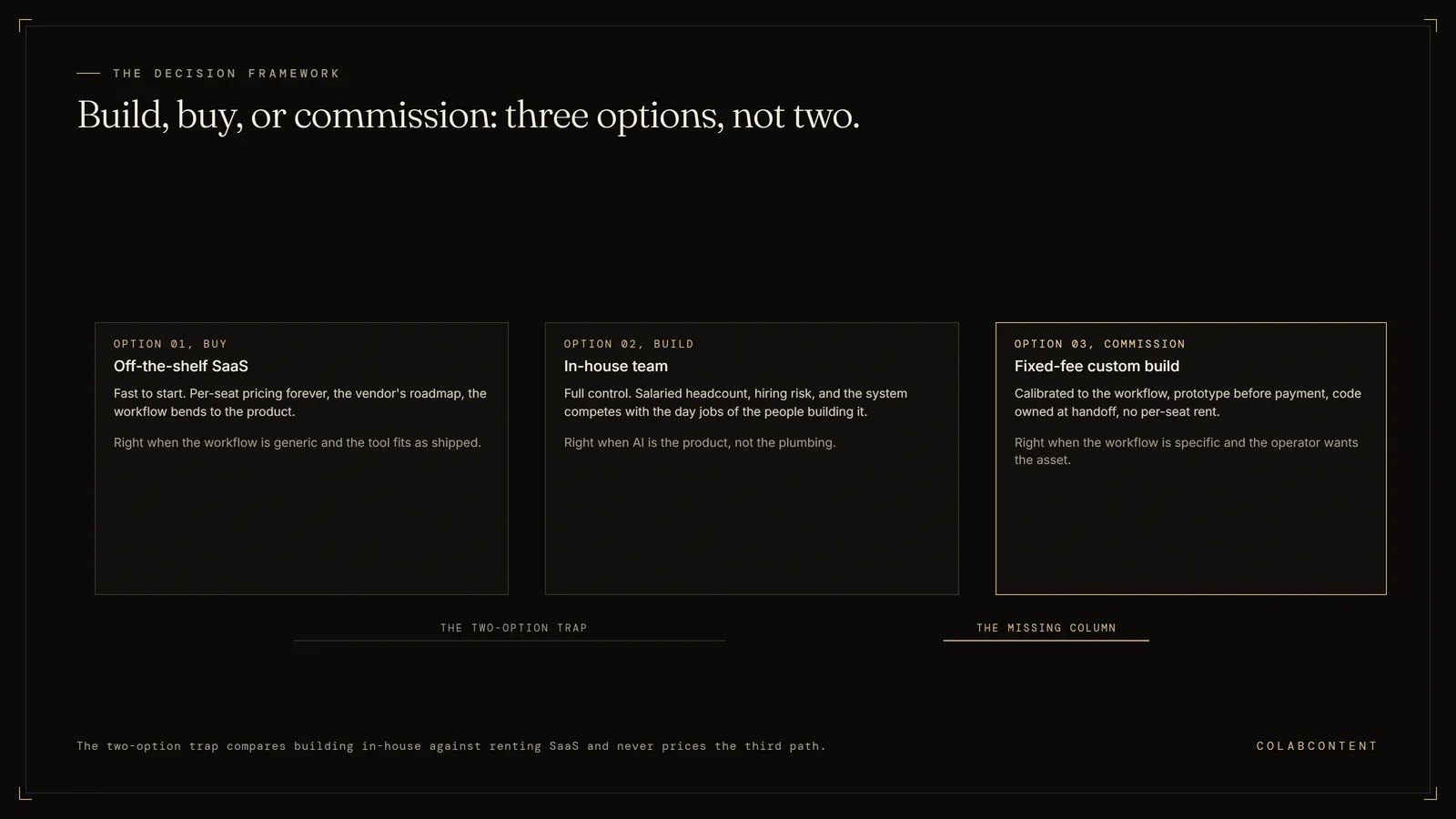
Three options, not two: buy off the shelf dealer management software priced per rooftop forever, build with an in house team and carry the hiring risk, or commission a fixed fee custom build calibrated to the store's workflow and owned by the dealer at handoff
Three paths, not two. Vendor comparison pages only ever show you the first one.

Written for the dealer principal or group operator who already pays CDK. We do not sell a dealer management system, we take no referral fee from anyone in the table below, and there is a whole section further down arguing that some stores should stay exactly where they are.

ForFranchised dealers and groups, roughly 1 to 25 rooftops
CDK costNo published price. Reported $1,995 base to $30,000 loaded, per rooftop per month
Our fixed fee$45,000 to $180,000, one time
StanceNeutral. We sell no DMS.
Bottom lineCrossover early in year 2 at a $45K build
CostFree 45-minute diagnosis
Last updatedAugust 29, 2026, vendor pages read the same day

The short answer.

If the reason you are reading this is the renewal, understand first that you cannot benchmark your way out of it. CDK does not publish a rate card, and neither does Tekion, Dealertrack, Reynolds and Reynolds, DealerSocket, Auto/Mate or PBS Systems. Exactly one name on the list publishes a figure on its own website that a dealer can check without a sales cycle, and that name is Dominion DMS, whose published figure for its core platform is zero. So the standard move, shopping competitors to build leverage, produces less leverage in this category than in almost any other kind of business software. The strongest number you can carry into a renewal meeting is not a rival quote you cannot get. It is your own total cost over five years, which is the thing this page is built to hand you.

If the reason you are reading this is June 2024, the answer is different and more useful. The question a dealer principal actually has after that month is not which logo is prettier. It is what happens if the system goes dark again, and what your contract lets you do about it. That question has a documented, sourced answer further down this page, and it is not a comfortable one. It is also the reason the ownership argument on this page is stronger in auto retail than in most industries we write about, and the reason we spend as much space on contract language as on price.

What CDK actually does well.

Worth saying before the rest, because a page that only attacks reads as an advertisement and deserves to. CDK sits at the centre of franchised auto retail for reasons that are real. It runs the full store on one system: sales, service, parts, accounting, payroll and the manufacturer communications that a franchised dealer legally has to support. It carries deep original equipment manufacturer certifications, which is not a marketing line but a practical constraint, because the factory reporting requirements a franchise agreement imposes are not optional and not all systems support all brands equally. Its own product page describes going beyond the dealer management system into a wider platform of connected applications, which is exactly what a large group with standardised processes across many rooftops usually wants.

The integration ecosystem cuts both ways and it is worth stating the good half honestly. Nearly every vendor in automotive retail builds to CDK first, so a dealer on CDK has more third party choice than a dealer on a niche system. Institutional knowledge is real too. A controller who has closed a month in CDK for eleven years is fast in it, and that speed is worth money that does not show up on any comparison table.

None of that is the argument on this page. The argument on this page is about price you cannot check, contract terms you have probably not read since signing, and a documented event that showed every dealer in the country what dependence on one platform costs when it stops. A system can be good and still be the wrong thing to be locked into.

Why dealers start looking for a way out.

The renewal, and the fact that you cannot price it. CDK publishes nothing. We opened its dealer management system page on August 29, 2026 and confirmed it: no price, no cost, no dollar figure. That means when a quote arrives you have no public number to hold it against, and neither does the dealer down the road, so the two of you cannot compare notes in any rigorous way either.

The bolt-on stack, and what it does to the bill. The gap between the two reported CDK figures, $1,995 per rooftop per month for a base package and near $30,000 loaded, is not a disagreement between sources. It is the cost of everything a working store actually attaches to the system. Most dealers who feel their DMS bill is out of control are not describing the licence. They are describing the stack.

Third party data access fees. This is the oldest complaint in the category and it has a paper trail, though the paper is older than most people realise. On the DealerRefresh dealer forum, in a thread titled CDK Third Party Access Pricing Guide, participants posting in July 2017 described integration fees around $10,000 and possibly closer to $40,000, a $30,000 upfront integration fee in one case, and roughly $200 per month per rooftop in recurring access charges for a single third party application. Those are dealer and vendor forum posts from 2017, which is nine years old, and we are printing the date deliberately: treat them as evidence that the fee structure exists and is old, not as a current rate card.

June 2024. The outage put a number on dependence for a lot of principals who had never thought about it as a risk. The section below covers what happened, what it cost the industry, and what dealers were and were not able to do about it afterward.

Notice what is not on that list: almost nobody leaves CDK because the software does not work. That is worth holding onto, because it points at what the actual fix is, and it is not always a migration.

The June 2024 outage, on the record only

What happened, what it cost, and what dealers could do about it.

This section is the reason this page exists, because the comparison pages a dealer finds when researching alternatives treat this decision as a features and star ratings exercise and do not mention any of it. Every statement of fact below traces to a named outlet, and each one is named inline rather than in a footnote. Where we could not read a source directly, we say so at that sentence instead of implying we did. Nothing here asserts or implies that CDK was found liable for anything, because it was not, and nothing here predicts how any pending matter resolves.

What happened

The attack. BleepingComputer, on June 22, 2024, reported that the BlackSuit ransomware gang was behind CDK Global's IT outage, dated the initial shutdown to June 19, 2024 with a second incident on June 20, and described BlackSuit as a May 2023 rebrand of the Royal ransomware operation, itself believed to be the direct successor of the Conti cybercrime syndicate. VERIFIED read directly off bleepingcomputer.com on August 29, 2026.

The scale. CBS News, in a story updated June 24, 2024, reported that the affected dealer management system is used by some 15,000 dealerships and powers sales for roughly half of the car dealerships in the United States, that CDK took its services down as a precaution, and that a second cyberattack that week compounded the problem. VERIFIED read directly off cbsnews.com on August 29, 2026.

The duration. TechTarget's explainer on the incident dates the first attack to June 18 and the second to June 19, and reports that after a phased restoration process all dealerships should have been running again by July 4, 2024. Different outlets place the first intrusion on June 18 or June 19, so we are giving you the range rather than a single tidy number: the outage began in the third week of June 2024 and was reported resolved by July 4, which is roughly two to three weeks depending on whose start date you take. VERIFIED read directly off techtarget.com on August 29, 2026.

The ransom. CyberScoop, on July 12, 2024, reported that researchers at blockchain intelligence firm TRM Labs identified approximately 387 bitcoin, worth roughly $25 million at the time, moving on June 21 to a wallet tied to the group, and that representatives for CDK and its parent firm refused to answer questions about whether CDK or a representative made a ransom payment. REPORTED read directly off cyberscoop.com on August 29, 2026. We state it as reporting rather than as fact because the company has not confirmed it, and because the researchers' own finding does not conclusively establish who sent the funds.

What it cost the industry

Anderson Economic Group, a consulting firm in East Lansing, Michigan, published a revised study estimating total direct losses to franchised auto dealers of about $1,020 million across the three calendar weeks that included June 19 and ran through early July 2024, including lost earnings on roughly 56,200 new vehicle sales that did not happen in the window, plus lost earnings on used vehicles, parts and service, additional staffing and information technology costs, and additional floor plan interest on inventory. Automotive News reported that revised figure under the headline that dealers lost $1.02 billion from the CDK cyberattack, and TechTarget independently reports the same firm's estimate as more than $1 billion collectively. REPORTED. Our direct fetch of both the Anderson Economic Group release and the Automotive News article was blocked, so we are relying on the study as reported by those outlets and on TechTarget's independent reference to it, which we did read directly.

Read that figure as what it is. It is a third party economic model of an industry wide loss over a defined window. It is not a CDK admitted number, it is not audited, and it does not tell you what your rooftop lost. Your own number is sitting in your June and July 2024 financial statements, and pulling it is the single most useful hour of preparation before any conversation about any of this.

What dealers were able to do about it

Lawsuits were filed quickly. The National Law Review, on July 18, 2024, reported complaints in the United States District Court for the Northern District of Illinois and the United States District Court for the Southern District of Florida, alleging among other things that CDK negligently failed to protect consumer information, with damages sought related to loss of commissions and sales. VERIFIED read directly off natlawreview.com on August 29, 2026.

A year later, they had mostly gone quiet. Automotive News reported, on June 19, 2025, under the headline that car dealers dropped or arbitrated their lawsuits over the 2024 CDK hack, that all of the federal civil lawsuits brought by retailers against the dealer management system provider appeared to have been dropped or to have gone to arbitration. REPORTED. We could not read the full article, which sits behind a subscriber paywall, so this is that outlet's published headline finding and nothing beyond it. If this matters to a decision you are making, have your counsel read the original.

One contract claim survived. Crain's Chicago Business, under the headline that CDK Global cyberattack lawsuits can proceed, and Automotive News, under the headline that a judge let breach of contract suits against CDK Global proceed, both reported that United States District Judge Jeremy Daniel allowed Travelers Excess and Surplus Lines Co., as subrogee of Mills Auto Group in Minnesota and Castle Automotive Group in Illinois, to pursue breach of contract claims arising from the 2024 attack, while dismissing the companion negligence and gross negligence claims under the economic loss doctrine, the rule barring tort recovery for purely economic losses arising from a failure to perform contractual obligations. REPORTED. Both outlets are paywalled and blocked our direct read, so this is their published reporting of the ruling and no more. Allowing a claim past a motion to dismiss is a procedural step and not a ruling on the merits. We make no prediction about how it resolves, and nothing here should be read as a finding that CDK breached any contract.

The part that is actually about you

Strip the headlines out and a pattern is left that has nothing to do with whether anyone behaved well. When a vendor agreement routes disputes to arbitration, a headline lawsuit rarely becomes a public verdict. Arbitration outcomes are typically confidential, which means that whatever other dealers recovered, you cannot look it up, cannot cite it, and cannot use it. Arbitration clauses are standard across software contracts generally and are not unique to this vendor or this category. That is not an accusation. It is the structure.

What follows from it is a practical instruction rather than a legal one, and it applies whether you stay or leave. Read your own agreement now, while nothing is on fire. Four things specifically: the dispute resolution clause and whether it sends you to arbitration; any business continuity, uptime or service level language and what remedy it actually provides if there is one; the limitation of liability clause, which in most software agreements caps recovery at some multiple of fees paid; and the data access, export and termination assistance terms. Those four paragraphs, not press coverage of what happened to somebody else, are what will govern your options on the worst day. Most dealer principals we talk to have not read them since signing. That is an hour of work with your own counsel and it is worth more than anything else on this page.

The thing we will not let this page imply

Commissioning a custom build is not a security strategy, and nobody should read this section as suggesting it is. A system you own can be breached. Moving off a large shared platform relocates the target and changes who is accountable, and that second part is the point: accountability moves to you and to whoever you build with. Name the obligations plainly, because they do not disappear when the vendor does. Backup cadence and, more importantly, tested recovery, meaning somebody actually restores from backup on a schedule and times it. Uptime monitoring and alerting that pages a human. Patch management on the operating system, the runtime and every dependency. An incident response plan that names who calls whom, in what order, with the phone numbers written down somewhere that does not require the system to be up. A custom build that skips any of those is less safe than a well run vendor platform, not more. And nothing about buying from us removes your own legal or regulatory exposure, which attaches to conduct and to the data you hold, not to who wrote the software.

What you are actually paying

Every number on this page, with its source.

Start with the uncomfortable finding, because it shapes everything after it. CDK publishes no price. We opened cdkglobal.com's own dealer management system page on August 29, 2026, it loaded normally with its full marketing content, and there is no pricing, no cost and no dollar figure anywhere on it. That is how we know rather than assume. Exactly one vendor in the table below publishes a real number on its own site. Six publish nothing at all.

Labels on this page are used in one fixed way, and we are copying the definition rather than paraphrasing it, because a paraphrase is how this word drifts. VERIFIED means read off the VENDOR's own page, or verified-by-absence at the vendor's own URL. A figure published by a third-party aggregator (Vendr, PriceLevel, SelectHub, ITQlick, G2, Capterra, checkthat.ai, any buyer-data or review platform) is REPORTED, however good that aggregator's data is. ASSUMPTION means it is a modelling input of ours rather than anyone's published figure. Where we found nothing, the cell says so instead of being filled in, and where our own attempt to read a source failed, the cell says that too rather than pretending the absence was observed.

Vendor and productSold byPublished or reported priceImplementation, one timeSource
CDK Drive (dealer management system)Per rooftop / month, quote onlyNo published price. Reported base package $1,995 per rooftop per monthReported $1,250 integration and training per franchiseVERIFIED cdkglobal.com/dms/cdk-drive loaded on August 29, 2026 and publishes no figure. REPORTED itqlick.com for the $1,995 and $1,250 figures; our direct fetch of that aggregator page was blocked and we read the figures through a search index rendering of it.
CDK Drive loaded with 10 to 15 third party bolt-onsPer rooftop / month, all inReported near $30,000 per rooftop per monthNot publishedREPORTED vendormotive.com, carried in this site's own dated pricing ledger since August 26, 2026. Our direct fetch returned a rate limit error on August 29, 2026, so we did not observe the page ourselves and we are not treating this figure as strongly sourced.
CDK third party data access and integration feesCharged to the vendor, passed to the dealerIntegration fees described as $10,000 and possibly closer to $40,000, one case at $30,000 upfront, plus roughly $200 per month per rooftop recurringSee leftREPORTED forum.dealerrefresh.com thread CDK Third Party Access Pricing Guide, read directly on August 29, 2026. The posts are dated July 2017. Nine years old. Evidence the structure exists, not a current rate card.
Tekion Automotive Retail CloudQuote onlyNo published price. No third party figure we could trace to a named source, so we print none.Not publishedVERIFIED tekion.com/products/dms loaded on August 29, 2026 and publishes no figure.
Dealertrack DMSCox Automotive, quote onlyNo published price. No third party figure found for the dealer management system itself.Not publishedVERIFIED us.dealertrack.com/content/dealertrack/en/dealer-management-solutions.html, loaded on August 29, 2026 with its feature list and FAQ answers, publishes no price for the system.
Reynolds and Reynolds (ERA-IGNITE, POWER)Enterprise licence, quote onlyReported $1,000 to $5,000 per store per month depending on modules, on three to five year contracts with roughly four percent annual increasesNot publishedREPORTED rfp.wiki dealer management system comparison, carried in this site's own pricing ledger since August 26, 2026. reyrey.com returned only page titles to us on August 29, 2026 rather than readable content, so we make no absence claim about its own site.
DealerSocketSolera, quote onlyReported $750 to $4,000 per store per month base, with integrations reported far higherReported $3,000 to $15,000 onboardingREPORTED third party cost guides carried in this site's own pricing ledger. dealersocket.com/pricing returned a Page Not Found error on August 29, 2026.
Auto/MateSolera, quote onlyNo dollar figure published. The vendor's own page claims dealers often find Auto/Mate monthly support bills 65 to 75 percent less than Reynolds and Reynolds or CDK.Not publishedVERIFIED automate.com/dms/pricing/ loaded on August 29, 2026, publishes no dollar figure, and carries that comparative claim as the vendor's own marketing statement, not an independently verified number.
PBS Systems (v10 APEX)Quote onlyNo published price, and no third party dollar figure found anywhereNot publishedVERIFIED pbssystems.com loaded on August 29, 2026 with its full navigation and publishes no figure. No aggregator figure exists to report.
Dominion DMS, VUE Core platformFranchised dealerships$0 upfront and $0 per month for the core platform covering sales, service, parts, accounting and OEM communicationsStated as $0 upfrontVERIFIED dominiondms.com press release read directly on August 29, 2026, announced January 27, 2023. Add on and integration pricing is not in that figure.
ColabContent commissioned buildOne time fixed fee$45,000 to $180,000, scoped per engagementIncluded in the feeOur own published pricing. Maintenance modelled at 15 percent a year, ASSUMPTION, not a standing contract term.

Four numbers we deliberately did not print

This is worth a paragraph because the omissions are as much of the finding as the entries. Tekion. A specific monthly figure circulates in search summaries. We went to trace it and it attributed only to unnamed dealer level reporting with no source we could name, so it does not appear here. A number we cannot stand behind is worse than no number, because it looks the same as a real one on the page. Dealertrack. Cox Automotive's adjacent products do have reported figures in circulation, for vAuto and VinSolutions, but those are a merchandising tool and a CRM rather than the dealer management system, and printing them next to a DMS comparison would mislead. PBS Systems. Nobody has published a figure, vendor or third party. We checked the vendor's own site and it loaded, so the absence there is observed rather than assumed. Auto/Mate. The 65 to 75 percent claim on its own pricing page is a vendor marketing statement about its own product, not a verified comparison, and we present it as exactly that.

That leaves a category where one vendor out of eight publishes a checkable number and that number is zero. If price transparency is why you started reading, the honest finding is that switching does not deliver it. What switching can deliver is a different cost structure, and that is a different argument.

The Dominion DMS number, handled honestly

It is real and it is the vendor's own. Dominion DMS announced on January 27, 2023 that its VUE Core DMS platform would be offered to franchised automotive dealerships at $0 upfront and $0 per month, covering sales, service, parts, accounting and OEM communications through a web based interface, and stated an average savings of $6,500 per month per store against what dealers had been paying. That is VERIFIED because we read it on dominiondms.com, and the savings figure is the vendor's own claim about its own customers rather than an independent finding.

Now the catch, because $0 is not the same as free. The announcement does not price the optional third party integrations a real store adds on top of the free core, and monetising that layer rather than the core licence is the visible business model. So the honest reading is that the free core is genuine and vendor published, and it is not yet an apples to apples replacement for a loaded CDK bill until you have priced the add ons your store would actually need. Ask for that list in writing before anything else. It is still the most interesting number in this category by a distance, because it demonstrates that a core dealer management system can be delivered at a price of zero, which reframes what the licence half of your current bill is actually buying.

The five year model, and the caveat it carries

The model below takes a single rooftop, uses the REPORTED ITQlick base package figure of $1,995 per rooftop per month, adds the REPORTED $1,250 integration and training cost once at year zero, and escalates the licence four percent a year from the first renewal. That four percent is an ASSUMPTION when applied to CDK, and it is important to say why we chose it. CDK publishes no escalation term and no source gives a CDK specific annual increase rate. The one sourced escalation figure anywhere in this category is roughly four percent a year on Reynolds and Reynolds contracts, REPORTED by rfp.wiki. Rather than invent a higher number that would pull the crossover toward our own conclusion, we used the sourced figure from the nearest comparable vendor and labelled it. The five percent variant is printed below it so you can see how little the choice matters.

Against it sits a commissioned build at $45,000, which is the floor of our $45,000 to $180,000 range and not a quote for any specific dealer, with maintenance at fifteen percent of the build fee per year as a stated ASSUMPTION.

YearCDK that yearCumulative CDKBuild cost that yearCumulative build
0$23,940 licence plus $1,250 setup$25,190.00$45,000 one time$45,000.00
1$24,897.60$50,087.60$6,750$51,750.00
2$25,893.50$75,981.10$6,750$58,500.00
3$26,929.24$102,910.35$6,750$65,250.00
4$28,006.41$130,916.76$6,750$72,000.00
5$29,126.67$160,043.43$6,750$78,750.00

One year: $50,087.60 on CDK against $51,750.00 owned, and note the direction, because the build is still losing at that point. Two years: $75,981.10 against $58,500.00. Three years: $102,910.35 against $65,250.00. Five years: $160,043.43 against $78,750.00, a gap of $81,293.43.

Swap the four percent assumption for five percent and the same model gives $76,720.85 against $58,500.00 at year two and $164,087.79 against $78,750.00 at year five. The crossover year does not move. That is the useful thing about running both: the conclusion is not sensitive to the assumption we could not source.

Now run the loaded figure, and see why we did not lead with it

Put the REPORTED $30,000 per rooftop per month loaded figure into the same model and cumulative CDK spend is $361,250 before the end of year zero, against $45,000 for the build. The crossover is immediate, the five year gap is over $2.3 million, and the chart would be a vertical line next to a flat one.

We are showing you that case and not leading with it, for two reasons that are both about credibility. First, that figure is the weakest sourced number on this page: it comes from an aggregator, we could not load that aggregator's page ourselves on the day we built this, and it describes a fully loaded stack rather than a licence. Second, a crossover that fast reads as a sales pitch to any dealer principal who has actually negotiated a DMS contract, and they are right to distrust it. The conservative case is the one we will defend, and it is the one wired into the calculator's defaults. If your real invoice is closer to the loaded number, the calculator will tell you so as soon as you type it in, and the conclusion gets stronger without us having to reach for it.

The caveat that runs the other way. Both CDK figures exclude your third party data access fees, because those are charged per integration and nobody publishes a current schedule. If you are paying anything like the $200 per rooftop per month the DealerRefresh thread described in 2017, for each of several integrations, then every crossover on this page happens sooner for you than it does here.

The crossover

Where the two lines meet.

Cumulative spend for a single rooftop, five years out, on the conservative case. CDK at the $1,995 per rooftop per month base package figure REPORTED by ITQlick, with the $1,250 integration and training cost from the same source paid at year zero, escalating four percent a year from the first renewal as a labelled ASSUMPTION benchmarked to the one sourced escalation figure in this category, roughly four percent a year on Reynolds and Reynolds contracts REPORTED by rfp.wiki. Against it, a commissioned build at $45,000, the floor of our $45,000 to $180,000 range rather than a quote for anyone, paid once at year zero, with maintenance at fifteen percent of the build price a year as a stated ASSUMPTION. Every figure in the chart comes from the table above, and every label comes with it. The loaded $30,000 per month case is not plotted because it would not fit this scale; it crosses over immediately, in year zero.

Cumulative five year cost: CDK Global subscription versus a one time commissioned build Cumulative cost chart, Year 0 through Year 5, for a single dealership rooftop. CDK spend on the reported base package figure starts at $25,190 in Year 0 and rises to $50,088 at Year 1, $75,981 at Year 2, $102,910 at Year 3, $130,917 at Year 4 and $160,043 by Year 5. A one time ColabContent build at $45,000 plus 15 percent annual maintenance starts higher at $45,000 and rises slowly to $51,750, $58,500, $65,250, $72,000 and $78,750 by Year 5. The build line is above the CDK line for roughly the first thirteen months, so the subscription is genuinely the cheaper decision at first. The two lines cross early in Year 2, at roughly $52,000 of cumulative spend on each path, after which the CDK line stays above the build line for the rest of the chart. By Year 5 the gap is $81,293. $0 $50K $100K $150K $200K Year 0 Year 1 Year 2 Year 3 Year 4 Year 5 Crossover, early in year 2 about $52,000 each CDK $160,043 Owned build $78,750 CDK, 1 rooftop at $1,995 per month REPORTED, 4% escalation ASSUMPTION Commissioned build, $45,000 once, 15% maintenance ASSUMPTION

Look at the first two years before anything else, because that is the part most vendor charts hide by starting the axis somewhere flattering. The build line starts higher and stays higher through year one. At the twelve month mark the subscription has cost $50,087.60 and the build has cost $51,750.00, so staying on CDK is genuinely the cheaper decision for roughly the first thirteen months, which is where the two lines cross at about $52,000 of cumulative spend each. That is not a concession we are making reluctantly. It is the actual shape of the trade, and any dealer who needs the money to work inside twelve months should stop here.

The lines cross early in year two, at roughly $52,000 of cumulative spend on each path. After that the gap widens every single year, because one curve has a slope and the other is nearly flat. By the end of year three the difference is $37,660.35 in your favour. By year five it is $81,293.43, and nothing in the model bends the subscription line back down, because nothing in the real contract does either.

Change the build price and the crossover moves, which is the honest limit of the argument. At $45,000 it lands early in year two as drawn. At $95,000, the middle of our range, against this single rooftop it does not land until year six. At $180,000 against one rooftop it does not land inside ten years at all, which is as far as the calculator will run, and we would tell you that on the call rather than let you discover it. Add rooftops and it moves the other way fast, because the subscription is per rooftop and the build is not. That is what the calculator below is for.

Your store, your numbers

The CDK total cost calculator.

Every default below is a figure from the table above, and every one of them is editable, because the defaults are third party estimates and your invoice is a fact. Nothing is submitted anywhere. There is no email gate, the tool makes no external request, and it stores no value. The arithmetic runs in your browser and stops there. If your inputs make the build lose, the tool says so rather than quietly hiding the result.

CDK is priced per rooftop, so this is the input that drives the licence. A commissioned build is not priced per rooftop.
Default is the $1,995 base package figure REPORTED by ITQlick. The loaded figure REPORTED by VendorMotive is near $30,000. CDK publishes nothing. Use your invoice.
Dealer forum posts from July 2017 described roughly $200 per rooftop per month per integration. Nine years old. Enter your own total if you know it, or 0 to leave it out.
Reported $1,250 per franchise by ITQlick. Enter 0 if you have already paid it.
Default 4 percent, the one sourced escalation figure in this category, REPORTED by rfp.wiki for Reynolds and Reynolds. CDK publishes no escalation term. Set to 0 to remove it.
The headline total is calculated over this horizon. The three and five year rows below are fixed.
ColabContent fixed fee range, $45,000 to $180,000, set after the diagnosis call.
Stated assumption, not a ColabContent contract term. Replace it with a real quote before deciding.
The roundup

Seven alternatives, plus the option nobody sells you.

A word on the roster first. The alternatives lists a dealer finds for this product are mostly software directory pages that earn a fee when you request a demo, and it shows in the shortlists: consumer listing sites and independent lot tools sitting in the same table as enterprise franchised dealer systems, scored on star ratings, with pricing shown as Contact Vendor for almost every row. None of those pages mentions the outage, the contract structure, or what leaving actually involves. That does not make them worthless. It does mean the shortlist they hand you was not assembled for a franchised dealer holding a multi year agreement. The list below covers the systems CDK actually competes against for a franchise point, in the order a dealer would sensibly evaluate them.

1. Tekion Automotive Retail Cloud

What it is. The cloud native challenger, founded in 2018 and built after the cloud rather than migrated onto it, covering the full store on one platform. It is the system large groups shortlist when the complaint is that the incumbent feels architecturally old.

Price. VERIFIED that tekion.com/products/dms publishes no pricing; we loaded it on August 29, 2026 and there is no dollar figure on it. No third party figure appears here either, because the one in circulation traced only to unnamed dealer level reporting. Expect a multi month enterprise sales process before a quote.

Best for. Groups with the appetite for a full platform replacement and the internal capacity to run one, who want a single modern system rather than a core plus a decade of bolt-ons.

Where it falls short. Same pricing opacity as the incumbent, so it does not solve the transparency problem. It is also the destination in the one publicly documented data transfer fight in this category, described in the migration section below, which tells you the switch is not administratively simple.

Verdict. The strongest architectural upgrade on the list, and no more transparent about money than what you are leaving.

Is Tekion better than CDK?

Answered here as a section rather than spun into its own page, because it is a question inside this decision and not a separate decision. On architecture, most dealers who have run both describe Tekion as the more modern system, and that is the whole basis of its growth. On price, nobody can answer, because neither vendor publishes anything. On the switch itself, there is one documented data point and it is worth knowing before you start: Auto Remarketing reported on October 3, 2024 that the Superior Court of Gwinnett County in Georgia instructed CDK to provide the data of four Asbury Automotive Group dealerships to Tekion as part of a pilot program, and reported that before that order CDK had refused to transfer the data. Asbury's chief information officer was quoted saying the group was pleased it could proceed despite the roadblocks raised by CDK. REPORTED, read directly off autoremarketing.com on August 29, 2026. Tekion has separately alleged in its own public statements that CDK held dealer data hostage to block switching; that is an allegation made by a competitor which is also a party to litigation against CDK, and we present it as an allegation and nothing more. The practical takeaway for a dealer is neither vendor's marketing. It is that the data exit is the part of this switch to get in writing first.

2. Dealertrack DMS (Cox Automotive)

What it is. Cox Automotive's dealer management system, sold as a cloud platform with open integrations and positioned heavily on data fee policy, and in practice bought alongside the rest of the Cox stack: vAuto for inventory, VinSolutions for CRM, Xtime for service scheduling.

Price. VERIFIED that Dealertrack publishes no price for the system. We loaded us.dealertrack.com/content/dealertrack/en/dealer-management-solutions.html on August 29, 2026, with its feature list and its FAQ answers, and there is no price on it. The only dollar amounts on that page sit inside a data fee savings estimator, which is a marketing widget rather than a rate card. No third party figure for the DMS itself could be sourced either. Pricing is negotiated dealership by dealership and is frequently bundled with other Cox products, which makes the effective rate harder to isolate rather than easier.

Best for. Dealers already deep in the Cox ecosystem, and dealers for whom third party integration policy is the central complaint, since Dealertrack markets openness on exactly that axis.

Where it falls short. Bundling is a double edged benefit. A blended discount across four products is genuinely cheaper and also genuinely harder to unpick at renewal, and it deepens single vendor dependence rather than reducing it, which is the opposite of what a dealer shopping after June 2024 usually says they want.

Verdict. The most natural switch for a Cox house, and a lateral move on the concentration risk that sends most people looking.

3. Reynolds and Reynolds

What it is. The other legacy incumbent, selling ERA-IGNITE and POWER under its Retail Management System umbrella. Between them, Reynolds and CDK have held the franchised dealer market for decades.

Price. No published pricing. REPORTED at $1,000 to $5,000 per store per month depending on modules, typically on three to five year contracts with roughly four percent annual increases, per an rfp.wiki dealer management system comparison carried in this site's own pricing ledger. We are not claiming verified absence at the vendor's own site: reyrey.com returned only page titles to our reader on August 29, 2026 rather than readable body content, so we did not observe the absence ourselves and we will not label an unread page.

Best for. Dealers who want the other established incumbent, with comparable original equipment manufacturer certification depth and a comparably mature support organisation.

Where it falls short. This is a lateral move on every axis that this page is about. Same pricing opacity, same long contract terms, same concentration. Both companies were also named as defendants in the dealer antitrust class action that CDK settled for $100 million in August 2024, over an alleged conspiracy to charge unlawful prices for dealer management system services and data integration services, per the Milberg firm's published account of the settlement, which states expressly that the settlement is not an admission of wrongdoing or liability by any party. REPORTED, and stated as an allegation resolved by settlement without admission, not as a finding against anyone.

Verdict. A real option that changes your vendor and not your situation.

4. DealerSocket

What it is. A CRM led platform now inside Solera, with dealer management adjacent modules including inventory, desking and equity mining. The name gets used for several different products, which is worth knowing before you compare quotes.

Price. No published pricing; dealersocket.com/pricing returned a Page Not Found error when we checked it on August 29, 2026. REPORTED third party cost guides put the base at $750 to $4,000 per store per month, with onboarding reported at $3,000 to $15,000 and integrations far above that. Treat that range with suspicion in the useful sense: it is wide because it spans different products under one brand, so confirm which module any quote covers.

Best for. Dealers whose real pain is the CRM and sales process rather than accounting and factory reporting.

Where it falls short. It is not a full franchised dealer management system replacement in the way CDK Drive, Reynolds or Tekion are, and buying it as though it were is a well documented way to end up running two systems and paying for both.

Verdict. Strong in its own lane. Do not shortlist it as a like for like DMS swap without confirming exactly which modules are in the quote.

5. Auto/Mate

What it is. A dealer management system that built its reputation on being the anti incumbent option for independent minded stores, with a support led culture. Also now part of Solera.

Price. VERIFIED that automate.com/dms/pricing/ publishes no dollar figure; we loaded it on August 29, 2026 and it directs buyers to a sales conversation. The page does carry one comparative claim, which we quote as the vendor's own marketing statement rather than as an independent finding: dealers often find their Auto/Mate monthly support bills to be 65 to 75 percent less than what they are paying with Reynolds and Reynolds or CDK. No independent source confirms that, and no dollar figure exists anywhere to test it against.

Best for. Small and mid size franchised dealers who feel they are paying enterprise pricing for a store that is not enterprise scale.

Where it falls short. A vendor's own percentage claim about its competitors' bills is a marketing number, and the absence of any dollar figure means you cannot check it before entering a sales process. Consolidation under a larger owner is also a legitimate diligence question for a dealer buying on the strength of a support culture.

Verdict. Worth a quote if your bill feels disproportionate to your store size. Bring your invoice and make them show the comparison on your actual numbers.

6. PBS Systems

What it is. A North American dealer management system running the v10 APEX platform, covering accounting, sales, service, parts and CRM, with a substantial installed base in Canada and a growing one in the United States.

Price. VERIFIED that pbssystems.com publishes no pricing; we loaded it on August 29, 2026 with its full navigation and it directs buyers to request a demo. No aggregator, forum or third party source publishes a dollar figure either, which we checked rather than assumed. That combination is worth naming plainly: any number you are quoted cannot be tested against a public benchmark, because there is no public benchmark.

Best for. Single point stores and small groups, particularly with Canadian operations, who want a genuinely different vendor rather than the other half of the duopoly.

Where it falls short. Smaller third party integration ecosystem than the incumbents, which matters more than dealers expect, because the tool you like may not connect. And the total pricing opacity means the negotiation is entirely on their information.

Verdict. A real alternative outside the duopoly. Get the integration list for the tools you already run before anything else.

7. Dominion DMS

What it is. The VUE platform, and the only vendor in this roundup that publishes an actual number on its own website.

Price. VERIFIED, read directly off dominiondms.com on August 29, 2026: the VUE Core DMS platform is offered to franchised automotive dealerships at $0 upfront and $0 per month, covering sales, service, parts, accounting and OEM communications through a web based interface, announced January 27, 2023. The vendor states an average savings of $6,500 per month per store against what dealers had been paying, which is its own claim about its own customers rather than an independent finding.

Best for. Dealers whose licence line is the problem, and dealers who want a concrete number to hold every other quote against. Even if you never buy it, a published $0 changes what you can ask everyone else.

Where it falls short. The announcement does not price the optional third party integrations a real store adds on top of the free core, and monetising that layer is the visible model. So $0 is the honest headline for the core and not the honest headline for your total bill. Get the add on schedule in writing before you compare anything.

Verdict. The most interesting data point in the category, and the strongest evidence that the licence half of a loaded incumbent bill is not the part doing the work.

8. A commissioned build you own

What it is. Not a dealer management system, and we will keep saying that because the distinction is where most bad projects start. It is a custom system built for the workflows no dealer management system covers the way your store actually runs them, sitting alongside whichever DMS you keep, owned by you at handoff. In practice that means things like service scheduling and follow up that behaves the way your best advisor behaves, an internet lead response layer that answers in seconds at eleven at night, equity and service to sales mining against your own book on your own rules, or the deal jacket and compliance document chase that your finance office rebuilds by hand every week.

Price. A fixed fee of $45,000 to $180,000, set after a free 45-minute diagnosis and after integration depth is named, paid in two installments at build start and at handoff. You own the code, prompts, models and pipeline at handoff and run it in your own cloud tenant. Maintenance is modelled at fifteen percent a year on this page as a stated ASSUMPTION, not a standing contract term.

Best for. Dealers and groups whose DMS basically works and who can name one or two workflows that leak money every month. Multi rooftop groups get the most from it, because the fee does not multiply by rooftop and the subscription does.

Where it falls short. It is a bigger single cheque, it needs a tighter scope than buying software does, and it does not make your DMS go away. If what you want is to stop paying CDK entirely, this is not that. It is also not a security strategy, as the outage section above says at length.

Verdict. The option nobody in the table above will show you, and the only one where the bill stops going up.
The ownership case

Ten arguments for owning it instead.

Each of these is either arithmetic you can check on this page or a structural fact about the two models. No invented percentages appear in any of them. Where an argument does not honestly apply to your store, the section right after this one says so.

One. The math, restated. A subscription never ends. On a single rooftop, modelled at the $1,995 base package figure REPORTED rather than published, escalating at the four percent ASSUMPTION benchmarked to the one sourced figure in the category, against a build carrying maintenance at the fifteen percent ASSUMPTION, cumulative CDK spend passes cumulative build spend early in year two: $75,981.10 against $58,500.00 at the twenty four month mark. By year five it is $160,043.43 against $78,750.00, a difference of $81,293.43. Year six on the subscription starts from zero progress. Year six on the build starts from an asset you already own.

Two. Per rooftop pricing taxes growth. Every point you add raises the licence on day one whether or not it performs in year one. At the reported base figure that is $23,940 a year per rooftop, added automatically, with nobody making a decision. A commissioned system has no marginal licence cost per rooftop at all, which takes a software line item out of every acquisition model you build. For a group that intends to buy stores, this is the argument that compounds hardest.

Three. Asset versus expense. Five years of subscription payments leave you with nothing on the balance sheet and no leverage in the next negotiation. A build is a transferable asset. If you sell the store or the group, the buyer acquires a working system rather than inheriting an assignment negotiation with a vendor. Nobody buys a dealership because of its DMS, but buyers do discount for operational dependencies they cannot control, and this is one.

Four. Built around your store, not the other way round. A dealer management system is built for the average of fifteen thousand dealerships. Your pay plans, your service drive process, your used car reconditioning workflow and your factory's specific reporting quirks are not average, which is why every store runs a layer of spreadsheets and habits beside the system. A commissioned build starts from that layer instead of asking you to abandon it, and you pay for none of the modules your store never opens.

Five. AI at the core, not sold by the seat. Across this category, artificial intelligence arrives as a module quoted on top of the base contract, and not one vendor in the table above publishes what that module costs, which we checked rather than assumed. In a commissioned build the AI is not a line item at all, because it is the system. That difference compounds with headcount on one side and not on the other.

Six. Unlimited seats. Add a salesperson in March, three porters in June and a seasonal service greeter in November, and an owned system costs the same as it did in February. Per seat and per rooftop software makes headcount a software decision, which is exactly backwards for a business whose staffing moves with the season and the market.

Seven. Data ownership, and no exit ransom. This is the argument with the strongest documentary support in this vertical, and it is not ours. Auto Remarketing reported on October 3, 2024 that a Georgia court instructed CDK to provide four Asbury Automotive Group dealerships' data to Tekion for a pilot, after CDK had refused to transfer it. REPORTED. Whatever the merits, note the mechanism: a publicly traded dealer group needed a court to move its own data. With a commissioned build the data sits in your cloud tenant under your credentials, and there is no counterparty to ask.

Eight. Vendor risk you stop carrying. Consolidation is the constant in this category, and two of the seven alternatives on this page are now inside the same parent company. Products get acquired, merged, repriced and sunset on somebody else's schedule, and your migration timetable becomes their roadmap decision. An owned system is not on anybody's roadmap but yours.

Nine. Change speed. A change request to your own system is a conversation and a sprint. A feature request to a platform serving fifteen thousand dealerships is a queue position behind fourteen thousand nine hundred and ninety nine other stores, and the honest answer from any vendor is that your priority is a function of your size. Dealers who have sat through a two year wait for a workflow change already know which of those two things they are buying.

Ten. One fixed fee, and proof you can check. $45,000 to $180,000, scoped, one time, set after the diagnosis call. On proof, we will only name what is real and checkable. Jim Glaser Law is a named client and the principal takes reference calls. We built and run the LELF platform. Our AI systems have handled more than 6,000 calls in production. We have delivered more than 40 commissions. We have not built a dealer management system, we have no auto retail case study to show you, and we would rather you read that here than discover it on the call.

The honesty section

Who should stay on CDK.

Six situations where every argument in the previous section fails, and where we would tell you to stay put on a call.

Single point stores where the crossover is genuinely marginal. Read the chart again. At one rooftop on the conservative figure, the build is still losing at the twelve month mark and only pulls ahead early in year two. If your store is at the smaller end and your invoice is at the low end, the arithmetic is close enough that the operational disruption is not worth it, and the answer is to renegotiate rather than build.

Groups with deep institutional knowledge and in house CDK administrators. A controller and a service director who have run this system for a decade are fast in it in ways that do not show up on a comparison table. Retraining that team has a real cost. Where consolidation across many rooftops is genuinely working, the burden of proof sits on the change rather than on staying.

Dealers whose factory requirements are the binding constraint. Original equipment manufacturer certification and reporting requirements are not optional and not uniform across brands. If your franchise agreements point at a shortlist of certified systems, that shortlist is the decision, and no amount of cost modelling overrides it. Confirm certification for every brand you hold before evaluating anything.

Stores already mid transition, mid acquisition or mid construction. A DMS migration is a real operational risk stacked on top of whatever else is happening. Doing it during an acquisition integration or a facility rebuild is a way to have two problems. That is a reason to time the move, not to rule it out.

Dealers whose actual pain is one feature gap. If the honest answer to why you are looking is one missing integration or one clunky screen, a full platform migration is disproportionate on any measure. Raise it with your account team in writing first and see what comes back before anyone builds a business case.

Dealers with nobody to own a system internally. A commissioned build needs one named person who cares about it, even at a light touch, and in a dealership that person is usually the general manager or the controller and is already fully occupied. Without them you get an orphaned system that decays quietly, which is a worse outcome than renting. If you cannot name that person today, rent.

Decision tree

Six questions, in order, with stop points.

1. Have you read your own agreement's dispute resolution, liability, uptime and data access clauses in the last twelve months? If no, stop here and do that first, with counsel, before evaluating a single vendor. It is the highest value hour available to you and it costs nothing but the hour. Everything below assumes you know what your contract says. If yes, continue.

2. Do your franchise agreements restrict you to a shortlist of certified systems? If yes, that shortlist is your decision and cost modelling does not override it. Stop, and take the total cost figure from this page into your renewal instead. If no, or if the shortlist has more than one name on it, continue.

3. Do you have your actual CDK invoice, including every third party data access line, in front of you? If no, stop and go find it. Everything after this depends on your real number, and the reported figures on this page are a poor substitute for that document rather than a replacement for it. If yes, continue.

4. Run your numbers in the calculator above. Is your five year CDK total below about $110,000? That $110,000 line is our own rule of thumb rather than anyone's published figure, ASSUMPTION: the cheapest build we would scope is $45,000, which is $78,750 over five years with maintenance at our stated assumption, and we set the cutoff meaningfully above that because a margin that thin does not justify the disruption. If your total is under it, stop; renegotiating at renewal is the better use of your energy. If no, continue.

5. Is the thing costing you money actually a dealer management system problem? If yes, meaning core accounting, factory reporting, parts inventory or deal structure, then a different DMS may genuinely help, and Tekion, Dealertrack, Reynolds or PBS Systems is where to look, with Dominion DMS as the number to hold them all against. Stop here and go price them. If no, continue.

6. Can you name the workflow in one sentence, with a rough dollar or hour figure attached, and is the budget for a $45,000 to $180,000 fixed fee real this quarter? If no to the first half, stop and spend two weeks measuring before anyone spends money; every failed build we have seen started with an unnamed constraint. If no to the second half, park it and revisit at renewal with the total cost figure from this page in the file. If yes to both, the diagnosis call is the next step, and a meaningful share of them end with us telling a dealer to stay where they are.

Next step

Book the 45-minute diagnosis.

Bring your CDK invoice, your data access lines, and one sentence describing the workflow that leaks. You leave with the constraint written down either way, and a meaningful share of these calls end with us telling a dealer to stay exactly where they are.

Free · 45 minutes
Under NDA
Operator to operator
No follow-up unless asked
Migration reality

What leaving CDK actually involves.

Almost nobody writing about switching answers this with specifics, which is strange, because it is the question that decides whether a dealer ever acts on any of the rest.

The data exit is the project, and there is a documented case that proves it. Auto Remarketing reported on October 3, 2024 that the Superior Court of Gwinnett County in Georgia instructed CDK to provide the data of four Asbury Automotive Group dealerships to Tekion as part of a pilot program, and reported that prior to the entry of that order CDK had refused to transfer the dealerships' data to Tekion, which competes with CDK in providing dealer management systems. Asbury's vice president and chief information officer was quoted saying the group was pleased it could proceed with the pilot despite the roadblocks raised by CDK. REPORTED, read directly on August 29, 2026. We are describing what a named outlet reported about a court order and a party's public statement, not making a finding about anyone's conduct.

Sit with the scale of that for a second, because it is the whole argument. Asbury is a large publicly traded dealer group with counsel on retainer, moving four stores as a pilot, and the transfer still went through a court. Whatever your own agreement says, plan the data exit as the first work stream rather than the last, and get the export format, the fields included, the historical depth and the delivery timeline in writing before you sign anything with anyone.

The fee structure around data access has its own long history. Two separate antitrust matters resolved without any admission of wrongdoing, and both are about data access fees rather than about the outage. In August 2024 CDK agreed to pay $100 million to a class of United States dealerships that bought a CDK or Reynolds dealer management system between September 2013 and August 2024, over an alleged conspiracy by CDK and Reynolds and Reynolds to charge unlawful prices in the markets for dealer management system services and data integration services, per the Milberg firm's published account, which states that the settlement is not an admission of wrongdoing or liability by any party. In January 2025 CDK agreed to pay $630 million to settle claims by AutoLoop and 242 other software vendors who alleged CDK cut off access to auto dealer systems and drove up the prices vendors pay to access data for their applications, filed in federal court in Madison, Wisconsin, with the company denying any wrongdoing in agreeing to settle, per Claims Journal. REPORTED, both read directly on August 29, 2026. These are a different legal track from the ransomware matter and should not be blended with it: the $1 billion loss estimate and these settlement figures are not the same money and are not about the same events.

What actually has to move. Not one database. Customer and prospect records with their full contact and consent history. Deal jackets and finance and insurance documentation, which carry retention obligations. Repair order history, which your service retention marketing depends on and which is the thing dealers most often discover they lost. Parts inventory and pricing files. Accounting history and the general ledger, at whatever depth your accountant and your factory require. Payroll and pay plan configuration. Factory communication interfaces, which have to be recertified rather than migrated. And the report set your general manager reads every morning, which is the one everybody forgets and the one that gets noticed on day one.

Timelines, stated honestly. We did not find a source for a CDK specific migration duration that we would put a number behind, so we are not printing one. Anyone quoting you a tidy figure for this should be asked where it came from. What we will say, and label as our own view rather than a sourced figure, is that the phases are predictable even when the duration is not: discovery and data audit, cleanup, configuration, multiple test loads, parallel operation, cutover, and a stabilisation period before you decommission anything. Ask any vendor bidding for the work to put their own timeline in writing with the phase breakdown attached, then hold them to it.

What drives the number is your data, not your destination. A store with a decade of inconsistent charge codes, duplicate customer records and three people maintaining the parts file differently will take the long end of any range regardless of which platform it picks. You can measure this in a week by asking your controller how many manual adjustments it takes to close a month, and your service manager how much of the repair order history they would actually trust.

What we do and do not do here. We have not run a CDK decommissioning and we are not going to imply otherwise. What we build is the workflow layer that sits alongside whichever system you land on, which is a different job. If your project needs a migration partner, that is a specialist engagement, and the platform you are moving to will usually name two or three.

The option most dealers do not consider. You do not have to leave to fix the problem. In a large share of the cases we see, the platform is fine, the licence is defensible, and the money is leaking in a workflow sitting beside it: internet lead response after hours, service scheduling and follow up, equity mining, or the document chase in the finance office. That path keeps the DMS, keeps the institutional knowledge, keeps the factory certifications, and builds only the missing piece. No migration, no parallel run, no data extraction fight.

Deep dive

The dimensions the price table cannot show.

Seven dimensions, side by side.

Price transparency. One vendor out of eight publishes a checkable figure on its own site, and that figure is $0 for a core platform. CDK, Tekion, Dealertrack, Reynolds and Reynolds, DealerSocket, Auto/Mate and PBS Systems publish nothing, and one of those pricing URLs returns a Page Not Found error. Transparency is not the same as cheapness, but an undisclosed price lets the seller quote against the buyer rather than against the work.

Cost slope. Every subscription here rises with rooftop count and with renewal. A commissioned build is a one time fee plus a flat maintenance line. The slope, not the starting point, decides a five year comparison, and on a single rooftop it decides it early in year two.

Concentration risk. This is the dimension June 2024 made visible and no comparison table has a column for. Running the whole store on one vendor's platform means sales, service, parts, payroll and factory reporting share a single failure. That is a real operational benefit most of the time and a total stop the rest of the time, and the question is not whether the vendor is careful. It is what your contract entitles you to when carefulness is not enough.

Contractual remedy. Related and separate. What does your agreement actually give you if the system is unavailable for three weeks? In most software agreements the answer involves an arbitration clause and a limitation of liability capped at some multiple of fees paid. That is standard across the industry and not specific to any vendor here, which is exactly why it is worth reading rather than assuming.

Where the AI sits. On the platforms, artificial intelligence arrives as a module quoted on top of the base contract, at a price none of them publishes. In a commissioned build the AI is not a line item at all, because it is the system.

Data access and portability. Every vendor here retains the schema and the pipeline; you get an export on terms the agreement sets. The one publicly documented large group data transfer in this category went through a court order. A commission transfers code, prompts, models and pipeline at handoff, running in your own cloud tenant. That is the difference between an export and a handover.

Ownership and consolidation posture. Two of the seven alternatives here now sit under the same parent. Consolidation is not a defect and it is a diligence item, because it determines whose roadmap your operations follow. Neither fact exists for a system you own.

When to pick which, in one paragraph each.

Stay on CDK if your group is large, your team's knowledge is deep, your factory certifications point here, and your renewal terms are defensible. Take the five year total from this page into the renewal conversation as leverage rather than as a reason to leave.

Move to Tekion if the architecture is the complaint and you have the capacity for a full platform replacement, accepting that you get no more price transparency than you had and that the data exit needs planning first.

Move to Dealertrack if you are already a Cox house and integration policy is your central issue, accepting that bundling deepens single vendor dependence rather than reducing it.

Move to Reynolds and Reynolds only for a specific capability or certification reason, because on every axis this page is about it is a lateral move.

Look at Auto/Mate or PBS Systems if you are a smaller store paying what feels like enterprise money and you want a vendor outside the duopoly. Bring your invoice and make them work against it.

Get a Dominion DMS quote regardless of whether you would ever switch, because a published $0 core is the only public benchmark in this category and it changes what you can ask everybody else.

Commission a build if the DMS basically works, the constraint is a named workflow, and your five year subscription total is comfortably above what a scoped build would cost. Most dealers in that position keep their system and build beside it.

Why this page is written by someone who does not sell a dealer management system.

Worth saying plainly, because it should change how you read everything above. The comparison pages a dealer finds for this product are almost all published by software directories that earn a fee when you request a demo from a vendor in the list. That is a legitimate business and it produces a predictable output: feature checklists, star ratings, Contact Vendor in every pricing cell, and no mention of contracts, outages or exit terms. At least one widely circulated list mixes consumer listing sites and independent lot tools in with enterprise franchised dealer systems, which tells you it was assembled by keyword rather than by anyone who has run a store.

ColabContent sells commissioned AI builds. We do not sell a dealer management system, we take no referral fee from anyone in the roundup, and we have no reason to steer you toward or away from any of them. That does not make us neutral about the conclusion, obviously. The reason we publish the arithmetic, the assumptions and the sources is so you can see exactly where our interest starts affecting the numbers. It is also why this page uses the conservative CDK figure rather than the dramatic one, why it says the build is still losing at twelve months, why it says a custom build is not a security strategy, and why it tells you we have no auto retail reference for you to call.

What a build alongside your DMS actually looks like.

Four workflows come up repeatedly in auto retail, and they share a property: none of them is a core dealer management system function, which is why the platform does not solve them and why replacing the platform would not either.

Internet lead response that does not sleep. Not an autoresponder. A system that answers a lead in seconds at eleven at night with a real answer to the actual question asked, qualifies against your inventory, books the appointment on your real availability, and writes the whole thread back into your CRM rather than trapping it in a separate tool.

Service scheduling and follow up that behaves like your best advisor. Declined work that actually gets followed up on the right cadence, recall and maintenance outreach against your own repair order history, and a rebooking conversation that knows what the customer was told last time.

Equity and service to sales mining on your rules. Not a monthly list somebody exports and forgets. A standing process that watches your own book against current values and your own thresholds, and hands a salesperson a named, reasoned opportunity with the conversation already drafted.

The finance office document chase. The stipulation and compliance document chase your finance managers run by hand, which is pure administrative time, is highly rule driven, and is usually the fastest thing to measure and the easiest to justify.

The posture on all four is read and suggest by default, human in the loop, relaxing only after a sustained period of held output quality. Integration happens at whatever interface your DMS exposes, and where data access is restricted or charged for, that constraint gets designed around rather than argued with, which sometimes means the build works from what your CRM and your own exports can give it. We do not replace your dealer management system, and we will say so on the call if what you actually need is a different platform rather than a build.

Questions

The eight questions CDK buyers actually ask.

What happened in the CDK Global cyberattack?

CDK Global shut down its dealer management system in June 2024 after a ransomware attack, and dealerships across North America lost their sales, service, parts, payroll and accounting systems at the same time. BleepingComputer, in a story published June 22, 2024, attributed the attack to the BlackSuit ransomware group, described BlackSuit as a May 2023 rebrand of the Royal ransomware operation and a believed successor to the Conti cybercrime syndicate, and dated the initial shutdown to June 19, 2024 with a second incident on June 20. CBS News, in a story updated June 24, 2024, reported that the affected dealer management system is used by some 15,000 dealerships and powers sales for roughly half of the car dealerships in the United States, and that a second cyberattack that week compounded the problem. TechTarget's timeline of the incident dates the first attack to June 18 and the second to June 19, and reports that after a phased restoration process all dealerships should have been running again by July 4, 2024. So the honest span is that the outage began in the third week of June 2024 and ran to roughly the fourth of July, which is somewhere between two and three weeks depending on which outlet's start date you take. Separately, CyberScoop reported on July 12, 2024 that researchers at blockchain intelligence firm TRM Labs identified approximately 387 bitcoin, worth roughly $25 million, moving to a wallet tied to the group on June 21, and that representatives for CDK and its parent firm refused to answer questions about whether a ransom was paid. That last point matters: the payment has been reported by a named outlet, and it has not been confirmed by the company.

How much did the CDK outage cost dealers?

The figure everyone quotes is $1.02 billion, and it is an economic modelling estimate rather than an audited number, so it is worth knowing exactly whose estimate it is. Anderson Economic Group, a consulting firm in East Lansing, Michigan, published a revised study estimating total direct losses to franchised auto dealers of about $1,020 million across the three calendar weeks that included June 19 and ran through early July 2024. That estimate includes lost earnings on roughly 56,200 new vehicle sales that did not happen in the window, plus lost earnings on used vehicles, parts and service, additional staffing and IT costs, and additional floor plan interest on inventory that sat longer than planned. Automotive News reported the revised figure under the headline that dealers lost $1.02 billion from the CDK cyberattack, and TechTarget independently reports the same firm's estimate as more than $1 billion collectively. Read it as what it is: a credible third party model of an industry wide loss, not a number CDK published or admitted, and not a number that tells you what your own rooftop lost. Your own figure is in your own June and July 2024 financial statements, and pulling it is the single most useful hour of preparation before any renewal conversation.

Did car dealers sue CDK Global over the 2024 hack, and what happened?

Yes, and the reported outcome is the part most dealers have not seen. Lawsuits were filed within weeks. The National Law Review, on July 18, 2024, reported complaints in the United States District Court for the Northern District of Illinois and the United States District Court for the Southern District of Florida, alleging among other things that CDK negligently failed to protect consumer information and seeking damages related to loss of commissions and sales. A year later, Automotive News reported, on June 19, 2025, under the headline that car dealers dropped or arbitrated their lawsuits over the 2024 CDK hack, that all of the federal civil lawsuits brought by retailers against the dealer management system provider appeared to have been dropped or to have gone to arbitration. We could not read the full Automotive News article, which sits behind a subscriber paywall, so we are reporting its published headline and lede finding and nothing more. Nothing in that outcome is a finding that CDK did anything wrong, and nothing in it is a finding that CDK did not. Cases that go to arbitration do not produce public verdicts, which is precisely why a dealer reading this cannot look up what other dealers recovered. One separate thread is still live and is described in the next answer.

Is any CDK cyberattack litigation still going on?

One narrow thread is, and it is a contract claim rather than a negligence claim. Crain's Chicago Business, under the headline that CDK Global cyberattack lawsuits can proceed, and Automotive News, under the headline that a judge let breach of contract suits against CDK Global proceed, both reported that United States District Judge Jeremy Daniel allowed Travelers Excess and Surplus Lines Co., as subrogee of Mills Auto Group in Minnesota and Castle Automotive Group in Illinois, to pursue breach of contract claims arising from the 2024 attack, while dismissing the companion negligence and gross negligence claims under the economic loss doctrine, a rule that bars tort recovery for purely economic losses arising from a failure to perform contractual obligations. Both outlets sit behind paywalls that blocked our direct read, so we are reporting the finding as those outlets published it and are not quoting beyond it. Two things about this that a dealer should hold onto and no more. First, allowing a claim to proceed past a motion to dismiss is a procedural step, not a ruling on the merits, and we make no prediction about how it resolves. Second, the claim that survived was the contract claim. That is the shape of this whole area: what you can argue after an outage is mostly what your contract already said before it.

How much does CDK Global cost per month?

CDK does not publish a price. We checked cdkglobal.com's own dealer management system page on August 29, 2026, it loaded normally, and there is no pricing, no cost, and no dollar figure anywhere on it. Every number you will see quoted for CDK, including the ones on this page, comes from a third party. Two figures circulate and they are almost ten times apart, which confuses people until you see why. The lower one is a base package figure: the aggregator ITQlick reports a Modern Retail package at $1,995 per rooftop per month with a $1,250 one time integration and training cost per franchise. The higher one is a loaded figure: VendorMotive reports a full DMS plus ten to fifteen third party bolt-ons running near $30,000 per rooftop per month. They are not contradicting each other. One is the licence and the other is the licence plus everything a working store actually bolts onto it, including the third party integrations that carry their own fees. Both are reported figures from aggregators, neither is confirmed by CDK, and your own invoice is the only number that is actually true for you. If you want a single sentence to carry into a renewal meeting: nobody, including us, can tell you whether your CDK quote is good, because there is no public benchmark to test it against.

What is the best CDK Global alternative?

There is no single winner, and any page that names one is selling something. It depends on which of four problems you actually have. If your problem is the platform feeling like it was built for a different decade, Tekion is the cloud native challenger most dealers shortlist, and Asbury Automotive Group's publicly reported move toward it is the closest thing to a large group proof point that exists. If your problem is that you want to stay inside an ecosystem you already buy from, Dealertrack is the Cox Automotive answer and it bundles with vAuto, VinSolutions and Xtime. If your problem is purely the monthly number, Dominion DMS is the only vendor on this list that publishes an actual figure on its own site, and that figure is $0 per month for the core platform, with the honest caveat that add on and integration pricing is not in it. If your problem is that you are a smaller store paying enterprise money, Auto/Mate and PBS Systems are both real and both worth a quote, though neither publishes a price. And if your problem is not the DMS at all but one or two workflows that leak money every month, replacing the DMS is an expensive way to not fix it, and a commissioned build alongside whatever DMS you keep is the cheaper answer.

Is Tekion better than CDK?

On architecture, most dealers who have used both say yes, and on price nobody can tell you, because Tekion publishes nothing either. We checked tekion.com's dealer management system page on August 29, 2026 and it loaded with no pricing on it at all. We also went looking for a third party Tekion figure and deliberately did not print the one we found, because it traced back only to unattributed dealer level reporting with no named source behind it, and a number we cannot stand behind is worse than no number. What is documented is the data fight. Auto Remarketing reported on October 3, 2024 that the Superior Court of Gwinnett County in Georgia ordered CDK to provide data for four Asbury Automotive Group dealerships to Tekion as part of a pilot program, and that before the order CDK had refused to transfer the dealerships' data to Tekion. Tekion has separately alleged in its own public statements that CDK held dealer data hostage to prevent switching; that is an allegation by a competitor and a party to litigation, and we present it as one. So the honest comparison is this. Tekion is a genuinely modern system built after the cloud. It is also a private company with no published price, sold through a multi month enterprise sales process, and moving to it from CDK is the specific migration that has already produced a court order. Better architecture, same opacity.

Can I get my data out of CDK if I switch?

It is your data, and there is a documented case where getting it out took a court order anyway. Auto Remarketing reported on October 3, 2024 that a Georgia court, the Superior Court of Gwinnett County, instructed CDK to provide the data of four Asbury Automotive Group dealerships to Tekion for a pilot program, and reported that prior to the order CDK had refused to transfer that data to Tekion, which competes with CDK in supplying dealer management systems. Asbury's chief information officer was quoted saying the group was pleased it could proceed despite the roadblocks raised by CDK. Separately, and on a different legal track that is about fees rather than the outage, CDK agreed in January 2025 to pay $630 million to settle antitrust claims brought by AutoLoop and 242 other software vendors who alleged CDK cut off access to auto dealer systems and drove up the prices vendors pay to reach that data, per Claims Journal reporting of the filing in federal court in Madison, Wisconsin, with the company denying any wrongdoing in agreeing to settle. And in August 2024 CDK agreed to pay $100 million to a class of United States dealerships that bought a CDK or Reynolds dealer management system between September 2013 and August 2024, over an alleged conspiracy to charge unlawful prices for dealer management system services and data integration services, per the Milberg firm's account of the settlement, which states expressly that the settlement is not an admission of wrongdoing or liability by any party. None of that predicts what your own exit looks like. What it says is that data portability in this category is a contract question and sometimes a litigation question, so read your own agreement's data access and termination assistance language now rather than during a migration.

Buyer worksheet

What to have in front of you before any call.

Six documents to pull before you talk to anyone.

One. Your current CDK agreement, not the invoice. The agreement is where the term, the renewal mechanics, the escalation clause if there is one, the notice period, the arbitration clause, the limitation of liability and the data access terms all live. Every reported figure on this page is a substitute for that document and a worse one.

Two. A line by line list of every module and every third party integration you are paying for. Then mark which ones your team used last month. The gap between those two lists is usually the fastest money in the whole exercise, and the integration lines are where the data access fees hide.

Three. Your rooftop count and your monthly cost per rooftop, separately. Group deals blend across points, and you cannot tell whether a specific store is priced sensibly until you have unblended it.

Four. Your last three renewal notices. Put the increases next to each other. If they compound, you now have your own escalation rate rather than the four percent assumption we borrowed from a comparable vendor, and the calculator on this page will give you a much sharper number.

Five. Your June and July 2024 financial statements. Whatever the industry wide estimate says, your own store has its own number for that month, and it is the only outage figure that belongs in your business case.

Six. One sentence naming the workflow that leaks, with a dollar or hour figure attached. If you cannot write that sentence, no vendor on this page can help you, and neither can we.

Six questions to ask every vendor, including us.

What is the term, and what happens at renewal? Ask for the escalation clause in writing. A vendor that will not commit one to paper has told you something useful.

What is the total in year five, not year one? Make them do the arithmetic on your rooftop count with their own escalation assumption, then compare that number to the one the calculator on this page produced.

What does third party data access cost, per integration, in writing? This is the question with the longest history in this category and the one most likely to be answered vaguely. Ask for the schedule, not a reassurance.

If the system is unavailable for three weeks, what does this contract entitle me to? Ask it exactly like that, and ask where in the document the answer is. Then ask the same question about the arbitration clause and the liability cap.

What exactly do we own at the end, and in what format? For a subscription the answer is an export on the vendor's terms. For a commission it should be code, prompts, models, datasets, runbook and integration documentation, in writing.

Can we speak to a customer you did this for? Then ask that customer three things: what the constraint was, what the system does now, and whether they would do it again. Our answer is Jim Glaser Law, and the principal takes reference calls. It is not an auto retail reference, and we would rather tell you that here than let you find out on the call.

When not to buy from us.

Do not commission a build if you are a single point store at the low end of the reported CDK range. The chart on this page shows the build still losing at twelve months in exactly that scenario, and we will say so on the call rather than take the engagement.

Do not commission a build if what you actually want is to stop paying CDK. We do not replace a dealer management system, and a commission sits alongside one rather than instead of it. If leaving the category is the goal, price Tekion, Dealertrack, PBS Systems and Dominion DMS and use this page's cost model as the yardstick.

Do not commission a build if you are buying it as a response to June 2024. A custom system is not a security strategy, it can be breached, and it hands you the backup testing, uptime monitoring, patching and incident response obligations directly. If security is the driver, spend the money on your own security posture and your contract review first, and come back to this decision on its own merits.

Do not commission a build if a vertical specific reference is a hard requirement for you. We have not built a dealer management system and we have no auto retail case study. That is a legitimate requirement to have, and if you have it, we are the wrong vendor.

Do not commission a build if nobody at the store will own the system after handoff. An owned system with no internal owner decays, and that outcome is worse than renting.

Do not commission a build if you cannot name the constraint in a sentence. Book the diagnosis call anyway, because naming it is the work of the call, but do not sign anything until the sentence exists.

Sources, with dates and labels.

All read on August 29, 2026 unless noted. The label definition is copied verbatim above and is not restated here in different words. Where our own attempt to read a source failed, we say so rather than implying we read it, because a blocked page is a failure to observe and not an observation.

VERIFIED, read directly off the vendor's own page. cdkglobal.com/dms/cdk-drive, which loaded with full content and publishes no pricing. tekion.com/products/dms, same. us.dealertrack.com/content/dealertrack/en/dealer-management-solutions.html, which loaded with its feature list and FAQ answers and publishes no price for the system. automate.com/dms/pricing/, which publishes no dollar figure and carries the vendor's own 65 to 75 percent comparative claim. pbssystems.com, which loaded with full navigation and publishes no figure. dominiondms.com press release dated January 27, 2023 for the $0 upfront and $0 per month VUE Core platform and the vendor's own $6,500 average monthly savings claim. dealersocket.com/pricing, which returned a Page Not Found error.

VERIFIED, read directly off the named outlet. bleepingcomputer.com, June 22, 2024, for the BlackSuit attribution, the June 19 and June 20 dates and the Royal and Conti lineage. cbsnews.com, updated June 24, 2024, for the roughly 15,000 dealerships figure and the second attack. techtarget.com for the incident timeline and the July 4, 2024 restoration. natlawreview.com, July 18, 2024, for the courts and claims in the first wave of complaints. cyberscoop.com, July 12, 2024, for the TRM Labs finding of approximately 387 bitcoin worth roughly $25 million moving on June 21 and for CDK declining to answer whether a payment was made. autoremarketing.com, October 3, 2024, for the Gwinnett County order regarding Asbury and Tekion. claimsjournal.com, January 29, 2025, for the $630 million vendor settlement and the denial of wrongdoing. milberg.com for the $100 million dealership class settlement, its class definition and its express statement that it is not an admission of wrongdoing or liability.

REPORTED, published by a third party rather than the vendor. itqlick.com for the $1,995 per rooftop per month Modern Retail figure and the $1,250 integration and training cost; our direct fetch of that page was blocked and we read the figures through a search index rendering of it. vendormotive.com for the near $30,000 per rooftop per month loaded figure, carried in this site's own pricing ledger since August 26, 2026; our direct fetch returned a rate limit error, so we did not observe it ourselves. forum.dealerrefresh.com for the third party access fee figures, read directly, with posts dated July 2017. rfp.wiki, via this site's own pricing ledger, for the Reynolds and Reynolds range and the roughly four percent annual increase. Third party cost guides, via the same ledger, for the DealerSocket range. Anderson Economic Group's revised loss study as reported by Automotive News and referenced independently by TechTarget; our direct fetch of both the Anderson Economic Group release and the Automotive News article was blocked. autonews.com, June 19, 2025, for the dropped and arbitrated lawsuits finding, and autonews.com and chicagobusiness.com for the breach of contract ruling; all three are paywalled and blocked our direct read, so we report their published headline findings and nothing further.

ASSUMPTION, our own modelling inputs and labelled as such wherever they appear. Annual renewal escalation of four percent applied to CDK, chosen because it is the one sourced escalation figure in this category rather than because it flatters our conclusion, with the five percent variant printed alongside it. Build maintenance at fifteen percent of the build price per year. The $110,000 five year rule of thumb in the decision tree.

Claims we withheld. No Tekion dollar figure appears on this page, because the one in circulation traced only to unnamed dealer level reporting. No Dealertrack DMS dollar figure appears, because none could be sourced, and we deliberately did not substitute figures for adjacent Cox Automotive products. No PBS Systems figure appears, because none exists anywhere. No migration duration figure appears, because we could not source one for this vendor specifically and we will not invent a range. No figure of any kind is attached to what an outage would cost your store, because that number is not knowable in advance and any version of it we printed would be fiction. And we make no absence claim about reyrey.com's own site, because it did not return readable content to us.

Bring your renewal notice.

Free 45-minute diagnosis, under NDA. We will run your real rooftop count and your real rate against the model on this page and tell you honestly whether the answer is renegotiate, switch, or build. A meaningful share of these calls end with us telling a dealer to stay where they are.