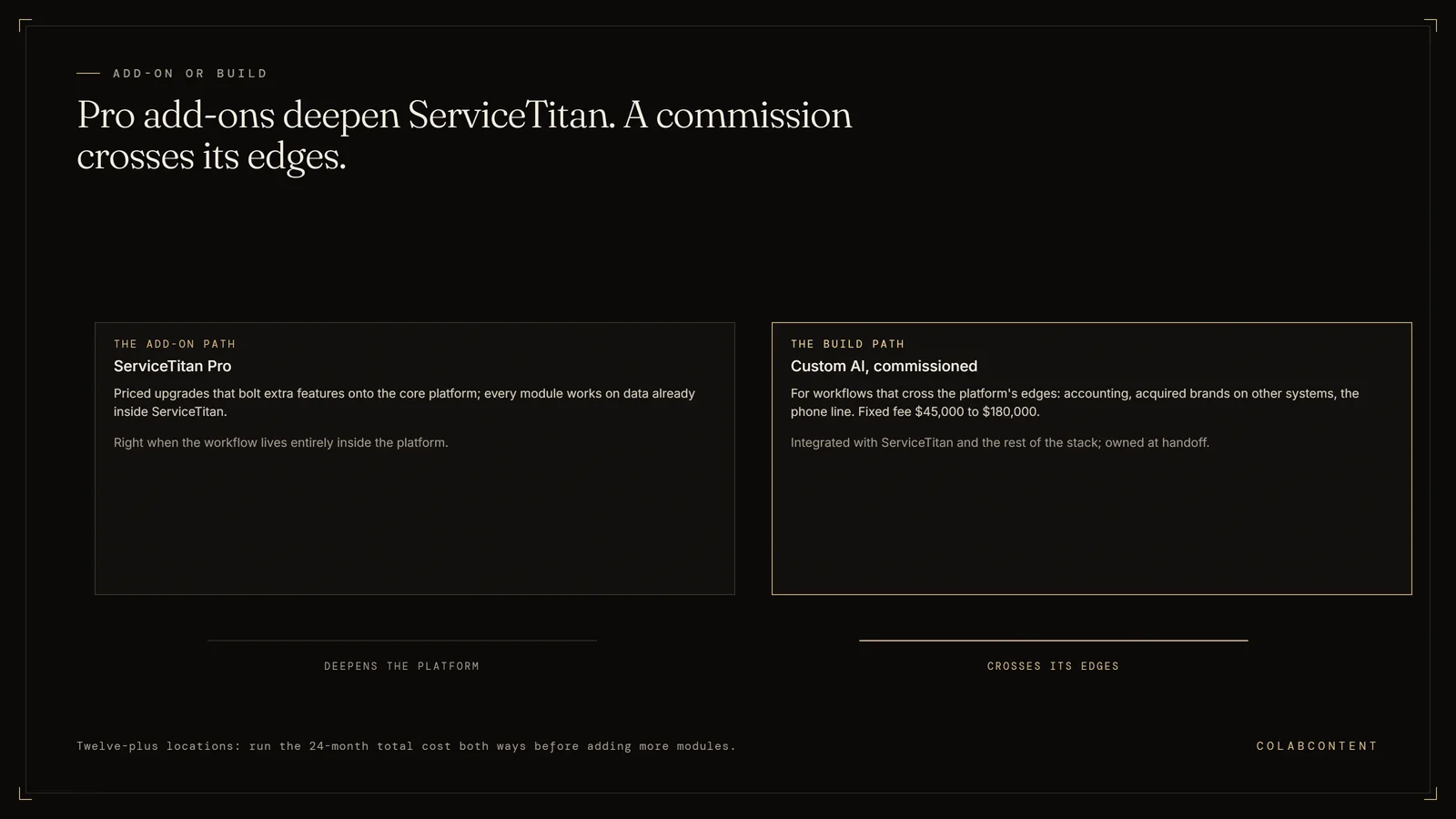
What each alternative handles from dispatch to invoice.
If you are on ServiceTitan and the reason you are reading this is the invoice, the honest first move is usually not a different platform. It is arithmetic you can take into a renewal conversation, and the number that gives you leverage is the three year total further down this page rather than the per technician rate on your statement. If the reason is that ServiceTitan will not do a specific thing your company needs, then be careful, because five of the six alternatives below are the same shape of product and will not do that thing either. They all hold customers, jobs, dispatch, invoices and a pricebook. They are good at that. None of them was built to know how your business quotes a replacement, how your call takers actually triage, or how your acquired brand in the next county still runs on a different system.
So the verdict splits three ways, and it splits on headcount. Shops under roughly fourteen technicians should price Housecall Pro, Jobber and Service Fusion honestly against their ServiceTitan quote, because at that size the published alternatives are genuinely cheaper and a custom build at the larger example build price does not return its cost. Shops between roughly two and fourteen technicians are where the arithmetic on this page actually flips, because at our lower build prices the subscription curve overtakes a one time build inside the first year while the per technician model keeps taxing every hire you make. And shops that genuinely live inside one ServiceTitan capability, or that are mid contract with a reported five figure termination exposure, should stay, and there is a whole section below arguing that case as hard as we know how.
What ServiceTitan actually does well.
Worth being precise about this, because a comparison page that treats the incumbent as a punching bag is useless to the person actually holding the contract. ServiceTitan is a mature, deep field service platform, and the things it is good at are the things that are genuinely hard to assemble from parts.
One record of the job, from call to cash. Booking, dispatch, the technician's mobile flow, the pricebook, the invoice and the payment all sit in one system with one identity for the customer and the location. Every shop that has tried to stitch scheduling software to a separate invoicing tool knows what that is worth on the day something goes wrong.
A real, documented API. ServiceTitan exposes REST (a standard way for software to exchange data over the web) API v2 with module scoped endpoints under a tenant (a private cloud account) ID, authenticated with OAuth (the standard sign-in handshake between two systems) client credentials plus a separate app key header, and it publishes export endpoints built for bulk and incremental replication with continuation tokens. That matters twice: it is why a custom layer can sit on top of ServiceTitan without replacing it, and it is why your own data is reachable if you ever leave. Our ServiceTitan AI integration playbook documents that surface end to end.
Depth at the top end. Capacity planning, arrival windows, membership programs, multi business unit reporting and commercial project work are all present. The alternatives below are honest about which of those they do not match, and several do not match them.
The Pro modules, within their lane. Marketing Pro, Phones Pro, Pricebook Pro and Scheduling Pro deepen the platform on data already inside it. They are useful and they are priced as separate line items, which is the second half of why the bill grows. We wrote a whole comparison of what those modules reach and what they do not rather than repeat it here.
Why shops start looking for a way out.
Four patterns, in the order we hear them on calls.
The bill grew without anyone deciding it should. Per technician pricing means every hire raises the invoice automatically. A shop that added eight technicians last season finds the number moved by roughly $28,800 a year at a reported $300 a seat, with no purchase order, no approval and no conversation. There is no published rate card to argue against, which is a negotiating problem as much as a pricing one.
The modules arrived as separate invoices. The capability everyone now expects, marketing attribution, call handling, dynamic pricing, tends to arrive as an add on rather than as part of the platform, priced per seat or per module on top of the base licence. We are not printing a dollar figure for those, because we could not verify current rates for any of them today, and an unsourced number would undermine the rest of this page.
The thing the shop needs is not a field service problem. Cross brand consolidated reporting when the acquisition still runs on a different system. Quote follow up that actually happens. Reconstructing why a technician's average ticket dropped. None of those is a scheduling feature, and no amount of licence spend converts one into the other.
Onboarding took most of a year. Reported implementation timelines run from two to twelve months. At the long end you are paying full subscription for a system that is not fully live, and that cost never shows up on an invoice as a line item, which is exactly why nobody counts it.